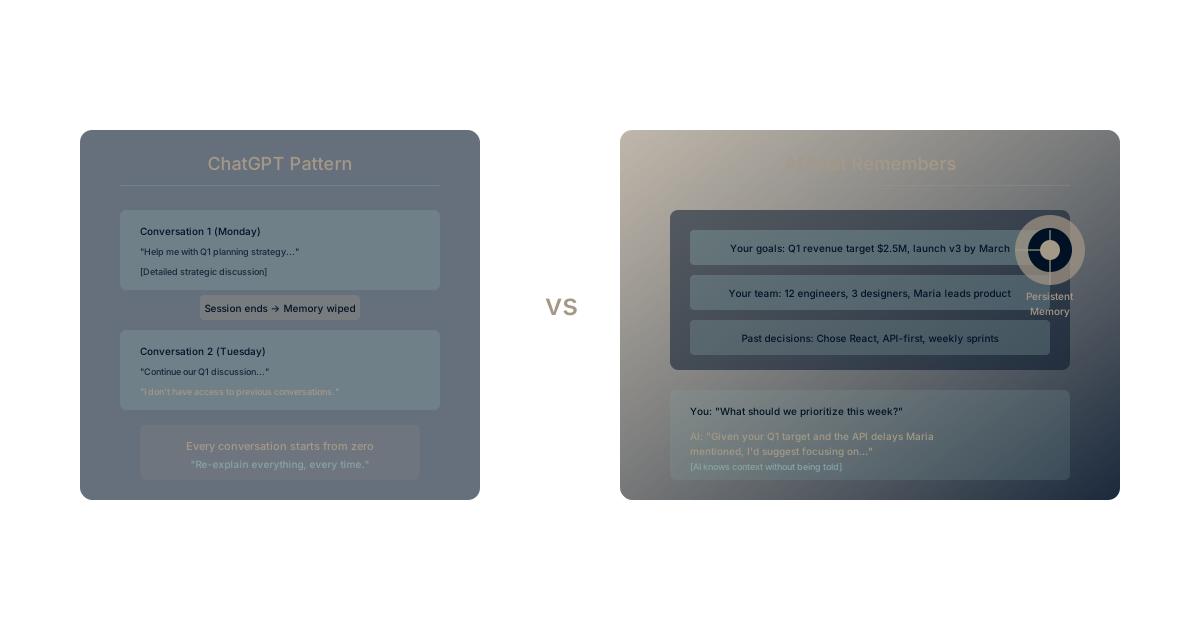
Monday morning. You have a strategic planning conversation with ChatGPT. It's helpful—generates ideas, challenges assumptions, helps structure thinking. You cover ground that took weeks of team discussion.
Tuesday morning. You return to continue. ChatGPT has no memory of yesterday. "I don't have access to previous conversations." You start over. Again. And again.
This isn't a ChatGPT bug. It's a fundamental architectural choice that makes ChatGPT useful for tasks but useless for organizational intelligence.
The future isn't AI that helps once and forgets. It's AI that remembers, learns, and compounds understanding over time.
The ChatGPT Memory Model
How ChatGPT Works
ChatGPT operates on a session model:
Session starts: Empty context, fresh slate Conversation builds: Context accumulates within session Session ends: Everything is forgotten Next session: Starts completely fresh
This design was intentional. It ensures privacy (nothing persists), reduces complexity (no state management), and keeps inference costs manageable.
But it fundamentally limits organizational utility.
What Gets Lost
Each conversation loses:
Context built during discussion: The understanding developed through dialogue Decisions reached: Conclusions you came to together Background provided: Company-specific information you explained Preferences learned: How you like to work with AI History accumulated: Everything from previous sessions
According to user research, people spend 20-30% of AI interaction time re-establishing context that existed in previous sessions.
The Session Tax
The session model creates ongoing costs:
Re-explanation overhead: Repeatedly providing company background Lost continuity: Can't reference "what we discussed last week" Fragmented assistance: Each interaction isolated from others No learning: AI doesn't improve with your usage
You get the same AI on day 1000 as day 1. It never knows you better, never understands your organization more deeply, never accumulates useful context.
Why Organizational AI Must Remember
The Enterprise Context Problem
Organizations have context that AI needs to be useful:
Strategic context:
- What are our goals for this quarter/year?
- What decisions have shaped current direction?
- What constraints do we operate within?
Operational context:
- What projects are underway?
- Who's working on what?
- What dependencies exist?
Historical context:
- What have we tried before?
- What worked? What didn't?
- What patterns repeat?
Relationship context:
- Who are our key customers?
- What's the history with specific partners?
- What do different stakeholders care about?
ChatGPT knows none of this. Copilot knows documents but not decisions. Most AI tools are strangers to your organization.
The Value of Persistent Memory
AI with organizational memory can:
Answer contextual questions:
- "What's blocking our Q1 goals?" (knows goals and status)
- "What did we decide about the pricing model?" (knows decisions)
- "Who knows most about this customer?" (knows relationships)
Provide relevant assistance:
- Meeting prep that surfaces relevant context
- Document drafts informed by company knowledge
- Recommendations aligned with company direction
Learn and improve:
- Understanding that deepens over time
- Patterns recognized across interactions
- Suggestions that get better with usage
The Compounding Advantage
Memory creates compounding returns:
Month 1: AI learns basic organizational context Month 6: AI understands patterns and preferences Year 1: AI provides expert-level contextual assistance Year 2+: AI becomes institutional knowledge repository
Organizations that build AI memory now create advantages that compound while competitors restart from zero each session.
Beyond ChatGPT: Memory Architectures
The Memory Hierarchy
Effective organizational AI needs multiple memory types:
Working memory: Current conversation context (ChatGPT has this) Session memory: What happened in this interaction (ChatGPT has this) User memory: Individual preferences and history (mostly missing) Organizational memory: Company-wide knowledge (completely missing) Strategic memory: Goals, decisions, direction (completely missing)
Current tools mostly have working and session memory. The valuable layers are missing.
Building Organizational Memory
Creating AI with organizational memory requires:
Knowledge capture: Systematically gathering organizational information Structure design: Organizing knowledge for AI access Update mechanisms: Keeping memory current Retrieval systems: Efficiently accessing relevant context Integration architecture: Connecting memory to AI interaction
This is context engineering—the discipline of making organizational context available to AI.
The Context Compass Solution
The Context Compass framework addresses the memory gap:
Strategic layer: Goals, decisions, direction—captured and connected Execution layer: Projects, tasks, status—linked to strategy Knowledge layer: Information, history, learning—indexed and searchable Connection layer: Relationships between all elements
AI built on Context Compass has organizational memory by design—not as a feature, but as fundamental architecture.
What AI Memory Enables
Continuous Conversations
Instead of sessions that end and restart:
Conversation spans time: Pick up where you left off Context accumulates: Understanding builds across interactions No re-explanation: AI already knows the background Progressive depth: Each conversation goes further
Work with AI becomes collaboration rather than repeated orientation.
Contextual Recommendations
With organizational memory, AI can:
Anticipate needs: "You have a meeting with X tomorrow—here's relevant context" Suggest priorities: "Based on Q1 goals, you might want to focus on..." Identify patterns: "This looks similar to what happened with Y project" Connect dots: "This relates to the decision you made about Z"
AI becomes proactive rather than purely reactive.
Organizational Intelligence
Memory enables AI that:
Knows the organization: History, decisions, patterns, relationships Understands direction: Goals, priorities, constraints Recognizes context: How current work connects to bigger picture Improves over time: Gets better at helping your specific organization
This is AI that functions as organizational intelligence—not generic assistant.
Building Toward AI Memory
Start With Structure
Before AI can remember, you need:
- Goal documentation: What you're trying to achieve, captured systematically
- Decision records: What you've decided and why
- Project connections: How work relates to goals
- Knowledge organization: Information structured for retrieval
This groundwork enables AI memory. Without it, there's nothing to remember.
Add Capture Mechanisms
Memory requires capture:
Automatic capture: Information gathered through normal work Triggered capture: Prompts to document decisions and learnings Structured capture: Templates that ensure completeness Review mechanisms: Processes to verify and update
The goal is organizational memory that builds without heroic effort.
Enable AI Access
With structure and capture, connect AI:
Knowledge retrieval: AI can query organizational information Context injection: Relevant context provided automatically Learning loops: AI improves based on feedback Memory persistence: Understanding survives across sessions
This architecture creates AI that remembers.
Measure the Difference
Track memory's impact:
Re-explanation frequency: Should decrease dramatically AI response relevance: Should increase with organizational context Time to useful output: Should decrease as AI knows more Value of AI assistance: Should grow over time
These metrics show whether AI memory is working.
The Future of Organizational AI
From Sessions to Relationships
The AI future isn't thousands of isolated conversations. It's ongoing relationships:
- AI that knows your organization's history
- AI that understands your strategic direction
- AI that learns your preferences and patterns
- AI that gets more valuable over time
This is what AI could be—and what current tools largely aren't.
The Memory Advantage
Organizations building AI memory now will have:
- AI assistants with deep organizational understanding
- Institutional knowledge that persists beyond individuals
- Intelligence that compounds rather than resets
- Capabilities competitors can't quickly replicate
The gap between organizations with AI memory and those without will grow rapidly.
Experience AI That Remembers with Waymaker
Want to see what AI with organizational memory looks like? Waymaker One provides AI that knows your goals, understands your decisions, and learns from your organization over time.
No more starting from zero. No more re-explaining context. Just AI that remembers and gets better.
Register for the beta and experience the AI your organization deserves.
ChatGPT that forgets is a tool. AI that remembers is intelligence. The difference isn't just convenience—it's the gap between generic assistance and organizational capability. Build memory now, compound advantages forever. Learn more about Copilot's limitations and explore the Context Compass framework.
Stuart Leo built enterprise AI memory systems before the ChatGPT era. This analysis reflects years of experience with what organizational AI requires—and what current consumer tools lack.
About the Author

Stuart Leo
Stuart Leo founded Waymaker to solve a problem he kept seeing: businesses losing critical knowledge as they grow. He wrote Resolute to help leaders navigate change, lead with purpose, and build indestructible organizations. When he's not building software, he's enjoying the sand, surf, and open spaces of Australia.