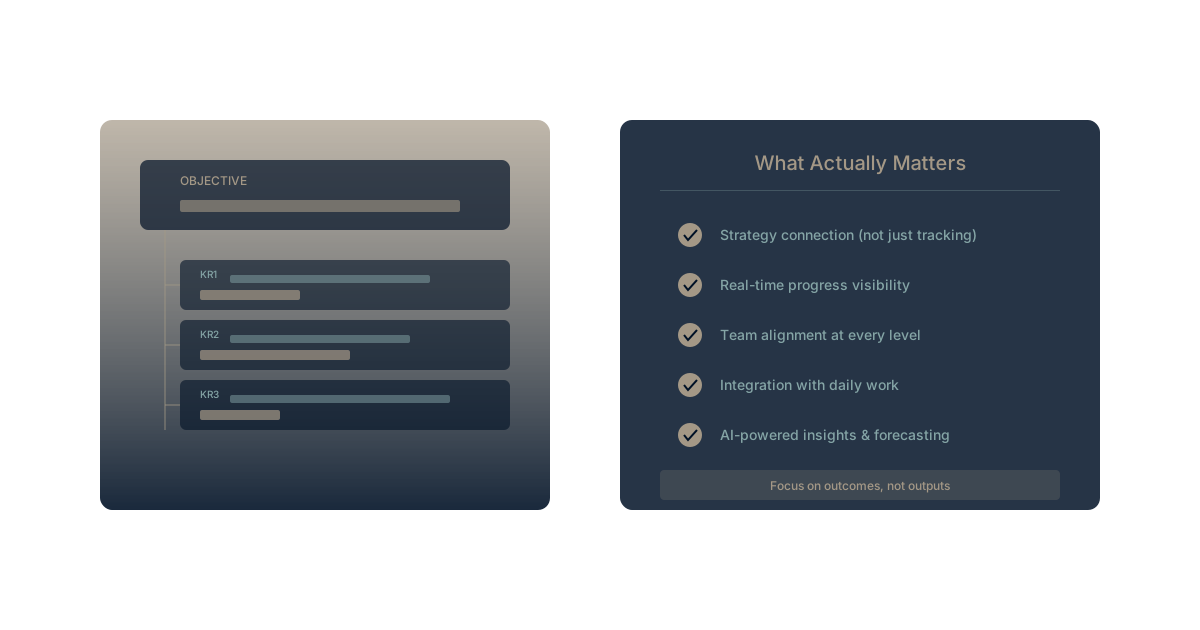
Most OKR software documents goals. Very little of it moves them. The distinction matters because it predicts which tools get abandoned in the second quarter: if an objective lives somewhere separate from the work that advances it, someone has to maintain the connection by hand, and eventually nobody does.
That is the criterion this comparison is built on.
What OKRs actually need from software
The framework is deceptively simple. Objectives describe what you want to achieve. Key results measure whether it happened. It works when it produces focus, alignment, accountability and honest progress — and it fails, reliably, in the gap between the objective and the work.
Research published in Harvard Business Review found that a large majority of well-formulated strategies fail in execution rather than in formulation. OKRs are strategy-execution instruments. Most implementations join that majority, and the tooling is a contributing cause rather than an innocent bystander.
So the requirement is narrower than feature lists suggest. OKR software has to answer three questions without a human doing reconciliation:
- What work is moving this objective right now?
- What changed since the last check-in, and why?
- Which objectives have gone quiet, and how long ago?
Nearly every tool answers the first question with a manually-updated percentage. That is documentation, not execution.
Does your HR system already do this?
Worth addressing directly, because it is the most common version of the question.
BambooHR, Lattice, 15Five and similar systems include goal features, and they are built for a specific and legitimate purpose: goals that belong to the performance cycle. An objective set in January, discussed at a mid-year review, scored at year end, and attached to a person's development record.
If that is what you want, an HR platform is the right layer and a dedicated OKR tool is redundant.
If you want goals that reflect what the team did this week, it is the wrong layer — not because the software is weak, but because it is organised around people and review cycles rather than around work. The goal sits next to an appraisal instead of next to a project, and the appraisal is not what moves it.
The field, honestly
Perdoo — the most methodologically serious dedicated OKR platform. Strong on the discipline of writing good key results, which is genuinely where most teams fail first. Its limit is the shared one: it sits beside your work tools rather than inside them.
Quantive (formerly Gtmhub) — the deepest integrations ecosystem, which is the honest attempt at solving the connection problem. If you are committed to keeping OKRs separate, this is the strongest version of that choice.
Lattice — excellent performance management with goals attached. Choose it when OKRs are part of how you develop people, not part of how you run projects.
15Five — built around the check-in habit, and very good at it. Lighter on strategic execution, which its own positioning is fairly honest about.
Weekdone — the most approachable for smaller teams. Cadence over depth, which for a thirty-person company is often the correct trade.
Workboard — enterprise strategy execution, with the complexity that implies. Right for large organisations with a dedicated strategy function; heavy for anyone else.
Pricing across all of these is per-user and tiered, and changes often enough that quoting figures here would mislead — check each vendor's own page, and note which capabilities sit above the entry tier, since that is where the cost actually lives as you grow.
Work platforms that already have goals
Worth checking before buying anything dedicated: several tools you may already pay for include goal features. Asana has Goals, Monday and ClickUp both have objective tracking, and Notion databases are frequently bent into the same shape.
These are usually thinner than a dedicated OKR product — lighter on cascading, on scoring discipline, and on the rituals that make the framework work. Their advantage is the one that matters most in practice: the goal already sits beside the projects, because it is in the same system as the work. If you are on one of those platforms, evaluate what it has before adding a second subscription.
What changes when goals sit next to the work
The alternative to a dedicated tool is not a worse dedicated tool. It is the goal living in the same system as the projects, tasks and roles that move it.
Three things change, and they are concrete rather than aspirational.
Progress stops being self-reported. When an objective is linked to projects, its status is derived from work that already happened rather than from someone's estimate on the Friday before a review.
Silence becomes visible. An objective with no associated activity for six weeks is a fact the system can surface. In a separate tool that same objective still shows 60%, because 60% is what someone last typed.
The reason survives. Why a key result was revised in March is recorded next to the work that prompted it, so the next planning cycle starts from what happened rather than from memory.
None of that requires the goal system to be sophisticated. It requires it to be in the same place as the work, which is a structural property rather than a feature.
It is not maintenance-free, and claiming otherwise would be dishonest. Someone still has to decide which projects belong to which objective, and revisit that when the work changes shape. The difference is that the relationship is defined once and then holds, rather than a number being retyped every fortnight — which is a smaller claim than "no manual effort" and the one that actually survives contact with a real quarter.
How to choose
Start with where work actually happens. If your team lives in one system already, the burden of proof is on any goal tool that lives outside it.
Then ask who maintains the connection. If the answer is a person, that person will stop within two quarters. This is the single most reliable predictor of OKR tooling failure.
Then check the abandonment surface. During a trial, the question is not whether it demos well. It is what the tool looks like in week seven when the initial enthusiasm has gone and nobody has updated anything. Good OKR software makes that state obvious. Poor OKR software hides it behind a stale percentage.
And consider doing nothing. Below about thirty people a shared document reviewed on a real cadence outperforms a tool nobody opens. Adding a point solution to an already fragmented stack frequently makes execution worse rather than better.
Where WaymakerOS fits
WaymakerOS takes the structural position: goals live in Commander (the productivity suite) alongside the projects, tasks, roles and documents that move them, rather than in a system beside them. Because the objective and the work share a system, "which objectives have had no activity for six weeks" is a question the data can answer rather than one someone has to assemble. One (the AI intelligence layer) reads across the same record.
Pricing starts at $19 per user per month, and every tier includes all 20 Commander tools — goals are not a higher-tier feature.
Where we are the wrong answer: if your OKRs genuinely belong to the performance cycle, buy Lattice or 15Five and do not overthink it. If you need enterprise strategy-execution reporting with a dedicated function behind it, Workboard is built for that and we are not. And if you are eight people in one room, use a document.
There is also a deliberate version of separation worth respecting. Some mature organisations keep objectives away from execution tooling on purpose — so that strategic focus is not coloured by operational noise, or because goals belong to leadership rather than to the teams delivering the work. That is a considered position rather than an accident, and a platform argument does not answer it.
The comparison that matters is not feature-by-feature. It is whether the objective and the work that moves it are in the same place — and if they are not, who you expect to keep them connected.
Stuart Leo is the founder of WaymakerOS and the author of Resolute, on leading through disruption.
Part of our guide to okrs and goal tracking.
Frequently asked questions
- What should OKR software actually do?
- Connect an objective to the work that moves it. Software that only stores objectives and asks for a quarterly percentage is a spreadsheet with a login. The capability that changes behaviour is the goal being visible next to the projects, tasks and people it depends on, updating as they do.
- Does BambooHR have OKR or goal tracking features?
- BambooHR includes goal setting, but it sits inside performance management — goals are reviewed alongside appraisals rather than alongside work. If you want objectives revisited twice a year in a review cycle, that fits well. If you want goals that reflect what the team did this week, an HR system is the wrong layer for it.
- What are the best OKR tools in 2026?
- Perdoo and Quantive are the strongest dedicated OKR platforms; Lattice and 15Five are better if goals belong with performance reviews; Weekdone suits smaller teams wanting cadence over depth. All of them share one limit: they sit beside the tools where work happens rather than inside them.
- Why do OKRs fail?
- Usually because they live where nobody works. A goal set in January in a system opened quarterly is stale by February — not because the objective was wrong, but because nothing connected it to the work that would have moved it. Failure shows up as abandonment rather than as a missed target.
- Do you need dedicated OKR software at all?
- Below about thirty people, usually not. A shared document reviewed on a real cadence beats a tool nobody opens. Dedicated software earns its place when goals span teams that cannot see each other's work — and even then, the platform already running the work is often the better home.
About the Author

Stuart Leo
Stuart Leo founded Waymaker to solve a problem he kept seeing: businesses losing critical knowledge as they grow. He wrote Resolute to help leaders navigate change, lead with purpose, and build indestructible organizations. When he's not building software, he's enjoying the sand, surf, and open spaces of Australia.