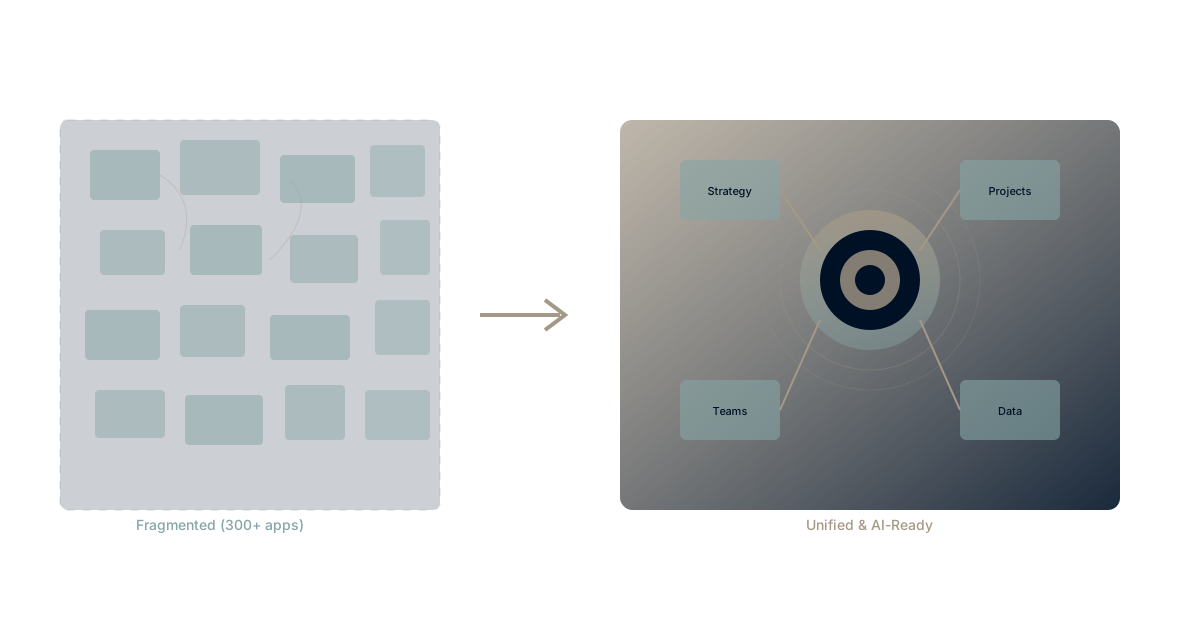
The average enterprise runs 300+ SaaS applications. That number grew 18% last year. It will grow again this year unless something changes.
For CIOs, tool sprawl has always been a governance headache. Security reviews, compliance documentation, integration maintenance, vendor management—the overhead scales with every addition. But in 2026, the stakes are higher.
AI changes everything.
Gartner predicts that 80% of enterprises will deploy generative AI by 2026. But here's what the vendors don't tell you: AI capabilities depend entirely on unified data access. Your fragmented tool stack isn't just expensive—it's actively blocking your AI potential.
This guide provides a strategic framework for tool rationalization that positions your organization for AI-native operations.
The AI Data Problem Nobody's Talking About
Why Fragmentation Kills AI Value
Current AI assistants—Microsoft Copilot, Google Duet AI, even ChatGPT Enterprise—share a critical limitation: they can only work with data they can access.
When your organization's knowledge lives in 47 different tools:
- AI can summarize a single document but can't connect it to your strategy
- AI can draft an email but doesn't know your projects, goals, or team context
- AI can search one system but can't synthesize across your organization
This is the context engineering problem at enterprise scale. The AI is only as intelligent as the context you can provide. Fragmented tools mean fragmented context.
The Real Cost Calculation
Traditional rationalization ROI focuses on:
- License cost savings
- Reduced integration maintenance
- Lower security overhead
These are real, but they're now secondary to AI opportunity cost.
AI Opportunity Cost Formula:
AI Value Lost =
  (Decisions made without AI insight) ×
  (Quality improvement AI would provide) ×
  (Organizational impact of better decisions)
Organizations with unified data platforms are already seeing:
- 40% faster strategic decisions
- 60% reduction in information synthesis time
- 2x improvement in cross-functional project success
Your competitors with unified platforms will have these advantages. Those still fragmented won't.
The Strategic Rationalization Framework
Step 1: Map Your Data Topology
Before rationalizing tools, understand where organizational knowledge actually lives.
Create a Data Flow Diagram:
| Data Type | Primary Location | Secondary Locations | Accessibility |
|---|---|---|---|
| Strategic plans | Slides, spreadsheets | Shared drives | Manual only |
| Project status | PM tool #1, #2, #3 | Email, chat | Scattered |
| Customer context | CRM | Support tickets, emails | Siloed |
| Team decisions | Slack/Teams threads | Meeting notes (various) | Lost |
| Company knowledge | Wiki, docs, drives | People's heads | Fragmentary |
Identify AI-Critical Data:
Not all data needs AI access. Prioritize:
- Strategic context: Goals, plans, priorities
- Operational state: Projects, tasks, progress
- Customer intelligence: Relationships, history, needs
- Institutional knowledge: Decisions, rationale, learnings
These are the data categories that make AI genuinely useful for business decisions rather than just document editing.
Step 2: Evaluate Platform Consolidation Options
Tool rationalization has three strategic paths:
Option A: Best-of-Breed with Integration Layer
Keep specialized tools, add integration platform (Workato, Tray.io) to unify data.
Pros: Preserves user preferences, gradual transition Cons: Integration complexity, ongoing maintenance, partial unification
AI Readiness: Medium. Data can flow between systems, but real-time context synthesis remains challenging.
Option B: Suite Consolidation
Standardize on a major suite (Microsoft 365, Google Workspace) and eliminate alternatives.
Pros: Native integration, simplified governance, vendor leverage Cons: Suite limitations, forced feature compromises, lock-in risk
AI Readiness: Medium-High within suite boundaries. But Copilot and Duet have limitations in cross-domain intelligence.
Option C: Platform Transformation
Migrate to an integrated platform designed for unified work and AI-native operations.
Pros: True unification, AI-ready architecture, long-term alignment Cons: Significant change management, migration complexity, vendor risk
AI Readiness: High. Purpose-built for contextual AI capabilities.
Recommendation: Most enterprises should pursue a hybrid approach—suite consolidation for commodity functions (email, basic docs) combined with platform transformation for strategic work (planning, execution, intelligence).
Step 3: Build the Rationalization Business Case
Tool rationalization requires executive buy-in and organizational change tolerance. Your business case needs multiple value dimensions.
Direct Cost Savings:
| Category | Typical Savings |
|---|---|
| Eliminated licenses | 15-30% of SaaS spend |
| Reduced integration maintenance | $50-200K annually |
| Vendor consolidation leverage | 10-20% on remaining tools |
| Simplified security/compliance | 0.5-1.0 FTE equivalent |
Productivity Gains:
| Category | Improvement |
|---|---|
| Reduced context switching | 20-30% focus time recovered |
| Faster information finding | 50% search time reduction |
| Simplified onboarding | 40% faster time-to-productivity |
| Better collaboration | 25% reduction in meetings |
AI Capability Unlock:
| Capability | Value Driver |
|---|---|
| Strategic AI assistance | Better decisions, faster |
| Automated reporting | Real-time organizational intelligence |
| Predictive insights | Early warning on projects, customers |
| Knowledge synthesis | Instant access to institutional memory |
Frame the business case around AI readiness as much as cost savings. The former is strategic positioning; the latter is table stakes.
Step 4: Design the Migration Architecture
Rationalization isn't a single project—it's an architectural transformation. Design for phases.
Phase 1: Foundation (Months 1-3)
- Establish the target platform
- Define data model and taxonomy
- Build integration bridges from legacy systems
- Migrate pilot teams
Phase 2: Core Migration (Months 4-9)
- Systematic department migrations
- Data migration with validation
- User training and support
- Parallel running periods
Phase 3: Optimization (Months 10-12)
- Eliminate legacy systems
- Enable advanced AI features
- Measure and communicate wins
- Establish governance for future additions
Critical Success Factors:
- Executive sponsorship at C-level
- Clear timeline with milestones
- Change management investment (not an afterthought)
- Wins along the way to maintain momentum
- Sunset discipline to actually eliminate old tools
Step 5: Establish Governance for the Future
Rationalization is meaningless without discipline to prevent re-fragmentation.
New Tool Governance Process:
Request → Business case review → Security assessment →
Integration requirements → Sunset plan →
Approval committee → Conditional approval
Key Governance Questions:
- Does this duplicate existing capability?
- What's the integration requirement?
- Who owns the data, and how is it accessed?
- What's the AI implication (data accessibility)?
- What existing tool does this replace (sunset plan)?
Governance Metrics to Track:
- Total tool count (trend should be flat or declining)
- Per-employee tool count
- Integration complexity score
- Shadow IT incidents
- AI data accessibility percentage
The AI-Native Future State
What Unified Looks Like
In an AI-ready rationalized environment:
Single context layer: All strategic and operational data accessible through one intelligence layer
Continuous memory: AI that knows your goals, projects, team context, and history without you re-explaining
Cross-domain synthesis: AI that can connect customer feedback to product roadmap to resource allocation to financial impact
Predictive operations: Early warning systems that actually work because they have complete information
This is context engineering at the enterprise level. It's the difference between AI as a document editing toy and AI as a genuine strategic partner.
The Competitive Imperative
Your industry peers are making this transition. Those who rationalize successfully will have:
- Decision velocity advantage: AI-assisted strategy that moves faster
- Institutional memory: Knowledge that doesn't walk out the door
- Operational intelligence: Real-time awareness of organizational state
- Customer insight depth: AI that actually knows each customer relationship
Those who don't rationalize will:
- Continue paying the context switching tax
- Watch knowledge fragment across ever-more systems
- Struggle to deploy AI effectively
- Fall behind competitors who move faster with better intelligence
Making It Happen
Building Coalition Support
Tool rationalization is organizational change. You need allies:
CFO: Lead with cost savings and AI capability unlock CHRO: Emphasize productivity gains and employee experience Business unit leaders: Focus on their specific pain points End users: Find champions frustrated with current fragmentation
Managing Resistance
Common objections and responses:
"Our team needs [specific tool]" → "Let's document the requirements. We'll either replicate the capability or provide a sanctioned alternative."
"Migration will disrupt our work" → "Yes, short-term. The current fragmentation is disrupting your work permanently."
"We just implemented [new tool]" → "Sunk cost. The question is what's best going forward, not what we've already spent."
"AI is overhyped" → "Perhaps. But unified data has immediate benefits regardless of AI timeline."
Experience Unified Strategic Execution
Want to see what rationalized, AI-ready work looks like? Waymaker Commander provides the integrated platform for strategic planning, project execution, team collaboration, and contextual AI—in one unified environment.
The result: AI that actually knows your business because all your business context lives in one place.
Register for the beta and see the future of enterprise work.
Tool rationalization isn't IT housekeeping—it's strategic positioning. The organizations that unify their data now will lead with AI. Those that don't will chase them. Learn more about context engineering and explore our organizational memory framework.
Stuart Leo has advised Fortune 500 CIOs on enterprise transformation and tool rationalization strategy. This guide reflects patterns from hundreds of successful rationalization programs.
Part of our guide to all-in-one business platforms.
About the Author

Stuart Leo
Stuart Leo founded Waymaker to solve a problem he kept seeing: businesses losing critical knowledge as they grow. He wrote Resolute to help leaders navigate change, lead with purpose, and build indestructible organizations. When he's not building software, he's enjoying the sand, surf, and open spaces of Australia.