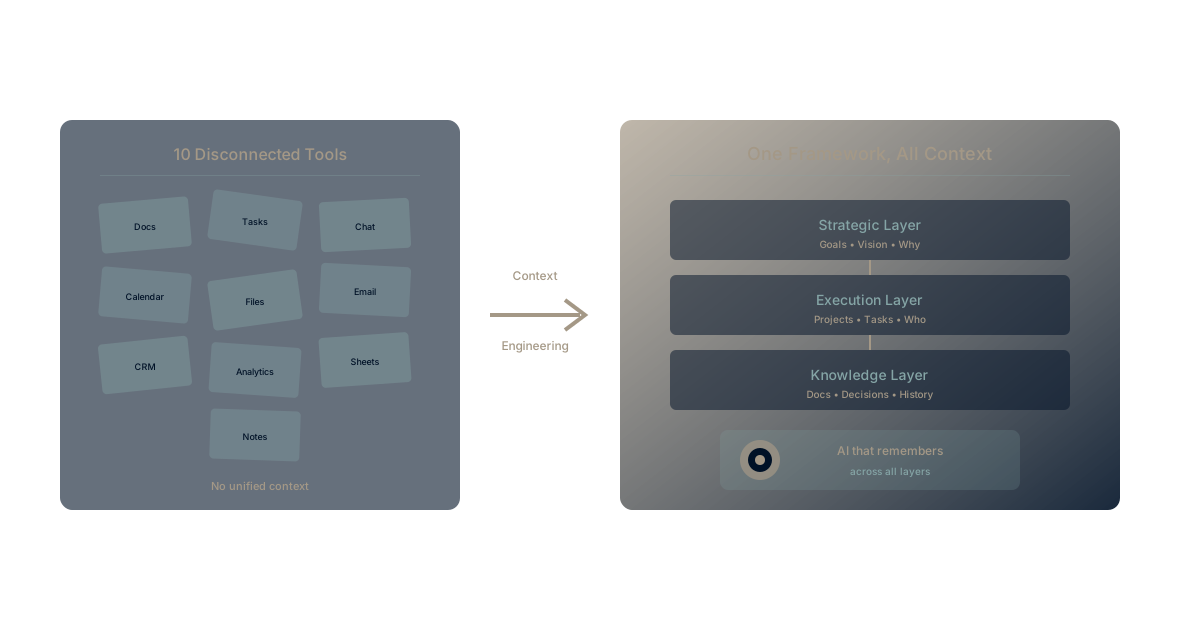
Your organization uses 47 apps. Your personal workflow involves at least 10. Documents here. Tasks there. Decisions scattered. Knowledge fragmented. You've learned to navigate the chaos—switching contexts, bridging systems, translating between tools.
What if there was one skill that could replace the need for all that navigation? Not a new tool. Not another app. A framework for thinking that makes tool chaos irrelevant.
That skill is context engineering.
The 10-Tool Reality
What Knowledge Workers Actually Use
A typical knowledge worker's daily toolkit:
- Documents: Google Docs, Notion, or Word
- Tasks: Asana, Monday, or Jira
- Chat: Slack or Teams
- Email: Gmail or Outlook
- Calendar: Google Calendar or Outlook
- Files: Drive, Dropbox, or SharePoint
- Notes: Notion, Evernote, or Apple Notes
- Analytics: Various dashboards and BI tools
- CRM/Database: Salesforce, Airtable, or similar
- Specialized tools: Industry-specific applications
Each tool has its own:
- Login and interface
- Data model and structure
- Search and navigation
- Context and conventions
The Context Switching Tax
Moving between tools isn't just inconvenient. It's cognitively expensive:
- 23 minutes to regain focus after context switch
- 4+ hours daily lost to tool navigation
- 30%+ productivity consumed by fragmentation
This is the context switching cost in action—not a single tool's fault, but the cumulative effect of fragmented work environments.
Why Tools Multiply
Tools proliferate because each solves a specific problem:
- Need project tracking? Add project tool.
- Need document collaboration? Add document tool.
- Need communication? Add chat tool.
Each addition makes sense individually. Collectively, they create chaos no single tool addresses.
Enter Context Engineering
What Is Context Engineering?
Context engineering is the skill of:
Structuring information so it connects naturally Designing workflows so context flows between activities Building systems so knowledge accumulates rather than fragments Enabling AI to access and utilize organizational memory
It's not about finding the right tool. It's about building the right structure—regardless of tools.
See our full exploration of context engineering vs. prompt engineering for the technical foundation.
The Three Layers
Context engineering structures work in three layers:
Strategic Layer: Why are we doing this?
- Vision and mission
- Annual objectives
- Key results and outcomes
Execution Layer: What are we doing?
- Projects and initiatives
- Tasks and deliverables
- Timelines and dependencies
Knowledge Layer: What do we know?
- Decisions and rationale
- History and learning
- Patterns and principles
When these layers connect, context flows naturally. When they don't, you need 10 tools to bridge the gaps.
How It Replaces Tools
Most tool needs exist because context is fragmented:
| Tool Need | Context Engineering Solution |
|---|---|
| Task management | Tasks connected to objectives |
| Document storage | Docs linked to decisions and projects |
| Note taking | Notes integrated into knowledge base |
| CRM | Relationships connected to outcomes |
| Analytics | Metrics tied to goals |
| Chat search | Conversations indexed in context |
The tools exist because context doesn't flow. When context flows, tool count decreases.
The Context Compass Framework
Implementing Context Engineering
The Context Compass framework provides practical implementation:
Layer 1: Strategic Context
- Goals documented and connected
- Decisions captured with rationale
- Direction visible to all
Layer 2: Execution Context
- Projects linked to goals
- Tasks connected to projects
- Progress visible automatically
Layer 3: Knowledge Context
- Information indexed and searchable
- History preserved and accessible
- Learning accumulated over time
Layer 4: AI Memory
- Context available to AI assistants
- Organizational knowledge queryable
- Intelligence that compounds
The Connection Principle
Context engineering's core principle: Everything connects.
- A task isn't isolated—it serves a project
- A project isn't isolated—it advances an objective
- An objective isn't isolated—it realizes strategy
- A decision isn't isolated—it informs future choices
When connections exist, you don't need tools to bridge them.
The Accumulation Principle
Second principle: Knowledge accumulates.
In fragmented environments:
- Information scatters across tools
- Context evaporates when people leave
- Organizations repeatedly learn the same lessons
With context engineering:
- Information consolidates naturally
- Context persists beyond individuals
- Learning compounds over time
This is the solution to business amnesia—not through heroic effort, but through structure.
From Tools to Framework
The Mindset Shift
Tool-centric thinking: "What app do I need for this?" Context-centric thinking: "How does this connect to everything else?"
The shift changes how you approach problems:
Tool approach: Find a note-taking app → Take notes → Hope to find them later Context approach: Define knowledge structure → Capture in connected system → Retrieve automatically
The Skill Development
Context engineering skills include:
Information architecture: How should knowledge be structured? Connection design: How should pieces relate to each other? Workflow integration: How should context flow through activities? AI enablement: How should AI access and use organizational knowledge?
These skills apply regardless of specific tools. They make you effective in any environment.
The Organizational Application
Beyond individual productivity, context engineering enables:
Shared understanding: Everyone works from connected context Reduced coordination: Less need to manually bridge information Faster onboarding: New people can explore connected knowledge Better decisions: Full context available when deciding
Organizations that apply context engineering systematically outperform those that accumulate tools.
Practical Implementation
Start With Connections
Begin by connecting what you already have:
- Link tasks to goals: Why does each task matter?
- Connect documents to decisions: What did you decide? Why?
- Tie projects to outcomes: What happens if this succeeds?
- Index knowledge: What do you know? Where does it live?
These connections create context without new tools.
Reduce Through Structure
As connections grow, tool needs decrease:
- Consolidated document home: One place for connected docs
- Integrated task view: Tasks visible with context
- Unified knowledge base: Searchable organizational memory
- Connected communication: Conversations linked to work
Each consolidation removes a tool from your daily rotation.
Enable AI Context
With connected structure, AI becomes powerful:
Before: AI as general assistant (knows nothing about your work) After: AI as organizational intelligence (knows your goals, decisions, history)
This is the Context Compass vision—AI that understands your organization, not just general knowledge.
Measure the Shift
Track the transformation:
- Tools used daily: Should decrease
- Time finding information: Should decrease
- Questions answered by systems: Should increase
- Context available to AI: Should increase
Progress means less tool navigation, more direct work.
The Unified Future
Beyond Tool Wars
The industry debates: Notion vs. Confluence. Asana vs. Monday. Slack vs. Teams.
Context engineering makes these debates less relevant. When context flows properly:
- The best tool for each function matters less
- Switching costs decrease (context persists)
- Integration burden reduces (connections exist)
Focus shifts from "which tool" to "how well does it connect."
Platform Thinking
Context engineering naturally leads to platform thinking:
Instead of: Best task tool + best doc tool + best chat tool + integration layer Consider: Platform where tasks, docs, and chat share context naturally
This is why unified platforms emerge—not to do everything, but to make context flow.
The AI Advantage
Organizations with context engineering have AI advantages:
- AI can access organizational knowledge
- AI can understand company-specific context
- AI can make relevant recommendations
- AI becomes organizational intelligence
This compounds over time. Organizations that start now build advantages others can't catch.
Experience Context Engineering with Waymaker
Want to see context engineering in action? Waymaker Commander embodies these principles—connecting strategy to execution to knowledge in one unified platform.
No more 10 tools for context that should flow naturally. No more bridging systems that should already connect.
Register for the beta and experience the skill that replaces tools.
Context engineering isn't about finding better tools—it's about building better structure. When context flows naturally, tool counts decrease. When knowledge accumulates, organizational intelligence grows. Learn more about context engineering fundamentals and explore the Context Compass framework.
Stuart Leo built the Context Compass framework over 6+ years of organizational memory systems development. This guide reflects the principle that structure beats tools.
About the Author

Stuart Leo
Stuart Leo founded Waymaker to solve a problem he kept seeing: businesses losing critical knowledge as they grow. He wrote Resolute to help leaders navigate change, lead with purpose, and build indestructible organizations. When he's not building software, he's enjoying the sand, surf, and open spaces of Australia.