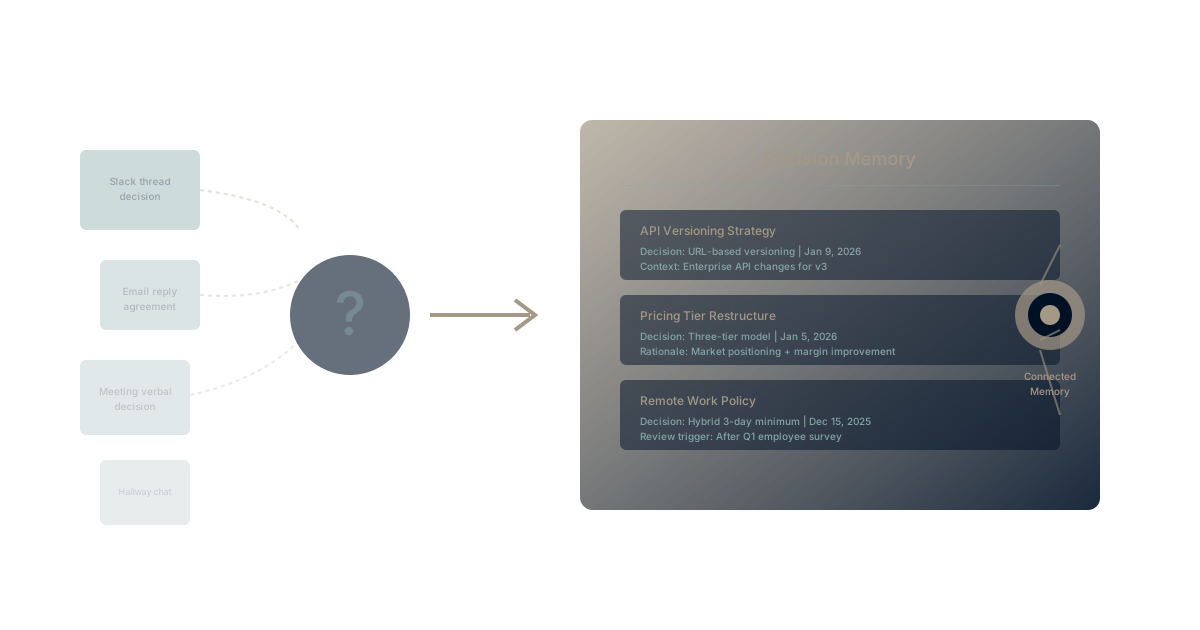
Three months ago, your team made a critical product decision. You chose Option B over Option A. There were good reasons at the time. Smart people debated and decided.
Today, a new team member asks: "Why did we choose Option B?"
Everyone pauses. The reasons are fuzzy. The context is lost. Someone guesses. Someone else half-remembers a Slack thread. The meeting where it was decided? No recording, no notes, no record.
This is business amnesia in action. Not dramatic institutional failure—just the quiet, daily erosion of organizational memory.
The Decision Documentation Crisis
Where Decisions Actually Happen
Decisions in modern organizations happen:
- In Slack threads: "Let's go with vendor X" buried in #proj-alpha
- In email chains: Reply-all conclusions lost in inboxes
- In meetings: Verbal agreements with no written record
- In hallway conversations: "Yeah, we decided not to do that"
- In people's heads: Unspoken reasoning never shared
None of these are designed for retrieval. All of them are designed for communication in the moment.
The gap between "decision was made" and "decision is findable" is where institutional knowledge goes to die.
The Cost of Undocumented Decisions
Repeated debates: Without decision records, teams re-litigate settled issues. The same arguments, the same analysis, the same conclusion—repeated quarterly because nobody remembers it was already decided.
Inconsistent execution: When people don't know why a decision was made, they can't apply its logic to related situations. They make contradictory calls or ask for approval on things already covered by prior decisions.
Slow onboarding: New team members can't understand why things are the way they are. They propose changes to things that were already considered and rejected. They reinvent solutions that were already tried.
Lost context for AI: As context engineering becomes critical for AI assistance, undocumented decisions mean AI can't help with organizational reasoning. It doesn't know what you've decided or why.
Accountability erosion: Without documented decisions, it's hard to learn from outcomes. Was it a bad decision or bad execution? Nobody can tell because the decision itself isn't clearly recorded.
What Good Decision Documentation Looks Like
The Decision Record Structure
Every significant decision should capture:
1. The Question What specific decision needed to be made? Frame it clearly.
2. The Context What circumstances prompted this decision? What constraints existed? What was happening in the market, product, or organization?
3. The Options Considered What alternatives were evaluated? Don't just document the winner—document the losers and why they lost.
4. The Criteria What factors mattered in making this choice? Speed? Cost? Quality? Strategic alignment? Be explicit about tradeoffs.
5. The Decision What was decided? By whom? When?
6. The Rationale Why this choice over alternatives? What made Option B better than Option A?
7. The Implications What follows from this decision? What does it mean for related areas?
8. The Review Trigger Under what circumstances should this decision be revisited? Time-based? Event-based? Outcome-based?
Example Decision Record
DECISION: API versioning strategy

DATE: 2026-01-09
DECISION MAKERS: Engineering leads, Product Director

CONTEXT:
Our API is used by 50+ enterprise customers. We're planning
significant changes for v3. Need to determine versioning approach.

OPTIONS CONSIDERED:
A) URL versioning (/v2/, /v3/)
B) Header versioning (Accept-Version: v3)
C) Query parameter versioning (?version=3)

CRITERIA:
- Customer migration burden (high weight)
- Developer experience (medium weight)
- Caching implications (medium weight)
- Industry standards (lower weight)

DECISION: Option A - URL versioning

RATIONALE:
- Most visible to customers (they know what version they're using)
- Industry standard for enterprise APIs
- Simplest for customers to implement
- Header versioning (B) had customer pushback in interviews
- Query params (C) complicates caching

IMPLICATIONS:
- Need clear deprecation timeline for v2
- Documentation must cover both versions during transition
- SDK updates required for v3 launch

REVIEW TRIGGER:
- After v3 launch (assess customer feedback)
- If adoption < 50% at 6 months, evaluate alternative approaches
Decision Documentation Principles
Document at the time: Don't try to reconstruct decisions later. Capture them when they're made, when context is fresh.
Link to artifacts: Reference the documents, data, and discussions that informed the decision.
Make it findable: Decisions in random Notion pages are barely better than undocumented. Establish a consistent location or tagging system.
Include dissent: If someone disagreed, note it. Future reviewers benefit from knowing the decision wasn't unanimous and why.
Update outcomes: Come back and note what actually happened. Decisions are hypotheses about the future—record whether they proved correct.
Building Decision Documentation Practice
Start with High-Stakes Decisions
You can't document everything. Start with decisions that are:
- Strategic: Direction choices that affect multiple teams
- Expensive: Significant resource commitments
- Hard to reverse: Changes that are costly to undo
- Precedent-setting: Choices that establish patterns for future decisions
- Frequently questioned: Decisions people keep asking about
Integrate with Existing Workflow
Decision documentation shouldn't feel like extra work. Integrate it:
In meetings: Add "decision documentation" as a standard meeting output. If decisions were made, someone captures them.
In tools: Whatever system you use for project management or documentation, create a decision log location.
In templates: Build decision record templates that make capture quick.
In culture: Make "where's the decision doc?" a normal question when someone proposes work related to a prior decision.
The Decision Log
Maintain a findable index of documented decisions:
| Date | Decision | Domain | Owner | Doc Link |
|---|---|---|---|---|
| 2026-01-09 | API versioning: URL-based | Engineering | J. Smith | /decisions/api-v3 |
| 2026-01-05 | Pricing tier changes | Product | M. Jones | /decisions/pricing-2026 |
| 2025-12-15 | Remote work policy | HR | L. Chen | /decisions/remote-policy |
A simple log becomes organizational memory. People can browse or search to find decisions relevant to their work.
Common Objections and Responses
"We don't have time to document decisions"
You don't have time to re-debate decisions either. Documentation takes 10 minutes. Re-litigation takes hours. Plus, the context engineering benefits compound as AI tools access your decision history.
"Our decisions are complex—they don't fit a template"
Templates are starting points, not straitjackets. Adapt the structure. The goal is capture, not format compliance.
"We'll never look at these again"
You will when:
- Someone new joins and asks why
- A decision isn't working and you need to understand original reasoning
- Related decisions need to be consistent
- AI assistants need context to help effectively
"Decisions evolve—documentation gets stale"
Include review triggers and update with outcomes. Living documentation > dead documentation > no documentation.
From Documentation to Intelligence
Decision Patterns
When you document decisions over time, patterns emerge:
- What criteria matter most in your organization?
- Which decision types generate controversy?
- Where do you tend to choose speed over quality (or vice versa)?
- Which past decisions need revisiting?
These patterns become organizational self-awareness.
AI-Ready Decision Memory
As AI tools become more capable, documented decisions become a strategic asset. AI that can access your decision history can:
- Suggest past decisions relevant to current questions
- Identify inconsistencies between related decisions
- Provide context when similar situations arise
- Help onboard new team members with "why" explanations
This is the Context Compass framework in practice—capturing decisions as organizational working memory.
Experience Decision Memory with Waymaker
Want to see decision documentation integrated into how you work? Waymaker Commander connects strategic decisions to projects, tasks, and outcomes—so the why is never separated from the what.
When your decisions live in the same place as your execution, organizational memory builds automatically.
Register for the beta and experience work that remembers.
Every undocumented decision is a memory gap waiting to cause problems. The organizations that document well think better, move faster, and avoid the endless re-litigation that kills momentum. Learn more about organizational memory and explore the Context Compass framework.
Stuart Leo has built decision systems for 200+ organizations. This guide reflects the patterns that separate organizations that remember from those that repeat.
Frequently asked questions
- Why does decision documentation matter?
- Because the reasoning behind a decision disappears faster than the decision itself. Teams remember what was decided and lose why, so the same debate reopens months later with none of the original context. The cost is not the meeting — it is re-deciding something that was already settled.
- Where do business decisions actually get made?
- In chat threads, in meetings nobody minuted, and in hallway conversations between two people. Almost never in the document that later describes the outcome. That gap is the problem: the artefact records the conclusion and loses the alternatives considered and the constraints that ruled them out.
- What does a good decision record contain?
- The decision, the date, who made it, the options considered, and the reasoning that selected one. The reasoning is the part with lasting value — a record of what was chosen without why it was chosen cannot be re-evaluated when circumstances change.
- What does undocumented decision-making cost?
- Repetition. The same question returns, is argued again from scratch, and is often answered differently — not because anyone changed their mind, but because nobody could recover the original reasoning. New joiners pay the same cost, discovering constraints by breaking them.
- How do you start documenting decisions without adding process?
- Write the record where the work already happens rather than in a separate system, and keep it short enough that nobody avoids it. A decision, a date, the options and one paragraph of reasoning is enough. Anything longer becomes a process people route around.
About the Author

Stuart Leo
Stuart Leo founded Waymaker to solve a problem he kept seeing: businesses losing critical knowledge as they grow. He wrote Resolute to help leaders navigate change, lead with purpose, and build indestructible organizations. When he's not building software, he's enjoying the sand, surf, and open spaces of Australia.