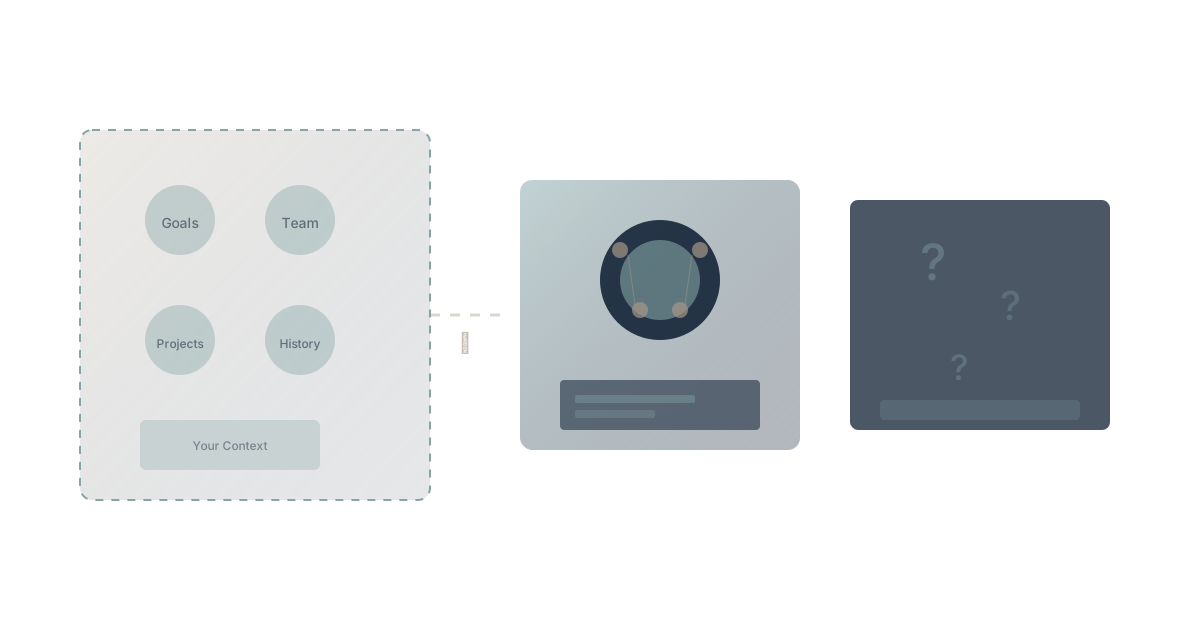
Google renamed Duet AI to Gemini for Workspace. The rebrand doesn't change the fundamental reality: Google's AI feels like a stranger to your organization.
It can write emails. It can summarize documents. It can help create presentations.
It doesn't know your business.
Ask it about your strategic priorities. It doesn't know them. Ask about a decision made last quarter. It can't find it. Ask it to connect information across your company's work. It doesn't understand the connections.
This isn't a bug. It's the architecture.
What Gemini for Workspace Does
Document-Level Assistance
Gemini operates at the document level:
In Gmail: Draft emails, summarize threads, suggest replies In Docs: Write content, summarize documents, help with editing In Sheets: Generate formulas, analyze data in the current sheet In Slides: Create presentations, generate images, suggest layouts In Meet: Take notes, summarize meetings
The pattern: Gemini helps with the document or conversation in front of you. Its context window is what you're currently working on.
Google's documentation describes these capabilities accurately. Within their scope, they work.
The Search Addition
Gemini can search across your Workspace data—emails, documents, calendar. When you ask a question, it retrieves relevant content.
The improvement: You don't have to know exactly where something is. The limitation: Retrieval isn't understanding.
Search finds content containing keywords. It doesn't understand organizational context, relationships between documents, or why things matter.
Where Gemini Falls Short
The Strategic Understanding Gap
Ask Gemini: "Based on our strategic priorities, which project should we focus on this quarter?"
What you'll get: Generic advice about project prioritization, or a request for you to provide the strategic priorities it should consider.
What you need: AI that already knows your strategy, understands your projects, and can reason about priorities with organizational context.
Gemini doesn't know your strategy because your strategy lives in scattered documents, emails, and conversations without coherent structure it can understand.
The Memory Gap
Ask Gemini: "Why did we decide to pivot from B2B to B2C six months ago?"
What you'll get: Search results for emails and documents mentioning those terms. Maybe a document that explains it, if someone wrote one and it's findable.
What you need: AI that remembers organizational decisions, knows the context behind them, and can explain rationale even when it wasn't explicitly documented.
Gemini's "memory" is your documented content. If it wasn't written down and made findable, it doesn't exist to AI.
Research shows 80% of organizational knowledge is tacit—in people's heads, not systems. Gemini can only access the 20% that's documented, and even then, only if search can find it.
The Connection Gap
Ask Gemini: "How does our current marketing campaign connect to our product roadmap?"
What you'll get: Potentially some retrieved documents about marketing and product—if they exist, are findable, and explicitly mention each other.
What you need: AI that understands how different parts of your organization relate, can trace connections between initiatives, and identifies dependencies.
Gemini doesn't understand your organization's structure. It searches content. Structural understanding requires organizational memory architecture, not just document search.
The Learning Gap
Ask Gemini: "Based on what worked in previous launches, what should we do differently this time?"
What you'll get: Generic launch advice, or search results that might contain relevant historical documents.
What you need: AI that has accumulated learning from your organization's history—what worked, what didn't, what patterns repeat.
Gemini doesn't learn your organization. Each interaction starts fresh. There's no cumulative intelligence built from organizational experience.
The Architecture Problem
Why This Happens
Gemini for Workspace is built on top of Google Workspace's existing architecture:
Workspace architecture: Files in folders. Emails in threads. Calendar events. Separate silos.
Gemini addition: AI that can search these silos and help with individual documents.
What's missing: A coherent organizational knowledge layer that connects everything.
The architecture problem predates AI. Google Drive's knowledge graveyard isn't fixed by adding AI search—the underlying chaos remains chaotic.
Document AI vs. Organizational AI
Document AI (what Gemini does):
- Helps with the current document
- Searches and retrieves content
- Generates text based on prompts
- Works within single contexts
Organizational AI (what's needed):
- Understands organizational structure
- Maintains persistent knowledge
- Connects information across silos
- Learns and accumulates understanding
The gap between these isn't incremental. It's architectural.
The Retrieval Limitation
Gemini uses RAG (Retrieval Augmented Generation)—retrieving relevant content to inform AI responses.
RAG limitations for organizational intelligence:
- Must find the right content (search quality matters)
- Must interpret correctly (context within content matters)
- Can't use knowledge that isn't documented
- Can't synthesize across many documents coherently
- Can't understand relationships not explicitly stated
RAG is a technique. It's not organizational memory.
The Cost-Benefit Analysis
What You're Paying
Gemini for Workspace is included with some plans or available as an add-on. Pricing varies by plan and changes over time.
What You're Getting
Real value:
- Faster email drafting
- Document summarization
- Meeting notes
- Formula help
- Presentation assistance
These are legitimate productivity improvements. Gemini handles individual tasks well.
What You're Not Getting
- Strategic AI that understands organizational context
- Memory that persists across interactions and time
- Cross-functional intelligence that connects silos
- Cumulative learning that grows with your organization
If your need is task-level assistance, Gemini provides it. If your need is organizational intelligence, Gemini doesn't address it.
The Alternative Architecture
What Organizational AI Requires
The Context Compass framework describes what comprehensive AI memory needs:
Working Memory: Real-time awareness of what's happening now Episodic Memory: Historical knowledge of what happened before Semantic Memory: Structural understanding of how things work Procedural Memory: Operational knowledge of how to do things
Gemini touches Working Memory (current document context) and can retrieve from Semantic Memory (documented policies). It lacks true Episodic Memory (organizational history) and Procedural Memory (learned workflows).
From Assistant to Partner
Task assistant (Gemini level):
- "Help me write this email"
- "Summarize this document"
- "Create a slide about this topic"
Strategic partner (organizational AI level):
- "Based on our strategy and this client's history, what should we propose?"
- "Given past project patterns, what risks should we watch for?"
- "How does this initiative align with our goals and resources?"
The difference isn't marginal improvement—it's fundamental capability change.
Building Organizational Memory
Instead of accepting document-level AI as the ceiling:
Unified platforms: Where work, documents, and decisions exist together with inherent structure AI can understand.
Context engineering: Deliberate architecture that builds organizational memory across all four layers.
Learning systems: AI that grows more capable as organizational history accumulates.
The Decision Framework
When Gemini for Workspace Works
Good fit:
- Task-level AI assistance is the goal
- Workspace is already the productivity platform
- Individual productivity improvement is the priority
- Organizational knowledge needs are modest
When Something More Is Needed
Consider alternatives when:
- Strategic AI capability matters
- Organizational memory is important
- Work happens across many tools beyond Workspace
- You need AI that learns your organization
The Integration Question
"We're in Google Workspace. Can we add organizational memory?"
Possible approaches:
- Third-party tools that layer on top of Workspace
- Gradual platform transition for key workflows
- Hybrid architecture with specialized systems for organizational knowledge
The honest reality: Workspace's underlying architecture fragments data in ways that make comprehensive organizational memory difficult. True unification may require different foundations.
Experience AI That Remembers
Want to see what AI looks like when it actually knows your organization? Waymaker Commander brings organizational memory to work management—AI that understands your strategy, remembers your decisions, and connects context across work.
The result: Ask strategic questions, get strategic answers. Build on previous interactions. Watch AI capability grow with your organization.
Register for the beta and experience the difference between document assistance and organizational intelligence.
Gemini for Workspace is document-level AI marketed as workplace transformation. It helps with individual tasks well. It doesn't provide organizational memory, strategic understanding, or cumulative learning. Understanding this limitation is essential for making informed decisions about AI investments and organizational capability building. Learn more about our Context Compass framework and explore how context engineering builds the organizational memory AI actually needs.
Stuart Leo has evaluated enterprise AI solutions across major platforms. He's the author of Resolute and founder of Waymaker, designed for organizations that need AI with actual organizational understanding.
Part of our guide to leaving google workspace.
About the Author

Stuart Leo
Stuart Leo founded Waymaker to solve a problem he kept seeing: businesses losing critical knowledge as they grow. He wrote Resolute to help leaders navigate change, lead with purpose, and build indestructible organizations. When he's not building software, he's enjoying the sand, surf, and open spaces of Australia.