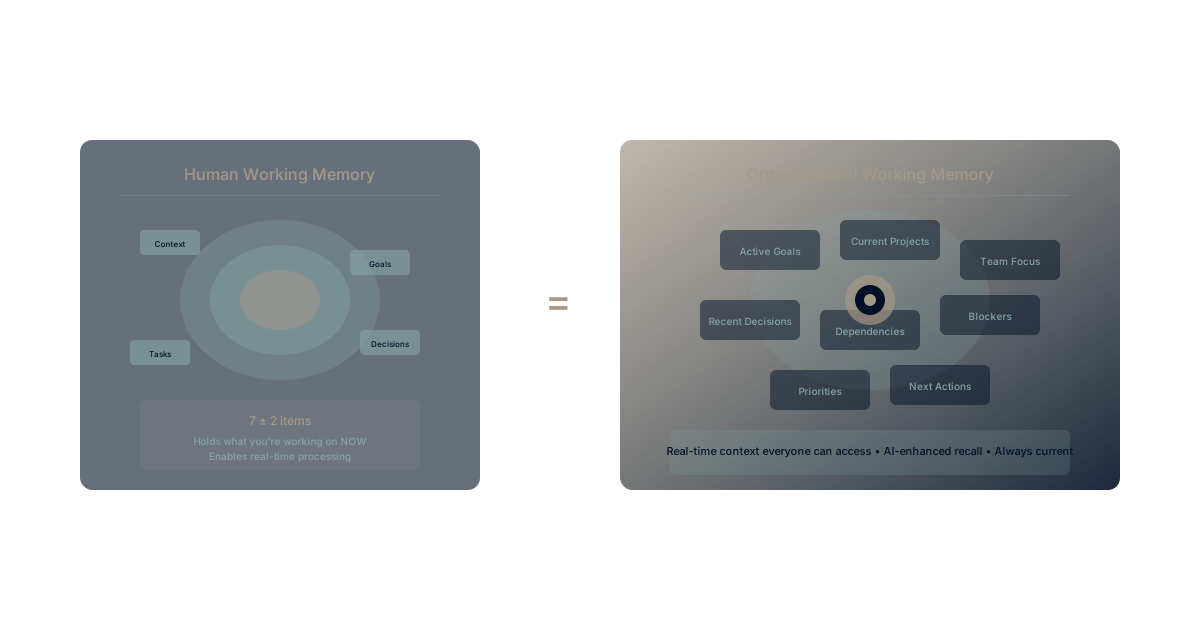
Your brain has working memory—the cognitive space holding what you're actively using. It's limited (7±2 items) but essential. Without working memory, you couldn't process thoughts, make decisions, or take coherent action.
Organizations need working memory too. Not archive storage. Not reference documentation. Real-time context that the organization is actively using to think and act.
Most organizations lack this. They have long-term storage (documents, wikis, databases) but no working memory. They can't access the context they need, when they need it, to think and act effectively.
What Is Organizational Working Memory?
The Human Analogy
Human working memory:
- Holds 7±2 items currently being processed
- Enables real-time manipulation of information
- Connects to long-term memory for retrieval
- Allows complex thought and decision-making
Without working memory, you'd need to re-read everything every time you wanted to think about it. You couldn't hold context while processing new information.
The Organizational Equivalent
Organizational working memory should hold:
- Active goals: What we're trying to achieve now
- Current projects: Work underway across the organization
- Recent decisions: Choices affecting current work
- Active blockers: Problems preventing progress
- Team focus: What different groups are working on
- Dependencies: How work connects across teams
- Priorities: What matters most right now
- Next actions: What happens next
This information should be instantly accessible—not buried in archives requiring search and excavation.
Why Most Organizations Lack It
Traditional systems create long-term storage:
Documents: Written once, rarely updated, hard to find Wikis: Knowledge captured but quickly stale Project tools: Status scattered across many systems Email: Information trapped in individual inboxes Meetings: Decisions made but not captured persistently
None of these function as working memory. They're storage without the real-time, accessible, connected nature that working memory requires.
The Working Memory Gap
The Symptoms
Organizations without working memory experience:
Constant re-explanation: "Let me bring you up to speed on..." Repeated decisions: Re-debating previously settled questions Invisible blockers: Problems nobody realizes are affecting others Misaligned effort: Teams working at cross-purposes without knowing Meeting overload: Synchronous time to share what should be visible
These aren't communication problems. They're structural gaps—the absence of shared context that working memory would provide.
The Costs
The working memory gap creates costs:
Time cost: Hours weekly per person finding and sharing context Decision cost: Choices made without available information Alignment cost: Effort wasted on misaligned work Speed cost: Everything takes longer without shared context
According to research on knowledge worker productivity, 20-30% of time goes to searching for information and re-establishing context. That's a working memory problem.
Who Suffers Most
The gap affects:
New employees: No access to organizational context Cross-functional projects: Teams can't see each other's work Distributed teams: Can't absorb context through proximity Leaders: Can't see operational reality without manual aggregation AI assistants: Have no organizational context to work with
Everyone operates with partial information, making local decisions without organizational context.
Building Organizational Working Memory
The Required Capabilities
Effective working memory needs:
Real-time currency: Information updated as work happens Universal access: Available to anyone who needs it Connection structure: Elements linked to each other Query capability: Able to ask questions and get answers Persistence: Context maintained without individual effort
These requirements exceed what traditional tools provide.
The Information Architecture
Working memory organizes information by:
Activity: What's happening now vs. what happened before Relevance: What affects current decisions vs. background reference Connection: How elements relate to each other Currency: What's current vs. what's historical
This differs from document storage, which typically organizes by type, date, or creator.
The Context Compass Approach
The Context Compass framework provides working memory through:
Strategic layer (what we're trying to achieve):
- Active objectives and key results
- Current priorities and focus areas
- Strategic decisions affecting work
Execution layer (what we're doing):
- Projects and their status
- Tasks and assignments
- Dependencies and blockers
Knowledge layer (what we know):
- Recent decisions with rationale
- Relevant information and context
- Learning and patterns
Connection layer (how things relate):
- Links between goals, projects, and tasks
- Relationships between teams and work
- Dependencies across the organization
Together, these create working memory that the organization can use to think and act.
Working Memory and AI
The AI Memory Problem
Current AI assistants have no organizational memory:
ChatGPT: Starts fresh each conversation Copilot: Knows your documents but not your decisions Most tools: General intelligence without organizational context
This limits AI to generic assistance. It can't answer questions like:
- "What's blocking our Q1 goals?"
- "Why did we choose this approach last month?"
- "What should I know before this customer meeting?"
AI With Working Memory
When AI connects to organizational working memory:
Questions become answerable:
- "What's our current priority?" (knows active goals)
- "Who's working on the API?" (knows current projects)
- "What did we decide about pricing?" (knows recent decisions)
Context becomes automatic:
- Meeting prep with relevant context surfaced
- Document drafts informed by organizational knowledge
- Recommendations aligned with company direction
Memory becomes persistent:
- AI remembers across sessions
- Knowledge compounds over time
- Organizational intelligence grows
This is the vision of context engineering—AI that understands your organization, not just general knowledge.
The Compounding Effect
Working memory + AI creates compounding value:
Year 1: AI learns organizational context Year 2: AI provides increasingly relevant assistance Year 3: AI anticipates needs based on pattern recognition Year 4+: Organizational intelligence rivals best human knowledge
Organizations that build working memory now gain AI advantages others can't replicate.
Implementation Path
Start With Current State
Assess what exists:
- Where does current context live?
- How do people find what they need?
- What's the time cost of context searching?
- What decisions get made without available information?
The answers reveal where working memory gaps hurt most.
Identify Core Elements
Define what working memory should hold:
Essential:
- Active goals and priorities
- Current project status
- Recent key decisions
- Known blockers and dependencies
Important:
- Team focus and capacity
- Upcoming milestones
- Cross-functional connections
- Resource constraints
Useful:
- Historical context for active work
- Related decisions and learnings
- Pattern information
Start with essential elements. Expand as capability grows.
Build the Structure
Create connected architecture:
- Central context repository: Where working memory lives
- Update mechanisms: How information stays current
- Access patterns: How people retrieve context
- Query capability: How questions get answered
- AI connection: How AI accesses and uses context
The technical solution matters less than the structural approach.
Measure the Improvement
Track working memory effectiveness:
- Time to find needed context (should decrease)
- Decisions made with full context (should increase)
- Re-explanation frequency (should decrease)
- AI assistance relevance (should increase)
These metrics show whether working memory is functioning.
Experience Organizational Working Memory with Waymaker
Want to see what organizational working memory looks like? Waymaker Commander creates the connected context that functions as working memory—goals, projects, decisions, and knowledge linked and accessible.
Real-time organizational context. AI that remembers. Working memory that scales.
Register for the beta and experience an organization that can think.
Your brain couldn't function without working memory. Neither can your organization. The gap between archive storage and real-time context is where organizational effectiveness lives. Build working memory and watch thinking improve. Learn more about the Context Compass framework and explore business amnesia solutions.
Stuart Leo designed organizational working memory systems across hundreds of implementations. This framework reflects the patterns that create organizational intelligence.
About the Author

Stuart Leo
Stuart Leo founded Waymaker to solve a problem he kept seeing: businesses losing critical knowledge as they grow. He wrote Resolute to help leaders navigate change, lead with purpose, and build indestructible organizations. When he's not building software, he's enjoying the sand, surf, and open spaces of Australia.