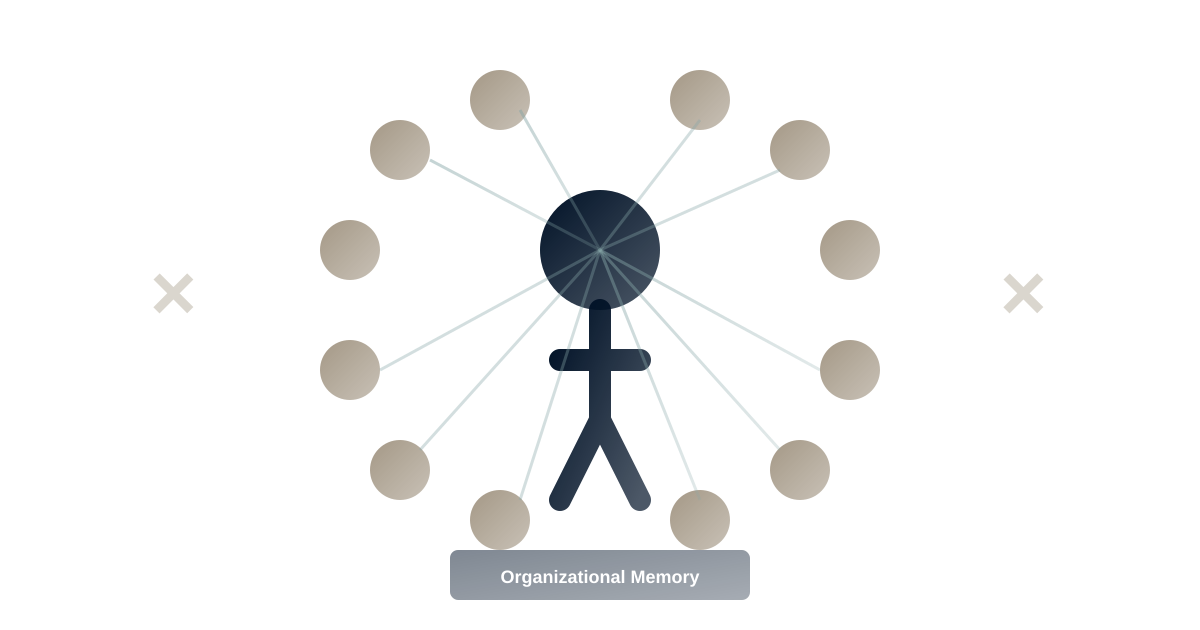
Most organizations recognize when executive bandwidth becomes the constraint on growth. The CEO works increasingly longer hours, strategic initiatives stall waiting for executive attention, cross-functional coordination breaks down without senior leadership facilitation, and critical decisions accumulate in queues. The typical response involves hiring additional executives or redistributing responsibilities, but these solutions often fail to address the underlying challenge: strategic coordination and organizational alignment require dedicated capacity that most executive teams lack.
The Chief of Staff role emerged to solve this precise problem—not by adding another functional leader but by extending executive strategic capacity through coordination, alignment, and execution discipline. Yet the most valuable contribution of an effective Chief of Staff isn't just tactical project management or meeting coordination. It's the systematic building of organizational memory and capability that enables performance improvements to persist and compound over time.
Organizations without Chiefs of Staff often experience a recurring pattern: they achieve performance improvements through leadership focus and initiative, but these gains erode when attention shifts to new priorities. Companies with effective Chiefs of Staff show a different trajectory: performance improvements become institutionalized through documented systems, embedded processes, and organizational memory that makes gains permanent rather than temporary.
1. Strategic Initiative Execution Without Organizational Amnesia
Every organization launches strategic initiatives with clear goals, defined resources, and committed timelines. Yet research from the Harvard Business Review shows that 70% of strategic initiatives fail to achieve their intended outcomes, with the primary cause being execution breakdown rather than strategic flaws. The gap between strategy and execution widens not because plans are defective but because organizations lack systematic discipline to track progress, maintain accountability, and capture learnings.
A Chief of Staff addresses this execution gap by building memory-rich tracking systems. Rather than relying on individual recall or scattered status updates, effective CoS roles implement structured initiative management: documented project charters with clear objectives and success criteria, systematic progress tracking with regular review cadences, identified blockers and escalation protocols, resource allocation transparency and adjustment processes, and learning capture systems that document what works and what doesn't.
These systems transform initiative execution from dependent on individual memory and heroic effort to supported by institutional discipline and organizational memory. When the chief marketing officer leaves, marketing initiatives don't lose momentum because initiative tracking systems preserve context, decisions, and progress. When strategic priorities shift, the documented history of previous initiatives informs better resource reallocation decisions.
According to McKinsey research, organizations with systematic strategic initiative management—the core deliverable of effective Chiefs of Staff—show 45% higher initiative success rates and 38% faster time-to-value compared to organizations relying on informal tracking. This performance advantage stems directly from organizational memory replacing individual memory as the foundation for execution discipline.
2. Cross-Functional Coordination That Scales
As organizations grow beyond 50-100 employees, cross-functional coordination challenges multiply exponentially. Marketing needs engineering resources for product launch support. Sales requires operations changes to deliver new service packages. Finance demands clearer forecasting from all departments. Without systematic coordination mechanisms, these cross-functional needs generate constant executive escalation, consuming leadership bandwidth and creating delays.
The Chief of Staff function creates coordination infrastructure that makes cross-functional collaboration systematic rather than crisis-driven. This includes facilitated cross-functional working groups with clear charters and decision rights, documented escalation protocols that resolve conflicts without constant executive involvement, shared visibility systems showing resource allocations and dependencies, decision frameworks that clarify which choices require executive input versus team resolution, and knowledge repositories capturing successful cross-functional patterns for reuse.
This coordination infrastructure represents organizational memory in action. New employees can review documented decision frameworks to understand how cross-functional trade-offs should be evaluated. Teams facing coordination challenges can reference successful patterns from previous initiatives. Executives spend time on genuinely strategic coordination rather than routine conflict resolution because systematic processes handle most coordination needs.
Research from Gartner indicates that organizations with formal cross-functional coordination systems—a primary Chief of Staff deliverable—show 50% higher cross-functional project success rates and 35% faster project completion times. More importantly, these coordination capabilities persist even as personnel change because they're embedded in documented systems rather than residing solely in individual relationships and experience.
3. Executive Team Effectiveness and Alignment
Executive teams often struggle with a paradox: the same strong individuals who drive functional excellence can create coordination challenges that undermine organizational performance. The VP of Engineering optimizes for product quality and technical excellence. The Head of Sales focuses on revenue growth and customer acquisition. The CFO prioritizes financial efficiency and risk management. These different optimization functions create natural tensions that, without active management, fragment organizational strategy.
Chiefs of Staff serve as executive team effectiveness multipliers by implementing systematic alignment mechanisms. This includes structured executive team meeting rhythms with clear agendas and decision outcomes, documented strategic frameworks that make alignment visible and trackable, decision record systems that capture executive choices and rationales, conflict resolution protocols that surface and address strategic disagreements systematically, and strategic communication systems ensuring the entire organization hears consistent messages from leadership.
These alignment systems create shared executive memory about strategic priorities, decision criteria, and organizational direction. When the executive team makes a strategic trade-off—choosing market expansion over product development, for example—that decision gets documented with its rationale, making it available to guide future choices and provide context for questioning if conditions change.
According to research from the Corporate Executive Board, organizations with high-performing executive teams—often supported by effective Chiefs of Staff—show 35% higher employee engagement, 40% better strategic alignment, and 45% superior financial performance compared to organizations with poorly aligned executive teams. These outcomes stem from systematic alignment mechanisms that make strategic coherence permanent rather than dependent on constant executive negotiation.
4. Organizational Knowledge Capture and Management
One of the most expensive yet invisible costs in business is the constant re-learning of lessons the organization has already paid to learn. Sales makes the same prospecting mistakes that were solved three years ago but not documented. Product development encounters technical challenges that engineering solved in a previous project but didn't capture. Customer success handles escalations using approaches that vary by individual rather than building on proven best practices.
This organizational amnesia costs companies an estimated 20-30% of productive capacity according to research from Prov research consultancy—time spent reinventing solutions that already exist somewhere in the organization but aren't accessible or even known to exist.
Chiefs of Staff address this knowledge loss by architecting organizational memory systems: documented strategic frameworks and decision criteria, playbooks and process guides for recurring organizational challenges, retrospective learning capture from major initiatives and decisions, accessible knowledge repositories organized for practical retrieval, and systematic knowledge sharing practices that surface relevant experience when needed.
These systems transform expensive experience into valuable institutional knowledge. When a team faces a strategic decision similar to one made previously, they can access the documented framework explaining how such decisions should be evaluated, review the record of the previous decision and its outcomes, and apply proven approaches rather than starting from scratch.
Research from APQC (American Productivity & Quality Center) shows that organizations with mature knowledge management practices—often built and maintained by Chiefs of Staff—achieve 40% faster problem resolution, 35% higher employee productivity, and 30% better decision quality compared to organizations without systematic knowledge capture. The difference reflects organizational memory working effectively.
5. Strategic Communication and Message Consistency
Organizations often suffer from what might be called "strategic babel"—different parts of the organization understanding strategic priorities differently, using different language to describe objectives, and working toward goals that aren't actually aligned even though everyone believes they're executing the same strategy. This communication fragmentation wastes enormous effort as different teams pull in slightly different directions, unaware of the misalignment.
The fragmentation happens because strategic communication typically occurs through multiple channels—executive emails, team meetings, town halls, one-on-ones—with inevitable drift in messaging as strategies pass through multiple retellers. Without systematic message management, strategic clarity degrades like information in a game of telephone.
Chiefs of Staff solve this problem by implementing systematic strategic communication architecture. They create authoritative strategic communication documents that serve as single sources of truth, consistent messaging frameworks used across all organizational communication, regular strategic communication rhythms ensuring ongoing alignment, feedback mechanisms that surface communication gaps and misunderstandings, and communication templates that maintain message fidelity as strategy cascades.
This systematic approach builds organizational memory about strategic priorities and messaging. When employees join the organization or move to new teams, they can access canonical strategic documents rather than relying on third-hand explanations that may have drifted from original intent. When questions arise about strategic priorities, documented communications provide authoritative answers.
According to research from McKinsey on organizational alignment, organizations with systematic strategic communication practices—typically managed by Chiefs of Staff—show 50% higher strategy comprehension among employees, 40% better cross-functional alignment, and 35% faster strategy execution compared to organizations with informal communication approaches.
6. Decision Quality Through Process and Memory
Organizations make hundreds of consequential decisions monthly: which customers to pursue, which features to prioritize, which people to hire, which investments to approve, which risks to accept. The cumulative impact of these decisions determines organizational performance far more than any single strategic choice. Yet most organizations approach decision-making inconsistently, with quality depending heavily on who's involved and whether they happen to remember relevant context.
Chiefs of Staff improve decision quality systematically by implementing decision processes and memory systems. This includes decision frameworks appropriate for different decision types, documented decision criteria aligned with strategic priorities, decision records capturing choices, rationales, and expected outcomes, retrospective analysis comparing decision expectations with actual results, and accessible decision history enabling pattern recognition and learning.
These systems make organizational decision-making progressively smarter. When facing a customer pricing decision, teams can review documented frameworks for pricing choices, examine records of previous pricing decisions and their outcomes, apply proven decision criteria rather than reinventing evaluation approaches, and access institutional knowledge about what factors drive successful pricing.
Research from Bain & Company indicates that organizations with systematic decision processes—a core Chief of Staff contribution—make decisions 50% faster while achieving 40% better decision quality compared to organizations with ad hoc decision approaches. Perhaps more importantly, decision quality improves over time as organizational memory accumulates, creating compounding returns on decision process investment.
7. Change Management and Transformation Leadership
Organizational change initiatives—whether digital transformation, operating model evolution, culture change, or strategic repositioning—fail at alarming rates. According to research from McKinsey, 70% of organizational change programs fail to achieve their goals, typically not due to flawed change strategies but because of implementation breakdowns, insufficient stakeholder engagement, or loss of momentum.
Chiefs of Staff significantly improve transformation success by providing dedicated change leadership and building change capability into organizational memory. Rather than treating transformation as an exceptional event requiring heroic leadership effort, effective CoS roles create systematic change management infrastructure: documented change methodologies and frameworks, stakeholder engagement processes and communication plans, resistance identification and mitigation approaches, progress tracking and adaptation mechanisms, and learning capture ensuring each change initiative improves organizational change capability.
This systematic approach means organizational change capability strengthens over time rather than resetting with each new initiative. When the next transformation begins, the organization can apply documented change frameworks, build on lessons learned from previous transformations, engage stakeholders using proven approaches, and track progress with established systems. The organizational memory created through previous changes accelerates future change.
Research from Prosci shows that organizations with formal change management capability—often developed by Chiefs of Staff—achieve 95% higher change initiative success rates and 40% lower change-related disruption compared to organizations approaching change ad hoc. This performance advantage stems from systematic capability that becomes institutional memory rather than depending on individual change expertise.
8. Performance Management System Implementation
Strategic planning without execution tracking creates aspiration without accountability. Most organizations set ambitious goals, but research shows that fewer than 20% of employees can correctly identify their organization's most important strategic priorities, and fewer than 10% of strategies successfully execute according to plan. The gap between strategy and results reflects performance management system failure rather than strategic flaws.
Chiefs of Staff address this gap by implementing systematic performance management infrastructure that makes strategy execution visible and accountable. This includes goal-setting frameworks cascading from organizational to team to individual levels, progress tracking systems providing real-time visibility into strategic execution, review rhythms ensuring regular performance conversations and course correction, accountability mechanisms clarifying ownership for strategic outcomes, and learning systems capturing performance insights for continuous improvement.
These systems create organizational memory about what drives performance, what obstacles repeatedly emerge, which approaches prove effective, and how execution patterns predict outcomes. Over time, this accumulated knowledge makes organizations progressively better at setting realistic goals, anticipating challenges, and executing strategies successfully.
According to research from the Corporate Executive Board, organizations with systematic performance management—typically designed and maintained by Chiefs of Staff—show 60% higher goal achievement rates, 45% better employee engagement, and 50% stronger financial performance compared to organizations with informal performance approaches. The difference reflects the power of systematic memory and discipline over ad hoc management.
9. Special Project Leadership for Critical Priorities
Every organization faces special strategic projects beyond normal operational cadence: major customer implementations, competitive response initiatives, crisis management situations, strategic partnership negotiations, or urgent capability building. These critical projects often fail not because of inadequate resources but because they lack dedicated leadership with sufficient authority and organizational perspective to drive completion.
Chiefs of Staff provide this dedicated leadership capacity, serving as project executives for the organization's most critical strategic priorities. Unlike functional leaders whose primary accountability lies in their operating domains, Chiefs of Staff can dedicate full attention to special projects with enterprise-wide scope. More importantly, they build systematic approaches to special project management that become organizational memory and capability.
Effective CoS special project leadership includes rigorous project planning with clear objectives and success criteria, systematic stakeholder engagement and alignment, disciplined progress tracking and escalation, resource coordination across functional boundaries, risk identification and mitigation, and post-project learning capture and knowledge transfer.
This systematic approach means each special project strengthens organizational capability for handling future critical initiatives. The project management frameworks, stakeholder engagement approaches, risk mitigation strategies, and execution disciplines developed through one project become documented organizational memory applied to subsequent projects with progressively greater effectiveness.
10. Executive Bandwidth Multiplication Through Leverage
The fundamental constraint on organizational growth is often executive bandwidth. Strategic opportunities go unpursued because leadership lacks capacity to evaluate them. Cross-functional initiatives stall awaiting executive attention. Important decisions accumulate in queues. The executive team works increasingly long hours yet still can't keep pace with organizational demands.
Chiefs of Staff multiply executive bandwidth not by working harder but by building systematic leverage infrastructure. They create decision frameworks that enable teams to make good decisions independently rather than requiring constant executive input. They implement progress tracking systems that surface issues requiring executive attention while allowing well-functioning initiatives to proceed without intervention. They design communication systems that keep executives informed without demanding their direct participation in every interaction.
This leverage infrastructure represents a form of organizational memory—codifying executive judgment into accessible frameworks, documenting executive preferences and priorities into clear decision criteria, and capturing executive strategic thinking into reusable strategic frameworks. Over time, these systems allow organizations to execute at growing scale without proportional increases in executive time investment.
Research indicates that effective Chiefs of Staff can multiply executive capacity by 3-5x through systematic leverage mechanisms, enabling organizations to pursue significantly more strategic initiatives, make faster decisions with maintained quality, and scale strategic leadership effectiveness as the organization grows.
11. Board and Investor Relations Support
As organizations grow and particularly as they take outside investment or go public, executive teams face increasing demands for board and investor relations. Preparing board materials, managing investor updates, coordinating due diligence, and ensuring governance compliance consume enormous executive bandwidth. These activities are critically important but often crowd out strategic work if not managed efficiently.
Chiefs of Staff streamline board and investor relations by implementing systematic processes and building institutional memory. They create standard board reporting frameworks that consistently communicate strategic progress, maintain organized data rooms with comprehensive company information, coordinate cross-functional input for investor updates without requiring executive chasing, ensure governance compliance through documented processes and calendars, and capture institutional knowledge about investor and board member interests and preferences.
These systems create efficiency that compounds over time. Each board meeting strengthens the reporting templates and process. Each investor interaction adds to institutional knowledge about investor priorities. Each due diligence exercise improves the organization's ability to provide comprehensive information quickly. The organizational memory built through effective board and investor relations makes these critical functions progressively less demanding on executive time.
12. Culture Building and Value Reinforcement
Organizational culture isn't created through values statements on walls—it's built through consistent behaviors, decision patterns, and priorities demonstrated daily throughout the organization. Yet maintaining cultural consistency as organizations grow and teams distribute geographically proves enormously challenging. Without systematic culture reinforcement, organizational values become aspirational rather than operational, and culture fragmentation undermines performance.
Chiefs of Staff strengthen culture by building systematic culture reinforcement mechanisms that embed values into organizational memory and practice. They translate abstract values into concrete behavioral expectations and decision criteria, implement recognition and celebration systems that reinforce cultural priorities, design communication that consistently models and reinforces cultural values, create onboarding systems that transmit culture to new employees systematically, and capture stories and examples that make culture tangible and memorable.
These systems transform culture from dependent on founder or executive presence to embedded in organizational systems and memory. New employees learn cultural expectations through documented onboarding rather than osmosis. Distributed teams maintain cultural alignment through systematic communication rather than proximity. Decision-making reflects cultural values because those values are codified in accessible decision frameworks.
Research from Deloitte on organizational culture shows that organizations with systematic culture management—often a Chief of Staff responsibility—achieve 40% higher employee engagement, 35% lower turnover, and 50% stronger financial performance compared to organizations with informal culture approaches. The difference stems from culture becoming organizational memory rather than remaining dependent on individual leaders to transmit.
Conclusion: The Chief of Staff as Organizational Memory Architect
The twelve reasons to invest in a Chief of Staff all converge on a single fundamental value: building organizational memory systems that make strategic capability permanent rather than temporary, institutional rather than individual, and compounding rather than cyclical.
Without systematic memory mechanisms, organizations continually relearn lessons, reinvent solutions, and rebuild capabilities. With effective Chiefs of Staff building memory infrastructure, organizations get progressively smarter, faster, and more capable over time. The return on investment comes not just from improved execution on current initiatives but from the accumulated institutional intelligence that makes every future initiative more successful.
As you consider whether your organization needs a Chief of Staff, ask not just whether you face execution challenges today but whether you're building the memory systems that will make your organization progressively more capable tomorrow. The most valuable contribution of this role isn't solving today's coordination challenges—it's architecting the knowledge systems that prevent those challenges from recurring and enable performance gains to compound over time.
Organizations that see Chiefs of Staff as project coordinators or glorified Executive Assistants miss the strategic opportunity. Organizations that position Chiefs of Staff as organizational memory architects unlock compounding returns on leadership investment, accelerating execution, and building institutional capability that becomes a sustainable competitive advantage. The choice determines whether your people's performance improvements evaporate when attention shifts or compound into lasting organizational excellence.
Part of our guide to the chief of staff role.
About the Author

Stuart Leo
Stuart Leo founded Waymaker to solve a problem he kept seeing: businesses losing critical knowledge as they grow. He wrote Resolute to help leaders navigate change, lead with purpose, and build indestructible organizations. When he's not building software, he's enjoying the sand, surf, and open spaces of Australia.