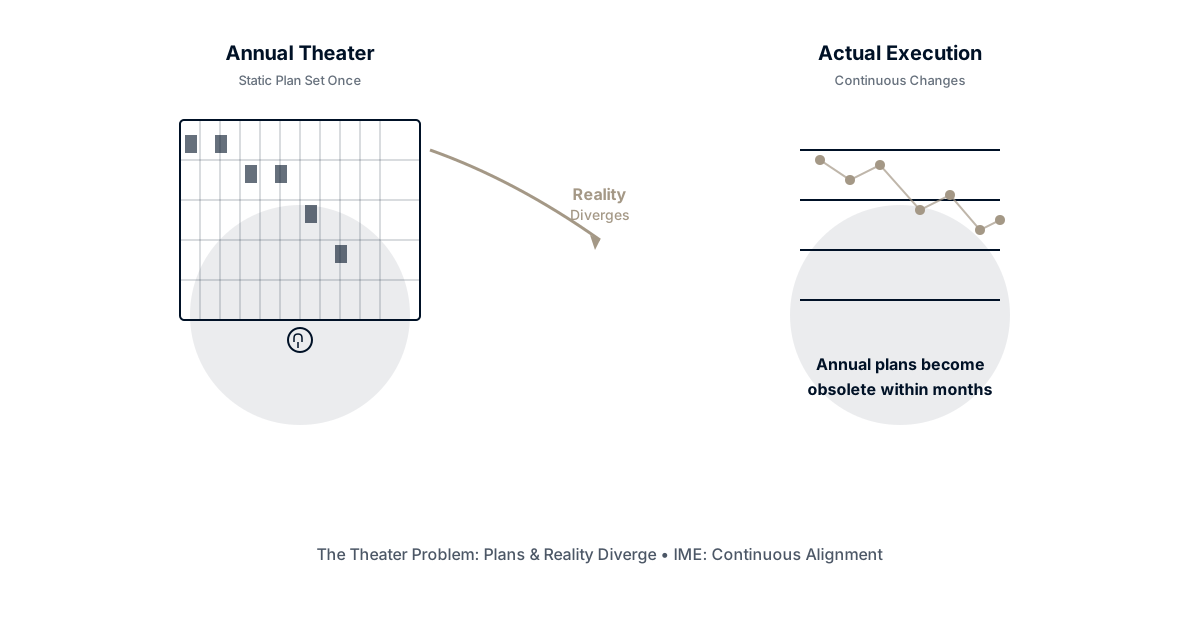
January: Leadership team spends two weeks crafting a brilliant strategic plan. Vision is clear. Priorities are set. OKRs cascade through the organization. Everyone aligns on Q1-Q4 objectives. The PDF goes into Notion. The kickoff meeting is inspiring.
March: Competitor launches a game-changing feature. Major customer changes requirements. Key engineering lead quits. Market conditions shift. Budget gets cut 15%. But the strategic plan? Still says "Q1-Q4 objectives" from January. Nobody has updated it.
June: Strategy review meeting. "Why are we 6 months behind?" Because the strategy became fiction in March, but everyone kept executing the January plan. Not because they're incompetent. Because traditional planning tools don't support continuous alignment.
This is annual planning theater - the expensive ritual where organizations create elaborate strategies that become obsolete faster than they can execute them. IME solves this through continuous strategic alignment instead of point-in-time planning.
The Three-Month Rule: When Strategy Becomes Fiction
Research from McKinsey shows that the average business strategy becomes measurably outdated within 90 days of creation. Not in years. Not in quarters. In three months.
Why three months? Because that's how long it takes for:
- Market conditions to shift (competitor moves, economic changes)
- Customer needs to evolve (feedback accumulates, preferences change)
- Team composition to change (people leave, join, shift roles)
- Technology landscape to advance (new tools, new capabilities)
- Resource availability to fluctuate (budget changes, capacity constraints)
Your January plan assumed a reality that no longer exists by April. But the plan is still "the plan" because updating it requires:
- Reconvening leadership (everyone's busy now)
- Rewriting strategic docs (who owns this?)
- Reprioritizing projects (across multiple tools)
- Reallocating people (HR doesn't have bandwidth)
- Adjusting metrics (data team is swamped)
So the plan stays unchanged while reality diverges. This is strategic drift.
The Cost of Strategic Drift
For a 50-person organization, strategic drift costs:
Misaligned execution: 30% of work continues on deprecated priorities = 15 person-equivalents building the wrong things = $1.8M annually (at $120K average salary)
Delayed pivots: 90-day lag between market shift and response = missed opportunities worth $500K-$2M depending on market timing
Decision-making paralysis: Teams unsure if old plan or new reality drives decisions = 4 hours/week in alignment meetings per person = $780K annually
Total cost: $3.1M-$4.5M per year for a 50-person company
This isn't theoretical. Every company doing annual planning pays this tax. They just don't measure it.
How Annual Planning Theater Works
Let's walk through a typical annual planning cycle:
January: The Plan
Leadership commits January 6-8 to strategic planning. Three days offsite. The result:
- 5 strategic priorities for the year
- OKRs cascading from priorities to teams
- Quarterly milestones and KPIs
- Resource allocation and budget
- Beautiful 47-slide deck
Effort: 120 leadership hours + facilitation + offsite costs = $30K investment
Output: "The 2025 Strategic Plan" - a comprehensive document everyone genuinely believes will guide the year.
February: Early Optimism
Teams kick off projects aligned to the plan. Marketing launches campaigns for Priority 1. Engineering starts building features for Priority 3. Sales focuses on the target customer profile from the plan.
Everything works. The plan is fresh. Reality matches assumptions. Execution feels aligned.
March: Reality Intrudes
- Competitor launches AI features (not in your plan)
- Top enterprise customer demands integration (not on roadmap)
- Engineering lead quits (capacity assumptions wrong)
- Board cuts growth budget 20% (financial model broken)
- Market research shows your ICP is wrong (targeting wrong customers)
The plan is now obsolete. But nobody has time to rewrite it. Leadership makes tactical pivots in Slack and email. Teams adapt locally. The strategic plan PDF remains unchanged.
April-May: Fragmentation
Different teams operate on different implicit strategies:
- Engineering focuses on enterprise integration (responding to customer demands)
- Marketing still executes campaigns for old ICP (following the plan)
- Sales targets new customer profile (based on March market research)
- Product builds AI features (responding to competitive pressure)
Nobody is wrong. Everyone is responding rationally to new information. But they're responding independently because there's no system to maintain strategic coherence.
June: The Reckoning
Strategy review meeting. Leadership reviews progress against January plan. Confusion:
- Why is engineering behind on Priority 3? (They pivoted to enterprise work)
- Why are marketing metrics down? (Wrong ICP)
- Why didn't we respond to competitor AI? (We did, but it's not in the plan)
- What are we actually optimized for? (Nobody knows anymore)
The reaction: "We need better alignment!" So leadership schedules more meetings, writes more Notion docs, sends more strategy emails.
The actual problem: Annual planning doesn't support continuous reality.
Want to eliminate strategic drift? Commander maintains continuous alignment from strategy to execution automatically - no manual propagation required.
Why Annual Planning Persists (Despite Evidence It Fails)
If annual planning creates strategic drift, why does every company do it? Because until recently, continuous planning was operationally impossible.
Annual planning persists because:
- Calendar Legacy: Fiscal years and quarterly reporting create artificial planning boundaries
- Tool Limitations: Traditional tools can't maintain continuous strategic alignment
- Cognitive Load: Leaders can't manually propagate strategic changes across dozens of projects
- Coordination Complexity: Synchronizing strategy changes across teams requires massive coordination overhead
- Measurement Lag: Performance data arrives monthly/quarterly, too slow for continuous adjustment
Annual planning isn't optimal. It's just the best we could do with manual coordination and fragmented tools.
But AI changes everything. Modern AI can understand strategic intent, track cross-functional impact, suggest alignment corrections, propagate changes automatically, and maintain coherence continuously.
This is why Integrated Management Experience emerges now - the technology to support continuous alignment finally exists.
The IME Alternative: Continuous Strategic Alignment
An IME like Commander replaces annual planning theater with continuous strategic alignment:
How Continuous Alignment Works
Strategic Update (Leadership): "We're pivoting from PLG to enterprise sales" AI Analysis (Commander):
- Identifies 23 projects aligned with PLG that need review
- Suggests 8 projects to pause, 7 to modify, 8 to continue
- Highlights 4 team members with enterprise sales experience
- Recommends metric changes: MAU → ACR, viral coefficient → sales cycle time
- Flags 3 OKRs that need revision
Leadership Review (30 minutes): Approve or modify AI suggestions Automated Propagation (Commander):
- Updates strategic priority across all connected systems
- Adjusts project priorities and assignments
- Updates metrics and dashboards
- Notifies affected team members with context
- Maintains decision log for future reference
Total time: 90 minutes from strategy change to complete organizational alignment
Contrast this with traditional tools: Same pivot requires 2-3 weeks, 15+ hours of coordination meetings, manual updates across 6 different tools, and usually incomplete alignment.
The Continuous Alignment Loop
- Strategy changes (market shifts, new information, pivots)
- AI identifies implications across projects, people, metrics
- Leadership reviews and approves changes
- System propagates updates automatically
- Performance data flows back, informing next strategic iteration
This loop runs weekly or as-needed, not annually. Strategy stays alive, not archived.
Real-World Example: SaaS Company Pivots
Company: 50-person B2B SaaS, $5M ARR Pivot: Mid-market focus to enterprise
Traditional Annual Planning Approach
- Week 1-2: Leadership realizes mid-market isn't scaling, decides on enterprise
- Week 3-4: Update strategy docs, communicate change
- Week 5-8: Product manually reviews roadmap, reprioritizes features
- Week 9-10: Engineering manager updates Linear tickets
- Week 11-12: Marketing rebuilds campaigns
- Week 13-14: Sales adjusts targeting
- Week 15+: Dashboard team updates metrics
Time to full alignment: 4 months Opportunity cost: $250K in misaligned execution during transition Coordination overhead: 80 hours across leadership and teams
IME Continuous Alignment Approach
- Monday morning: Leadership updates strategic priority in Commander
- Monday afternoon: AI suggests changes across projects, people, metrics
- Tuesday morning: Leadership reviews AI suggestions (90 minutes)
- Tuesday afternoon: Changes propagate automatically
- Wednesday: Full organizational alignment
Time to full alignment: 3 days Opportunity cost: Minimal - fast pivot, minimal drift Coordination overhead: 90 minutes leadership review
Savings: 4 months → 3 days, $250K opportunity cost eliminated, 75+ coordination hours saved
Moving Beyond Planning Theater
The alternative to annual planning theater isn't "no planning." It's continuous planning supported by systems that maintain alignment automatically.
The future of strategy:
- Strategy as living system, not static document
- Weekly iteration, not annual revision
- AI-maintained alignment, not manual propagation
- Real-time measurement, not quarterly reports
- Continuous adaptation, not periodic course correction
Companies that adopt continuous strategic alignment first will have a massive advantage. Their strategy won't just be better documented - it will actually drive reality. Their teams won't waste months executing deprecated plans. Their leadership won't spend weeks manually propagating changes.
This is the IME transformation. From planning theater to planning reality.
Read more about how Commander maintains continuous alignment and explore the ROI of continuous strategic alignment.
Experience Continuous Planning with Commander
Want to eliminate strategic drift? Commander provides:
- Living Strategy - Plans that evolve with reality, not annual documents
- AI Propagation - Strategic changes cascade automatically across organization
- Real-Time Alignment - Projects, people, metrics stay synchronized continuously
- Faster Pivots - Days to full alignment instead of months
Get started and replace annual planning theater with continuous strategic alignment.
Annual planning fails because it treats strategy as a point-in-time exercise. IME succeeds because it treats strategy as a continuous adaptive system. Learn more about what makes IME different and discover the Four Pillars of continuous alignment.
About the Author

Stuart Leo
Stuart Leo founded Waymaker to solve a problem he kept seeing: businesses losing critical knowledge as they grow. He wrote Resolute to help leaders navigate change, lead with purpose, and build indestructible organizations. When he's not building software, he's enjoying the sand, surf, and open spaces of Australia.