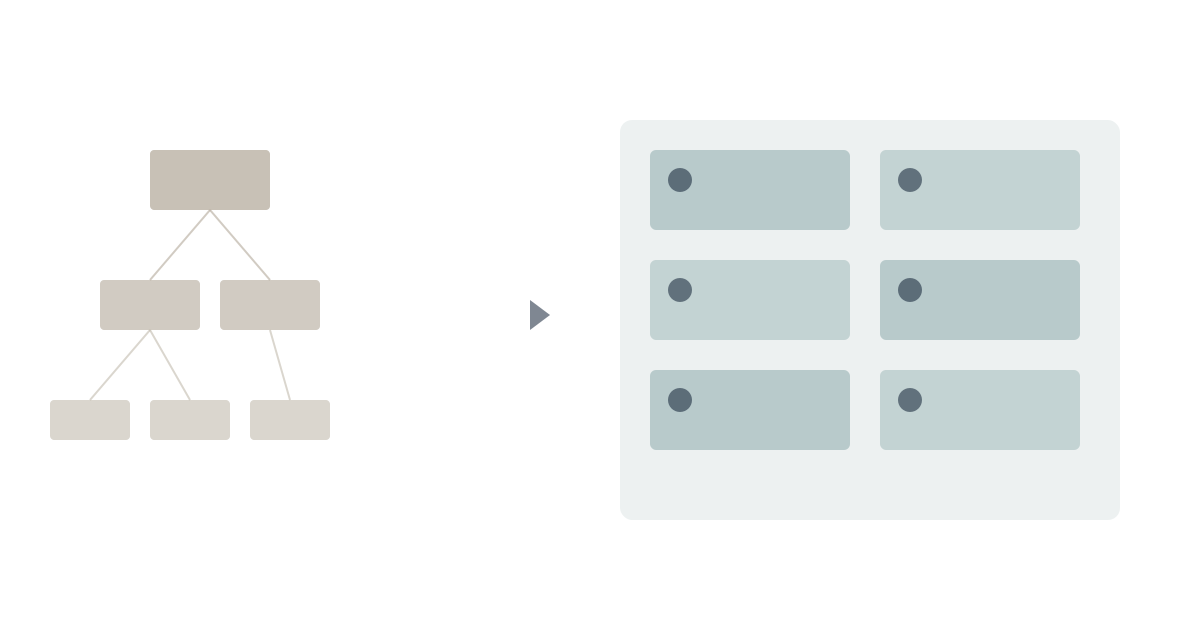
You've built your EOS Accountability Chart. Every seat has a clear owner. Each person has their three to five accountabilities written out. Your structure looks clean.
And yet, at quarterly reviews, you keep hearing the same frustrating refrain: "I did everything on my accountability list, but we still missed our targets."
Here's the uncomfortable truth: You can complete every accountability on your chart and still fail. The Accountability Chart tells you what someone does. It doesn't tell you what they achieve. That's the missing piece.
The Accountability Chart's Hidden Limitation
The Entrepreneurial Operating System (EOS) has helped over 200,000 companies bring structure to chaos. The Accountability Chart is foundational - it ensures everyone knows their seat, who they report to, and what they're responsible for doing.
A typical Accountability Chart entry looks like this:
Sales Manager
- Reports to: VP of Sales
- Accountabilities:
- Manages sales team of 8 reps
- Runs weekly sales meetings
- Coaches underperforming reps
- Maintains CRM discipline
- Submits weekly pipeline reports
This is useful. It defines scope. It prevents overlap. It creates clear boundaries.
But notice what's missing: There's nothing here about revenue targets, conversion rates, pipeline velocity, or customer acquisition costs. Nothing about outcomes. Nothing about what success actually looks like.
The Activity Trap: Busy But Not Productive
When roles are defined by activities rather than outcomes, people optimize for doing rather than achieving. They become busy - very busy - but that busyness doesn't necessarily translate to business results.
Consider two Sales Managers:
Manager A completes every accountability:
- Runs weekly meetings (52/52)
- Submits pipeline reports (52/52)
- Coaches all underperformers (monthly sessions documented)
- CRM updated (95% compliance)
- Revenue: -15% YoY
Manager B misses some accountabilities:
- Weekly meetings (44/52 - missed during quarter-end pushes)
- Pipeline reports (42/52 - sometimes late)
- Coaching (informal, undocumented)
- CRM (78% compliance)
- Revenue: +23% YoY
By the Accountability Chart, Manager A is the better performer. By any reasonable business measure, Manager B is crushing it.
The math: If you're evaluating people on activities and they deliver activities but not results, whose fault is it? The accountability framework created the wrong incentive.
What Outcome-Based Role Architecture Actually Is
The Waymaker approach to roles starts from a different premise: Roles exist to deliver outcomes, not to perform activities.
This isn't just semantic. It fundamentally changes how you think about role design, hiring, performance management, and organizational structure.
The fundamental shift:
- EOS Accountability Chart: "What does this person do?"
- Waymaker Role Canvas: "What does this person achieve?"
Think of it this way: The Accountability Chart describes the scope of someone's garden - which beds they tend, which tools they use, which paths they maintain. The Role Canvas describes what the garden should produce - the yield, the quality, the timing of the harvest. Both matter. But if you only define the garden beds without defining the expected harvest, don't be surprised when you get beautiful maintenance and no vegetables.
The Role Canvas: 6 Elements That Complete Your Accountability Chart
The Role Canvas from Resolute (Management Question 2) provides the outcome architecture that the Accountability Chart lacks. It doesn't replace EOS - it completes it.
Element 1: Role Name
What it is: A clear, descriptive title that conveys function.
Why it matters: Names shape expectations. "Sales Manager" is generic. "Revenue Growth Leader" signals a different level of outcome ownership.
EOS gives you: Role titles. Waymaker adds: Intentional naming that signals outcome responsibility.
Element 2: Purpose
What it is: Why this role exists and what problem it solves for the organization.
Why it matters: Purpose connects individual roles to organizational strategy. When people understand why their role exists - not just what it does - they make better autonomous decisions.
Without Purpose: "I manage the sales team." With Purpose: "I exist to accelerate revenue growth by building a scalable, high-performance sales engine that converts qualified leads into customers."
EOS gives you: Implicit purpose through placement in the chart. Waymaker adds: Explicit purpose statements that connect roles to business outcomes.
Element 3: Reports To
What it is: Clear line of accountability and hierarchy.
Why it matters: Both EOS and Waymaker agree here - clear reporting is essential.
EOS and Waymaker align: This element works the same in both frameworks.
Element 4: Team
What it is: The team this role belongs to within the organization.
Why it matters: Understanding team membership enables collaboration, communication, and shared context.
EOS gives you: Departmental placement. Waymaker adds: Team identity that enables cross-functional coordination.
Element 5: Metrics (The Critical Missing Piece)
What it is: Specific, measurable outcomes this role owns - expressed in percentages, numbers, or dollars.
Why it matters: This is where the Accountability Chart falls short and where Waymaker delivers the most value. Metrics define success in objective, measurable terms.
Without Metrics: "Manages sales team effectively." With Metrics:
- Net new revenue: $2.4M per quarter
- Win rate: 35%+
- Sales cycle: <45 days average
- Rep quota attainment: 80%+ hitting target
- Pipeline coverage: 3x+ at all times
EOS gives you: Accountabilities (activities). Waymaker adds: Metrics (outcomes) that define what winning actually looks like.
Element 6: Incumbent
What it is: The person currently in this role.
Why it matters: Creates clear accountability by name, not just by position.
EOS and Waymaker align: Both assign specific people to specific roles.
The Complete Role Architecture: EX Role Description
For roles that need more depth - leadership positions, complex functions, or roles with significant cultural impact - Waymaker's EX Role Description framework (Leadership Question 6) extends even further with seven comprehensive elements.
Beyond the Role Canvas, the EX Role Description adds:
- Goals & Outcomes: Detailed success criteria with specific metrics
- Key Tasks & Responsibilities: Activities linked to outcomes (not standalone)
- Skills & Systems Required: Technical skills, soft skills, and tool proficiency
- Values, Principles & Behaviors: How the role lives organizational culture
- Leadership Framework: Meeting cadence, reporting rhythms, development expectations
- Onboarding & Development: 30/90/365 day milestones and growth pathway
This creates what we call a "personal business plan" for each role - not just a job description, but a complete roadmap for success.
Practical Integration: Keep EOS, Add Waymaker
You don't need to throw out your Accountability Chart. You need to complete it.
Step 1: Start with Your Existing Chart
Keep your current structure. The seats, the reporting lines, the departmental organization - all of that remains valuable.
Step 2: Add Metrics to Each Role
For every seat in your chart, answer: "What metrics would tell us this role is succeeding?" Push for specific numbers:
- Revenue targets ($)
- Efficiency metrics (%)
- Quality scores (#)
- Time-based targets (days, hours)
Step 3: Connect Activities to Outcomes
Your existing accountabilities become "how" - the activities that should drive the metrics. The metrics become "what" - the outcomes that matter.
Before (EOS only):
- Manages sales team
- Runs weekly meetings
- Coaches underperformers
After (EOS + Waymaker):
- Outcome: Net new revenue of $2.4M per quarter
- Activities that drive this:
- Manages sales team (8 reps, each with $300K target)
- Runs weekly meetings (pipeline review, deal coaching)
- Coaches underperformers (to improve close rates)
Now the activities have purpose. Coaching isn't checkbox compliance - it's a lever to improve close rates, which drives revenue, which is the actual goal.
Step 4: Evaluate on Outcomes, Not Activities
When review time comes, the question isn't "Did they complete their accountabilities?" The question is "Did they achieve their outcomes?"
This creates healthy tension. Someone might find more efficient ways to achieve outcomes - and that's good. Innovation happens when you optimize for results, not compliance.
The Complete Picture: EOS + Waymaker Integration
Here's how the two frameworks work together:
| Component | EOS Provides | Waymaker Adds |
|---|---|---|
| Structure | Seat in org chart | Team context |
| Reporting | Clear hierarchy | Same |
| Scope | 3-5 accountabilities | Activities linked to outcomes |
| Success | Implicit (GWC) | Explicit metrics (%, #, $) |
| Culture | Core Values | Values + Behaviors + Development |
| Growth | Right seat, right person | 30/90/365 milestones + pathway |
EOS gives you the foundation. Waymaker gives you the performance architecture.
Why This Matters for EOS Companies
If you're running EOS successfully, you've already built organizational discipline. You have structure, rhythm, and accountability. That's significant - most companies never get there.
EOS was designed for the entrepreneur who needed to go from chaos to structure. It solves the "nobody knows who does what" problem brilliantly. The simplicity is the genius - V/TO, Rocks, L10, Scorecard, Accountability Chart. Clear. Repeatable. Effective.
Resolute builds on that foundation. The Resolute methodology doesn't replace EOS - it adds depth for companies that have mastered the basics and are ready for more:
- EOS gives you the Accountability Chart → Resolute adds the Role Canvas with outcome metrics
- EOS gives you Rocks → Resolute adds the Goal Canvas with cascading outcomes
- EOS gives you V/TO → Resolute adds the 7 Questions for complete strategic architecture
- EOS gives you L10 → Resolute adds the Meeting Canvas for full operating rhythms
- EOS gives you Scorecard → Resolute adds the Data Canvas for performance intelligence
The next evolution is from structure to performance. From "everyone has a seat" to "everyone knows what winning looks like in their seat." That's where Resolute's outcome-based frameworks and Waymaker's AI-powered technology complete the picture.
We're not replacing EOS. We're standing on its shoulders.
Read more about translating EOS Rocks into strategic outcomes and discover how the 7 Questions of Leadership extend your V/TO.
Experience Outcome-Based Role Architecture with Waymaker
Ready to move from accountability charts to performance architecture? Waymaker provides the AI-powered technology to bring your EOS implementation to life.
Commander: Your Integrated Management Experience
Waymaker Commander gives you the essential tools - Taskboards, Documents, Sheets, Tables and Forms - all connected in a VS Code-inspired workspace. Your Role Canvases live alongside your goals, your meeting notes, and your performance data. Everything connected. Nothing siloed.
OneAI: Strategic Performance Intelligence
Ask questions like "Which roles are hitting their metrics?" or "Show me the connection between Sarah's outcomes and the Q2 revenue goal" - and get instant, context-aware answers. OneAI understands your business because it's built on your organizational data, not generic training.
Host: Build Custom Role Dashboards
Need a custom view for your leadership team's role performance? Deploy it with Waymaker Host. Internal apps inherit your organization's authentication automatically - no extra security configuration needed.
Keep your EOS. Add AI-powered execution. That's how you go from people completing their accountabilities to people achieving their goals.
The Accountability Chart tells you who owns what. The Role Canvas tells you what winning looks like. You need both. Learn more about building complete employee experiences and explore the 5 Questions of Management that power Waymaker's approach to organizational performance.
EOS® and Entrepreneurial Operating System® are registered trademarks of EOS Worldwide, LLC. Waymaker is not affiliated with, endorsed by, or sponsored by EOS Worldwide.
About the Author

Stuart Leo
Stuart Leo founded Waymaker to solve a problem he kept seeing: businesses losing critical knowledge as they grow. He wrote Resolute to help leaders navigate change, lead with purpose, and build indestructible organizations. When he's not building software, he's enjoying the sand, surf, and open spaces of Australia.