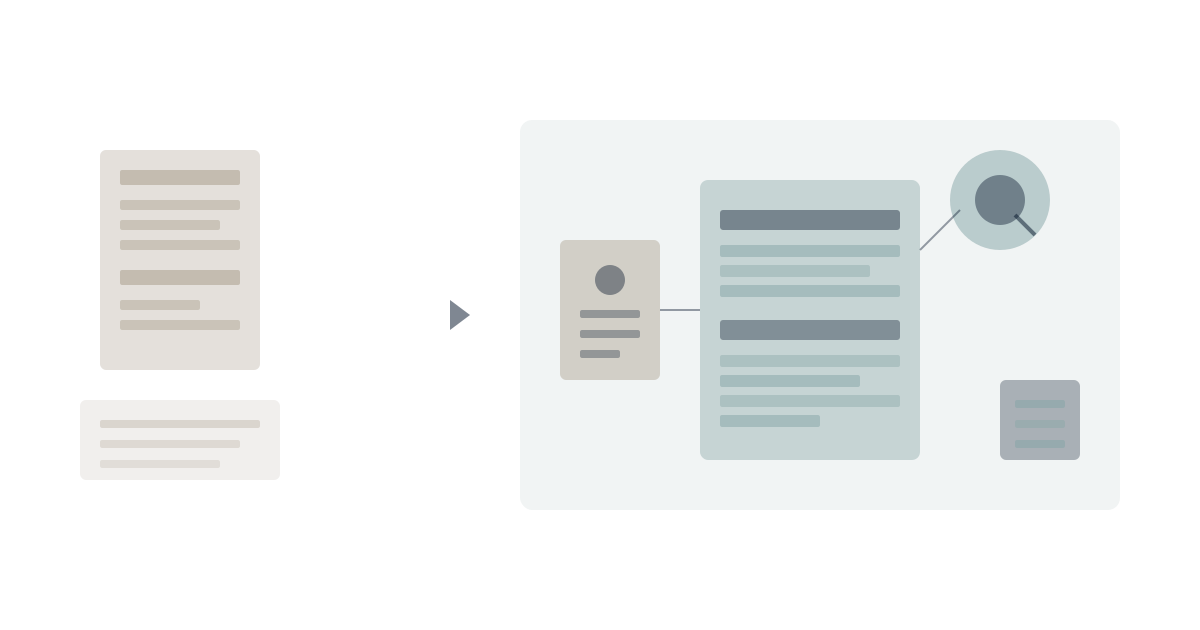
Your EOS implementation included documenting core processes. The HR Process. The Sales Process. The Marketing Process. You spent hours getting the 20% of processes that drive 80% of results onto paper.
Quick question: When was the last time anyone actually used those documents?
If you're like most companies, those process documents live in a Google Drive folder, a SharePoint site, or a Notion workspace somewhere. They were created, maybe even updated once, and then... abandoned. New hires don't know they exist. Existing team members can't find them. The knowledge is documented but not accessible.
You did the work. But the work isn't working.
The Core Process Promise
EOS Core Processes are well-intentioned. The principle is sound: identify the handful of processes that create the most value, document them clearly so anyone can follow them, simplify and systemize for consistency.
A documented EOS Core Process might look like:
Sales Process: The Waymaker Way
- Qualify → 2. Discovery → 3. Proposal → 4. Close → 5. Handoff
Each step has detailed substeps. Checklists exist. Roles are defined. It's comprehensive.
This is valuable work. When it was created, it represented real organizational knowledge.
The problem isn't the documentation. It's the life cycle.
The Documentation Graveyard
Most process documentation follows a predictable lifecycle:
Month 1: Created with care, comprehensive and current Month 6: Mostly accurate, a few things have changed Month 12: Several steps outdated, workarounds not documented Month 18: New hires don't know it exists, veterans ignore it Month 24: "We should really update that documentation..."
The math: If you invest 40 hours creating core process docs, and they're useful for 6 months, that's about $1,000/month in realized value. But if they become outdated and unused, that $2,000-4,000 investment yields maybe $6,000 in value before abandonment. That's a poor return on knowledge work.
Why Documentation Dies
Process documentation fails for predictable reasons:
- Static format: Documents don't change when processes change
- Disconnected: Not linked to where work actually happens
- Searchability: People can't find what they need when they need it
- Maintenance burden: Updating is nobody's explicit job
- No feedback loop: No way to know if docs are accurate or used
The documentation is a snapshot. The organization is a movie.
What Living Playbooks Actually Are
Living playbooks are process knowledge that stays current, connected, and accessible. Instead of static documents that decay, they're dynamic knowledge systems that evolve with your organization.
The fundamental shift:
- Core Process Docs: "We documented how we do things"
- Living Playbooks: "Our knowledge is always current and immediately accessible"
Think of it this way: Traditional process docs are like printed maps - accurate when published, increasingly wrong over time. Living playbooks are like GPS - always current, always accessible, getting you where you need to go.
Building Living Playbooks: The Key Principles
Transforming static documentation into living knowledge requires four shifts.
Principle 1: Connected to Work
Static docs: Live in a separate document repository Living playbooks: Embedded where work happens
When a sales rep is working a deal in your CRM, the relevant playbook sections should be accessible right there - not in a separate Google Doc they have to search for.
In Waymaker: Playbooks connect to roles, goals, and tasks. When you're working on a task, relevant process knowledge is surfaced automatically.
Principle 2: AI-Accessible
Static docs: Humans have to read and interpret Living playbooks: AI can query and surface relevant knowledge
Example interaction:
- Question: "What's our process for handling a customer escalation?"
- Static docs: Search Google Drive, find doc, read 5 pages, extract relevant section
- Living playbooks: Ask OneAI, get instant answer with source reference
In Waymaker: OneAI can search your playbooks, understand context, and provide relevant answers instantly.
Principle 3: Version-Aware
Static docs: Updated sporadically, version history unclear Living playbooks: Changes tracked, current version clear, history available
When a process changes, the playbook updates. When you need to know how things were done before, history is accessible. When there's a question about what's current, the answer is clear.
In Waymaker: playbooks live as Commander documents, so everyone opens the same current version and edits happen in one place.
Principle 4: Feedback-Enabled
Static docs: No way to know if accurate or useful Living playbooks: Usage tracked, feedback collected, gaps identified
If a playbook section is never accessed, maybe it's not needed - or maybe people don't know it exists. If the same questions keep coming up that the playbook should answer, there's a gap.
In Waymaker: Commander tracks which playbook content is accessed and surfaces patterns in questions that indicate missing documentation.
Practical Integration: Transform Your Core Processes
You don't need to start over. You can transform your existing documentation into living playbooks.
Step 1: Audit Current Documentation
List all your process documentation:
- Where does it live?
- When was it last updated?
- Who maintains it?
- How do people access it?
Most companies discover: lots of docs, scattered locations, unclear ownership, low usage.
Step 2: Prioritize by Impact
Not all processes need living playbooks. Focus on:
- High frequency: Processes executed daily or weekly
- High variance: Processes where people do it differently
- High stakes: Processes where errors are costly
- High onboarding: Processes new hires need to learn
Your EOS "20% that drives 80%" is a good starting point.
Step 3: Connect to Work Context
For each priority process:
- What roles execute this process?
- What tasks involve this process?
- What systems are used during execution?
- When would someone need to reference this?
Map documentation to work context, not file folders.
Step 4: Enable AI Access
Structure playbooks so AI can understand and query them:
- Clear headers and sections
- Explicit steps and checklists
- Defined terms and concepts
- Links between related content
When playbooks are AI-accessible, your team can ask questions in natural language instead of searching through folders.
Step 5: Assign Ownership
Every playbook needs:
- Owner: Accountable for accuracy and currency
- Review cadence: How often is it validated?
- Update triggers: What events should prompt review?
No owner = certain decay.
The Complete Picture: EOS + Waymaker Integration
EOS Core Processes and Waymaker Living Playbooks work together:
| Aspect | EOS Core Processes | Waymaker Living Playbooks |
|---|---|---|
| Format | Static documents | Connected, dynamic knowledge |
| Location | Document repository | Embedded in work context |
| Access | Search and read | Ask AI, get answers |
| Updates | Manual, periodic | Real-time, version-tracked |
| Feedback | None built-in | Usage analytics, gap identification |
EOS gives you the discipline of documenting. Waymaker makes documentation live.
Why This Matters for EOS Companies
If you've documented core processes, you've already invested in organizational knowledge. That's significant - most companies don't even start.
Waymaker builds on that foundation. Living playbooks don't replace your documentation work - they make it actually work:
- EOS gives you core processes → Waymaker adds connected, living playbooks
- EOS gives you the 20/80 focus → Waymaker adds AI accessibility for instant answers
- EOS gives you documented knowledge → Waymaker adds real-time sync and version control
The next evolution is from "documented" to "accessible and alive." That's where Waymaker's technology completes the picture.
We're not replacing your process work. We're making it actually useful.
Read more about AI-powered execution and discover how context engineering transforms organizational knowledge.
Experience Living Playbooks with Waymaker
Ready to transform your core process docs into living knowledge? Waymaker provides the technology stack to make it happen.
Commander: Your Playbook Home
Waymaker Commander gives you a connected workspace where playbooks live alongside roles, goals, and tasks. Documentation isn't in a separate system - it's part of how work gets done.
OneAI: Knowledge at Your Fingertips
Ask questions like "What's our escalation process?" or "How do we handle a refund over $1000?" - and get instant, accurate answers pulled from your playbooks. No more searching through folders.
One Source: Always Current
Each playbook is one Commander document. Update it once and everyone, including OneAI, reads the new version. No copies drifting apart in different folders.
Host: Custom Playbook Apps
Need a custom interface for a specific process? Waymaker Host lets you build lightweight apps on top of your playbooks - think onboarding wizards, checklists, or process guides.
Keep your core process work. Make it live. That's how you go from documented to truly systematized.
EOS gives you documentation discipline. Living playbooks make documentation work. You need both. Learn more about context engineering and explore AI-powered execution.
EOS® and Entrepreneurial Operating System® are registered trademarks of EOS Worldwide, LLC. Waymaker is not affiliated with, endorsed by, or sponsored by EOS Worldwide.
About the Author

Stuart Leo
Stuart Leo founded Waymaker to solve a problem he kept seeing: businesses losing critical knowledge as they grow. He wrote Resolute to help leaders navigate change, lead with purpose, and build indestructible organizations. When he's not building software, he's enjoying the sand, surf, and open spaces of Australia.