Your L10 has been incredible at solving issues. The shipping delay? IDS'd and fixed in 15 minutes. The pricing confusion? Identified, discussed, solved - done. The sales process bottleneck? Same deal.
But there's that one issue that keeps coming back. "Culture" or "communication" or "cross-department collaboration." It's been on the Issues List for months. You've IDS'd it multiple times. You've assigned to-dos. Nothing really changes.
Here's the uncomfortable truth: IDS is brilliant for certain problems. It's the wrong tool for others. Using the same approach for every problem type is like using a hammer for every job - sometimes you need a screwdriver.
The IDS Problem-Solving Powerhouse
EOS IDS - Identify, Discuss, Solve - is genuinely powerful. It forces teams to:
- Identify the real issue (not the symptom)
- Discuss to understand it fully
- Solve with specific action items
This works remarkably well. Most leadership teams waste hours in circular discussions. IDS cuts through to decision and action. For the right problems, it's excellent.
But notice the assumption: IDS assumes every problem has a solvable solution that can be identified through discussion. That's true for many problems. It's not true for all.
When IDS Works Brilliantly
IDS excels with problems that have:
- Clear cause and effect
- Identifiable root causes
- Definable solutions
- Predictable outcomes
Examples:
- "Shipping is taking 7 days instead of 3" → Root cause: warehouse understaffed → Solution: hire two more people
- "Sales proposals take too long" → Root cause: manual process → Solution: implement template system
- "Cash flow is tight" → Root cause: 60-day payment terms → Solution: offer 2% discount for 15-day payment
These are complicated problems. They're hard, but solvable. Analysis reveals the answer.
When IDS Struggles
IDS struggles with problems that have:
- No clear cause and effect
- Multiple interacting factors
- Solutions that aren't predictable
- Outcomes that emerge over time
Examples:
- "Our culture isn't where we want it" → Cause: ??? → Solution: ???
- "Cross-department collaboration is poor" → Cause: multiple factors → Solution: ???
- "Innovation is stalling" → Cause: hard to pinpoint → Solution: ???
- "Employee engagement is dropping" → Cause: complex → Solution: ???
These are complex problems. You can't analyze your way to a solution. The solution has to emerge through experimentation.
The IDS Trap
When you apply IDS to complex problems, you get:
- Superficial solutions that feel decisive but don't work
- To-dos that check boxes but don't change anything
- The same issue returning to the list months later
- Frustration that "we keep solving this but nothing changes"
The trap: IDS gives you the feeling of progress (we solved it!) without actual progress (nothing changed).
What Problem-Type Awareness Actually Is
The Cynefin Framework, developed by Dave Snowden, provides a way to categorize problems and match them with appropriate approaches. Different problem types need different solutions.
The fundamental shift:
- IDS Thinking: "What's the issue? Let's discuss and solve it."
- Cynefin Thinking: "What type of problem is this? What approach does it need?"
Think of it this way: A doctor doesn't use the same treatment for every patient. They diagnose first - is it bacterial or viral? Acute or chronic? Different diagnoses lead to different treatments. Problem-solving should work the same way.
The Cynefin Framework: Problem Types and Approaches
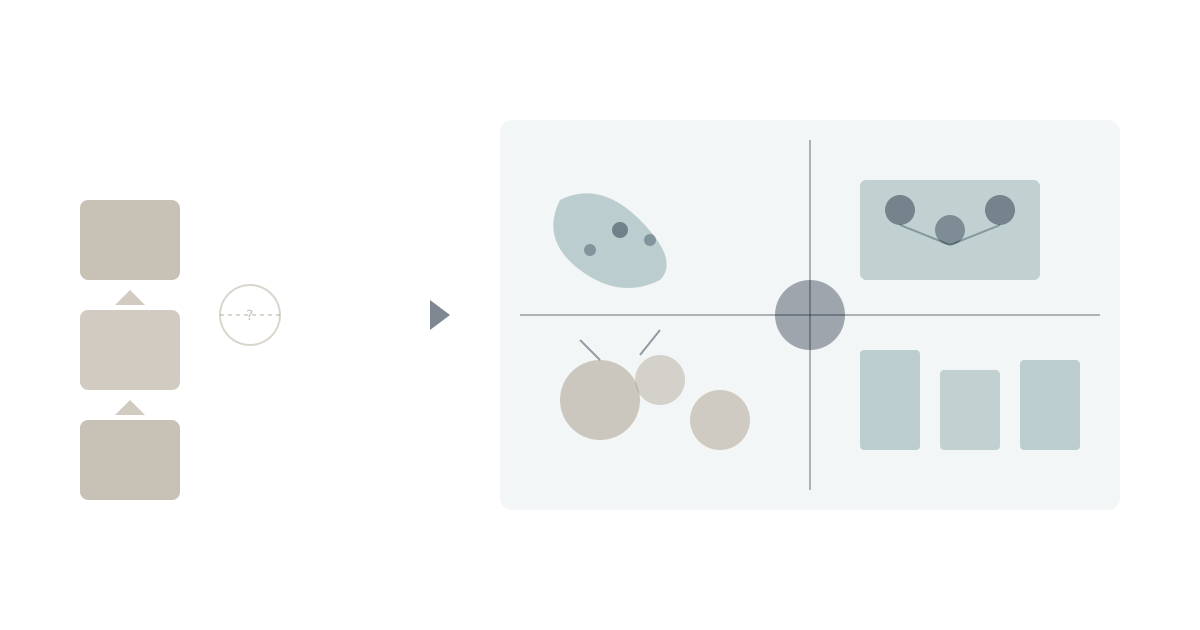
The Cynefin Framework identifies five domains. Each requires a different response.
Domain 1: Clear (Simple)
Characteristics: Cause and effect is obvious. Best practices exist. Anyone can solve it.
Examples:
- Customer forgot their password → Send reset link
- Invoice has wrong amount → Correct and resend
- Team member is sick → Follow coverage procedure
Approach: Sense → Categorize → Respond
- See the problem
- Match to known category
- Apply standard solution
IDS fit: Overkill. These don't need 60 minutes of L10 time. Just fix them.
Domain 2: Complicated
Characteristics: Cause and effect exists but requires analysis. Experts can figure it out. Multiple right answers may exist.
Examples:
- Why is conversion rate dropping?
- How should we structure the sales team?
- What's causing the production defect?
Approach: Sense → Analyze → Respond
- Gather information
- Apply expertise/analysis
- Implement solution
IDS fit: Perfect. This is where IDS shines. Discuss to analyze, then solve.
Domain 3: Complex
Characteristics: Cause and effect only visible in hindsight. No expert can predict the outcome. Solutions emerge through experimentation.
Examples:
- How do we improve our culture?
- How do we increase innovation?
- How do we improve cross-department collaboration?
- How do we enter a new market?
Approach: Probe → Sense → Respond
- Try small experiments
- See what works
- Amplify what works, dampen what doesn't
IDS fit: Poor. You can't "solve" complex problems in a meeting. You have to run experiments and learn.
Domain 4: Chaotic
Characteristics: No cause and effect relationship discernible. Crisis mode. Need immediate action to stabilize.
Examples:
- Server is down, customers can't access anything
- Key team member quit without notice
- Major customer threatening to leave today
- Security breach discovered
Approach: Act → Sense → Respond
- Take action to stabilize
- See what works
- Move to complex or complicated domain
IDS fit: Too slow. In chaos, you act first, analyze later.
Domain 5: Disorder
Characteristics: You don't know which domain you're in. Confusion about what's happening.
Approach: Break down into smaller parts, categorize each, act accordingly.
IDS fit: Can help identify what type of problem you're facing.
Practical Integration: Use IDS + Cynefin Together
You don't need to abandon IDS. You need to match it to the right problems.
Step 1: Categorize Before IDS-ing
When an issue hits your list, first ask: "What type of problem is this?"
Quick categorization:
- "Is the cause obvious?" → Clear (just do it)
- "Can we analyze our way to a solution?" → Complicated (IDS it)
- "Will we need to experiment to find what works?" → Complex (different approach)
- "Is this a crisis needing immediate action?" → Chaotic (act now)
Step 2: Apply the Right Approach
For Complicated issues (most L10 issues): Use IDS as designed. Identify root cause, discuss options, solve with clear to-dos.
For Complex issues: Replace "Solve" with "Experiment":
- Identify the challenge (not the "solution")
- Discuss possible experiments to try
- Define small, safe-to-fail probes
- Set a timeframe to review what we learned
- Iterate based on results
Example - Complex Issue: "Culture isn't where we want it"
Bad IDS:
- Identify: "People aren't living our values"
- Discuss: "We need to reinforce values"
- Solve: "Create values poster, add to performance reviews"
- Result: Poster goes up, nothing changes
Good Cynefin-Informed Approach:
- Identify: "We want a culture of [specific behavior] but we're seeing [current behavior]"
- Discuss: "What small experiments might shift this?"
- Experiment: "Let's try: (1) Leaders model the behavior daily for 30 days, (2) Recognize one example in each L10, (3) Include in one-on-ones"
- Review: "In 30 days, what did we learn? What's working? What should we amplify or stop?"
Step 3: Time-Box Complex Issues Differently
Complicated issues: IDS in 10-20 minutes, move on Complex issues: Define experiment in 10 minutes, review results in future L10s
Don't keep re-IDS-ing the same complex issue. Run experiments, learn, adapt.
The Complete Picture: EOS + Resolute Integration
IDS and Cynefin work together:
| Problem Type | EOS Approach | Resolute Enhancement |
|---|---|---|
| Clear | Delegate | Don't bring to L10 |
| Complicated | IDS | IDS (perfect fit) |
| Complex | IDS (struggles) | Probe-Sense-Respond experiments |
| Chaotic | Crisis management | Act-Sense-Respond |
EOS gives you IDS for complicated problems. Resolute gives you Cynefin for problem-type awareness.
Why This Matters for EOS Companies
If you're running L10s with IDS, you've already built problem-solving discipline. That's significant - most teams avoid issues or discuss endlessly without deciding.
Resolute builds on that foundation. Cynefin doesn't replace IDS - it tells you when IDS is the right tool:
- EOS gives you IDS → Resolute adds problem-type awareness
- EOS gives you Issues List → Resolute adds categorization by type
- EOS gives you To-dos → Resolute adds experiments for complex problems
The next evolution is from "solving every issue the same way" to "matching approach to problem type." That's where Resolute's Cynefin integration and Waymaker's tracking tools complete the picture.
We're not replacing EOS. We're standing on its shoulders.
Read more about building complete meeting rhythms and discover how the 7 Questions help you think strategically about complex challenges.
Experience Problem-Type Awareness with Waymaker
Ready to match your problem-solving to problem types? Waymaker provides the tools to categorize, experiment, and learn.
Commander: Track Experiments, Not Just To-dos
Waymaker Commander lets you track complex issues differently. Define experiments with hypotheses, timeframes, and learning reviews. See which experiments worked and which didn't over time.
OneAI: Pattern Recognition
Ask questions like "Which issues keep recurring on our list?" or "What experiments have we tried for culture issues?" - and get instant analysis. OneAI helps you see patterns in your problem-solving history.
Connected Learning
When an experiment generates learning, it's captured in Commander. Next time a similar complex issue arises, you have institutional memory of what worked and what didn't.
Keep your IDS for complicated problems. Add Cynefin for complex ones. That's how you actually solve the issues that keep coming back.
IDS is brilliant for complicated problems. Complex problems need a different approach. Know the difference. Learn more about first principles thinking and explore meeting excellence.
EOS® and Entrepreneurial Operating System® are registered trademarks of EOS Worldwide, LLC. Waymaker is not affiliated with, endorsed by, or sponsored by EOS Worldwide.
About the Author

Stuart Leo
Stuart Leo founded Waymaker to solve a problem he kept seeing: businesses losing critical knowledge as they grow. He wrote Resolute to help leaders navigate change, lead with purpose, and build indestructible organizations. When he's not building software, he's enjoying the sand, surf, and open spaces of Australia.