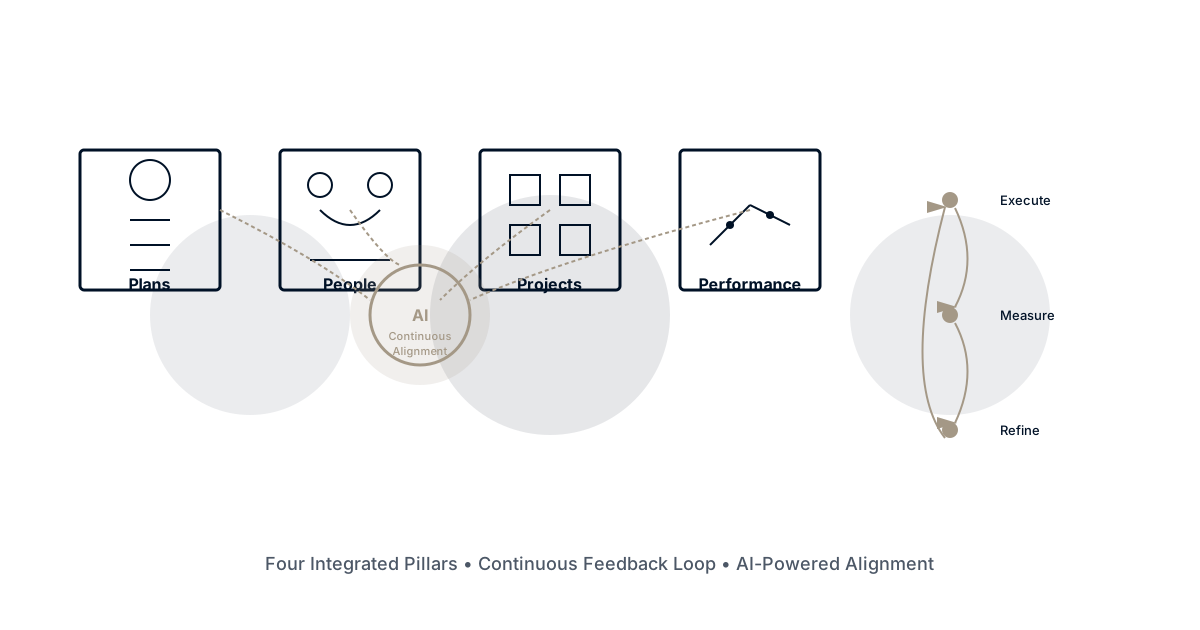
Most business software fails at alignment because it optimizes one dimension while ignoring the others. Monday.com excels at project execution but disconnects from strategy. Notion documents your plans but doesn't track execution. BI tools measure performance but can't tell you why the numbers changed or who's responsible.
An Integrated Management Experience (IME) solves this through architectural integration across four essential dimensions: Plans (strategy), People (organization), Projects (execution), and Performance (measurement). When all four pillars stay continuously aligned, strategic drift becomes impossible.
Here's how the Four Pillars framework works and why each pillar is essential for organizational coherence.
Why Four Pillars, Not Three or Five?
The Four Pillars emerge from a fundamental question: What does an organization need to know to execute strategy successfully?
You need to know WHAT you're trying to achieve (Plans). You need to know WHO will do it (People). You need to know HOW it will get done (Projects). And you need to know WHETHER it's working (Performance).
These four dimensions are necessary and sufficient for organizational alignment. Missing any pillar creates a specific failure mode. Having all four enables continuous strategic coherence.
What Happens When Pillars Are Missing
Missing Plans: Teams execute efficiently toward unclear or outdated objectives. High velocity, zero strategic impact.
Missing People: Strategy and projects exist, but nobody owns execution. "Everyone's responsible" means nobody's accountable.
Missing Projects: Great strategy, clear ownership, but no systematic execution. Plans stay plans, never becoming reality.
Missing Performance: Activity without measurement. You're building, shipping, and growing - but can't tell if any of it advances your actual goals.
The research is clear: Most organizations have 2-3 of these pillars. The companies that align all four consistently outperform their peers by 3-5x on strategic execution.
Pillar 1: Plans - The Strategic Layer
What it is: Your organization's strategy, goals, frameworks, decisions, and the "why" behind your work. This includes strategic priorities, OKRs/goals, decision logs, strategic frameworks, and market positioning.
Why it matters: Without clear strategy, teams optimize for local efficiency instead of global objectives. They ship features nobody needs, hit metrics that don't matter, and stay busy without creating value.
The Plan Problem in Traditional Tools
In most organizations, the plan lives in:
- A Notion doc that leadership updates quarterly
- OKRs in a spreadsheet that HR tracks
- Strategic priorities in a slide deck from the last all-hands
- Product roadmap in Productboard or Aha!
- Annual budget in Excel or NetSuite
Five different systems. None connected to daily execution. When strategy changes (and it always does), these documents get updated at different times, by different people, with different interpretations. Strategic drift isn't a failure of planning - it's a consequence of disconnected planning systems.
How IME Unifies the Plans Pillar
In an IME like Commander, Plans is a living strategic layer that connects directly to execution:
Strategic Priorities connect to Projects that execute them → AI tracks whether execution advances the strategy OKRs connect to People who own them → AI monitors whether the right people are working on strategic goals Decision Logs connect to Performance Data → AI shows whether decisions produced expected outcomes
Real Example: Product team decides to pivot from enterprise to mid-market. In traditional tools, this requires manually updating Notion docs, reprioritizing Monday boards, reassigning people in BambooHR, and changing metrics in Looker. In an IME, you update the strategic priority once - the entire organization realigns automatically because Plans connect architecturally to People, Projects, and Performance.
Want to experience strategic alignment without manual propagation? Commander maintains continuous alignment from strategy to execution automatically.
Pillar 2: People - The Organizational Layer
What it is: Roles, responsibilities, team structure, skills, capacity, and who owns what across your organization. This includes org structure, role definitions, skill inventories, capacity planning, and ownership mapping.
Why it matters: Strategy fails when nobody owns execution or when the wrong people work on critical priorities. The best plan executed by misaligned people produces mediocre results.
The People Problem in Traditional Tools
Most organizations track people in:
- BambooHR or Workday for HR data
- LucidChart for org charts
- Notion for role definitions
- Spreadsheets for capacity planning
- Individual managers' heads for who's good at what
When strategic priorities shift, nobody knows:
- Do we have the skills needed for this new direction?
- Who should own this initiative?
- What projects need to pause to free up capacity?
- Are our most strategic priorities staffed by our best people?
The data exists in fragments. The analysis requires manual investigation and tribal knowledge.
How IME Unifies the People Pillar
In an IME, People connects directly to Plans and Projects:
Strategic Priorities → AI identifies required skills/roles → People shows who has those skills and current capacity Projects → AI maps to People assignments → Reveals whether strategic work is staffed appropriately Role Changes → AI updates Project ownership and Performance accountability automatically
Real Example: New strategic initiative requires AI/ML expertise. Traditional tools can't answer "do we have AI/ML skills in-house?" without asking around. An IME knows every person's skills, current assignments, and capacity. AI can suggest: "Sarah has ML background (from past projects), currently at 60% capacity, suitable for this initiative" or "No current team members have ML expertise - recommend hiring or outsourcing."
The People pillar transforms from static org charts into dynamic organizational intelligence.
Pillar 3: Projects - The Execution Layer
What it is: The actual work - tasks, boards, dependencies, documents, meetings, deliverables. Where strategy becomes reality. This includes task boards, development tickets, project timelines, dependencies, and meeting notes.
Why it matters: Projects without strategic context become busywork. Teams can be 100% utilized shipping features that advance zero strategic objectives.
The Projects Problem in Traditional Tools
Most organizations execute projects in:
- Monday.com, Asana, or ClickUp for general projects
- Linear or Jira for development work
- Google Calendar for meetings
- Confluence or Notion for project documentation
- Email and Slack for coordination
The disconnect: Projects know WHAT is being built but not WHY it matters strategically or WHO it connects to organizationally or WHETHER it's working performance-wise.
How IME Unifies the Projects Pillar
In an IME, every project explicitly connects to strategic goals (Plans), assigned people (People), and success metrics (Performance):
Project Creation → AI suggests Strategic Priority alignment based on description Task Assignment → AI checks if assigned Person has capacity and relevant skills Project Status → AI updates related Performance Metrics and highlights strategic impact
Real Example: Engineering team shows 85% task completion velocity. Traditional tools show green status - shipping fast. But an IME reveals: 65% of completed tasks connect to deprecated strategic priorities from last quarter. Only 20% of velocity advances current strategy. The team is busy, not strategic. IME makes this visible automatically.
This is the power of integrated Projects - execution transparency at the strategic level.
Pillar 4: Performance - The Measurement Layer
What it is: Metrics, analytics, KPIs, and data that reveal whether strategy is working and the organization is progressing toward goals. This includes business metrics, team KPIs, project analytics, outcome tracking, and strategic dashboards.
Why it matters: You can't improve what you don't measure. But measuring outdated metrics is worse than not measuring - it creates false confidence while strategic drift accelerates.
The Performance Problem in Traditional Tools
Most organizations measure performance in:
- Looker, Tableau, or Power BI for analytics
- Google Sheets for KPI tracking
- Product analytics tools (Amplitude, Mixpanel)
- Financial systems (QuickBooks, NetSuite)
- Custom dashboards cobbled together
The disconnect: Metrics are defined once and rarely updated. When strategy changes from "user growth" to "revenue growth," the dashboard still shows MAU and DAU because nobody updated it. Leadership makes decisions on obsolete measures.
How IME Unifies the Performance Pillar
In an IME, Performance dynamically adapts to strategic priorities and connects to responsible people and driving projects:
Strategic Priority Change → AI suggests Performance Metric updates to measure new objectives Performance Data → AI connects to Projects that drive it and People accountable for it Metric Anomalies → AI traces back to Plan changes or Project issues that caused them
Real Example: Company pivots from B2C to B2B. Traditional BI tools keep measuring consumer metrics because nobody updated the dashboard. An IME recognizes the strategic pivot (Plans layer), automatically suggests B2B metrics (Performance layer), connects them to B2B sales projects (Projects layer), and assigns accountability to enterprise sales team (People layer). Complete strategic alignment cascades through measurement.
This is continuous performance alignment - metrics that evolve with your strategy.
How the Four Pillars Work Together: Continuous Alignment
The power of the Four Pillars isn't in each individual pillar - it's in how they work together as an integrated system.
The Alignment Loop
Plans change (market shifts, new opportunities, strategic pivots) → People adapt (AI suggests role changes, skill development, capacity reallocation) → Projects realign (AI reprioritizes work, suggests project changes, highlights misalignment) → Performance updates (AI adjusts metrics, tracks new KPIs, measures strategic progress) → Plans iterate (Performance data informs next strategic cycle)
This loop runs continuously in an IME. Not quarterly. Not monthly. Real-time.
What Breaks the Loop
In traditional tools: Each pillar exists in a different system. The loop requires manual intervention at every step. Humans become the integration layer - attending alignment meetings, writing status updates, manually propagating changes.
Result: The loop runs quarterly at best. Usually less often. Strategic drift is inevitable.
In an IME: All four pillars exist in one architectural system. AI maintains the loop automatically by understanding organizational context, tracking cross-pillar dependencies, suggesting alignment corrections, and learning from organizational history.
Result: Continuous alignment without manual coordination overhead.
Assessing Your Four Pillars Maturity
Use this framework to evaluate your current state:
Plans Maturity
- Level 1: Strategy exists in slides, updated annually
- Level 2: Strategy documented in Notion, updated quarterly
- Level 3: OKRs tracked systematically, some project connection
- Level 4: Strategy connects to projects, updated continuously (IME)
People Maturity
- Level 1: Org chart in slides, roles in manager's heads
- Level 2: HR system tracks people, roles defined
- Level 3: Skills and capacity tracked, some project mapping
- Level 4: People dynamically aligned to strategic priorities (IME)
Projects Maturity
- Level 1: Email and spreadsheet project tracking
- Level 2: Project management tool (Monday, Asana)
- Level 3: Projects reference strategy docs
- Level 4: Projects architecturally connected to strategy (IME)
Performance Maturity
- Level 1: Gut feel and basic financial metrics
- Level 2: Dashboard with KPIs, updated manually
- Level 3: Analytics connected to projects
- Level 4: Metrics dynamically aligned to strategy (IME)
Most organizations operate at Level 2-3 across pillars. The gap to Level 4 isn't incremental improvement - it's architectural transformation.
From Four Silos to One System
The Four Pillars framework reveals why traditional "best-of-breed plus integrations" approaches fail at alignment. You can have the best Plans tool (Notion), best People tool (BambooHR), best Projects tool (Monday), and best Performance tool (Looker). But if they're architecturally separate, alignment requires human intervention.
IME takes a different approach: Build all four pillars as expressions of one unified organizational system. Not four tools integrated, but one system with four dimensions.
This is the fundamental innovation of Integrated Management Experience - treating organizational alignment as an architectural problem, not an integration problem.
Read more about how Commander implements continuous alignment and discover why teams are switching from fragmented tools to IME.
Experience Four-Pillar Alignment with Commander
Want to see the Four Pillars in action? Commander provides:
- Plans Layer - Strategy, goals, OKRs connected to daily execution
- People Layer - Roles, skills, capacity dynamically aligned to priorities
- Projects Layer - Work explicitly connected to strategic objectives
- Performance Layer - Metrics that adapt automatically to strategic changes
- AI Alignment - OneAI maintains continuous coherence across all four pillars
Get started and experience true organizational alignment.
The Four Pillars aren't separate systems to integrate - they're dimensions of one organizational reality that IME makes coherent. Learn more about what makes IME fundamentally different and explore how to transition from fragmented tools to unified management.
About the Author

Stuart Leo
Stuart Leo founded Waymaker to solve a problem he kept seeing: businesses losing critical knowledge as they grow. He wrote Resolute to help leaders navigate change, lead with purpose, and build indestructible organizations. When he's not building software, he's enjoying the sand, surf, and open spaces of Australia.