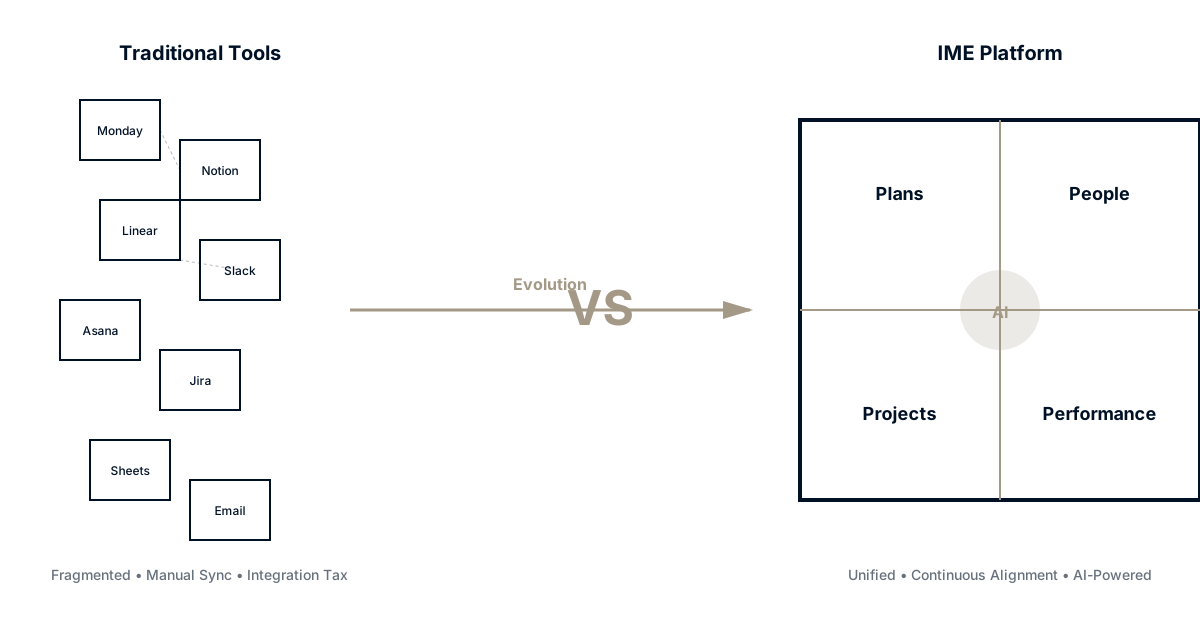
Monday.com for project management. Notion for documentation. Linear for development tickets. Slack for communication. Asana for marketing campaigns. Google Sheets for metrics. Jira for engineering. Email for everything that doesn't fit. That's 8 different tools, $2,300 per month, and 2.5 hours per day per person hunting for context.
This is how modern businesses run. Not by choice, but by accumulation. One team adopts Monday, another prefers Linear, marketing wants Asana, and suddenly you're paying for overlapping tools while information fragments across systems. Research from Asana shows that knowledge workers spend 60% of their time on "work about work" instead of actual skilled work.
An Integrated Management Experience (IME) takes a fundamentally different approach. Instead of stitching together specialized tools through brittle integrations, IME provides one architecturally unified platform where Plans, People, Projects, and Performance stay continuously aligned. Here's what that difference actually means in practice.
The Traditional Tools Approach: Best-of-Breed Becomes Worst-of-Integration
The "best-of-breed" software strategy sounds logical: choose the best tool for each specific job. Need project management? Monday's great. Need documentation? Notion's perfect. Need development workflow? Linear's the best.
The theory: Specialized tools excel at their specific function, so combining the best of each creates the optimal system.
The reality: Integration hell, context fragmentation, and constant manual alignment work.
What Traditional Tools Do Well
Let's be fair: specialized tools became specialized for good reasons.
Monday.com excels at visual project boards, custom workflows, and team collaboration on tasks. The flexibility is genuinely impressive - you can model almost any process.
Notion provides beautiful, flexible documentation with databases, wikis, and knowledge management. Perfect for building an internal knowledge base.
Linear offers the best development workflow for engineering teams - fast, keyboard-driven, excellent GitHub integration.
Slack dominates real-time communication with channels, threads, and extensive app ecosystem.
Each tool is legitimately excellent at its specific vertical. That's not the problem.
What Traditional Tools Can't Do
The problem emerges when these tools need to work together as a system. Because they were never designed as a system - they were designed as isolated products that might integrate later.
They can't maintain strategic alignment. Your strategy lives in a Notion doc. Your work lives in Monday boards. When strategy changes, Notion gets updated. Monday doesn't. Strategic drift is inevitable because nothing enforces continuous alignment between "what we decided" and "what we're building."
They can't connect people to strategy. Your org chart lives in BambooHR or LucidChart. Your strategic priorities live in Notion. Your project assignments live in Monday. When you ask "do we have the right people on our most strategic projects?" the answer requires manually cross-referencing three systems.
They can't measure strategic progress. Your KPIs live in Google Sheets or Looker. Your projects live in Monday. Your strategy lives in Notion. When leadership asks "are we on track for our strategic objectives?" you need to export data from multiple systems, manually correlate it, and hope your analysis is accurate.
They can't provide organizational context. Each tool knows its own data. Slack knows your conversations. Monday knows your tasks. Notion knows your docs. But none of them know your business - why decisions were made, how projects connect to strategy, what the historical context is for current initiatives.
This isn't a failure of the tools. It's a limitation of the architectural approach. Best-of-breed tools optimize for their vertical. IME optimizes for organizational coherence.
The IME Approach: Architectural Integration
An Integrated Management Experience starts with a different architectural assumption: Plans, People, Projects, and Performance are not separate systems that need integration - they're parts of one unified system that need coherent expression.
How IME Differs Architecturally
Traditional tools: Built vertically (project management, documentation, communication), then attempt horizontal integration through APIs, webhooks, and syncing.
IME: Built horizontally (organizational system), then provides vertical capabilities (planning, execution, measurement) as integrated expressions of that system.
Concrete example: In Monday + Notion + Linear:
- Strategy is a Notion document
- Projects are Monday boards that reference the strategy doc
- Development tasks are Linear issues that reference Monday boards
- Three separate databases, manually connected through URLs and integrations
In an IME like Commander:
- Strategy, projects, and development tasks are different views of the same organizational database
- Update strategy → projects automatically realign → tasks automatically reprioritize
- One database, one source of truth, continuous alignment built in
The Integration Tax
Every integration between traditional tools carries a maintenance burden:
API dependencies: When Linear's API changes, your Monday integration breaks. When Notion changes their data model, your custom scripts fail. You're dependent on multiple companies maintaining backward compatibility.
Synchronization lag: Data syncs run periodically (every 15 minutes, hourly, daily). During lag time, systems show different realities. Two team members looking at the same project in different tools see different status.
Field mapping complexity: Monday's "priority" field doesn't map cleanly to Linear's priority system. Notion's database properties don't align with Monday's custom fields. Every integration requires field mapping decisions that lose fidelity.
Authentication sprawl: 8 tools = 8 login systems, 8 permission models, 8 security configurations to maintain. When someone leaves, you need to revoke access in 8 places.
Context loss at boundaries: The reasoning behind a decision lives in Slack. The decision itself lives in Notion. The execution lives in Monday. The measurement lives in Google Sheets. The full context only exists in human memory.
IME eliminates the integration tax because there's nothing to integrate. It's one system from the ground up.
Want to experience continuous alignment without integration overhead? Commander is the first IME platform that unifies Plans, People, Projects, and Performance without requiring fragile integrations.
Real-World Comparison: 50-Person Product Team
Let's compare how a typical 50-person product team operates with traditional tools versus an IME.
Scenario: Strategic Pivot from Enterprise to Mid-Market
Traditional Tools Approach (Monday + Notion + Linear + Slack):
- Update Strategy (30 minutes): Product lead updates strategy doc in Notion explaining pivot to mid-market focus
- Communicate Change (1 hour): Write Slack message, schedule all-hands, explain context
- Reprioritize Monday (4 hours): Manually review 47 active projects, update priorities, reassign resources
- Update Linear (3 hours): Engineering manager reviews 180 active issues, re-tags priorities, closes irrelevant tickets
- Adjust Metrics (2 hours): Data team updates dashboards, changes KPIs from enterprise to mid-market indicators
- Update People (2 hours): HR updates job descriptions, realigns hiring priorities
- Document Everything (1.5 hours): Update Notion docs, project briefs, team wikis with new strategic context
Total time: 13.5 hours across multiple people Risk: Manual updates = missed tasks, inconsistent priorities, partial alignment Ongoing cost: Weekly realignment meetings to ensure tools stay synced
IME Approach (Commander):
- Update Strategy (30 minutes): Product lead updates strategic priority in Commander
- AI Cascade (automatic): Commander's AI identifies implications:
- 23 projects fully aligned with new strategy
- 15 projects partially aligned (suggested modifications)
- 9 projects misaligned (suggested pause/deprioritization)
- Review AI Suggestions (1 hour): Team reviews and approves AI recommendations
- Execute Changes (automatic): Commander updates project priorities, reassigns resources, adjusts KPIs, notifies affected team members
- Context Propagation (automatic): All team members see updated strategic context in their project views, AI remembers pivot for future recommendations
Total time: 1.5 hours Risk: AI ensures complete propagation, nothing falls through cracks Ongoing cost: Zero - alignment maintained automatically
Savings: 12 hours per strategic update, higher quality alignment, reduced cognitive load
When Traditional Tools Make Sense (And When They Don't)
Let's be honest about the trade-offs. IME isn't always the right answer.
Traditional tools make sense when:
- You're a 3-10 person team where human coordination still works
- Your business model is stable and strategy rarely changes
- One tool (like Notion) genuinely handles 80%+ of your needs
- Specialized vertical requirements outweigh integration pain (e.g., highly complex Jira workflows for compliance-heavy industries)
- Budget constraints prevent platform investments
IME makes sense when:
- You have 20+ people across multiple teams/functions
- Strategy evolves quarterly or more frequently
- You're using 5+ different business tools
- Leadership and execution teams struggle to stay aligned
- Onboarding takes 2+ months due to context sprawl
- You've tried integrations but they don't solve the fundamental problem
- Strategic planning feels like theater, not actual strategy
The inflection point is typically 15-25 people. Below that, human coordination scales. Above that, you need systematic coordination.
The Future: From Integration to Unification
The last two decades of business software followed the "best-of-breed plus integrations" model. Companies like Zapier built entire businesses connecting fragmented tools. The assumption was that specialization would always beat unification.
But AI changes the game entirely. Modern AI can understand organizational context in ways that simple data syncing never could. It can:
- Track strategic intent across changing conditions
- Identify misalignment between plans and execution
- Suggest realignment based on new priorities
- Learn from organizational history to improve recommendations
- Provide context that exists nowhere in your current systems
This is why IME emerges now, not five years ago. The technology to build truly unified, contextually intelligent business systems finally exists.
The companies that recognize this shift early will have a massive strategic advantage. Their strategy won't just be documented - it will drive execution automatically. Their teams won't just be busy - they'll be aligned. Their tools won't just integrate - they'll unify.
Read more about the hidden costs of tool fragmentation and discover how Commander implements true IME.
Experience Unified Management with Commander
Want to see unified management in action? Commander provides:
- One Platform - Replace Monday + Notion + Linear + dashboards with unified IME
- Continuous Alignment - Strategy changes propagate automatically to projects, people, and metrics
- AI Intelligence - OneAI maintains organizational context and suggests optimal alignment
- Zero Integration Tax - Architecturally unified, not stitched together through APIs
Get started and experience the difference between integrated tools and an Integrated Management Experience.
The difference between traditional tools and IME isn't incremental - it's architectural. One approach stitches together fragments. The other unifies from the ground up. Learn more about what makes IME fundamentally different and explore the Four Pillars framework that enables continuous alignment.
Part of our guide to all-in-one business platforms.
About the Author

Stuart Leo
Stuart Leo founded Waymaker to solve a problem he kept seeing: businesses losing critical knowledge as they grow. He wrote Resolute to help leaders navigate change, lead with purpose, and build indestructible organizations. When he's not building software, he's enjoying the sand, surf, and open spaces of Australia.