Every SaaS vendor promises integrations. "We connect with 500+ tools!" they advertise. What they don't mention: integrations have costs.
Significant costs.
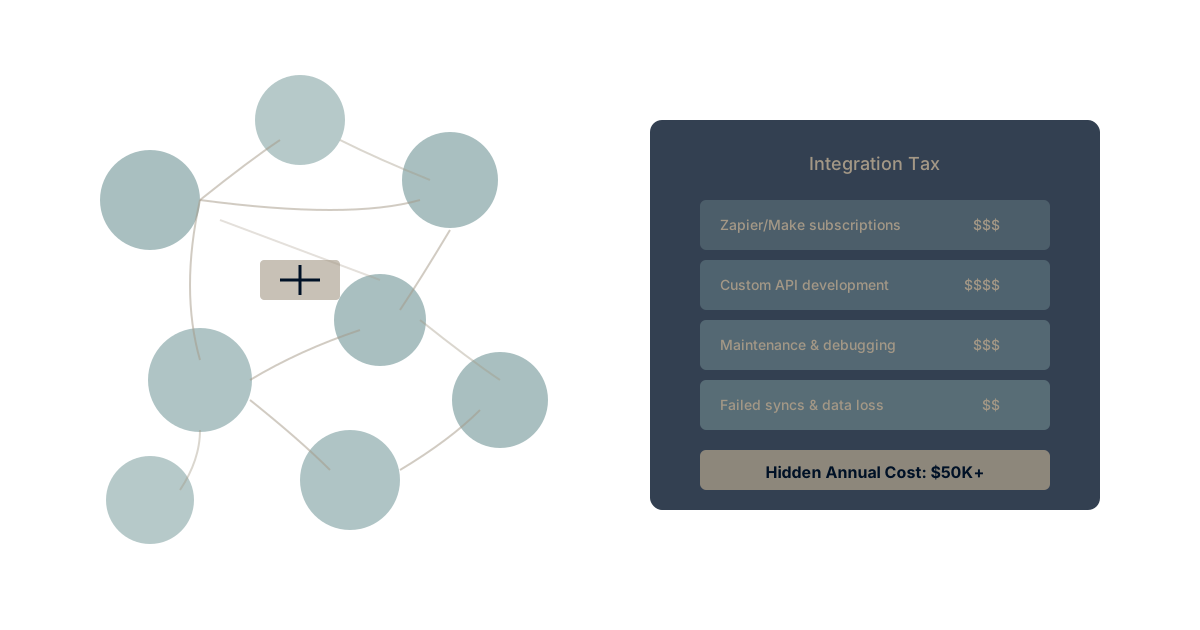
The integration tax is what organizations pay to make disconnected tools pretend to work together. It's measured in dollars, hours, and compromises—and it compounds as your tool count grows.
The Integration Landscape
How Organizations Get Here
The path is familiar:
- Marketing adopts HubSpot
- Engineering uses Jira
- Sales lives in Salesforce
- Customer success picks Zendesk
- Everyone uses Slack
- Projects tracked in Asana
- Documents in Google Drive or SharePoint
Each tool made sense when adopted. Now you have seven systems with crucial data that needs to flow between them.
Okta research shows the average company uses 89 apps. Enterprise companies exceed 200. Each connection point is an integration tax opportunity.
The Integration Promise
Tools promise seamless connection:
- "Native integration with Salesforce"
- "Zapier connects everything"
- "REST API for custom integrations"
- "Connect your entire stack"
The reality: These integrations come with costs, limitations, and maintenance requirements that marketing materials don't emphasize.
The Integration Tax Categories
Category 1: Direct Platform Costs
Integration platform fees:
Zapier:
- Free: 100 tasks/month, 5 zaps
- Starter ($19.99/mo): 750 tasks, 20 zaps
- Professional ($49/mo): 2,000 tasks, unlimited zaps
- Team ($69/mo): 2,000 tasks, unlimited zaps, collaboration
- Company: Custom pricing for high volume
Workato:
- Enterprise pricing, typically $10,000-50,000+ annually
Make (Integromat):
- Free: 1,000 operations/month
- Core ($9/mo): 10,000 operations
- Pro ($16/mo): 10,000 operations + advanced features
- Teams ($29/mo): Collaboration features
Tray.io:
- Enterprise pricing, typically $15,000-60,000+ annually
For a 100-person company with moderate integration needs, expect $500-5,000/month in integration platform fees alone—$6,000-60,000 annually.
Category 2: Implementation Costs
Someone has to build and configure integrations.
Time requirements per integration:
| Integration Type | Initial Setup | Testing | Documentation |
|---|---|---|---|
| Simple (pre-built) | 2-4 hours | 1-2 hours | 1 hour |
| Moderate (customized) | 8-20 hours | 4-8 hours | 2-4 hours |
| Complex (custom API) | 40-200 hours | 20-50 hours | 10-20 hours |
At $75/hour fully loaded cost:
- Simple integration: $250-500
- Moderate integration: $1,000-2,500
- Complex integration: $5,000-20,000
With 20-30 integrations (common for companies with 50+ tools), initial implementation easily reaches $50,000-150,000.
Category 3: Maintenance Burden
Integrations break. Constantly.
Why integrations fail:
- API changes by either connected tool
- Authentication token expiration
- Field mapping changes
- Rate limiting exceeded
- Service outages on either end
- Edge cases not handled
Maintenance reality:
Gartner estimates integration maintenance consumes 30% of IT's time in tool-heavy organizations.
Time per integration annually:
- Simple integrations: 5-10 hours
- Moderate integrations: 20-40 hours
- Complex integrations: 50-100 hours
For 25 integrations with moderate complexity: 500-1,000 hours annually = $37,500-75,000 in maintenance cost.
Category 4: Failure Costs
When integrations break, work breaks.
Direct failure costs:
- Data not synced, decisions made on stale information
- Automation stopped, manual work required
- Duplicates created, cleanup required
- Missing data discovered, reconstruction needed
Indirect failure costs:
- Lost customer trust from communication gaps
- Missed opportunities from delayed data
- Compliance issues from data inconsistencies
- Team frustration and workarounds
Quantifying these precisely is difficult, but they're not zero—and they compound with integration complexity.
Category 5: Capability Limitations
Integrations sync data. They don't provide understanding.
What integrations can do:
- Move data between systems
- Trigger actions based on events
- Transform fields between formats
What integrations can't do:
- Understand context across systems
- Enable AI with organizational memory
- Create unified user experience
- Maintain relationship understanding
You can integrate Salesforce with HubSpot with Asana with Slack. You can't create a coherent understanding of customer relationships, project context, and communication history through integration alone.
This is the context engineering problem. Integration moves data. It doesn't create organizational intelligence.
The Total Integration Tax Calculation
Sample Calculation: 100-Person Company
| Category | Annual Cost | Notes |
|---|---|---|
| Integration platforms | $24,000 | Zapier Pro for multiple users |
| Implementation (year 1) | $75,000 | 25 moderate integrations |
| Implementation (ongoing) | $15,000 | New integrations, updates |
| Maintenance | $50,000 | 0.5 FTE dedicated |
| Failure costs | $25,000 | Conservative estimate |
| Total Annual Tax | $189,000 | |
| Per employee/month | $158 |
This doesn't include the opportunity cost of capability limitations—what you can't do because integration doesn't enable real intelligence.
Scaling Reality
Integration tax scales non-linearly with tool count:
- 10 tools: Maybe 15-20 integrations needed
- 25 tools: 50-75 integrations needed
- 50 tools: 150-250 integrations needed
Each additional tool doesn't add one integration—it potentially needs connections to multiple existing tools. Complexity compounds.
The Alternative: Consolidation
The Math of Fewer Tools
Tool consolidation addresses integration tax directly:
Fewer tools = fewer integrations = lower tax
Reducing from 50 tools to 25 doesn't halve integration needs—it might reduce them by 75% because the remaining tools need far fewer connections.
Platform vs. Point Solution
Point solution approach:
- Best-of-breed tool for each function
- Integration required between all of them
- High flexibility, high integration tax
Platform approach:
- Integrated system covering multiple functions
- Built-in connections, no integration tax
- Some feature compromise, much lower overhead
The trend is toward platforms because context switching costs and integration tax make point solution portfolios unsustainably expensive.
The AI Readiness Factor
Integration tax has a strategic dimension: AI effectiveness.
Fragmented tools + integrations: Each AI works in its silo. No unified understanding.
Consolidated platforms: AI can understand the complete picture. Organizational intelligence possible.
Every year paying integration tax on fragmented tools is a year not building AI capability on unified data.
Reducing the Integration Tax
Strategy 1: Audit and Prioritize
Questions to ask:
- Which integrations are critical vs. nice-to-have?
- Which integrations cause the most problems?
- What data actually needs to flow between tools?
- Can some tools be eliminated entirely?
Reduce the integration count and complexity before optimizing individual integrations.
Strategy 2: Simplify Architectures
Principles:
- One-way data flows where possible (easier than bidirectional)
- Fewer data transformation requirements
- Standardized naming and formatting across tools
- Clear ownership for each integration
Complexity reduction in architecture reduces ongoing costs.
Strategy 3: Invest in Monitoring
Detection beats reaction:
- Automated monitoring for integration health
- Alerts before complete failures
- Regular audits of data consistency
- Clear escalation paths for issues
Problems caught early cost less than problems discovered late.
Strategy 4: Evaluate Consolidation
The honest question:
Would the cost of platform transition be less than ongoing integration tax?
If annual integration tax exceeds $100,000 and consolidation could eliminate 60% of it, the ROI math may favor transition—even with migration costs.
Experience Integration-Free Work
Want to see what work looks like when tools don't need constant integration? Waymaker Commander brings projects, documents, and strategy together in one platform—with AI that understands the connections because they're built in, not bolted on.
The result: Zero integration tax on core work management. Context preserved because it's never separated.
Register for the beta and experience the difference between integrated tools and unified platforms.
The integration tax is the hidden cost of tool sprawl. Every connection between disconnected tools costs money, time, and capability. Integration platforms, implementation, maintenance, and failure costs compound—often exceeding $100,000 annually for mid-size companies. The solution isn't better integration; it's fewer tools that need integration. Platform consolidation eliminates the tax at its source. Learn more about our Context Compass framework and explore how platform consolidation escapes the integration trap.
The Waymaker Editorial team researches enterprise technology costs. This TCO analysis synthesizes integration platform data, implementation research, and cost analysis across organizations.
Part of our guide to all-in-one business platforms.
About the Author

Waymaker Editorial
Stuart Leo founded Waymaker to solve a problem he kept seeing: businesses losing critical knowledge as they grow. He wrote Resolute to help leaders navigate change, lead with purpose, and build indestructible organizations. When he's not building software, he's enjoying the sand, surf, and open spaces of Australia.