Your customer success manager knows everything about your top 20 accounts. The history, the preferences, the personalities, the unwritten rules of engagement. It's invaluable knowledge.
It's also trapped in her head.
When she goes on vacation, questions go unanswered. When she leaves the company, that knowledge leaves with her. Years of accumulated insight—the kind that keeps customers happy and retention high—vanishes because it was never captured anywhere accessible.
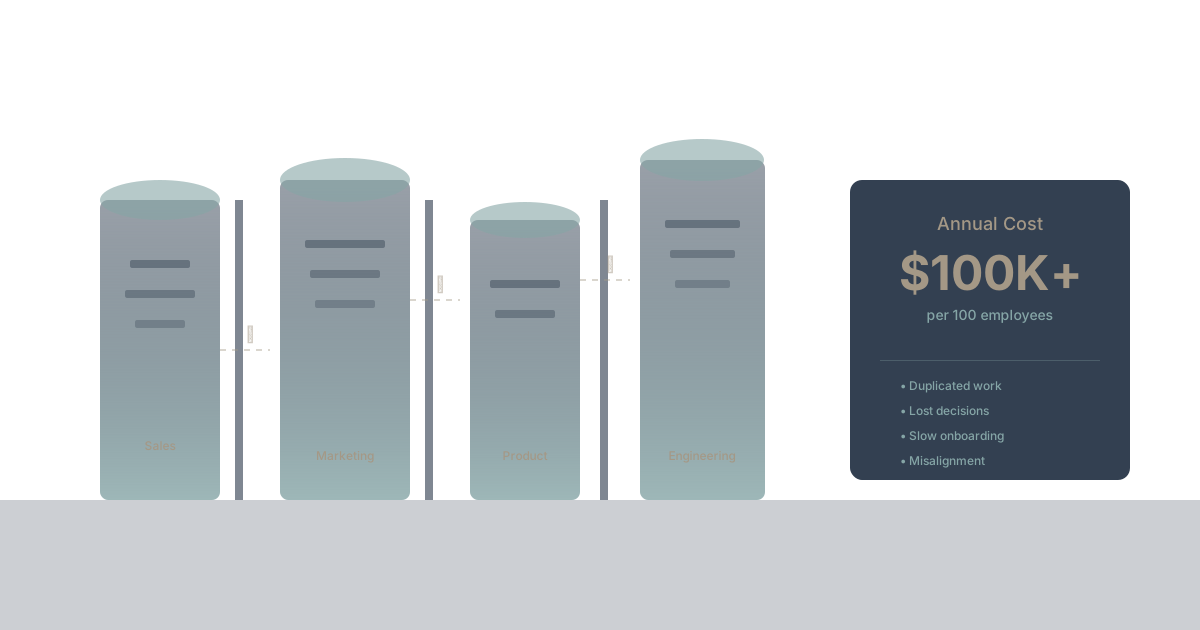
This is the knowledge silo problem. And according to IDC research, it costs organizations an average of $100,000 per 100 employees annually in lost productivity alone—before counting the strategic cost of decisions made without complete information.
The Three Types of Knowledge Silos
Type 1: Tool Silos
Definition: Information trapped in individual applications that don't share context.
Customer relationship data lives in Salesforce. Support conversations live in Zendesk. Product feedback lives in Productboard. Usage data lives in Amplitude. Financial data lives in NetSuite.
Each tool becomes a silo containing one perspective on your business. No single system holds the complete picture.
The cost: To answer the question "How is our enterprise segment performing?" requires pulling data from 5+ systems, manually synthesizing, and hoping nothing was missed. Strategic questions become research projects.
The acceleration problem: Each new tool added to the tool sprawl creates another silo. The more "best of breed" tools you adopt, the more fragmented your organizational knowledge becomes.
Type 2: Department Silos
Definition: Knowledge that stays within teams and doesn't flow across organizational boundaries.
Engineering knows about the technical debt that will affect next quarter's roadmap. Sales knows about the competitive threats emerging in the market. Customer success knows about the feature gaps causing churn. Finance knows about the unit economics that constrain strategic options.
Each department has crucial context. None of it flows naturally to where it's needed.
The cost: Decisions get made with partial information. Engineering builds features sales can't sell. Marketing messages capabilities support can't deliver. Strategy sets goals finance knows are unprofitable.
The meeting tax: Organizations create meetings to bridge silos—weekly syncs, monthly reviews, quarterly planning sessions. Research from Atlassian shows employees attend 62 meetings per month, many existing solely to share information that should flow automatically.
Type 3: Individual Silos
Definition: Knowledge trapped in individual people's heads, notebooks, and personal systems.
The senior developer who knows why that architectural decision was made three years ago. The operations manager who knows the workarounds that keep the system running. The executive assistant who knows every stakeholder's preferences and communication styles.
This is tribal knowledge—essential information that exists only in human memory.
The cost: When people leave, knowledge leaves. When people are unavailable, decisions wait. When people forget, organizations forget.
McKinsey research found that the average employee spends 19% of their workweek searching for and gathering information. Much of that time goes to hunting down the person who "might know" the answer.
Why Knowledge Silos Persist
The Tool Selection Problem
When organizations select tools, they optimize for feature sets and department needs. Marketing evaluates marketing tools. Engineering evaluates engineering tools. Each team picks what works best for their specific workflows.
Nobody's job is to optimize for organizational knowledge flow.
The result: A portfolio of excellent individual tools that don't communicate. Each tool excels at its function while fragmenting the organization's collective intelligence.
The Documentation Paradox
Organizations recognize they should document knowledge. They invest in wikis, knowledge bases, and documentation systems.
The paradox: Documentation takes time. The people with the most valuable knowledge are often the busiest people. The knowledge that most needs documenting is often the tacit knowledge hardest to articulate.
Documentation efforts launch with enthusiasm and die through neglect. The wiki becomes a graveyard of outdated information that nobody trusts.
Research from Guru found that 65% of documentation becomes outdated within weeks of creation, and employees spend an average of 5.3 hours weekly hunting for information that turns out to be wrong.
The Incentive Misalignment
Individual contributors are measured on their individual output. They have no incentive to spend time capturing knowledge for organizational benefit. In fact, hoarding knowledge can create job security—the person who "knows everything" becomes indispensable.
The result: Even with documentation systems available, knowledge doesn't flow. The systems exist; the motivation to use them doesn't.
The Compounding Cost
The Visible Costs
Duplicated effort: Multiple people solving the same problems because nobody knows the solution already exists.
Slower decisions: Questions that could be answered in minutes take days of investigation.
Rework: Work done incorrectly because relevant context wasn't available.
Meeting overhead: Time spent in meetings sharing information that should be systematically accessible.
The Hidden Costs
Strategic mistakes: Decisions made without complete context that later prove costly.
Lost opportunities: Insights that never surface because the relevant data is siloed.
Customer impact: Inconsistent service because customer context isn't shared across touchpoints.
Talent drain: Knowledge workers frustrated by information dysfunction who leave for better environments.
The Turnover Amplifier
SHRM research shows that median employee tenure is 4.1 years. In technology companies, it's often less.
Each departure takes knowledge with it. In siloed organizations, that knowledge isn't just "somewhere else"—it's gone entirely.
The calculation: If a departing employee takes $50,000 worth of undocumented knowledge (research, context, relationships), and you have 20% annual turnover, you're losing $10,000 per employee per year in knowledge destruction.
For a 100-person company: $1 million annually in knowledge walking out the door.
The AI Readiness Crisis
Here's why knowledge silos are urgent in 2026: AI effectiveness depends on unified data.
Context engineering enables AI to understand organizational context—your projects, decisions, customers, history. But AI can only work with data it can access.
Siloed knowledge means siloed AI. Each tool's AI can only see its own silo. Your marketing AI doesn't know what sales AI knows. Your support AI doesn't know what engineering AI knows.
The gap: Organizations with unified knowledge will deploy AI that understands the complete picture. Organizations with siloed knowledge will have AI that's as fragmented as their data.
Every month spent in siloed architecture is a month of compounding AI disadvantage.
Breaking Down the Silos
Strategy 1: Tool Consolidation
Fewer tools means fewer silos. Platform approaches that unify work management, documentation, and communication naturally break down tool silos.
The principle: Every tool you eliminate is a silo you eliminate. Every integration you build partially bridges silos but adds maintenance overhead.
The radical option: Replace the portfolio of point solutions with platforms designed for unity. Harder to switch but fundamentally changes the architecture of organizational knowledge.
Strategy 2: Context Engineering
Build systems that capture and preserve context automatically, not through manual documentation effort.
Working memory: Automatic capture of current context from communication and work tools.
Episodic memory: Systematic recording of decisions, discussions, and outcomes.
Semantic memory: Structured knowledge about your domain, products, and processes.
Procedural memory: Documented how-to knowledge for organizational processes.
The Context Compass framework provides this architecture—not as a documentation project but as an automated system for organizational memory.
Strategy 3: Cultural Intervention
Change the incentives and expectations around knowledge sharing.
Make documentation a KPI: If it's measured, it gets done.
Celebrate knowledge sharing: Recognition for those who capture and share effectively.
Penalize hoarding: Knowledge that helps only the individual while harming the organization should be addressed.
Build it into workflows: The best documentation happens automatically, embedded in work processes rather than as a separate task.
Strategy 4: AI-Augmented Capture
Use AI to reduce the friction of knowledge capture.
Meeting transcription and summarization: Automatically extract decisions and action items from conversations.
Email analysis: Surface important commitments and information from email threads.
Pattern recognition: Identify recurring questions that indicate documentation gaps.
Synthesis: Combine information across silos to surface insights no single silo contains.
This is where AI with organizational memory becomes transformative—not just answering questions but actively preventing knowledge from becoming siloed.
The Path Forward
Immediate Actions
Audit your silos: Map where critical knowledge lives. Which tools contain which data? Which people hold which expertise?
Identify high-value knowledge: Not all knowledge needs systematic capture. Focus on knowledge that's frequently needed, hard to recreate, or at risk of being lost.
Calculate the cost: Make the invisible visible. What does your organization spend searching for information? What decisions get delayed? What knowledge has walked out the door?
Strategic Decisions
Platform vs. point solution: Each new tool selection is a chance to either add silos or reduce them.
Build knowledge flow into processes: Don't rely on after-the-fact documentation. Embed capture into how work happens.
Invest in unification: The cost of breaking down silos is real. So is the cost of maintaining them. Choose consciously.
Experience Unified Knowledge
Want to see what work looks like when knowledge flows instead of siloing? Waymaker Commander brings projects, documents, decisions, and context together in one platform—with AI that understands connections across all your work.
The result: Questions answered in seconds, not days. Context preserved across projects. Knowledge that stays when people go.
Register for the beta and experience the difference between siloed tools and unified organizational memory.
Knowledge silos cost $100,000 per 100 employees annually—and that's just the measurable part. The strategic cost of decisions made without complete context, the human cost of information dysfunction, the competitive cost of fragmented AI—these amplify the problem. Breaking down silos isn't just operational improvement; it's strategic necessity. Learn more about our Context Compass framework and explore how context engineering creates unified organizational intelligence.
Stuart Leo has diagnosed knowledge silo problems in 500+ organizations. He's the author of Resolute and founder of Waymaker, designed for teams ready to break the silo cycle.
About the Author

Stuart Leo
Stuart Leo founded Waymaker to solve a problem he kept seeing: businesses losing critical knowledge as they grow. He wrote Resolute to help leaders navigate change, lead with purpose, and build indestructible organizations. When he's not building software, he's enjoying the sand, surf, and open spaces of Australia.