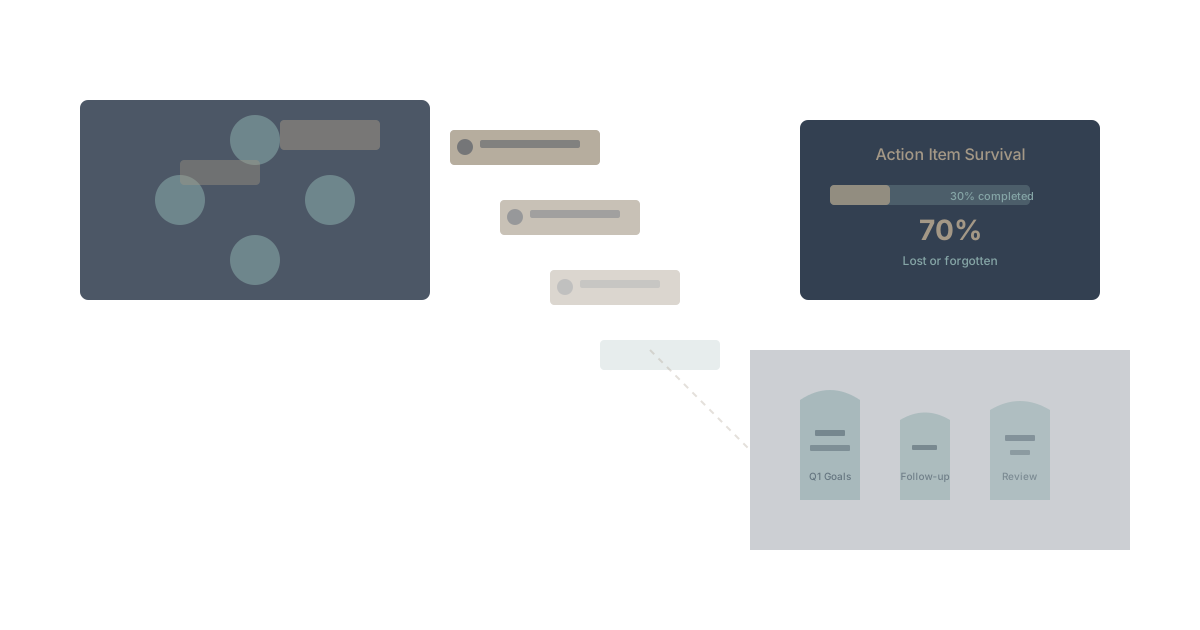
The meeting was productive. Decisions were made. Action items were assigned. Someone even took notes.
Two weeks later, nobody can find them.
This pattern repeats across organizations constantly. Meetings happen, outcomes emerge, and then those outcomes vanish into the action item graveyard—lost in email threads, buried in documents, scattered across tools.
The Graveyard Grows Daily
The Numbers
According to Atlassian research, professionals attend 62 meetings per month. That's approximately 15 meetings per week generating decisions, action items, and context.
Where do those outcomes go?
- Some in email threads (buried by Friday)
- Some in shared documents (unfindable by next week)
- Some in project management tools (if someone remembers to create tasks)
- Some in personal notes (leaving with the note-taker)
- Most nowhere (never captured at all)
The Cost
Research from Harvard Business Review shows knowledge workers spend significant time recreating decisions that were already made. The action item graveyard is a primary contributor.
Direct costs:
- Time re-making decisions
- Work duplicated because actions weren't tracked
- Delayed projects waiting for forgotten commitments
- Accountability impossible without records
Strategic costs:
- Organizational learning doesn't accumulate
- Patterns aren't recognized because data isn't connected
- Improvement is harder when history is lost
- Business amnesia compounds
How Outcomes Die
Path 1: The Email Burial
Meeting ends. Notes go to attendees via email. Reply-all discussion adds context. Replies get nested. Thread gets long.
One week later: Important decision buried 47 messages down in a thread nobody will reopen.
Two weeks later: Someone asks "What did we decide about X?" Search returns the email... and 50 others mentioning X.
One month later: The thread is effectively gone. Decision must be re-made.
Path 2: The Document Wasteland
Notes written in Google Docs or Word. Document shared with attendees. Document lives in... some folder.
What happens:
- Nobody remembers folder location
- Document title wasn't descriptive enough
- Search returns similar documents from other meetings
- Correct document found but outdated by subsequent discussions
This is Google Drive's knowledge graveyard at the meeting level—information technically exists but practically disappears.
Path 3: The Task Tool Gap
Someone creates tasks in Asana/Monday/ClickUp from action items. Progress?
What goes wrong:
- Only some action items become tasks
- Context about why doesn't transfer
- Decision rationale not captured
- Connection to meeting lost
- Original notes and tasks in different systems
The tool sprawl problem means meeting context and follow-up actions live in separate systems that don't naturally connect.
Path 4: The Personal Note Trap
Diligent attendee takes detailed personal notes. Best record of the meeting.
The problem:
- Notes are personal, not organizational
- Other attendees can't access
- If note-taker leaves, notes leave
- Organizational memory depends on individual memory
Path 5: The Never Captured
Most meeting outcomes never get written down at all.
The pattern:
- Meeting discussions feel clear in the moment
- Everyone assumes shared understanding
- No one explicitly captures decisions
- Understanding diverges immediately after meeting ends
Why This Keeps Happening
Structural Issues
Meeting tools don't connect to work tools: Zoom, Teams, and Meet handle meetings. Asana, Monday, and ClickUp handle tasks. Google Docs and Notion handle documentation. These are different systems with different data.
No single owner of meeting outcomes: Everyone attended, so everyone assumes someone else is handling capture. Nobody does.
Capture is extra work: After an hour-long meeting, nobody wants to spend 20 minutes documenting it. The easier path (not documenting) wins.
Cultural Issues
Meeting quantity over quality: Organizations schedule more meetings rather than better meetings with better outcomes.
Documentation isn't valued: Cultures reward action over documentation, even when documentation enables better action.
Accountability gaps: Without clear records, accountability is impossible to maintain.
Tool Issues
Meeting AI helps but doesn't solve: Transcription services and AI summaries are better than nothing but still produce documents that live outside work context.
Notes and tasks are separate: Even when captured, meeting notes and resulting tasks exist in different systems.
No memory layer: No system maintains the connection between decisions, context, and outcomes over time.
What Would Actually Work
The Three Requirements
1. Capture at the moment: Decisions and actions captured during meetings, not after.
2. Connected to context: Meeting outcomes linked to projects, goals, and prior decisions—not isolated documents.
3. Actionable and trackable: Actions become real tasks with clear ownership, not lines in a document.
Meeting Architecture That Works
Before: Meeting agenda connected to relevant projects and prior decisions.
During: Live capture of decisions and actions within work context.
After: Actions automatically become tracked tasks. Decisions become part of organizational memory.
Ongoing: AI that can answer "What did we decide about X?" because decisions are systematically captured and connected.
This requires context engineering—building systems where organizational context flows naturally rather than requiring constant manual transfer.
Practical Improvements
Quick Wins
Designated capture role: Every meeting has one person explicitly responsible for capturing outcomes. Rotate responsibility.
Two-minute close: Last two minutes of every meeting dedicated to explicitly stating decisions made and actions assigned.
Same-day transfer: Meeting actions transferred to task system same day, while context is fresh.
Decision log: Separate log for decisions (not just tasks) that accumulates over time.
Better Tools
Integrated meeting capture: Tools that combine meeting notes and task creation in one workflow.
AI assistance: AI that summarizes meetings and suggests action items (with human verification).
Connected systems: Platforms where meetings, projects, and tasks exist together.
Cultural Shifts
Value documentation: Recognize that capture work creates organizational value.
Reduce meeting quantity: Fewer, better-run meetings produce better outcomes than many careless ones.
Explicit decision-making: Make decisions explicit in meetings rather than assumed.
The Organizational Memory Connection
The action item graveyard is a symptom of a larger problem: organizations lack persistent memory systems.
What memory requires:
- Working memory: Current context—what's happening now
- Episodic memory: Historical context—what happened before
- Semantic memory: Structural knowledge—how things work
- Procedural memory: Process knowledge—how to do things
Meetings generate all four types of knowledge. Without systems to capture and connect that knowledge, it's lost immediately.
The Context Compass framework addresses this systematically—building organizational memory that persists across meetings, projects, and time.
Experience Meetings That Stick
Want to see what happens when meeting outcomes don't disappear? Waymaker Commander connects meeting decisions to projects and goals—so outcomes become part of work context, not lost documents.
The result: Decisions findable. Actions tracked. Context preserved. No more re-making decisions because nobody remembers what was decided.
Register for the beta and experience the difference between meeting notes that vanish and outcomes that persist.
The action item graveyard costs organizations time, alignment, and learning. Meetings happen, outcomes vanish, decisions get re-made. The problem isn't meeting quality—it's the gap between meeting outcomes and work systems. Solving this requires integrated platforms where meeting context lives with project context, not separate tools that fragment organizational knowledge. Learn more about our Context Compass framework and explore how context engineering preserves meeting outcomes.
The Waymaker Editorial team researches organizational productivity. This analysis synthesizes meeting research, productivity data, and common patterns in organizations struggling with meeting outcome capture.
About the Author

Waymaker Editorial
Stuart Leo founded Waymaker to solve a problem he kept seeing: businesses losing critical knowledge as they grow. He wrote Resolute to help leaders navigate change, lead with purpose, and build indestructible organizations. When he's not building software, he's enjoying the sand, surf, and open spaces of Australia.