Monday.com is one of the most popular work management platforms on the market. Beautiful boards. Flexible workflows. Impressive growth. So why are teams increasingly looking for alternatives?
After analyzing hundreds of team productivity stacks, the answer is consistent: Monday.com is great at project management, but project management is only part of the problem.
Why Teams Leave Monday.com
1. Pricing Complexity
Monday.com's pricing looks straightforward until you dig in:
| Plan | Per Seat/Month | Minimum Seats | Real Monthly Cost |
|---|---|---|---|
| Basic | $9 | 3 | $27 minimum |
| Standard | $12 | 3 | $36 minimum |
| Pro | $19 | 3 | $57 minimum |
| Enterprise | Custom | 3+ | $$$$ |
The catch: Most useful features require Pro or Enterprise. Time tracking? Pro. Workload management? Pro. Advanced integrations? Enterprise.
For a 50-person team on Pro: $950/month or $11,400/year just for project management.
And Monday.com doesn't include email, calendar, documents, chat, goals, or CRM. You still need those separately.
2. It's a Project Tool, Not a Platform
Monday.com does project management well. But modern teams need more than project management:
What Monday.com provides:
- Task boards and timelines
- Basic automations
- Dashboards and reporting
- File attachments
What Monday.com doesn't provide:
- Email (you still need Gmail/Outlook)
- Calendar (you still need Google/Outlook Calendar)
- Team chat (you still need Slack/Teams)
- Documentation (you still need Notion/Confluence)
- Goals/OKRs (you still need Lattice/15Five)
- CRM (you still need HubSpot/Salesforce)
The result? Monday.com becomes another tool in your already-crowded stack—not the unified solution that eliminates stack complexity.
3. Views ≠ Strategy
Monday.com offers dozens of views: Kanban, Gantt, Calendar, Timeline, Workload. The flexibility is impressive. But more views don't equal better strategy.
As I wrote in Resolute: "Questions are more valuable than answers." The best productivity systems don't just show you tasks differently—they help you ask better questions about why you're doing those tasks in the first place.
Monday.com excels at what and when. It struggles with why.
Where are your OKRs? Your strategic priorities? Your quarterly goals? Those live somewhere else—creating a disconnect between daily tasks and organizational strategy.
4. Integration Overhead
To make Monday.com work in a modern stack, you need integrations:
- Monday + Gmail (email tasks)
- Monday + Slack (notifications)
- Monday + Google Calendar (deadlines)
- Monday + Salesforce (deals to projects)
- Monday + Notion (documentation links)
Each integration is another failure point. Another sync delay. Another thing to maintain.
Teams report spending 5-10 hours/month just maintaining Monday.com integrations—time that could be spent on actual work.
What Teams Actually Need
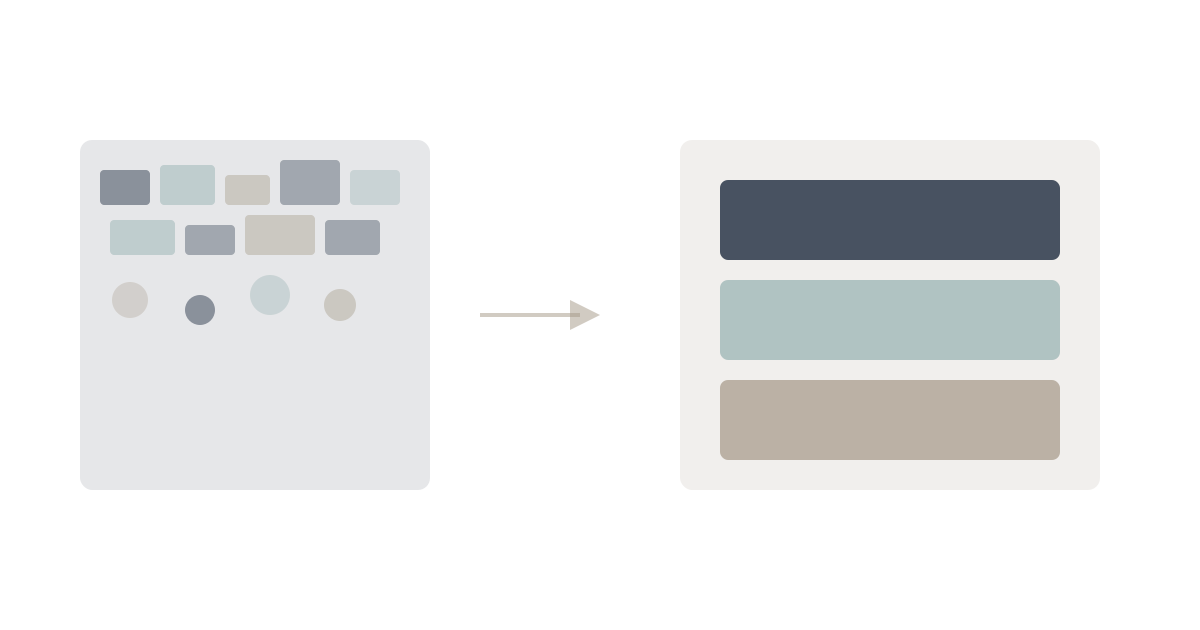
The teams leaving Monday.com aren't looking for another project management tool. They're looking for a unified productivity platform that eliminates the need for a fragmented stack.
The Modern Productivity Requirements
| Capability | Fragmented Stack | Unified Platform |
|---|---|---|
| Gmail | Built-in | |
| Calendar | Google Calendar | Built-in |
| Chat | Slack | Built-in |
| Tasks | Monday.com | Built-in |
| Documents | Notion | Built-in |
| Goals/OKRs | 15Five | Built-in |
| Video | Zoom | Built-in |
5-7 tools → 1 platform
The cost savings are obvious. But the productivity gains are even bigger—no context switching, no sync delays, no integration maintenance.
Top Monday.com Alternatives (2026)
For Teams Wanting Similar but Cheaper
Asana
- Comparable features at lower price points
- Better native timeline views
- Still requires separate email, chat, docs
- Starting at $10.99/user/month
ClickUp
- More features at lower price
- Steeper learning curve
- "Everything app" approach (not fully unified)
- Starting at $7/user/month
For Teams Wanting True Integration
Microsoft 365
- Includes email, calendar, Teams, documents
- Requires add-ons for project management (Planner is basic)
- Best for Microsoft-committed organizations
- $12.50-22/user/month
WaymakerOS
- Email, calendar, chat, tasks, docs, goals in one platform
- AI that understands organizational context
- Strategic framework integration (OKRs, Leadership Curve)
- Designed for mid-market teams
- Single price, all features
Comparison Matrix
| Feature | Monday.com | Asana | ClickUp | WaymakerOS |
|---|---|---|---|---|
| Task Boards | Excellent | Excellent | Excellent | Excellent |
| No | No | No | Yes | |
| Calendar | Basic | Basic | Basic | Yes |
| Team Chat | No | No | No | Yes |
| Documents | Basic | Basic | Yes | Yes |
| OKRs | Add-on | No | Yes | Yes |
| AI Context | Limited | Limited | Limited | Full |
| Price (50 users) | $950/mo | $550/mo | $350/mo | $1,000/mo |
| Total stack cost | $3,700/mo | $3,300/mo | $3,100/mo | $1,000/mo |
The platform that includes email, chat, and documents might look more expensive in isolation—but it eliminates thousands in other subscriptions.
Making the Switch: What to Consider
Migration Checklist
Before switching from Monday.com:
-
Export your data
- Board structures and templates
- Active project data
- Automations and workflows
- Custom fields and labels
-
Audit your integrations
- Which integrations are critical?
- What can be eliminated with a unified platform?
- What needs custom migration support?
-
Calculate true costs
- Current Monday.com subscription
- All complementary tools
- Integration/maintenance overhead
- Context switching time
-
Define success criteria
- What problems must the new solution solve?
- What features are non-negotiable?
- What timeline for migration?
Common Migration Patterns
Pattern 1: Like-for-Like Switch from Monday.com to Asana or ClickUp. Similar workflow, similar limitations, potentially cheaper.
Pattern 2: Platform Consolidation Switch from Monday.com + multiple tools to a unified platform. Bigger change, bigger payoff.
Pattern 3: Hybrid Keep Monday.com for specific use cases, add a unified platform for the rest. Transitional approach.
The Strategic Question
The real question isn't "What's the best Monday.com alternative?"
It's: "Do we want to keep managing a fragmented tool stack, or do we want to consolidate onto a platform that eliminates the fragmentation problem entirely?"
Monday.com is excellent at what it does. But what it does is project management—which is only one piece of organizational productivity.
The teams winning in 2026 aren't optimizing their project management tool. They're eliminating the need for separate project management tools by choosing platforms that include everything.
Ready to compare options? See our full comparison of ClickUp vs Monday vs Asana vs WaymakerOS or explore what unified productivity really means.
About the Author

Stuart Leo
Stuart Leo founded Waymaker to solve a problem he kept seeing: businesses losing critical knowledge as they grow. He wrote Resolute to help leaders navigate change, lead with purpose, and build indestructible organizations. When he's not building software, he's enjoying the sand, surf, and open spaces of Australia.