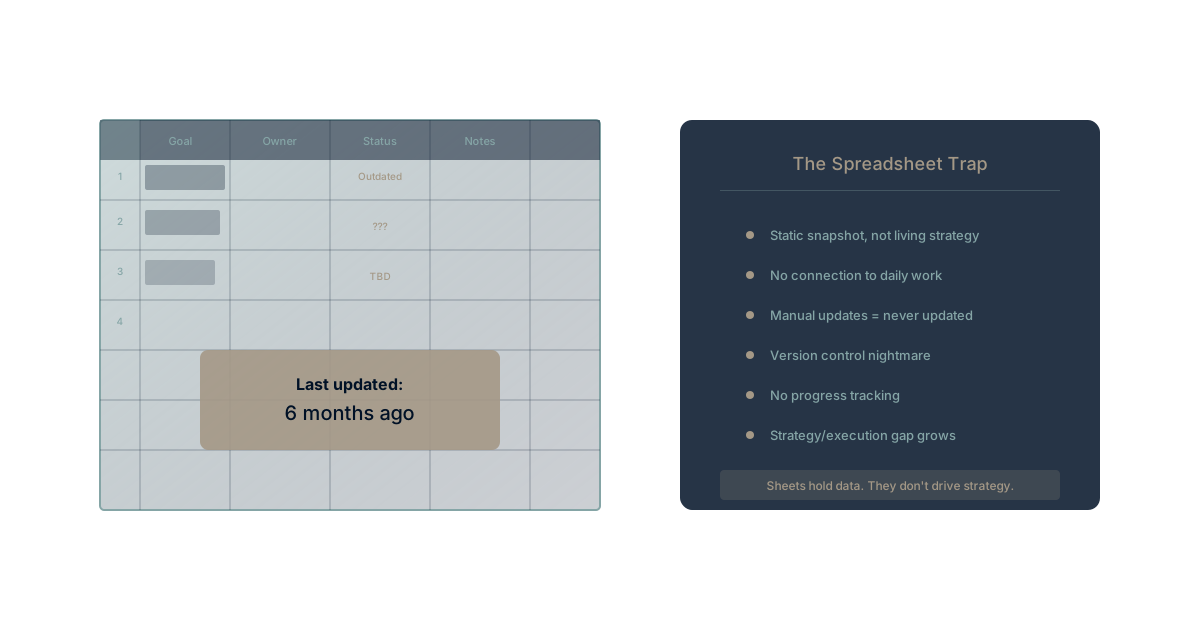
The strategic planning session ended. Priorities were clear. Goals were set. The plan was captured in... a Google Sheet.
Of course it was.
Spreadsheets are where strategic plans go to become lists of disconnected cells.
Google Sheets (and Excel) are remarkable tools for numerical analysis. They're terrible tools for strategic planning. Yet most organizations use them anyway, because they're familiar, available, and seem good enough.
They're not.
Why Spreadsheets Capture Strategy
The Familiarity Trap
Everyone knows spreadsheets. No training required. No new tool to learn. No procurement process.
The appeal:
- Available immediately
- Team can collaborate
- Familiar interface
- Feels flexible
- No additional cost
The reality: Familiarity doesn't equal fitness for purpose. Using a screwdriver as a hammer works—it's just not a good hammer.
The "Good Enough" Illusion
Strategy in a spreadsheet looks organized:
- Goals in column A
- Metrics in column B
- Owners in column C
- Status in column D
What's missing:
- Why these goals matter
- How they connect to each other
- The context behind each decision
- Learning from previous periods
- Connection to actual work
Spreadsheets capture strategy's skeleton. They miss its soul.
The Spreadsheet Strategy Problems
Problem 1: No Hierarchy, No Connection
Strategic planning is inherently hierarchical. Vision connects to mission connects to goals connects to initiatives connects to tasks.
Spreadsheets are flat. Rows are rows. You can indent text to imply hierarchy, but it's cosmetic. The structure doesn't understand relationships.
The consequence:
- Goals appear disconnected
- Initiatives don't obviously connect to what they serve
- The "why" behind each row is unstated
- Strategic coherence is invisible
Problem 2: Context Lives Elsewhere
Spreadsheet cells hold data. They don't hold context.
What a cell contains: "Launch product X by Q2"
What it doesn't contain:
- Why Q2 specifically?
- What decisions shaped this timeline?
- What dependencies affect it?
- What's the history of this initiative?
- What happens if we miss it?
Context about strategic items lives in emails, meeting notes, documents—anywhere but the spreadsheet containing the strategy.
This is business amnesia built into the planning process.
Problem 3: Version Chaos
Strategic plans evolve. Priorities shift. Timelines adjust. Goals change.
What happens in spreadsheets:
- "Strategic Plan v3 FINAL"
- "Strategic Plan v3 FINAL (updated)"
- "Strategic Plan Q2 revision"
- "Strategic Plan - use this one"
Which version is current? What changed between versions? Why did it change?
Google Drive's knowledge graveyard problem applied to your most important document.
Problem 4: No Connection to Execution
Strategy spreadsheets exist. Task management systems exist. The connection between them?
Manual. Fragile. Usually broken.
The pattern:
- Strategic plan created in spreadsheet
- Projects created in project management tool
- Someone manually maps between them (once)
- Reality diverges from both documents
- Nobody knows what's on track
The tool sprawl problem at its most strategic level—your highest-level planning disconnected from your execution systems.
Problem 5: Static in a Dynamic World
Spreadsheets are documents. You update them manually or they stay the same.
Strategic planning needs:
- Real-time progress visibility
- Automatic aggregation from execution data
- Alerts when things go off track
- Dynamic views of different audiences
Spreadsheets provide:
- Whatever someone last typed
- Manual status updates (when someone remembers)
- No aggregation
- One view for everyone
Problem 6: No Memory, No Learning
This year's strategic plan is a spreadsheet. Last year's? Also a spreadsheet somewhere.
What's lost:
- What worked last year?
- What didn't work and why?
- How did plans compare to outcomes?
- What patterns repeat across years?
Organizations make the same strategic mistakes repeatedly because spreadsheet-based planning has no institutional memory.
The Hidden Costs
Time Cost
Manual maintenance: Updating status, chasing owners, consolidating views—all manual in spreadsheets.
Search and reconciliation: Finding the right version, figuring out what changed, reconciling with execution systems.
Communication overhead: Spreadsheets don't communicate their contents. Someone must present, email, or explain them.
Quality Cost
Degrading accuracy: Manual data entry means errors. Infrequent updates mean staleness. Both compound.
Missing connections: Relationships between strategic items invisible, so disconnects don't surface until too late.
Context loss: Decisions made without understanding why things are in the plan.
Strategic Cost
Execution drift: Actual work drifts from strategic plan because connection is weak.
Misalignment persistence: Different interpretations of spreadsheet contents persist until crisis.
Learning failure: Same problems recur because organizational learning isn't captured.
What Strategic Planning Actually Needs
The Requirements
Hierarchy and connection: Strategy as a system, not a list. Goals connected to initiatives connected to execution.
Embedded context: Why decisions were made, what shaped priorities, how things relate.
Dynamic updates: Real-time visibility from execution data, not manual status entry.
Version intelligence: Understanding what changed and why, not just file version numbers.
Organizational memory: Learning from previous periods, patterns across time.
Tool Characteristics
Purpose-built: Designed for strategic planning, not adapted from general-purpose tools.
Integrated: Connected to execution systems so strategy and work stay aligned.
Contextual: Context preserved with strategic items, not stored separately.
Memory-enabled: Historical awareness built in, not dependent on file archaeology.
AI-ready: Structure that enables AI with organizational memory rather than AI searching disconnected spreadsheets.
The Transition Challenge
Why Organizations Stay
Switching cost: Everyone knows the spreadsheet. New tools require adoption.
Perceived adequacy: Strategy "works" in spreadsheets well enough—until it doesn't.
Tool fatigue: Yet another tool to learn and manage.
Budget constraints: Spreadsheets are free (ignoring hidden costs).
When to Move
Clear signals:
- Strategic initiatives regularly go off track without early warning
- Different stakeholders have different understandings of priorities
- Previous period learning never influences current planning
- Manual overhead for plan maintenance is significant
- AI initiatives limited by data fragmentation
If these patterns are familiar, spreadsheet strategy is costing more than it seems.
Experience Strategy That Connects
Want to see what strategic planning looks like when it's connected to execution, context-rich, and AI-enabled? Waymaker Commander integrates strategy with projects and tasks—maintaining the connections that spreadsheets can't.
The result: Strategy that stays connected to execution. Context preserved with decisions. Learning that accumulates over time.
Register for the beta and experience the difference between spreadsheet strategy and integrated strategic planning.
Google Sheets captures strategy's structure but loses its soul. Hierarchy becomes flat rows. Context lives elsewhere. Versions multiply. Execution disconnects. The hidden costs compound until strategic planning is ritual rather than direction. Purpose-built tools create the connections, context, and memory that spreadsheets cannot provide. Learn more about our Context Compass framework and explore how context engineering enables strategic execution.
Stuart Leo has facilitated strategic planning sessions at 300+ organizations. He's the author of Resolute and founder of Waymaker, designed for strategy that connects to execution.
Part of our guide to leaving google workspace.
About the Author

Stuart Leo
Stuart Leo founded Waymaker to solve a problem he kept seeing: businesses losing critical knowledge as they grow. He wrote Resolute to help leaders navigate change, lead with purpose, and build indestructible organizations. When he's not building software, he's enjoying the sand, surf, and open spaces of Australia.