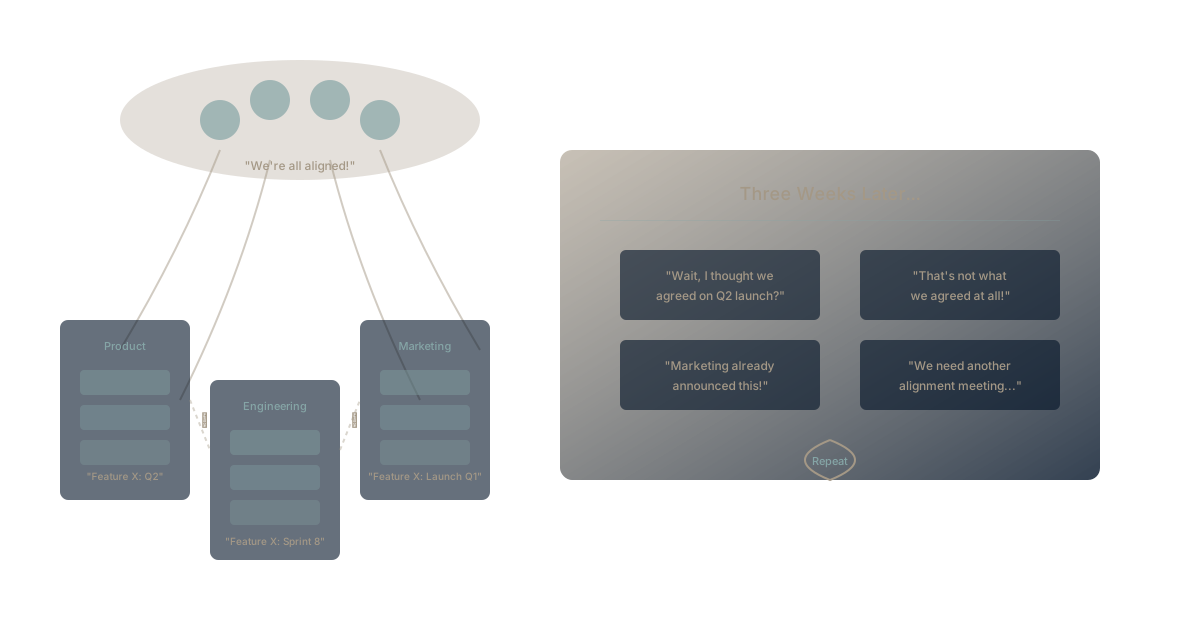
Your team had the kickoff meeting. Everyone nodded. The goals were clear. The timeline was set. Everyone left thinking they understood the plan.
Three weeks later, design delivered something product didn't expect. Engineering built to a spec that changed. Marketing launched messaging that contradicts the roadmap. Customer success promised features that don't exist.
What happened? Wasn't everyone aligned?
They thought they were. But alignment in a meeting room doesn't survive the journey back to fragmented tools.
The Alignment Illusion
The Meeting-to-Tool Gap
Watch what happens after any alignment meeting:
- Product goes back to their roadmap tool
- Engineering updates their project board
- Design notes priorities in their design system
- Marketing adjusts their campaign calendar
- Sales updates their pitch deck
Each person captures the alignment in their own context. Each tool has its own language, structure, and level of detail. By the time everyone's "updated," they've each documented a slightly different understanding.
The shared moment of alignment fragments into individual interpretations the instant people return to work.
According to McKinsey research, misalignment costs organizations 15-20% of productive time. Not because people don't try to align—but because the systems they use actively fragment alignment.
The Drift Pattern
Alignment doesn't break immediately. It drifts:
Day 1: Everyone understands the same thing (meeting just ended)
Week 1: Small interpretations diverge (each team applies alignment to their context)
Week 2: Dependencies reveal gaps ("Wait, I thought you were handling that")
Week 3: Conflicts emerge ("That's not what we agreed")
Week 4: Re-alignment meeting needed ("We need to get everyone back on the same page")
This cycle repeats throughout any initiative. The context switching between alignment and execution consumes organizational energy.
The Visibility Problem
In fragmented tools, no one can see the whole picture:
- Product sees their roadmap but not engineering's capacity
- Engineering sees their backlog but not marketing's timeline
- Marketing sees their campaigns but not product's priorities
- Leadership sees dashboards that are already out of date
Everyone has visibility into their domain. No one has visibility across domains. This is the structural condition that makes misalignment inevitable.
How Tool Fragmentation Creates Misalignment
Different Data Models
Each tool models work differently:
| Tool | Work Unit | Progress Model | Time Model |
|---|---|---|---|
| Roadmap tool | Features | Stages (Planned → Shipped) | Quarters |
| PM tool | Tasks | Status (To Do → Done) | Sprints |
| Design tool | Artboards | Comments/Reviews | None |
| Marketing tool | Campaigns | Launch states | Campaign periods |
When a "feature" moves in the roadmap, what updates in the PM tool? When a "campaign" launches, what changes in the design tool? Usually nothing—because they're not connected.
Different data models mean the same work is represented differently everywhere. Alignment requires manual translation between models.
Asynchronous Updates
Even when tools are "integrated," updates flow asynchronously:
- Product updates roadmap (Monday morning)
- Sync runs overnight
- Engineering sees update (Tuesday morning)
- Engineering updates their board (Tuesday afternoon)
- That update syncs overnight
- Design sees engineering's update (Wednesday)
By Wednesday, product might have already changed again. The "integrated" tools are always showing yesterday's state while decisions are made with today's information.
Context Loss at Boundaries
Information loses context as it crosses tool boundaries:
In the roadmap tool: "Customer Portal v2 - Redesign customer-facing dashboard for self-service capabilities, addressing top 5 support requests"
After syncing to PM tool: "Customer Portal v2"
In engineering's board: "Dashboard redesign - TBD"
The why evaporated. The scope compressed. The connection to customer needs disappeared. Someone working the task in the PM tool has no idea what problem they're solving.
This is the knowledge silo problem at the team level—context trapped in each tool's boundaries.
The Real Costs of Fragmented Alignment
Coordination Overhead
Teams compensate for fragmented tools with:
- More meetings: Sync meetings to share what tools should already know
- More Slack: Questions that arise from invisible changes
- More documents: Written summaries to bridge tool gaps
- More status updates: Manual reporting because dashboards disagree
This coordination overhead scales with team size and tool count. The more people involved, the more tools in use, the more work is spent on alignment maintenance.
Rework and Waste
Misalignment produces rework:
- Features built to the wrong spec
- Marketing materials that don't match reality
- Sales deals promised with inaccurate timelines
- Support trained on capabilities that changed
Studies suggest 20-40% of project effort goes to rework. Tool fragmentation is a primary cause—not because people are careless, but because their tools show them different versions of reality.
Decision Delay
Cross-functional decisions slow down when alignment requires:
- Gathering current state from each tool
- Reconciling conflicting information
- Getting everyone to agree on the actual situation
- Making the decision
- Updating all tools to reflect the decision
Steps 1-3 shouldn't exist. They do because tools fragment rather than connect information.
What Aligned Looks Like
Unified Work State
In a unified system:
- One place to see goals → Projects → Tasks → Outcomes
- One source of priority that everyone references
- Real-time visibility across all functions
- Automatic propagation of changes across related work
When product adjusts the roadmap, everyone sees it immediately—in context, with history, without manual syncing.
Structural Alignment
Beyond visibility, unified systems create structural alignment:
- Work is connected by design (task relates to project relates to goal)
- Changes cascade automatically
- Dependencies are visible and traceable
- Conflicts surface immediately rather than weeks later
This is the organizational memory approach to alignment—building systems where alignment is maintained by structure rather than effort.
Reduced Coordination Overhead
When tools unify:
- Fewer alignment meetings (the system shows current state)
- Faster decisions (information is already consolidated)
- Less rework (everyone works from the same reality)
- Better cross-functional collaboration (boundaries are transparent)
The goal isn't to eliminate human coordination—it's to eliminate coordination that only exists because tools fragment rather than connect.
From Fragmentation to Alignment
Short-Term: Improve Bridges
If you can't unify systems immediately:
- Establish source of truth for each type of information
- Define update cadences (when do tools sync?)
- Create translation guides (how does work in Tool A map to Tool B?)
- Assign boundary owners (who's responsible for cross-tool coherence?)
These are compensating controls—they reduce damage from fragmentation without eliminating it.
Medium-Term: Reduce Tool Count
Each tool you eliminate removes:
- A translation burden
- A sync failure point
- A visibility gap
- An alignment boundary
Prioritize eliminating tools that frequently appear in alignment breakdowns.
Long-Term: Unify Work Platform
True alignment requires systems designed for connection:
- Strategy and execution in one place
- All functions working from shared context
- Changes that propagate automatically
- Alignment maintained by design, not effort
This is the Context Compass vision—organizational intelligence that keeps everyone genuinely aligned.
Experience Aligned Work with Waymaker
Want to see what structural alignment looks like? Waymaker Commander connects goals to projects to tasks to outcomes—across all functions—in one unified platform.
When everyone works from the same context, alignment isn't something you maintain. It's something you have.
Register for the beta and experience teams that actually stay aligned.
The alignment problem isn't people—it's systems. Teams want to stay aligned. Fragmented tools make it structurally impossible. Change the systems, change the outcome. Learn more about knowledge silos and explore the cost of context switching.
Stuart Leo has diagnosed alignment issues in 300+ teams. The pattern is always the same: good intentions, fragmented tools, inevitable drift.
About the Author

Stuart Leo
Stuart Leo founded Waymaker to solve a problem he kept seeing: businesses losing critical knowledge as they grow. He wrote Resolute to help leaders navigate change, lead with purpose, and build indestructible organizations. When he's not building software, he's enjoying the sand, surf, and open spaces of Australia.