Your leadership team just spent 8 hours in a strategic planning session. Everyone contributed. The consultant facilitated brilliantly. You emerged with a 40-page strategic plan, complete with mission statement, core values, SWOT analysis, and 17 strategic initiatives. Three months later, you're executing exactly zero of those initiatives. The document sits in a shared drive, unopened since week two.
What went wrong? You had all the answers before you asked the right questions.
Strategic planning fails when it prioritizes documentation over inquiry. Teams spend hours crafting answers to questions they never properly explored. "What's our mission?" gets answered with corporate jargon nobody believes. "What's our strategy?" produces generic platitudes every competitor also claims. The result: plans that look impressive but don't drive action.
According to Harvard Business Review research on strategic decision-making, most well-formulated strategies fail due to poor execution, often because organizations focus on creating answers (the plan) rather than developing the capability to ask and answer the right questions continuously.
The fifth principle of the Resolute Leadership Curve addresses this: Questions are more valuable than answers. The 12 Questions framework (5 Management + 7 Leadership) provides the structured inquiry system that drives both strategic clarity and operational excellence—not through one-time planning, but through continuous questioning that adapts to changing reality.
The Problem: Answer-Focused Leadership in a VUCA World
We live in a VUCA environment: Volatile, Uncertain, Complex, and Ambiguous. The acronym originated in U.S. Army War College leadership training to describe post-Cold War conditions, but it perfectly characterizes modern business.
What VUCA Means in Practice
Volatile: Rapid, unpredictable change. Markets shift overnight. Customer preferences evolve faster than product cycles. What worked last quarter may fail next quarter.
Uncertain: Inability to predict outcomes with confidence. You can't know if your new product will succeed, if your key employee will stay, or if your largest customer will renew.
Complex: Multiple interconnected factors affecting outcomes. A pricing change impacts sales, which affects retention, which influences referrals, which changes acquisition costs—all simultaneously.
Ambiguous: Unclear cause-and-effect relationships. Did revenue drop because of the new pricing, market conditions, product changes, or competitor actions? Often, the answer is "all of the above" in proportions you can't determine.
Why Answers Fail in VUCA
Fixed answers become obsolete quickly. Your strategy from 12 months ago assumed conditions that no longer exist. The market evolved. Competitors moved. Customer needs shifted. Your carefully crafted answers are now wrong.
Example: COVID-19 Impact
Pre-pandemic answer: "Our distribution strategy is physical retail partnerships" March 2020 reality: Physical retail shut down globally Organizations that survived: Those that could quickly ask and answer "How do we deliver value without retail?" rather than defending their previous answer
Organizations that failed: Those that clung to the answer ("retail is our channel") instead of re-asking the question ("how do we reach customers?")
Question-based leadership adapts. Instead of defending outdated answers, you continuously re-evaluate:
- What's changed in our environment?
- What new assumptions are we making?
- What would we do differently if we started today?
This is the essence of the 12 Questions framework: not a one-time strategic plan, but a continuous inquiry system.
Learn how leading people vs managing things creates the positive tension that drives both execution and adaptation.
The 12 Questions Framework: Overview
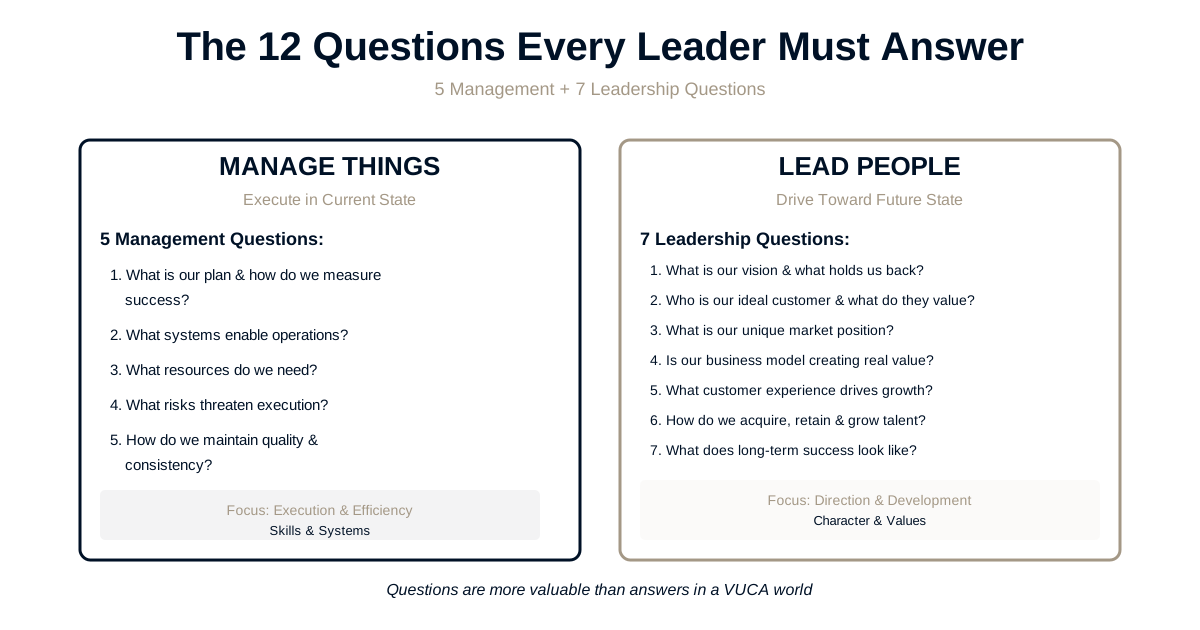
The Resolute Leadership Curve framework balances management (executing current state) and leadership (driving toward future state) through 12 Questions:
The 5 Management Questions: Executing Current State
These questions ensure effective execution of your current plan with discipline and precision:
- "What is our plan, and what metrics tell us if we are successful?" (Plan Canvas)
- "What roles does our plan require, and who is accountable for what parts?"
- "What goals and outcomes must each role achieve this quarter, half, or year?"
- "What meetings are necessary, what should we discuss, and how do we solve problems together?"
- "What data do we need to measure our progress and ensure success?"
Focus: Skills and systems that deliver results TODAY
Cadence: Weekly/monthly review to ensure execution stays on track
Output: Clear plans, metrics, systems, and accountability for current operations
The 7 Leadership Questions: Driving Future State
These questions drive vision, change, and development toward where you need to be:
- "What is our vision, is it driven by our purpose, and what is holding us back from reaching it?" (Vision Canvas)
- "What is our market, who is our ideal customer, what do they value, and what perceptions do we need to build?" (Market Canvas)
- "What is our strategy, where is our growth focused, and how do we improve our positioning?"
- "What is our business model, is it creating value, what metrics tell us this, and what practices improve our value proposition?" (Business Model Canvas)
- "What is our customer's experience, how do we acquire, retain, and grow customers through our journey & promise, and what improvements need to be made?" (CX Strategy)
- "What is our employee's experience, how do we acquire, retain, and grow talent through our journey & promise, and what improvements need to be made?" (Employee Experience)
- "What are the one, two, or three things that, if delivered in the quarter or half, will shift the needle on the business?"
Focus: Character and values that shape direction TOMORROW
Cadence: Quarterly/annual review to drive strategic evolution
Output: Clear vision, market positioning, business model, and experience strategies
Why Both Are Necessary
Management without leadership = Efficient execution of the wrong strategy. You hit your quarterly targets while competitors redefine your market.
Leadership without management = Inspiring vision with chaotic execution. Your team knows where you're going but can't deliver on commitments.
The 12 Questions together = Positive tension between executing today and building for tomorrow.
Why Questions Matter More Than Answers
Here's what makes questions more valuable than answers in organizational leadership:
1. Clarity Through Inquiry
The problem: Most organizational confusion stems from unstated assumptions, undefined terms, and misaligned understanding.
Example: "We need to be more customer-focused"
Everyone nods. Nobody knows what it actually means. Engineering thinks it means building more features. Sales thinks it means faster response times. Support thinks it means lower prices. Misalignment creates conflict.
Questions create clarity:
- What does "customer-focused" mean specifically?
- Which customer segment are we focusing on?
- What would change in our operations if we were "more" customer-focused?
- How would we measure whether we've succeeded?
After asking these questions, you discover: "Customer-focused" means reducing time-to-resolution for enterprise customers by 40% through dedicated support. Now everyone knows what to do.
Questions force specificity. Answers without inquiry produce vague platitudes. Questions without answers produce actionable clarity.
2. Driving Accountability
The problem: Leaders who provide all the answers create dependency. Teams wait for direction instead of taking initiative.
Answer-giving approach:
- Employee: "This customer is angry about delayed delivery. What should I do?"
- Leader: "Call them, apologize, offer 20% discount, overnight the order"
- Result: Employee learns to ask leader for answers. Doesn't develop judgment. Bottleneck created.
Question-asking approach:
- Employee: "This customer is angry about delayed delivery. What should I do?"
- Leader: "What do you think would resolve their frustration and preserve the relationship?"
- Employee: "Maybe call, apologize, offer a discount and expedited shipping?"
- Leader: "What's the right discount amount that shows we value them without setting unsustainable precedent?"
- Employee: "15-20%, depending on order size and history?"
- Leader: "I trust your judgment. Let me know how it goes."
- Result: Employee develops decision-making capability. Leader freed from every tactical decision.
Questions shift ownership. When you ask instead of tell, the other person owns the solution. Ownership drives accountability.
3. Enabling Adaptability
The problem: Fixed answers reflect past conditions. VUCA environments make past conditions obsolete.
Fixed answer approach: "Our target market is SMBs with 50-200 employees in manufacturing"
What happens when:
- Manufacturing automates aggressively (fewer employees per company)?
- Consolidation reduces number of SMB manufacturers?
- Larger enterprises show interest in your solution?
If you're wedded to the answer, you miss the opportunity.
Question-based approach: "Who is our ideal customer and what do they value?"
This question gets asked quarterly. Sometimes the answer is the same. Sometimes it evolves:
- Q1: SMB manufacturers (50-200 employees)
- Q2: Same, but we notice larger manufacturers are buying
- Q3: We expand to include 200-500 employee manufacturers
- Q4: We discover the real segmentation is "manufacturers who haven't automated" regardless of size
Questions enable evolution. Answers create inertia. In VUCA environments, inertia kills.
4. Uncovering Assumptions
The problem: Most strategic failures stem from untested assumptions that turn out to be wrong.
Example Assumption Failures:
- Blockbuster: "Customers want the in-store browsing experience" (Nope—convenience mattered more)
- Nokia: "Our hardware is superior, that's what customers want" (Nope—ecosystem and apps mattered more)
- Kodak: "We're a film company" (Nope—you were an imaging company, and digital was the future)
Each failure came from an unquestioned assumption. The companies had answers. They lacked questions.
Questions uncover assumptions:
Assumption: "Our product is too complex for SMBs"
Questions that challenge it:
- What evidence do we have that SMBs find it too complex?
- Have we actually tested it with SMBs?
- What if the complexity is in our explanation, not the product?
- What if SMBs need the complexity but want simpler onboarding?
After questioning, you discover: SMBs don't find the product too complex—your 40-page manual and 6-week implementation timeline are the barriers. Fix those, open a new market.
Questions reveal what you're assuming without realizing it.
The 5 Management Questions: Deep Dive
Let's explore each Management Question and how it drives execution:
Management Question 1: What is Our Plan and How Do We Measure Success?
Purpose: Translate vision and strategy into executable plans with clear metrics.
Why it matters: Plans without metrics become wish lists. Metrics without plans become pointless dashboards.
What it reveals:
- Do we have clear, achievable goals?
- Do we know what success looks like?
- Can we track progress in real-time?
- Do team members know what they're accountable for?
Common failure: Plans that describe activities instead of outcomes. "Launch new marketing campaign" instead of "Acquire 500 qualified leads at <$200 CAC."
Framework: Plan Canvas methodology for turning vision into measurable execution.
Management Question 2: What Systems Enable Our Operations?
Purpose: Ensure repeatable, scalable processes support execution.
Why it matters: Without systems, quality depends on individual heroics. Systems multiply effectiveness.
What it reveals:
- Can new team members execute without constant direction?
- Do we have documented processes for core operations?
- Are our systems enabling efficiency or creating bureaucracy?
Common failure: Enterprise systems implemented before organization is ready, creating complexity without value.
Management Question 3: What Resources Do We Need?
Purpose: Allocate capital, talent, time, and tools to support execution.
Why it matters: Plans fail when under-resourced. Over-resourcing wastes capital.
What it reveals:
- Do we have the budget required?
- Do we have the right skills on the team?
- Do we have the tools and technology needed?
- What's the timing of resource availability?
Common failure: Ambitious plans with insufficient resources. Hope is not a strategy.
Management Question 4: What Risks Threaten Execution?
Purpose: Identify and mitigate threats to successful delivery.
Why it matters: Unidentified risks become crises. Identified risks can be managed.
What it reveals:
- What could go wrong?
- How likely is each risk?
- What's the impact if it occurs?
- What's our mitigation plan?
Common failure: Risk lists that document everything that could go wrong without prioritization or mitigation plans.
Management Question 5: How Do We Maintain Quality and Consistency?
Purpose: Ensure execution maintains standards as we scale.
Why it matters: Inconsistent quality destroys customer trust and brand reputation.
What it reveals:
- What defines quality in our context?
- How do we measure quality?
- What processes ensure consistency?
- How do we maintain standards as we grow?
Common failure: Quality defined but not measured, or measured but not enforced.
The 7 Leadership Questions: Deep Dive
Now let's explore each Leadership Question and how it drives strategic direction:
Leadership Question 1: What is Our Vision and What's Holding Us Back?
Purpose: Define the future state and identify barriers preventing progress.
Why it matters: Vision without barrier awareness is wishful thinking. Barrier awareness without vision is paralysis.
What it reveals:
- Where are we trying to go (long-term)?
- Why does it matter?
- What's preventing us from getting there?
- What breakthrough would change everything?
Framework: Vision Canvas methodology for creating clarity around purpose and obstacles.
Common failure: Vision statements full of jargon nobody actually believes or understands.
Leadership Question 2: Who is Our Ideal Customer and What Do They Value?
Purpose: Achieve market clarity about who you serve and what matters to them.
Why it matters: "Everyone" is not a market. Trying to serve everyone means delighting no one.
What it reveals:
- Which customer segment do we serve best?
- What problems do they have that we can solve?
- What do they value most (speed, quality, price, experience)?
- What perceptions do we need to build?
Framework: Market Canvas for customer clarity
Common failure: Broad market definitions that prevent focused value delivery.
Leadership Question 3: What is Our Unique Position in the Market?
Purpose: Define competitive differentiation and strategic positioning.
Why it matters: Without differentiation, you compete on price alone. That's a race to the bottom.
What it reveals:
- What makes us different from competitors?
- Why would customers choose us over alternatives?
- What position do we own in customers' minds?
- How do we defend this position?
Common failure: Claiming differentiation that's neither unique nor valuable to customers.
Leadership Question 4: Is Our Business Model Creating Real Value?
Purpose: Validate that your business model generates value for customers and captures value for the company.
Why it matters: Revenue doesn't equal value creation. Some business models grow revenue while destroying value.
What it reveals:
- Are unit economics sustainable (LTV > 3x CAC)?
- Are we solving real problems or creating dependency?
- Does our model scale profitably?
- Where are we capturing vs. leaking value?
Framework: Business Model Canvas for value validation
Common failure: Growth metrics without profitability. See: WeWork, Theranos, countless startups.
Leadership Question 5: What Customer Experience Drives Growth?
Purpose: Design customer journey that drives acquisition, retention, and referral.
Why it matters: CX is your most powerful growth lever. Great experience creates compounding growth.
What it reveals:
- What's our customer promise?
- What's the actual journey customers experience?
- Where are moments of delight vs. frustration?
- What improvements would have highest ROI?
Framework: Customer Experience Strategy for journey optimization
Common failure: Focusing on acquisition while ignoring retention. Leaky bucket syndrome.
Leadership Question 6: How Do We Acquire, Retain, and Grow Talent?
Purpose: Create employee experience that attracts top talent and develops them into leaders.
Why it matters: Talent quality determines execution quality. Great people create great outcomes.
What it reveals:
- What's our employer brand and promise?
- How do we attract the right people?
- What's the employee journey from hire to departure?
- How do we develop future leaders?
Framework: Employee Experience Framework for talent strategy
Common failure: Treating employees as resources instead of humans. Leads to turnover and mediocrity.
Leadership Question 7: What Does Long-Term Success Look Like?
Purpose: Define end goals that guide all other strategic choices.
Why it matters: Without long-term clarity, short-term decisions drift or conflict.
What it reveals:
- What's our 5-10 year ambition?
- What would make this journey worthwhile?
- What legacy do we want to create?
- How do we measure ultimate success?
Common failure: Short-term thinking that sacrifices long-term position for quarterly results.
How the 12 Questions Work Together
The power isn't in asking one question—it's in how the 12 Questions interact:
The Cycle:
- Leadership Questions establish direction ("We're entering this market")
- Management Questions create execution plan ("Here's how we'll do it")
- Execution reveals new information ("We learned X about customers")
- Leadership Questions adapt direction based on learning ("Let's refine our positioning")
- Management Questions adjust plan ("Here's the updated approach")
Continuous loop. Constant adaptation. This is how you navigate VUCA.
Example in Practice:
Q1 Strategic Review (Leadership Questions):
- Vision: Become the leading CRM for healthcare SMBs
- Customer: Medical practices with 5-20 providers
- Business Model: SaaS with implementation services
- CX Strategy: White-glove onboarding + responsive support
Q1 Execution Planning (Management Questions):
- Plan: Acquire 50 healthcare customers at <$3K CAC
- Systems: Implement specialized healthcare onboarding process
- Resources: Hire healthcare industry sales specialist
- Risks: HIPAA compliance, long sales cycles
- Quality: 90% customer satisfaction, <5% churn
Q2 Review (Re-ask questions based on learning):
- Learning: Healthcare loves us, but veterinary practices are buying too
- Question: Should we expand ideal customer to include veterinary?
- Answer: Yes, similar needs, faster sales cycle, less regulation
- Adjusted Plan: Target both medical and veterinary practices
The 12 Questions enabled this adaptation. Without them, you'd either ignore the veterinary opportunity (rigid strategy) or chase it chaotically (no strategic framework).
This article introduces the 12 Questions framework overview. For the complete methodology with all 12 Clarity Canvas templates, detailed question guides, and step-by-step implementation playbooks, get Resolute by Stuart Leo on Amazon.
Practical Application: Using the 12 Questions
Quarterly Strategic Review (Leadership Questions)
Frequency: Quarterly or semi-annual
Participants: Leadership team + key department heads
Process:
- Review each of the 7 Leadership Questions
- Assess what's changed since last review
- Update answers based on new information
- Identify strategic shifts needed
- Document changes to communicate broadly
Output: Updated strategic direction, market positioning, and experience strategies
Monthly Execution Review (Management Questions)
Frequency: Monthly
Participants: Leadership + operational managers
Process:
- Review progress on current plan and metrics
- Assess system effectiveness and resource adequacy
- Identify and mitigate emerging risks
- Ensure quality standards are maintained
- Adjust tactical plans as needed
Output: Updated execution plans, resource allocation, and operational focus
The Cadence That Works
Weekly: Tactical execution (dashboards, metrics, adjustments)
Monthly: Management Questions review (execution health check)
Quarterly: Leadership Questions review (strategic adaptation)
Annually: Deep strategic planning (major direction changes)
This rhythm balances stability (we're not changing strategy weekly) with adaptability (we're not locked into annual plans that ignore reality).
From One-Time Planning to Continuous Inquiry
Here's the fundamental shift the 12 Questions framework creates:
Old approach (annual strategic planning):
- Leadership goes offsite for 2-day retreat
- Creates comprehensive strategic plan
- Presents plan to organization
- Expects execution for 12 months
- Ignores changed conditions because "we have a plan"
New approach (continuous inquiry):
- Leadership asks the 12 Questions quarterly
- Updates answers based on current reality
- Communicates changes transparently
- Adjusts execution while maintaining direction
- Adapts to changed conditions because "our plan evolves"
The difference: Old approach optimizes for document quality. New approach optimizes for decision quality.
In VUCA environments, decision quality beats document quality every time.
Learn how the 12 Questions fit within the complete Resolute Leadership Curve framework and discover how real growth is earned through systematic questioning.
Experience the 12 Questions Framework
This article provides an overview of why questions matter more than answers and introduces the 12 Questions framework. For complete Clarity Canvas templates for all 12 Questions, facilitation guides for running question workshops, and detailed implementation playbooks for each growth phase, get Resolute by Stuart Leo on Amazon.
The book provides:
- All 12 Clarity Canvas templates
- Question facilitation guides
- Divergent to convergent thinking process
- Industry-specific question examples
- Growth-phase-specific question priorities
The result: The capability to ask and answer the right questions at the right time, creating both strategic clarity and operational excellence through continuous inquiry rather than rigid planning.
Questions are more valuable than answers in a VUCA world. Learn Management Question 1: Plan & Metrics and Leadership Question 1: Vision to start applying the framework.
About the Author

Stuart Leo
Stuart Leo founded Waymaker to solve a problem he kept seeing: businesses losing critical knowledge as they grow. He wrote Resolute to help leaders navigate change, lead with purpose, and build indestructible organizations. When he's not building software, he's enjoying the sand, surf, and open spaces of Australia.