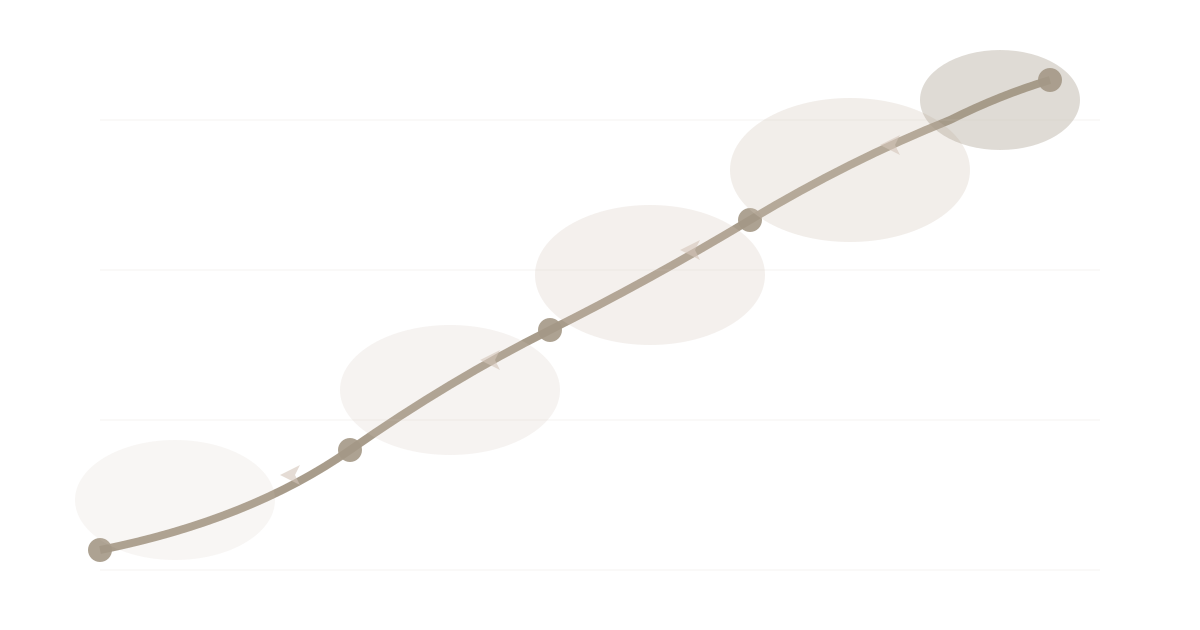
The Resolute Leadership Curve represents over a decade of pattern recognition across hundreds of organizations, distilling what separates high-performing businesses from struggling ones into a systematic framework for organizational development. This isn't theoretical—it's the diagnostic tool used daily by business leaders to understand where their organization actually is (versus where they think they are) and what specific capabilities must be built to reach the next level.
Most organizational assessment frameworks tell you symptoms: "Your team needs better communication" or "You should focus on culture." The Resolute Leadership Curve identifies root causes: the specific organizational capabilities that determine whether execution succeeds or fails, and the precise sequence in which those capabilities must be built.
Think of it as a GPS for organizational development—showing your current location, your destination, and the actual route between them, with clear indicators of what "right turn ahead" means at each stage of the journey.
Why Another Leadership Framework?
The business world drowns in leadership models, maturity frameworks, and developmental stages. Why does the Resolute Leadership Curve matter?
Most frameworks are descriptive: They tell you what high-performing organizations look like without explaining how to build those characteristics. Useful for diagnosis, useless for development.
Most frameworks are linear: They assume organizations progress steadily through predictable stages. Reality is messier—organizations can regress, skip steps, or operate at different maturity levels in different functions.
Most frameworks ignore memory: They focus on current state without addressing the fundamental challenge that organizations forget faster than they learn, losing capability as quickly as they build it.
The Resolute Leadership Curve is different: It's prescriptive (tells you what to build next), non-linear (recognizes messy reality), and memory-aware (addresses how capability gets preserved through turbulence).
The Curve Architecture: Five Distinct Stages
The curve maps five organizational maturity stages, each characterized by specific capabilities and constraints. Organizations don't "graduate" from one stage to the next automatically—they must deliberately build transition capabilities.
Stage 1: Reactive Foundation (0-20% Maturity)
Core challenge: Surviving chaos through heroic individual effort
Organizations at Stage 1 live in constant firefighting mode. No systematic planning survives contact with daily crises. Success depends entirely on specific individuals working unsustainable hours. Revenue is volatile. Customer experience is inconsistent. Team burnout is endemic.
This isn't a failing state—many successful organizations start here and some maintain it for years while growing. The constraint: you can't scale chaos. Growth amplifies dysfunction rather than building capability.
Key indicator: Ask employees "What are you working on this week and why?" If answers vary wildly and don't connect to any coherent direction, you're Stage 1.
What unlocks Stage 2: Establishing basic rhythms and processes that reduce reactive chaos enough to create thinking space.
Stage 2: Process Discipline (20-40% Maturity)
Core challenge: Making processes valuable rather than bureaucratic
Organizations at Stage 2 have established systematic processes, planning cadences, and metrics. The problem: processes exist as compliance exercises rather than value-creation tools. Teams follow processes because they must, not because processes help them succeed.
This stage feels frustrating—you've invested in structure but it often seems to slow you down. The key: you need process foundation before you can build strategic alignment, even though foundation alone doesn't create alignment.
Key indicator: Teams can explain your processes but struggle to explain how those processes serve strategic objectives. Process compliance is measured; strategic outcomes aren't.
What unlocks Stage 3: Connecting processes to strategic outcomes so teams understand why processes exist and how to use them effectively.
Stage 3: Strategic Alignment (40-60% Maturity)
Core challenge: Maintaining strategic coherence across organizational complexity
Organizations at Stage 3 have figured out how to cascade strategy through org levels, connect individual work to strategic objectives, and maintain reasonable alignment between intent and execution. Processes become strategic tools rather than administrative burdens.
This is where most "good" organizations operate. You have strategy. You have processes. They connect reasonably well. The limitation: alignment requires constant active maintenance. When pressure hits, strategic coherence degrades quickly.
Key indicator: Employees can explain top priorities AND the reasoning behind them. Cross-functional coordination happens systematically rather than heroically.
What unlocks Stage 4: Building organizational memory systems that preserve strategic context so alignment doesn't depend on constant leadership intervention.
Stage 4: Execution Excellence (60-80% Maturity)
Core challenge: Enabling distributed intelligence without losing coherence
Organizations at Stage 4 don't just plan well—they execute brilliantly. Strategic context flows throughout the organization. Teams make autonomous decisions aligned with strategy because they genuinely understand strategic intent. Learning from execution feeds back rapidly to improve strategy.
This is where competitive moats get built. You move faster than competitors while maintaining coherence they can't match. Execution capability itself becomes differentiating advantage.
Key indicator: Teams successfully make strategic decisions without escalation because they have sufficient context. Major initiatives complete on-time with intended outcomes >70% of the time.
What unlocks Stage 5: Systematic capture and application of organizational learning so every experience compounds capability.
Stage 5: Learning Organization (80-100% Maturity)
Core challenge: Sustaining excellence through change and scaling
Organizations at Stage 5 systematically learn from every experience and compound that learning into increasing competitive advantage. Strategy evolves continuously based on execution feedback. Innovation happens systematically. Knowledge multiplies—new employees become effective faster by accessing accumulated organizational wisdom.
This is rare air—very few organizations sustain Stage 5 capability. Those that do become category leaders and maintain advantages competitors can't easily copy. The challenge: this stage requires constant attention to prevent regression during major transitions.
Key indicator: Organization makes same mistake once, learns from it, codifies learning, and never repeats it. Capability compounds measurably year over year.
Using the Curve: Practical Application
The Leadership Curve isn't meant for wall decoration—it's a working diagnostic tool. Here's how to actually use it:
Application 1: Honest Current State Assessment
Most organizations overestimate their maturity by 1-2 stages. Leadership believes "we're reasonably well-aligned" (Stage 3) while frontline teams experience reactive chaos (Stage 1). Use objective diagnostics:
- Can 80%+ of random employees explain top three strategic priorities with reasoning? (Yes = Stage 3+, No = Stage 1-2)
- What percentage of planned initiatives complete on-time with intended outcomes? (<50% = Stage 1-2, 50-70% = Stage 3, >70% = Stage 4)
- How long from discovering organizational problem to implementing systematic prevention? (>6 months = Stage 1-2, 1-3 months = Stage 3, <1 month = Stage 4+)
Accept the honest diagnosis. Building from Stage 2 when you're actually Stage 2 works. Building Stage 4 capability when you're actually Stage 2 fails predictably.
Application 2: Next-Capability Identification
Once you know current stage, the curve prescribes what to build next. Don't try to skip stages—you'll waste resources implementing practices that require foundation you haven't built.
If you're Stage 1: Focus on process establishment, not strategic sophistication If you're Stage 2: Focus on strategic connection, not execution excellence If you're Stage 3: Focus on organizational memory, not learning systems If you're Stage 4: Focus on systematic learning, not maintaining excellence
The curve tells you both what's next AND what's premature.
Application 3: Regression Prevention
Organizations don't just progress forward—they regress during leadership transitions, rapid growth, acquisition integration, and crisis response. The curve helps identify regression risks:
Watch for regression indicators:
- Increasing percentage of work that's reactive (Stage 1 regression)
- Teams following processes without understanding why (Stage 2 regression)
- Strategic discussions repeating without resolution (Stage 3 regression)
- Decisions requiring escalation that teams used to make independently (Stage 4 regression)
Organizational memory systems prevent regression by preserving capability even when individuals change.
The Memory Dimension: What Makes the Curve Work
Traditional maturity models ignore the fundamental constraint: organizations forget faster than they learn without systematic memory. The Resolute Leadership Curve explicitly addresses this:
Stage 1→2 transition: Build memory of process rationale so processes don't become empty ritual Stage 2→3 transition: Build memory of strategic reasoning so alignment doesn't depend on leadership repetition Stage 3→4 transition: Build memory of decision context so distributed teams can operate autonomously Stage 4→5 transition: Build memory of organizational learning so knowledge compounds
At each stage, the curve prescribes not just what capability to build but what memory systems enable that capability to persist and scale.
This is why some organizations progress rapidly while others spin in place—progression requires building capability AND the memory systems that preserve it.
Common Curve Pitfalls
Pitfall 1: Stage Skipping "We'll implement OKRs to drive strategic alignment!" when you're Stage 1. OKRs are Stage 3 tools requiring Stage 2 foundation. Result: OKR theater that wastes time without improving execution.
Pitfall 2: Progress Assumption "We implemented processes, so we're Stage 2." Process existence doesn't equal process maturity. You're Stage 2 when processes actually reduce chaos and create thinking space, not when processes exist on paper.
Pitfall 3: Uniform Maturity Belief "We're a Stage 3 organization." Reality: Your product team might operate at Stage 4, sales at Stage 2, finance at Stage 3, and customer success at Stage 1. Organizational maturity is distribution, not single number.
Pitfall 4: Maturity as Destination "We need to get to Stage 5." For most organizations, Stage 3-4 is sufficient for excellent performance. Stage 5 is required only if your competitive context demands systematic innovation and learning velocity. Don't pursue maturity for its own sake.
Getting Started with the Curve
This week: Conduct honest assessment using the diagnostic questions in this article. Don't rely on leadership perception—sample frontline employees.
This month: Map different functions to the curve. Accept non-uniform maturity. Identify highest-priority area for development (usually where maturity constraint most limits performance).
This quarter: Build one specific next-stage capability in priority area. Measure capability development through execution outcomes, not activity completion.
This year: Progress one stage in priority area. Build organizational memory systems that preserve capability through turbulence.
The Resolute Leadership Curve isn't about judgment—it's about diagnosis and roadmap. Every organization is somewhere on the curve. What matters is knowing where you actually are, accepting the work required to reach where you're going, and building systematically rather than randomly.
Start your journey with honest assessment. Excellence awaits, one stage at a time.
Ready to apply the Leadership Curve systematically? Explore the comprehensive Leadership Maturity Curve guide with detailed transition playbooks.
About the Author

Stuart Leo
Stuart Leo founded Waymaker to solve a problem he kept seeing: businesses losing critical knowledge as they grow. He wrote Resolute to help leaders navigate change, lead with purpose, and build indestructible organizations. When he's not building software, he's enjoying the sand, surf, and open spaces of Australia.