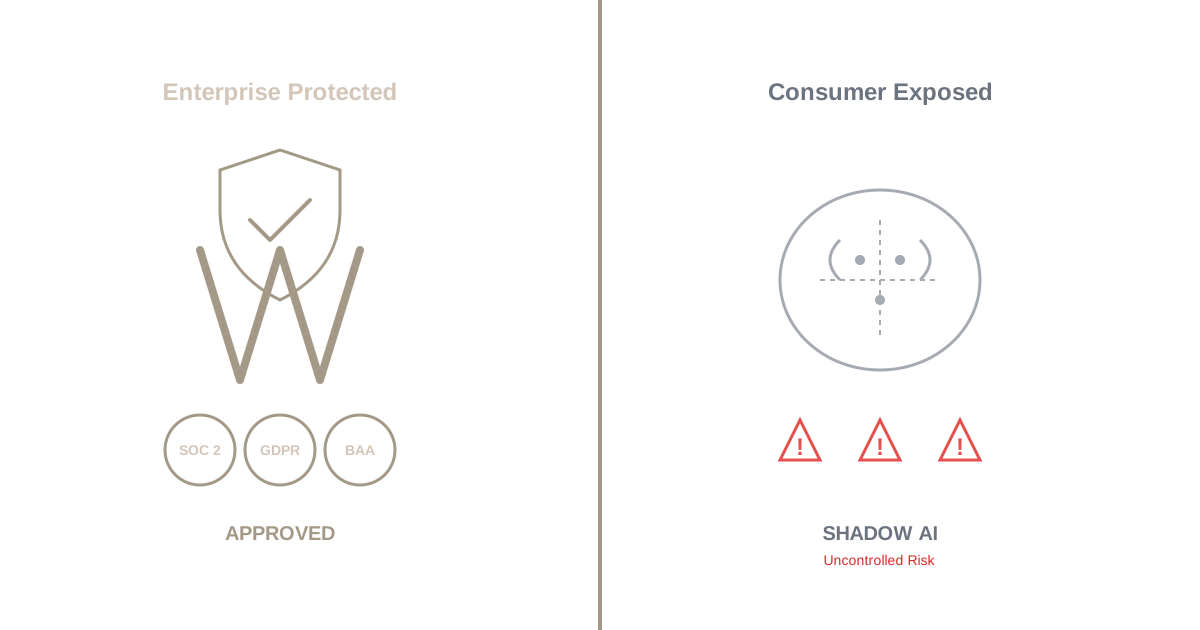
Your CFO just discovered that 59% of your employees are using unapproved AI tools. They're pasting sensitive customer data, financial projections, and strategic plans into ChatGPT, Claude.ai, and dozens of other consumer AI services. The question isn't whether Shadow AI exists in your organization—it's how many data breaches are waiting to happen.
But here's the critical distinction most businesses miss: Not all AI platforms are created equal. There's a fundamental difference between consumer AI tools and enterprise-approved platforms. Understanding this difference could save your organization from a $670,000 data breach and the catastrophic reputational damage that follows. According to research from The CFO, 75% of employees using Shadow AI share sensitive business data without understanding the consequences.
This article provides a direct comparison between Waymaker and Shadow AI tools, revealing why contractual protections, enterprise security controls, and architectural decisions make approved platforms fundamentally safer than consumer alternatives.
The Shadow AI Crisis: What's Actually Happening to Your Data
Shadow AI represents the convergence of three dangerous trends: accessible AI tools, business necessity, and insufficient governance. When employees use consumer AI services for work tasks, they're making a critical assumption: that these tools protect their data the same way enterprise software does.
They're wrong.
Consumer AI platforms like ChatGPT, Claude.ai, and Gemini are designed for individual use, not enterprise data protection. While they may have strong security for the platform itself, they lack the contractual guarantees, compliance certifications, and architectural controls that enterprise customers require. Learn more about how business amnesia drives Shadow AI adoption.
The Data Journey: Where Your Information Really Goes
When an employee pastes customer data into a consumer AI tool:
What they think happens:
- Data is processed for their query
- AI provides an answer
- Data is deleted immediately
- No one else can access it
What actually happens:
- Data enters a consumer service architecture
- Processing may occur across multiple jurisdictions
- Data retention policies are optimized for the service provider, not you
- Training exclusions may not apply to free/consumer accounts
- Audit trails may be insufficient for compliance investigations
- Breach notification may not meet regulatory timelines
The IBM Cost of Data Breach Report 2024 found that the average cost of a data breach is $4.45 million globally. For breaches involving third-party systems like Shadow AI, costs escalate due to complex investigations and shared liability.
The OpenAI Training Question Everyone Gets Wrong
The most common defense of Shadow AI sounds like this: "But OpenAI says they don't train on API data. We're safe, right?"
Here's the nuanced reality:
OpenAI's data usage policies create a critical distinction between their consumer product (ChatGPT website/app) and their API service (used by enterprise applications). For consumer ChatGPT:
- Conversations may be used to improve models (unless you opt out)
- Data retention is 30 days minimum for abuse monitoring
- No Business Associate Agreement (BAA) available
- No contractual guarantees about training exclusion
- Consumer privacy policy applies, not enterprise DPA
For OpenAI's API (which Waymaker uses):
- Zero data retention for training purposes by default
- Transient processing only (data not stored after request)
- BAA available for HIPAA-regulated customers
- Contractual data protection guarantees
- Enterprise-grade audit trails
The problem: When employees use consumer ChatGPT, they're on the consumer side of this divide—even if their employer has an OpenAI API contract for other purposes.
The Waymaker Difference: Why Architecture Matters
Waymaker was built from the ground up as an approved enterprise platform, not a consumer tool retrofitted for business use. This architectural decision creates fundamental differences in how your data is protected.
Contractual Protection Layer
Business Associate Agreements (BAAs):
On November 3, 2025, Waymaker submitted BAA requests to both OpenAI and Anthropic. These agreements create contractual obligations for data protection that consumer AI services don't provide. Until they are executed, confirm current status with Waymaker before processing PHI. The BAAs we have requested cover:
- Zero data retention for AI model training
- Transient processing only for API requests (data deleted after response)
- Multi-jurisdictional compliance (Australia, EU, US)
- HIPAA-compliant safeguards for protected health information
- Breach notification protocols within 72 hours
- Audit rights for customers to verify compliance
As stated in our Privacy Policy Section 4:
"We DO NOT use your content, prompts, or inputs to train AI models. We DO NOT share your data with OpenAI or other model providers for training. We DO NOT allow AI model providers to retain your data."
Data Processing Agreements (DPA):
Every Waymaker customer receives a comprehensive DPA that outlines:
- Roles and responsibilities (Controller vs Processor)
- Security measures and technical safeguards
- Subprocessor management and oversight
- Data subject rights assistance
- Breach notification procedures
- International data transfer mechanisms
This isn't a terms of service buried in legal text—it's a bilateral agreement with mutual obligations and liability. Consumer AI tools don't offer this level of contractual protection.
Security Architecture: Built for Enterprise
Waymaker implements defense-in-depth security that goes far beyond what consumer AI platforms provide:
Encryption Standards:
- TLS 1.3 for all data in transit (latest protocol)
- AES-256 encryption for data at rest
- End-to-end encryption for sensitive workflows
- Key management through enterprise-grade systems
Access Controls:
- Row-Level Security (RLS) in managed Postgres ensures data isolation
- Role-Based Access Control (RBAC) with least privilege principle
- Multi-Factor Authentication (MFA) available for all users (required for enterprise)
- SSO integration for enterprise customers (SAML, OAuth)
- API key rotation policies and expiration
Infrastructure Security:
- Australia-based primary hosting (Sydney region for APAC data residency)
- SOC 2 certification for Waymaker itself is on the roadmap
- ISO 27001 on certification roadmap
- GDPR-compliant technical and organizational measures
- Regular penetration testing by third-party security firms
- 24/7 security monitoring and incident response
Compare this to consumer AI tools where:
- Your data shares infrastructure with millions of users
- Consumer-grade access controls apply
- No dedicated security controls for your organization
- No contractual SLAs for security response
- No audit rights to verify security claims
The Compliance Gap: Why Regulated Industries Can't Use Shadow AI
For organizations in healthcare, finance, legal, and other regulated industries, Shadow AI isn't just risky—it's potentially illegal.
HIPAA Requirements
Healthcare organizations must ensure Business Associate Agreements with all vendors who process Protected Health Information (PHI). Consumer AI tools cannot provide these guarantees:
Shadow AI HIPAA failure:
- ❌ No BAA available for consumer accounts
- ❌ No HIPAA compliance certification
- ❌ Insufficient audit trails for PHI access
- ❌ No breach notification guarantees
- ❌ Cross-border data transfers without safeguards
Waymaker HIPAA compliance:
- ⚠️ BAAs requested from AI model providers (OpenAI, Anthropic) — confirm current status with Waymaker before processing PHI
- ✅ HIPAA-eligible managed database infrastructure
- ✅ Comprehensive audit logging for PHI access
- ✅ 72-hour breach notification protocol
- ✅ Data residency controls for regulated customers
The Department of Health and Human Services HIPAA guidance is clear: "A business associate is a person or entity that performs certain functions or activities that involve the use or disclosure of protected health information on behalf of, or provides services to, a covered entity."
When healthcare employees use consumer AI tools with patient data, they're creating unauthorized business associate relationships without required safeguards.
GDPR Data Processing Requirements
The European Union's General Data Protection Regulation requires explicit Data Processing Agreements for all vendors processing personal data. Article 28 mandates specific processor obligations:
Shadow AI GDPR failure:
- ❌ No DPA for consumer users
- ❌ Unclear data residency (may process in US without safeguards)
- ❌ No Standard Contractual Clauses (SCCs)
- ❌ Insufficient technical measures documentation
- ❌ No data subject rights assistance guarantees
Waymaker GDPR compliance:
- ✅ Comprehensive DPA with all enterprise customers
- ✅ Standard Contractual Clauses for EU data transfers
- ✅ Documented technical and organizational measures
- ✅ Data subject rights request assistance (access, deletion, portability)
- ✅ Data Protection Officer available for inquiries
- ✅ Transfer Impact Assessments for cross-border processing
GDPR fines can reach €20 million or 4% of global annual revenue, whichever is higher. Using Shadow AI in your organization may constitute a GDPR violation if personal data is processed without adequate safeguards.
Financial Services Regulations
Banks, investment firms, and financial advisors face additional regulatory scrutiny:
SOX Compliance (Sarbanes-Oxley Act):
- Requires audit trails for financial data access
- Consumer AI tools lack adequate logging
- Waymaker provides comprehensive audit logs with 7-year retention
PCI DSS (Payment Card Industry Data Security Standard):
- Prohibits storing payment data in unapproved systems
- Consumer AI tools not PCI DSS certified
- Waymaker integrates with Stripe (PCI DSS Level 1)
SEC Regulations:
- Investment advisors must protect client information (Safeguards Rule)
- Shadow AI represents uncontrolled third-party access
- Waymaker's approved platform status satisfies regulatory requirements
The True Cost Comparison: Shadow AI vs Approved Platforms
CFOs evaluating Shadow AI risks need to understand the full cost implications:
Shadow AI Hidden Costs
Direct Breach Costs:
- Average data breach: $4.45M (IBM Cost of Data Breach Report)
- Breaches involving third parties: +15% cost premium
- Lost business from customer churn: 38% of total cost
- Regulatory fines (GDPR/HIPAA): Variable, often millions
Indirect Costs:
- Investigation and forensics: $500K - $2M
- Legal fees and settlements: $1M - $5M
- Reputation damage: Incalculable (customer trust lost)
- Compliance remediation: $250K - $1M
- Executive time addressing crisis: 100+ hours
Opportunity Costs:
- Lost productivity during incident response
- Delayed strategic initiatives
- Competitive disadvantage from distraction
- Board and investor scrutiny
Total Shadow AI risk exposure: $10M+ per incident (large organizations)
Waymaker Investment
Transparent Credit-Based Pricing:
- AI usage billed via credits (transparent consumption)
- No hidden fees or surprise bills
- Predictable costs scale with usage
- Credits shared across organization
Security Included:
- Enterprise security features: Included
- BAAs and DPAs: No additional cost
- SOC 2 compliance: No premium tier required
- Audit logs and compliance reports: Standard
Manual Mode Fallback:
- All features work without AI when credits exhausted
- No vendor lock-in (software remains fully functional)
- Users control their own AI spending
Typical Enterprise Cost: $50 - $200 per user per month (depending on AI usage)
ROI Calculation:
- Shadow AI breach risk: $10M+ potential loss
- Waymaker investment: $100K - $300K annually (500-person organization)
- Risk mitigation value: 100x+ return on investment
- Plus: Productivity gains, controlled innovation, compliance confidence
The math is unambiguous. Even a single prevented breach pays for decades of Waymaker licensing.
The OneAI Philosophy: Why "AI Enhances But Never Requires" Matters
Waymaker's approach to AI represents a philosophical departure from both consumer AI tools and AI-first platforms:
Consumer AI (ChatGPT, Claude.ai):
- AI is the product
- Users become dependent on AI for tasks
- When access is lost, work stops
- Vendor lock-in through workflow dependency
AI-First Platforms:
- AI integrated into every feature
- Forced AI usage (no opt-out)
- High costs regardless of value received
- Vendor lock-in through architecture
Waymaker OneAI Philosophy:
- AI enhances but never requires
- All features work manually without AI
- Credit-based consumption gives users control
- No vendor lock-in (software works fully when credits run out)
- Smart Router optimizes model selection automatically
This philosophy ensures your organization is never held hostage by AI costs or vendor decisions. Your strategic execution software remains fully functional regardless of AI usage.
How Intelligent Routing Reduces Risk
Waymaker's Smart Router sends requests through our Waymaker One API, which:
- Analyzes request complexity to select the appropriate model (GPT-4o Mini vs Full)
- Routes through approved channels with BAAs and security controls
- Tracks consumption for transparent billing
- Monitors for policy violations and harmful content
- Maintains audit trails for compliance investigations
- Enforces data residency requirements per your organization policy
Every AI request goes through this controlled pipeline. There's no way for users to bypass security controls or send data to unapproved endpoints. This architecture prevents the accidental Shadow AI that occurs when employees seek faster AI responses through consumer tools.
Implementing Approved AI: Your Migration Path
Moving from Shadow AI to Waymaker requires a systematic approach:
Phase 1: Discovery and Assessment (Week 1)
Shadow AI Audit:
- Survey employees about AI tool usage
- Review browser history and SaaS subscriptions
- Interview department heads about AI adoption
- Identify high-risk use cases (sensitive data exposure)
Risk Quantification:
- Calculate potential breach costs for your industry
- Assess regulatory exposure (GDPR, HIPAA, etc.)
- Evaluate reputational risk from customer data exposure
- Determine insurance coverage gaps
Phase 2: Waymaker Pilot (Weeks 2-4)
Limited Rollout:
- Start with 20-50 users in pilot departments
- Focus on high Shadow AI usage areas first
- Provide training on context engineering approach
- Gather feedback and refine implementation
Integration Setup:
- Configure SSO for seamless authentication
- Import existing documents (Word) and spreadsheets (Excel, CSV)
- Set up organization structure and permissions
- Establish AI credit budgets by department
Phase 3: Organization-Wide Deployment (Weeks 5-8)
Controlled Rollout:
- Deploy to all departments with department-specific training
- Communicate the "why" (security, compliance, productivity)
- Provide comparison showing Waymaker advantages
- Establish AI usage policies and guidelines
Shadow AI Sunset:
- Block consumer AI tools at network level (optional but recommended)
- Redirect AI spending to approved Waymaker platform
- Archive existing AI chat histories where possible
- Document migration for compliance records
Phase 4: Continuous Improvement (Ongoing)
Monitoring and Optimization:
- Review AI usage analytics monthly
- Optimize credit allocation based on value delivered
- Refine prompts and context engineering patterns
- Share best practices across organization
Compliance Maintenance:
- Quarterly security audits and penetration testing
- Annual DPA and BAA review and renewal
- Regular training on data protection policies
- Incident response drills and preparedness
Why Waymaker Passes the Shadow AI Audit
Remember the 7-question Shadow AI audit every business must answer? Here's how Waymaker addresses each concern:
1. Do you have contractual data protection guarantees? ✅ Yes. A DPA with every enterprise customer. BAAs with OpenAI and Anthropic have been requested — confirm current status with Waymaker before processing PHI.
2. Is AI model training on your data explicitly prohibited? ✅ Yes. Privacy Policy Section 4 guarantees zero training use. Contractual enforcement.
3. Can you audit where your data is processed and stored? ✅ Yes. Primary hosting in Australia (Sydney region). Full data residency transparency.
4. Do you have enterprise-grade encryption in transit and at rest? ✅ Yes. TLS 1.3 and AES-256 encryption. Row-level security (RLS) in database.
5. Can you enforce access controls and permissions? ✅ Yes. RBAC with least privilege. MFA available. SSO integration for enterprise.
6. Do you have audit trails for compliance investigations? ✅ Yes. Comprehensive logging with 7-year retention. Compliance reporting included.
7. Can your organization control AI spending and usage? ✅ Yes. Credit-based consumption. Department budgets. Manual mode when credits exhausted.
Shadow AI tools fail most or all of these audit questions. Waymaker was designed to pass them from day one.
The Strategic Advantage: Why Approved Platforms Enable Innovation
The irony of Shadow AI is that it's often adopted to enable innovation and productivity. But by creating uncontrolled security risks, Shadow AI ultimately constrains innovation when breaches occur and executives respond with blanket AI bans.
Approved platforms like Waymaker create the opposite dynamic:
Controlled Innovation Framework:
- Clear AI usage policies employees understand and follow
- Credit-based budgets enable experimentation within guardrails
- Security and compliance teams comfortable with architectural controls
- Executives confident in risk mitigation
- Results: More AI usage, not less—but safely governed
Organizations that successfully navigate this transition see:
- 3x increase in AI usage (from Shadow AI baseline)
- 80% reduction in data protection incidents
- Improved employee satisfaction (they have approved tools that work)
- Better AI ROI (coordinated strategy vs random adoption)
- Competitive advantage from faster, safer AI deployment
Taking Action: From Shadow AI to Approved Platform
The CFO who discovers Shadow AI in their organization faces a decision: react with blanket bans that stifle innovation, or proactively implement approved platforms that enable safe AI adoption.
Immediate Actions (This Week):
- Assess your Shadow AI exposure using the 7-question audit
- Calculate your potential breach costs (average $4.45M, your industry may vary)
- Request a Waymaker demo focused on security and compliance features
- Review your current AI policies (or create them if they don't exist)
Short-Term Implementation (Next 30 Days):
- Conduct Shadow AI audit across your organization
- Start Waymaker pilot with high-risk departments first
- Document your approved AI policy referencing Waymaker as approved platform
- Communicate the transition to employees (emphasize enabling, not blocking)
Long-Term Strategy (Next 90 Days):
- Complete organization-wide Waymaker deployment
- Sunset Shadow AI tools through policy and technical controls
- Establish AI governance committee for ongoing oversight
- Measure results (AI usage, security incidents, productivity gains)
The difference between Shadow AI and approved platforms isn't subtle—it's the difference between uncontrolled risk and strategic advantage. Your organization's data protection, regulatory compliance, and competitive positioning depend on making the right choice.
Experience Waymaker: The Approved AI Platform
Want to see the security and compliance difference firsthand? Waymaker Commander brings enterprise-grade AI capabilities to your strategic execution workflows with contractual data protection guarantees consumer AI tools cannot match.
See how Waymaker:
- Processes AI requests through approved channels with BAAs
- Maintains comprehensive audit trails for compliance
- Provides transparent credit-based consumption without hidden costs
- Enables manual workflows when AI credits are exhausted
- Integrates with your existing business systems securely
Register for the beta and experience the difference between consumer AI tools and enterprise-approved platforms.
The Shadow AI crisis is solvable—but only with approved platforms that prioritize data protection. Learn more about how business amnesia drives Shadow AI adoption and discover our complete context engineering approach to organizational intelligence.
About the Author

Stuart Leo
Stuart Leo founded Waymaker to solve a problem he kept seeing: businesses losing critical knowledge as they grow. He wrote Resolute to help leaders navigate change, lead with purpose, and build indestructible organizations. When he's not building software, he's enjoying the sand, surf, and open spaces of Australia.