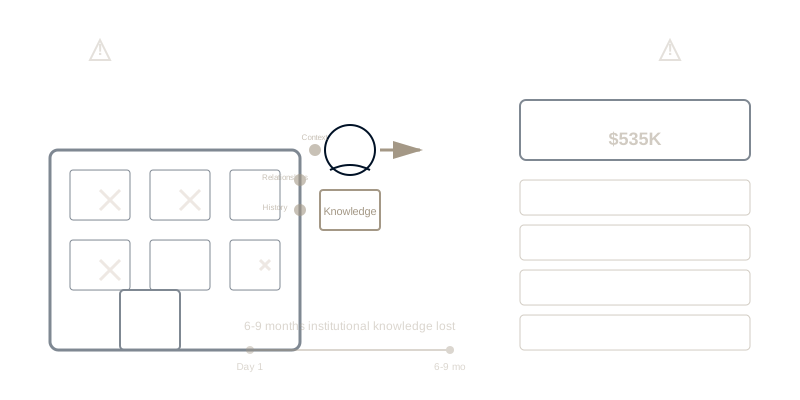
Every exit interview ends the same way: "We wish you the best." What nobody says out loud: "We just lost 6-9 months of institutional knowledge that we'll spend the next year trying to rebuild."
When a mid-level employee leaves, HR calculates replacement cost at 150% of salary. Research from Gallup confirms this: the average cost to replace an employee making $60K is $90K. But that calculation misses the real cost—the institutional knowledge that walks out the door and the organizational amnesia that follows.
After documenting knowledge loss patterns across hundreds of organizational transitions, I've identified a disturbing reality: the knowledge loss from employee departures costs 3-5x more than the replacement cost itself. Yet most organizations don't measure it, don't prevent it, and don't even realize how much it's costing them until critical capabilities suddenly vanish.
The Four Types of Knowledge That Disappear
Using the Context Compass framework, we can categorize exactly what knowledge disappears when employees leave—and why it's so expensive to replace:
Type 1: Working Knowledge - Project Context Evaporates
What's lost: Current state of all active initiatives, in-progress decisions, real-time relationship dynamics
When someone leaves mid-project, their successor inherits a puzzle:
- What's the current status really? (not what the doc says, what's actually happening)
- Why are things prioritized this way? (the unwritten logic)
- Who needs to be involved in what? (relationship context)
- What decisions are in flight? (and what context shaped them)
Real example: Product manager leaves during major feature development. New PM finds:
- Incomplete user research (interviews done, insights not synthesized)
- Partial design mockups (but doesn't know which were approved)
- Engineering estimates (but not the constraint discussions behind them)
- Stakeholder feedback (scattered across Slack, email, meeting notes)
Time to rebuild context: 3-4 weeks of full-time investigation before new PM can make confident decisions
Cost: $15K-20K in delayed decisions, plus opportunity cost of slowed momentum
Type 2: Episodic Knowledge - Organizational History Vanishes
What's lost: Why past decisions were made, what was tried and failed, validated learnings about what works
This is the most insidious loss because it's invisible until someone proposes repeating a failed experiment.
Real example: Senior engineer leaves. Six months later, team proposes microservices architecture. Nobody remembers:
- This was attempted 18 months ago
- $800K was invested
- It failed due to operational complexity at current team size
- It was rolled back with documented rationale
Result: Team spends 4 months and $600K before realizing the same constraints still exist. The original failure documentation? Buried in departed engineer's private Notion workspace.
Cost: $600K+ repeating failed experiments because episodic knowledge was lost
Stanford research on organizational learning confirms this pattern: organizations without systematic episodic memory repeat expensive mistakes on 3-5 year cycles as institutional memory degrades with turnover.
Type 3: Semantic Knowledge - Strategic Frameworks Disappear
What's lost: Custom methodologies, evaluation frameworks, organizational-specific approaches that outperform industry standards
Many organizations develop custom frameworks that work better than generic best practices for their specific context. When the knowledge carriers of these frameworks leave, organizations regress to industry standards—often without realizing they've lost a competitive advantage.
Real example: Sales leader departs. Team loses custom qualification framework that achieved 40% higher close rates than standard BANT methodology. New leader implements industry-standard BANT because nobody can articulate why the custom framework worked better.
Decline in performance:
- Close rate drops from 35% to 25%
- Sales cycle lengthens from 6 to 8 months
- Deal quality decreases (more churn from poorly-qualified prospects)
Annual cost: $2.3M in lost revenue from degraded sales effectiveness
Time to recognize: 9-12 months (gradual decline, hard to attribute) Time to rebuild: 18+ months of experimentation to rediscover what worked
Type 4: Procedural Knowledge - Political Navigation Disappears
What's lost: How to actually get things done, who really makes decisions, unwritten cultural rules
This is the "how work actually happens" knowledge that never gets documented because it seems too political, too nuanced, or too obvious to those who've been there a while.
Real example: Operations manager leaves. New hire follows documented approval process, gets repeatedly blocked. Doesn't know:
- CFO needs pre-brief before formal requests (hates surprises)
- Engineering lead must be consulted early (will veto if not involved)
- CEO prefers written context docs over verbal presentations
- Finance director's approval prerequisite to any spending
Impact:
- First three initiatives blocked (6 weeks wasted)
- Team loses confidence in new manager ("can't get anything done")
- Projects stall while learning political landscape
- Strategic momentum lost
Time to relearn: 4-6 months of trial and error Cost: $50K+ in stalled initiatives, damaged relationships, lost credibility
The Cascading Cost of Knowledge Loss
The real expense of departures isn't linear—it's cascading. One departure triggers multiple downstream costs:
The Replacement Cost Cascade
Direct replacement: $90K (standard calculation)
Knowledge reconstruction: $75K
- 3-4 weeks of new hire investigation/ramp time
- 20-30 hours of team time providing context
- Delayed decisions during knowledge transfer period
Failed initiatives (missing context): $150K
- Repeated failed experiments
- Strategic mistakes from missing historical knowledge
- Approach reversals due to lost institutional wisdom
Relationship disruption: $40K
- Client relationships requiring rebuild
- Partner relationships needing re-establishment
- Internal stakeholder trust reconstruction
Opportunity cost: $180K
- Strategic initiatives delayed 3-6 months
- Competitive responses slowed
- Market opportunities missed during transition
Total cascading cost: $535K for a $60K/year position
Replacement calculation captures: 17% of actual cost Hidden knowledge loss: 83% of actual cost
This isn't theoretical. MIT Sloan research on organizational knowledge documents that knowledge loss costs typically exceed replacement costs by 3-5x in knowledge-intensive roles.
The Turnover Amplification Effect
Here's where it gets worse: knowledge loss accelerates with turnover rates. Each departure makes subsequent departures more expensive because institutional knowledge degrades.
The Knowledge Degradation Curve
Year 1 (10% turnover in 50-person company):
- 5 departures
- Knowledge loss per departure: $200K average
- Total cost: $1M
- Organizational memory: 90% intact
Year 2 (15% turnover - degrading culture):
- 7.5 departures
- Knowledge loss per departure: $280K average (less institutional knowledge to draw on)
- Total cost: $2.1M
- Organizational memory: 75% intact
Year 3 (22% turnover - knowledge crisis):
- 11 departures
- Knowledge loss per departure: $380K average (severe institutional amnesia)
- Total cost: $4.2M
- Organizational memory: 55% intact
The death spiral: As institutional knowledge degrades, new hires struggle more, satisfaction decreases, turnover increases, knowledge loss accelerates.
Organizations experiencing 20%+ turnover are in active knowledge crisis—spending more on knowledge reconstruction than they're gaining in productivity from new hires.
What Specific Knowledge Disappears (and Why It Matters)
Let's get concrete about what actually walks out the door:
Client/Customer Relationship History
What's lost:
- Why this client relationship exists (origin story, relationship dynamics)
- What they've purchased before (and what they've rejected, and why)
- Who the actual decision-makers are (vs. org chart)
- What concerns keep them awake at night (context for engagement)
- Previous conflicts and how they were resolved (trust built over time)
Replacement reality: New account manager gets client name, company profile, purchase history. Doesn't get the relationship nuance that took 2-3 years to build.
Cost: 60% of client relationships experience friction during account manager transitions, 25% of relationships don't survive beyond 12 months post-transition
Decision Rationale for Strategic Choices
What's lost:
- Why we entered this market (what hypotheses we were testing)
- Why we exited that market (what we learned about fit/timing)
- Why we use this tech stack (what alternatives we evaluated and why)
- Why we structured the org this way (what we optimized for)
Replacement reality: New leaders see current state, don't understand the path dependency. Make "obvious" changes that undo hard-won strategic lessons.
Example: New CTO joins, sees legacy monolith, proposes microservices migration. Doesn't know this was attempted and rolled back. 6 months and $800K later, facing same issues that caused original rollback.
Failed Experiment Learnings
What's lost:
- What marketing channels we tested (and why they didn't work for us)
- What sales approaches we tried (and why we landed on current methodology)
- What product features we built and deprecated (and why)
- What organizational structures we tested (and what we learned)
Replacement reality: New teams see current state as starting point. Repeat failed experiments because the learning wasn't preserved.
Cost: Organizations without systematic failure documentation repeat 40-60% of past failed experiments within 3 years of original attempt
Network Effects and Informal Relationships
What's lost:
- Who knows whom across the organization
- Which informal networks get things done
- Who to ask for specific expertise
- Which relationships enable cross-functional collaboration
Replacement reality: New employees see org chart. Don't see informal networks that make organization actually function.
Time to rebuild: 12-18 months to develop equivalent network depth
Measuring Your Knowledge Loss: The Departure Audit
Most organizations don't measure knowledge loss. Here's how to audit what's really disappearing:
The 30-Day Departure Audit
When someone gives notice, conduct structured knowledge audit:
Week 1: Working Knowledge Capture
- What projects are in flight? (actual status, not documented status)
- What decisions are pending? (and what context shaped them)
- What relationships are critical? (and what's the relationship state)
Week 2: Episodic Knowledge Capture
- What past decisions should new person understand?
- What failed experiments should be documented?
- What validated learnings need preservation?
Week 3: Semantic Knowledge Capture
- What frameworks/methodologies does this person use?
- What evaluation criteria guide their decisions?
- What organizational-specific approaches have they developed?
Week 4: Procedural Knowledge Capture
- How do things actually get done? (vs. how they should work)
- Who really makes decisions? (vs. org chart)
- What cultural rules govern success?
Benchmark: Organizations conducting systematic departure audits reduce knowledge loss costs by 60-75%.
Preventing Knowledge Loss: Beyond Exit Interviews
The solution isn't preventing departures (turnover is inevitable). The solution is systematizing knowledge preservation so departures don't erase institutional memory.
Practice 1: Continuous Knowledge Capture
Don't wait for departures to document knowledge:
- Decision logs capturing rationale in real-time
- Retrospectives after major initiatives
- Relationship context documentation as it develops
- Framework documentation as methodologies evolve
Implementation: Make knowledge capture part of work, not extra work during transitions
Learn systematic knowledge preservation frameworks
Practice 2: Context Engineering for Institutional Memory
Build organizational memory systems using the Context Compass framework:
- Working memory: Current project states accessible to new team members
- Episodic memory: Historical decisions and learnings preserved
- Semantic memory: Strategic frameworks documented
- Procedural memory: Actual workflows codified
Implementation: Context engineering makes institutional knowledge accessible, not dependent on specific people
Practice 3: Structured Knowledge Transfer Protocols
90-day knowledge transfer for all departures:
- 30 days before: Structured knowledge capture
- During transition: Systematic handoff with context transfer
- 30 days after: New hire feedback on knowledge gaps
Benchmark: Structured transfer reduces knowledge loss by 70%
The Resolute Approach: Building Indestructible Organizations
In Resolute, I introduce the principle of organizational resilience—not organizations that never face challenges, but organizations that maintain capabilities despite challenges.
Fragile organizations: Capabilities depend on specific people. When people leave, capabilities disappear.
Resilient organizations: Capabilities embedded in institutional memory. When people leave, capabilities persist.
The difference is systematic knowledge preservation—treating organizational memory as strategic infrastructure, not individual memory.
From Hidden Cost to Competitive Advantage
Organizations that solve knowledge loss don't just reduce departure costs—they build unfair advantages:
Faster onboarding: New hires productive in weeks instead of months Higher retention: People stay when institutional knowledge is accessible (less frustrating) Strategic continuity: Each quarter builds on last instead of resetting Competitive moat: Institutional knowledge compounds, creating advantages competitors can't replicate
The question isn't whether you can afford to solve knowledge loss. The question is whether you can afford not to.
Every employee departure costs 6-9 months of institutional knowledge. But when that knowledge is written into the goals, documents and tasks your team keeps in one platform, it stays reachable—and Waymaker One can answer from it—turning departures from organizational amnesia events into routine transitions.
Register for the beta and experience organizational memory that survives people changes.
Employee departures don't have to erase institutional knowledge. Learn more about solving business amnesia and discover the Context Compass framework for building resilient organizational memory.
About the Author

Stuart Leo
Stuart Leo founded Waymaker to solve a problem he kept seeing: businesses losing critical knowledge as they grow. He wrote Resolute to help leaders navigate change, lead with purpose, and build indestructible organizations. When he's not building software, he's enjoying the sand, surf, and open spaces of Australia.