For the past two years, the business world has been obsessed with prompt engineering. Every company is training teams to write better prompts. But here's the uncomfortable truth: we're optimizing the wrong thing.
Even the best prompt can't overcome missing context. When your AI doesn't know your organizational history, strategic constraints, or accumulated learnings, no amount of clever prompting will fix it. The future isn't better prompts—it's better context. This is context engineering, and it's about to fundamentally reshape how organizations work with AI.
Research from Stanford's Human-Centered AI Institute confirms what forward-thinking organizations are discovering: AI effectiveness is constrained far more by context availability than by prompt quality. The organizations winning with AI in 2026 aren't those with the best prompt engineers—they're those with systematic context engineering.
Context Engineering Defined
Context engineering is the systematic design of AI's information environment to preserve organizational memory, enable intelligent decision-making, and compound institutional knowledge over time.
Where prompt engineering focuses on how you ask AI questions, context engineering focuses on what information environment AI operates within. It's the difference between teaching someone to ask good questions versus giving them access to the library.
The fundamental shift is profound:
- Prompt Engineering: "How do I phrase this request to get the best AI response?"
- Context Engineering: "What information architecture ensures AI has the organizational context it needs to give responses grounded in our institutional knowledge?"
Think of it this way: Prompt engineering is like learning to ask a stranger for directions. Context engineering is like giving a knowledgeable guide access to your organization's complete map, historical travel data, known obstacles, and strategic destination—then asking for directions.
The guide doesn't need perfect question phrasing when they have complete context.
Why Context Engineering Matters Now
Three converging forces make 2026 the inflection point for context engineering:
1. AI Context Windows Exploded
2022: GPT-3 context window: 4,096 tokens (~3,000 words) 2023: GPT-4 context window: 128,000 tokens (~96,000 words) 2024: Claude 3.5 context window: 200,000 tokens (~150,000 words) 2025: Gemini 1.5 Pro context window: 1,000,000 tokens (~750,000 words)
This isn't incremental improvement—it's a fundamental capability shift. OpenAI's research on long-context models shows that AI can now process entire codebases, complete project histories, comprehensive documentation sets in a single interaction.
The implication: The bottleneck shifted from "how much context can AI handle" to "how do we systematically provide AI with the right organizational context?"
2. Model Context Protocol (MCP) Standardized Context Delivery
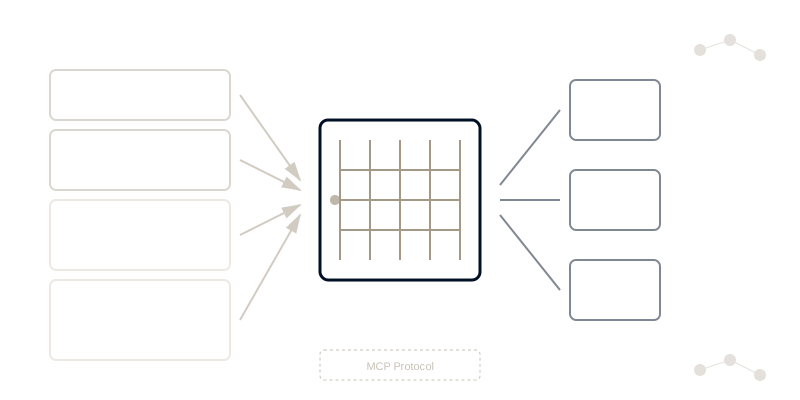
In late 2024, Anthropic released the Model Context Protocol—a universal standard for how AI systems access organizational context. Think of MCP as USB for AI context.
Before MCP: Every AI tool had its own context format. Organizational knowledge trapped in incompatible systems.
After MCP: Standardized context format means organizational knowledge becomes portable across AI systems. Build context architecture once, use across all AI tools.
The implication: Context engineering infrastructure you build today works across future AI platforms. This is the standardization moment that makes strategic context investment worthwhile.
3. Organizations Discovered Prompt Engineering Isn't Enough
The 2023-2024 prompt engineering wave revealed a hard limit: better prompts can't overcome missing organizational context.
Companies trained teams on prompt engineering, deployed AI tools widely, then discovered:
- AI recommendations ignore organizational constraints
- Generic "best practices" contradict validated learnings
- Strategic decisions lack institutional knowledge grounding
- Failed experiments get repeated because AI has no organizational memory
Harvard Business Review research on AI implementation confirms this: Organizations with sophisticated prompt engineering but poor context systems achieve 30-40% of AI's potential value. Organizations with systematic context engineering capture 80-90% of potential value.
The implication: Context engineering is the unlock that makes AI transformatively valuable instead of incrementally useful.
The Architecture of Context: Four Layers
After building the Context Compass framework through work with hundreds of organizations, I've identified four essential layers of organizational context that AI needs:
Layer 1: Working Memory - Current State Context
What it is: Real-time state of active initiatives, in-progress decisions, current strategic focus
Why AI needs it: Without working memory, AI treats every interaction as isolated—no awareness of current project state, active constraints, or in-flight decisions.
How to engineer it:
- Project state files that update as work progresses
- Initiative context documents with current status
- Active decision logs with real-time considerations
- Strategic focus declarations showing current priorities
Example: Product team uses working memory context file:
# Q4 Product Roadmap - Working Context

## Current State (Updated: 2026-01-15)
- Enterprise feature in beta (50 users, 83% satisfaction)
- Mobile redesign paused pending user research
- Integration API v2 shipping Feb 1

## Active Decisions
- Pricing tier structure (decision due Jan 20)
- Q1 hiring priority (PM vs Engineer)

## Strategic Constraints
- No new feature launches until core stability >99.5%
- Enterprise focus takes priority over SMB features
- Integration partnerships required for new verticals
When AI reads this before responding to "What should we prioritize in Q1?", recommendations are grounded in current organizational reality—not generic product management advice.
Layer 2: Episodic Memory - Historical Context
What it is: Past decisions, completed initiatives, historical events, what actually happened
Why AI needs it: Without episodic memory, AI can't learn from organizational history—it will confidently recommend strategies you've already tried and proven don't work.
How to engineer it:
- Decision logs with rationale, not just outcomes
- Initiative retrospectives with learnings
- Failed experiment documentation
- Success pattern analysis
Example: Engineering team's episodic memory:
# Microservices Migration Attempt - 2024 Retrospective

## Decision (March 2024)
Migrate monolith to microservices architecture

## Rationale
- Industry best practice for scale
- Better team autonomy
- Easier to hire specialized engineers

## What Happened
- 6 months effort, $800K investment
- Increased system complexity
- Operational overhead overwhelming for team size
- Rolled back to enhanced monolith

## Key Learning
Microservices require 3x current team size to operate effectively. Not viable until engineering team >30 people.

## Boundary Conditions
When to revisit: Team size >30, dedicated DevOps >3 people, monitoring infrastructure mature
Two years later, new CTO proposes microservices. AI references episodic memory, flags this as repeated failed experiment, suggests waiting until boundary conditions met. Saves $800K+ redundant effort.
Layer 3: Semantic Memory - Strategic Framework Context
What it is: Codified knowledge, strategic frameworks, methodologies, "how we think about things here"
Why AI needs it: Without semantic memory, AI defaults to generic industry frameworks that may contradict your organization's proven methodologies.
How to engineer it:
- Strategic framework documentation
- Custom methodology definitions
- Evaluation criteria and prioritization logic
- Organizational-specific best practices
Example: Sales team's semantic memory:
# Waymaker Sales Qualification Framework

## Standard Industry: BANT (Budget, Authority, Need, Timeline)
## Our Framework: IMPACT (validated 40% higher close rate)

**I** - Integration: How does this connect to existing systems?
**M** - Memory: Do they have organizational memory problems?
**P** - Process: Is strategic planning formalized?
**A** - Authority: Who owns strategic execution?
**C** - Commitment: Timeline for decision?
**T** - Transformation: What does success look like?

## Why This Works For Us
Our product solves memory + execution problems. BANT qualifies budget but misses strategic fit. IMPACT qualifies strategic need first, budget second.

## When to Use Standard BANT
Transactional sales <$10K, implementation <30 days
When AI helps qualify leads, it uses organizational semantic memory—not generic sales frameworks—producing dramatically better qualification accuracy.
Layer 4: Procedural Memory - How Things Actually Work
What it is: Unwritten workflows, cultural norms, political dynamics, "how to get things done here"
Why AI needs it: Without procedural memory, AI recommends theoretically sound approaches that are organizationally impossible to execute.
How to engineer it:
- Decision-making workflow documentation
- Stakeholder influence maps
- Approval process realities (not just formal process)
- Communication preference guides
Example: Product team's procedural memory:
# How Product Decisions Actually Get Approved

## Formal Process (what org chart says)
Product Manager → Product Director → CPO → Approval

## Actual Process (what works)
1. Pre-brief Finance Director (she has CPO's ear, will kill anything she hasn't vetted)
2. Get Engineering lead buy-in (CPO won't override engineering concerns)
3. Present to Product Director with Finance + Engineering already aligned
4. Product Director presents to CPO (near-certain approval)

## Why This Matters
Formal process has 40% approval rate, 6-week cycle time
Actual process has 90% approval rate, 2-week cycle time

## Communication Preferences
- Finance Director: Written brief first, meeting second (hates surprises)
- Engineering Lead: Technical depth matters (show you understand constraints)
- CPO: Strategic narrative, not feature list (connect to company vision)
When AI helps plan a product initiative, procedural memory ensures recommendations account for organizational realities—not just theoretical best practices.
Context Engineering vs. Traditional Knowledge Management
Many organizations think they already have this—they have wikis, documentation systems, knowledge bases. But traditional knowledge management and context engineering are fundamentally different:
Traditional Knowledge Management:
- Purpose: Help humans find information
- Structure: Human-readable documents, natural language
- Organization: Categories, tags, search
- Usage: Humans query when they need something
- Update cycle: Occasional, when someone remembers
Context Engineering:
- Purpose: Provide AI with persistent organizational memory
- Structure: AI-readable formats, structured data + context
- Organization: Layered memory architecture (working, episodic, semantic, procedural)
- Usage: AI continuously accesses contextual information
- Update cycle: Real-time, as organizational context evolves
The shift is from "documentation for reference" to "memory for intelligence."
Real-World Impact: The Economics of Context Engineering
Let's examine the financial impact on a 50-person consulting firm:
Pre-Context Engineering (Annual Costs)
Context reconstruction overhead: $450K annually
- Every project starts with context rebuilding
- Client history scattered across tools
- Methodology knowledge in people's heads
- 12 hours/project on average reconstructing context
Repeated failures: $200K annually
- Strategies that ignore past learnings
- Approaches that failed before get retried
- Client relationships damaged by forgotten history
Slow AI adoption: $150K in unrealized value
- AI recommendations too generic to use
- Teams don't trust AI without context
- Prompt engineering training doesn't help
Total cost: $800K per year
Context Engineering Investment
Initial setup: 120 hours to implement four context layers Ongoing maintenance: 3 hours/week = 156 hours/year
Total annual cost: 276 hours ≈ 0.14 FTE
At $200/hour fully loaded cost: $55K per year
Net savings: $800K - $55K = $745K per year ROI: 13.5x return on investment
And that's just direct cost savings. Context engineering also enables:
- Faster client onboarding: New consultants access full client history instantly
- Higher quality recommendations: AI grounded in organizational methodologies
- Strategic compounding: Each project builds on documented learnings
- Reduced knowledge loss: Consultant departures don't erase institutional knowledge
The MCP Revolution: Why This Changes Everything
The Model Context Protocol (MCP) announcement in late 2024 was the standardization moment that makes context engineering strategic infrastructure—not just another tool integration.
What MCP Actually Is
MCP is a universal protocol for how AI systems access contextual information. Think of it as:
- USB for AI context: One standard, works across all compatible systems
- API for organizational memory: Structured access to institutional knowledge
- Context middleware: Layer between your knowledge systems and AI tools
Why MCP Matters
Before MCP:
- Build custom integrations for each AI tool
- Context trapped in tool-specific formats
- Switching AI providers means rebuilding everything
- ROI uncertain because of vendor lock-in
After MCP:
- Build context architecture once, works across MCP-compatible AI
- Context infrastructure is platform-agnostic
- Switching AI providers doesn't lose context investment
- ROI clear because context infrastructure is durable
The implication: Context engineering you invest in today works with AI systems that don't exist yet. This is infrastructure, not integration.
Who's Implementing MCP
As of early 2025, MCP support includes:
- Anthropic Claude: Native MCP support
- Cursor IDE: MCP-enabled context for coding
- Windsurf: MCP integration for development
- GitHub Copilot: MCP protocol support announced
- Custom AI tools: Growing MCP ecosystem
The network effect is accelerating. Each new MCP-compatible tool makes your context engineering investment more valuable.
From Theoretical to Practical: Implementing Context Engineering
Here's the 60-day implementation framework I've used with organizations building context engineering capabilities:
Phase 1: Context Audit (Days 1-15)
Map existing organizational knowledge:
- Where does critical context currently live?
- What knowledge is in people's heads vs. documented?
- What context do teams reconstruct repeatedly?
- What institutional knowledge is being lost?
Identify high-value context:
- What contexts would 10x AI usefulness?
- What knowledge gaps cause repeated failures?
- What procedural knowledge slows new hires?
Assess current accessibility:
- How long to find strategic decision rationale?
- Can new team members access historical context?
- Is organizational methodology documented?
Phase 2: Architecture Design (Days 16-30)
Design four-layer context architecture:
- Working memory: What current-state context do teams need?
- Episodic memory: What historical decisions should be preserved?
- Semantic memory: What strategic frameworks define how you work?
- Procedural memory: What unwritten workflows should be codified?
Choose implementation approach:
- MCP-compatible systems (future-proof)
- AI-readable formats (Markdown, structured JSON)
- Version control (track how understanding evolves)
- Integration points (where context gets created/used)
Create documentation templates:
- Decision log template
- Project context template
- Retrospective template
- Framework documentation template
Phase 3: Pilot Implementation (Days 31-45)
Select pilot team/project:
- High AI usage potential
- Complex enough to validate approach
- Willing to experiment
Implement core context layers:
- Create working memory for active projects
- Document key historical decisions
- Codify relevant strategic frameworks
- Map critical procedural workflows
Connect to AI workflows:
- Make context accessible to AI tools
- Train team on context-aware AI usage
- Measure effectiveness vs. baseline
Phase 4: Scale and Optimize (Days 46-60)
Roll out across organization:
- Expand successful pilot patterns
- Train all teams on context engineering
- Establish context maintenance rituals
Build continuous improvement:
- Measure context accessibility
- Track AI effectiveness improvement
- Identify context gaps as they emerge
- Refine based on usage patterns
Establish governance:
- Who maintains each context layer?
- How often is context updated?
- What quality standards apply?
- How is context deprecation handled?
The Future Is Context-Aware: 2026 and Beyond
Here's what the next 12-24 months look like for context engineering:
Q1-Q2 2026: MCP becomes table stakes
- Major AI platforms complete MCP integration
- Organizations without context architecture fall behind
- Context engineering becomes core AI capability
Q3-Q4 2026: Context-aware becomes competitive advantage
- Organizations with mature context systems pull ahead
- AI recommendations grounded in institutional knowledge outperform generic
- Knowledge compounds instead of resets
2027: Context engineering as strategic infrastructure
- Treated like databases or security—foundational infrastructure
- Organizations measure "context health" like system uptime
- Context portability across AI platforms becomes critical capability
The companies that build context engineering capabilities now will have 12-24 month advantages that competitors can't quickly close.
Experience Context Engineering with Waymaker One
Want to see context engineering in action? Waymaker One answers from your organization's goals, documents and tasks, and the Waymaker MCP server gives any AI agent the same context. The Context Compass framework shows how to organize that memory in four quadrants.
The result: AI that actually remembers your organizational context, recommendations grounded in institutional knowledge, decisions that compound instead of reset.
Register for the beta and experience the difference between generic AI and organizationally-aware intelligence.
Context engineering is the shift from prompt optimization to information architecture. Learn more about context engineering vs. prompt engineering and discover the complete Context Compass framework for building context-aware AI systems.
About the Author

Stuart Leo
Stuart Leo founded Waymaker to solve a problem he kept seeing: businesses losing critical knowledge as they grow. He wrote Resolute to help leaders navigate change, lead with purpose, and build indestructible organizations. When he's not building software, he's enjoying the sand, surf, and open spaces of Australia.