The project management tool market is worth over $6 billion. Asana, Monday.com, ClickUp, Notion, Basecamp, Wrike, Smartsheet, and dozens more compete for your attention.
And somehow, most organizations still struggle to execute effectively.
The tools are better than ever. Prettier interfaces. More features. Better integrations. AI assistance. And yet execution gaps persist, priorities misalign, and strategic initiatives drift.
This isn't a tool quality problem. It's a problem definition problem. These tools solve the wrong problem exceptionally well.
What These Tools Actually Do
The Task Management Frame
Asana, Monday, and ClickUp are fundamentally task management tools. They answer the question: "What needs to get done and who's doing it?"
Core capabilities:
- Create and assign tasks
- Set due dates and dependencies
- Track progress and status
- Visualize work (boards, lists, timelines)
- Enable team collaboration
They do this well. The interfaces are polished. The features are comprehensive. The execution on task management is often excellent.
What They Don't Do
They don't answer:
- "Why does this task matter?"
- "How does this project connect to our strategic goals?"
- "What decision history led to this initiative?"
- "What organizational context should inform this work?"
Task management tools manage tasks. They don't manage the connection between tasks and organizational purpose.
The Execution Gap They Can't Close
Symptom: Busy But Not Productive
Organizations use these tools and still experience:
Misaligned priorities: Teams work hard on tasks that don't move strategic needles.
Context-free execution: Work happens without connection to why it matters.
Invisible strategic drift: Small disconnects compound until major misalignment emerges.
Decision amnesia: Same decisions made repeatedly because rationale isn't preserved.
Research from Harvard Business Review shows 67% of well-formulated strategies fail in execution. Better task management hasn't fixed this.
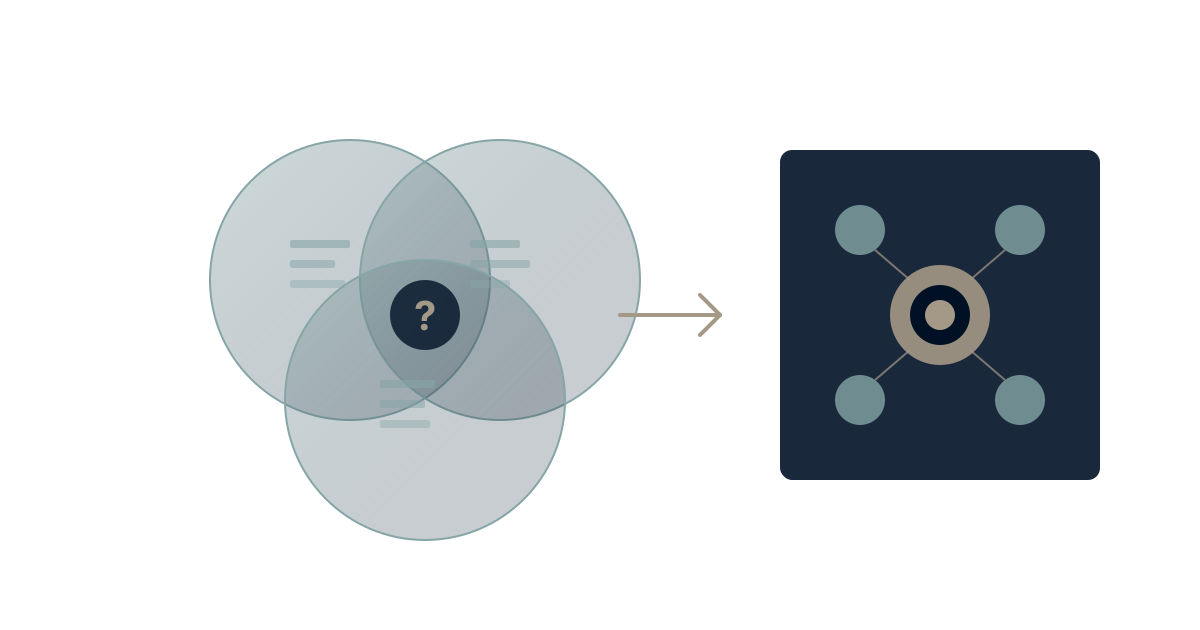
The Missing Layer
Between strategy and tasks, there's a missing layer.
Strategy: Why we exist. What we're trying to achieve. Where we're going.
??? (Missing): How strategy translates to initiatives. Why specific projects exist. What decisions shape execution.
Tasks: The specific work items people do daily.
Task management tools operate at the bottom layer. Strategy happens (when it does) in separate documents, presentations, or tools. The connection between them is manual, fragile, and often broken.
Evaluating the Major Players
Asana
Strengths:
- Clean, intuitive interface
- Strong task and project organization
- Good for team coordination
- Reliable and mature
The gap: Asana organizes tasks excellently. It doesn't connect them to strategic context. Goals features exist but feel bolted on rather than integrated.
Strategic execution rating: Tasks managed well, strategy connection weak.
Monday.com
Strengths:
- Highly visual and customizable
- Flexible workflows
- Good automation capabilities
- Strong for operational work
The gap: Monday's flexibility is strength and weakness. You can build almost anything—but the platform doesn't inherently understand organizational hierarchy. Work items exist without strategic framework.
Strategic execution rating: Operational excellence, strategic alignment absent.
ClickUp
Strengths:
- Feature-rich to the point of overwhelming
- Everything in one place attempt
- Affordable pricing
- Continuous feature addition
The gap: ClickUp tries to be everything. The result is complexity without coherence. Features exist but don't create strategic understanding.
Strategic execution rating: Many features, unclear strategic model.
The Common Pattern
All three (and most competitors) share the same fundamental approach:
- Create tasks
- Organize tasks into projects
- Assign tasks to people
- Track task completion
None fundamentally addresses:
- Why these tasks exist
- How tasks connect to goals
- What decisions shaped the work
- Whether completion equals progress
Why Feature Addition Doesn't Solve It
The Goals Feature Trap
All major platforms have added "Goals" or "OKR" features. Problem solved?
No. Goals features in task management tools typically:
- Exist in a separate module from daily work
- Require manual connection to projects
- Lack strategic context of their own
- Feel like checkbox additions, not integrated thinking
Adding a goals module to a task manager doesn't create strategic coherence. It adds another thing to maintain.
The AI Promise
Every platform now promises AI assistance. The reality:
What AI does in these tools:
- Suggests task descriptions
- Summarizes project status
- Drafts updates
- Automates routine workflows
What AI can't do without context:
- Understand your strategic priorities
- Know why decisions were made
- Connect work to organizational purpose
- Identify strategic drift before it compounds
AI in task management tools is feature AI, not organizational AI. It improves tasks without understanding strategy.
The Integration Excuse
"But we integrate with strategic planning tools!"
The integration tax doesn't solve the problem:
- Integrations maintain data, not understanding
- Context doesn't flow through APIs
- Multiple systems means multiple sources of truth
- Cognitive overhead remains
You can connect Asana to your OKR tool. You can't make the connection meaningful without human interpretation every time.
What Would Actually Solve the Problem
The Context Engineering Approach
Instead of better task management, organizations need context engineering—systems that maintain strategic context and connect it to execution.
What this means:
Goals live with work: Strategic objectives aren't separate modules—they're the framework within which work exists.
Decisions are captured: Why things are being done is preserved alongside what's being done.
AI understands context: Instead of suggesting task descriptions, AI understands organizational priorities and can identify alignment.
Memory persists: Organizational knowledge about why and how accumulates, not just records of what.
The Platform vs. Tool Question
Task management tools remain tools. What's needed is platform thinking.
Tool thinking: Manage tasks better. Platform thinking: Create an environment where work naturally connects to purpose.
This is the difference between point solutions and integrated platforms. Individual tools optimize individual functions. Platforms optimize organizational coherence.
What Execution Excellence Requires
Beyond task tracking, effective execution requires:
Strategic clarity: Clear understanding of why work matters Decision memory: Knowledge of how and why priorities were set Alignment visibility: Ability to see connection between daily work and goals Learning capture: Accumulating wisdom about what works and doesn't Context availability: Information where it's needed, when it's needed
No amount of task management sophistication provides these capabilities.
The Selection Framework
If You Need Task Management
If your problem is genuinely "we need to track tasks better," then Asana, Monday, ClickUp, or their competitors may help.
Good fit indicators:
- Clear goals, just need execution tracking
- Small team, limited complexity
- Operational work without strategic ambiguity
- Strong existing strategic alignment
If You Need Execution Excellence
If your problem is "we track tasks but still struggle to execute on strategy," task management tools aren't the answer.
Signs you need more:
- Strategic initiatives drift despite task completion
- Goals and work feel disconnected
- Context about why things exist is lost
- Teams are busy but strategic progress is slow
- New employees take forever to understand priorities
For these problems, consider platforms designed for strategic execution—or at minimum, complementary systems that address the context gap.
The Honest Assessment
What These Tools Do Well
- Task visibility and tracking
- Team collaboration on work items
- Workflow automation
- Progress reporting
- Integration with other tools
What They Can't Do
- Create strategic alignment
- Preserve decision context
- Build organizational memory
- Enable AI that understands your organization
- Solve the strategy-execution gap
Understanding this distinction prevents disappointment and misallocation of resources.
Experience Strategic Execution
Want to see what happens when strategy and execution live in the same system? Waymaker Commander connects goals, projects, and tasks in a unified platform—with AI that remembers your organizational context.
The result: Not just task management, but strategic execution. Work that connects to purpose automatically, not through manual maintenance.
Register for the beta and experience the difference between managing tasks and achieving strategic outcomes.
Asana, Monday, and ClickUp excel at task management. They don't solve strategic execution. The gap between formulated strategy and achieved outcomes persists despite better task tools because task management is the wrong problem to solve. Execution excellence requires context engineering—systems that maintain strategic understanding alongside task tracking. Learn more about our Context Compass framework and explore how context engineering creates the organizational coherence that task tools can't provide.
Stuart Leo has implemented all major project management tools at scale. He's the author of Resolute and founder of Waymaker, designed for organizations that need strategic execution, not just task tracking.
About the Author

Stuart Leo
Stuart Leo founded Waymaker to solve a problem he kept seeing: businesses losing critical knowledge as they grow. He wrote Resolute to help leaders navigate change, lead with purpose, and build indestructible organizations. When he's not building software, he's enjoying the sand, surf, and open spaces of Australia.