Your leadership team just spent three hours in a strategy session. Whiteboards are covered with ideas. Everyone contributed. The energy was high. But when you ask, "So what are we actually doing?" you get silence. No decisions. No commitments. No clarity.
This scenario plays out thousands of times daily in businesses worldwide. According to research from the Harvard Business Review on strategic decision-making, 67% of strategic initiatives fail during execution—not because of bad strategy, but because teams lack clarity on what the strategy actually means in practice. Teams confuse brainstorming with strategic planning. They generate ideas but never converge on decisions. They create motion without momentum.
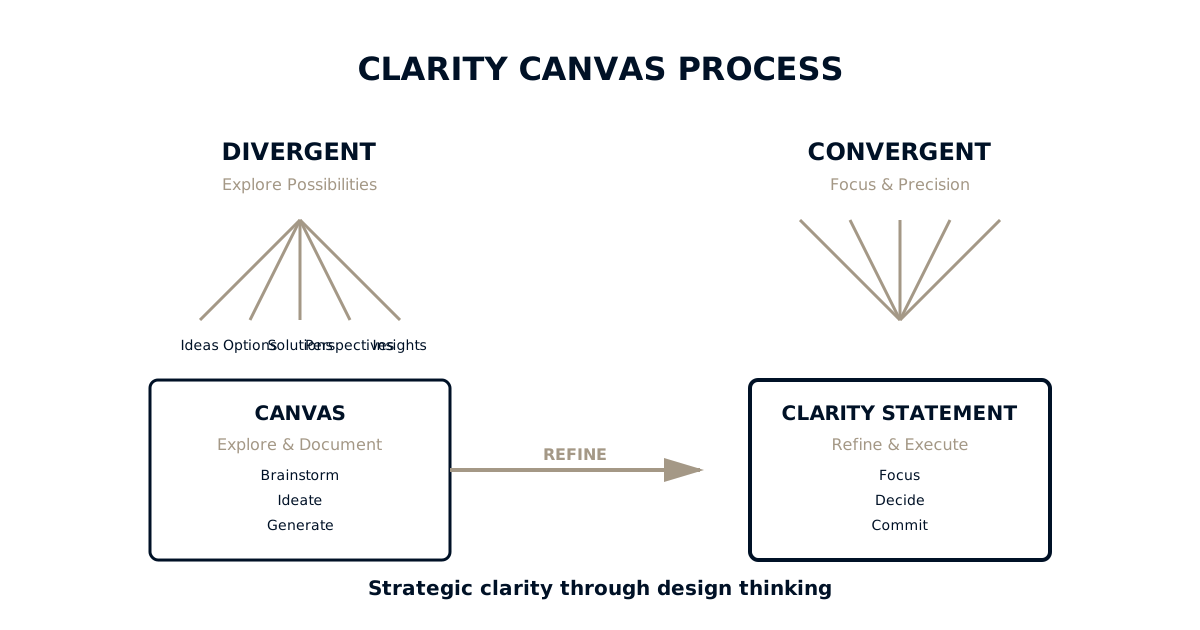
The seventh question in the Resolute Leadership Curve framework addresses this directly through a simple but powerful tool: Clarity Canvases. These workshop tools transform strategic conversations from aimless ideation into focused execution through a disciplined process of divergent exploration followed by convergent refinement.
The Problem: Brainstorming Without Structure Creates Chaos
Most leaders know how to generate ideas. Few know how to transform those ideas into executable strategy.
The Strategy Workshop That Goes Nowhere
Common scenario:
- Morning: Energetic brainstorming session produces 47 ideas
- Afternoon: Attempt to prioritize creates debate and politics
- End of day: No decisions, everyone exhausted
- Next week: Nobody remembers what was discussed
- Next month: Team repeats the same conversation
The root cause: Confusing divergent thinking (exploration) with convergent thinking (decision-making).
What Happens Without Clarity Canvases
50-person company attempting strategic planning without framework:
- Strategy sessions: 12 meetings over 3 months = 600 person-hours
- Ideas generated: 150+ possibilities across all sessions
- Decisions made: 3 vague commitments with no measurable outcomes
- Execution rate: 15% of intended initiatives actually launched
- Frustration: Leadership team questions the value of strategic planning
- Cost: $75K in leadership time with minimal strategic progress
Result: Motion masquerading as progress. Ideas confused with decisions. Strategic ambiguity disguised as open-mindedness.
The Hidden Cost of Strategic Ambiguity
Lack of strategic clarity causes:
- Wasted execution effort: Teams pursue conflicting priorities
- Leadership credibility erosion: Employees stop believing strategic pronouncements
- Resource misallocation: Budget spread across too many unfocused initiatives
- Competitive disadvantage: Competitors with clearer focus execute faster
- Talent attrition: High performers leave for organizations with clear direction
The difference between high-performing organizations and struggling ones isn't the quality of ideas—it's the quality of clarity that emerges from strategic conversations.
Learn more about how the 12 Questions framework creates systematic clarity across management and leadership.
What Clarity Canvases Actually Are
Clarity Canvas = A structured workshop tool designed to facilitate divergent thinking—encouraging exploration of multiple possible ideas, solutions, and perspectives without premature judgment or constraint.
It's not a template to fill out. It's a facilitation framework for disciplined exploration.
The Dual-Tool System
The Clarity Canvas methodology uses two complementary tools:
1. Canvas (Divergent Thinking Tool)
- Purpose: Explore possibilities without constraint
- Process: Brainstorming, ideation, perspective-gathering
- Mindset: Non-linear, creative, spontaneous, free-flowing
- Output: Wide range of possibilities documented and visible
2. Clarity Statement (Convergent Thinking Tool)
- Purpose: Refine exploration into focused direction
- Process: Analysis, prioritization, decision-making, commitment
- Mindset: Logical, exclusive, focused on clearest solution
- Output: Precise statement of strategic direction and commitment
Together, they implement design thinking for business strategy—the same methodology IDEO uses for innovation and Stanford's d.school teaches for solving complex problems.
The Cattle Mustering Analogy
Think of strategic clarity like mustering cattle on a vast Australian property, using helicopters for maximum vision and coverage:
Divergent Phase (Fan Out Wide):
- Helicopters spread across the entire property
- Looking for every animal scattered across thousands of acres
- Searching comprehensively without leaving gaps
- Strategic parallel: Exploring all ideas, perspectives, and possibilities
Convergent Phase (Bring to the Yards):
- Helicopters guide cattle toward central yards
- Individual animals identified, marked with ear tags
- Genetics assessed, health checked, treatments administered
- Strategic parallel: Each idea evaluated, tagged with priority, assessed for viability, strengthened through refinement
The result: A managed herd with clear genetic markers, health records, and growth trajectory. Strategic translation: A portfolio of initiatives with clear priorities, success metrics, and execution plans.
This article introduces the Clarity Canvas methodology. For the complete canvas templates, clarity statement formulas, and step-by-step facilitation guides, get Resolute by Stuart Leo on Amazon.
The Canvas → Clarity Process in Action
Stage 1: Canvas (Divergent Exploration)
Purpose: Generate the widest possible range of options before constraining to decisions.
The process:
- Frame the question - Start with one of the 12 Questions that needs clarity
- Silent generation - Each participant documents ideas individually first (prevents groupthink)
- Round-robin sharing - Everyone contributes without debate or evaluation
- Visual clustering - Group related ideas, identify themes, spot patterns
- Expand thinking - Ask "What else?", "What if?", "What about?" to push boundaries
Example: Vision Canvas Workshop
Leadership Question 1: "What is our vision, is it driven by our purpose, and what is holding us back from reaching it?"
Canvas exploration produces:
- 23 ideas about potential vision directions
- 15 identified barriers to achieving current vision
- 8 purpose statements from different perspectives
- 12 environmental factors shaping future possibilities
- 6 competitive positions to consider
Critical rule during divergent phase: No evaluation, no debate, no premature convergence. The goal is comprehensive exploration, not decision-making.
Stage 2: Clarity Statement (Convergent Refinement)
Purpose: Transform exploration into executable strategy through disciplined refinement.
The process:
- Evaluate options - Assess each idea against strategic criteria
- Identify patterns - What themes emerge? What contradictions appear?
- Force choices - Eliminate what doesn't serve the strategic direction
- Refine language - Make commitments specific and measurable
- Document clearly - Create precision statement that drives execution
Continuing Vision example:
Convergent process:
- Evaluate: Which vision directions align with our capabilities and market opportunity?
- Pattern: Three themes emerged around customer transformation, market leadership, industry evolution
- Choices: Eliminated visions requiring capabilities we can't build in 5 years
- Refinement: Crafted precise vision statement with measurable milestones
- Clarity Statement: "By 2028, we will be the recognized leader in [specific market] transformation, measured by [specific metrics], enabling [specific customer outcomes]."
Result: From 23 possibilities to 1 clear commitment that guides resource allocation and strategic initiatives.
Why the Sequence Matters (Divergent → Convergent)
Starting with convergent thinking (immediate decision-making) produces:
- ❌ Narrow solutions based on existing mental models
- ❌ Groupthink around first ideas suggested
- ❌ Missed opportunities not considered
- ❌ Political outcomes instead of strategic ones
Starting with divergent thinking (comprehensive exploration) produces:
- ✅ Broad solution space with novel possibilities
- ✅ Psychological safety for unconventional ideas
- ✅ Discovery of non-obvious strategic options
- ✅ Commitment based on thorough consideration
Research on design thinking methodologies shows that teams using structured divergent-convergent processes make 40% better strategic decisions than teams using unstructured brainstorming.
The 12 Canvases: Systematic Clarity Across Strategy
The Clarity Canvas methodology isn't a single tool—it's a system of 12 canvases, each designed to answer one of the 12 Questions in the Resolute Leadership Curve.
The 5 Management Canvases
Management Question Canvases focus on operational clarity:
- Plan Canvas - What is our plan, and what metrics tell us if we are successful?
- Roles Canvas - What roles does our plan require, and who is accountable for what parts?
- Goals Canvas - What goals and outcomes must each role achieve this quarter, half, or year?
- Meetings Canvas - What meetings are necessary, what should we discuss, and how do we solve problems together?
- Data Canvas - What data do we need to measure our progress and ensure success?
The 7 Leadership Canvases
Leadership Question Canvases focus on strategic clarity:
- Vision Canvas - What is our vision, is it driven by our purpose, and what is holding us back from reaching it?
- Market Canvas - What is our market, who is our ideal customer, what do they value, and what perceptions do we need to build?
- Strategy Canvas - What is our strategy, where is our growth focused, and how do we improve our positioning?
- Business Model Canvas - What is our business model, is it creating value, what metrics tell us this, and what practices improve our value proposition?
- Customer Experience Canvas - What is our customer's experience, how do we acquire, retain, and grow customers through our journey & promise, and what improvements need to be made?
- Employee Experience Canvas - What is our employee's experience, how do we acquire, retain, and grow talent through our journey & promise, and what improvements need to be made?
- Breakthrough Canvas - What are the one, two, or three things that, if delivered in the quarter or half, will shift the needle on the business?
Together, these 12 canvases create systematic clarity across every strategic and operational dimension of your business.
Practical Application: Running an Effective Canvas Workshop
The Facilitation Framework
Successful canvas workshops follow this structure:
Pre-Work (Before the Workshop)
- Select which canvas to use (which question needs clarity?)
- Assign pre-reading or data collection
- Schedule 90-120 minutes of uninterrupted time
- Prepare visual workspace (physical whiteboard or digital canvas tool)
Workshop Flow (90-120 minutes)
Part 1: Divergent Phase (45-60 minutes)
- Frame the question clearly (5 min)
- Silent individual ideation (10 min)
- Round-robin sharing without debate (20 min)
- Visual clustering and pattern recognition (15 min)
- Expansion questions to push thinking (10 min)
Part 2: Convergent Phase (45-60 minutes)
- Evaluation criteria discussion (10 min)
- Systematic evaluation of options (20 min)
- Debate and refinement of top choices (15 min)
- Craft clarity statement draft (10 min)
- Commitment and next actions (5 min)
Post-Work (After the Workshop)
- Finalize clarity statement wording
- Document decisions and rationale
- Communicate to broader organization
- Establish accountability for execution
- Schedule follow-up review
Common Facilitation Mistakes to Avoid
❌ Allowing debate during divergent phase - Kills psychological safety and creative exploration ❌ Skipping individual silent ideation - Allows dominant voices to drive all thinking ❌ Not using visual documentation - Teams can't see patterns without spatial organization ❌ Rushing to convergence - Premature decisions based on incomplete exploration ❌ Ending without clarity statement - Workshop produces ideas but not executable commitments ❌ No accountability assignment - Clarity without ownership produces no action
✅ Best Practice: Separate roles - One person facilitates process, leadership team provides content. Never ask the CEO to both facilitate and participate.
The Strategic Agility Rhythm
Canvas workshops aren't one-time events—they're recurring practices that build organizational muscle for strategic agility.
Recommended cadence:
- Quarterly: Revisit Vision, Strategy, and Breakthrough canvases
- Monthly: Review Plan, Goals, and Data canvases
- As needed: Market, Business Model, CX, and EX canvases when conditions change
- Annually: Complete refresh of all 12 canvases for strategic planning
Why repeat the process? Each iteration:
- Surfaces new information and market changes
- Tests previous assumptions against reality
- Deepens organizational alignment and understanding
- Builds team capability for strategic thinking
- Creates compound clarity over time—like compound interest for strategic intelligence
According to research from McKinsey on strategic agility, companies that revisit strategic questions quarterly are 3.2x more likely to outperform competitors in volatile markets than those conducting annual strategic planning only.
Experience Clarity Canvases in Practice
For complete Clarity Canvas templates, step-by-step facilitation guides, and clarity statement formulas for all 12 Questions, get Resolute by Stuart Leo on Amazon.
The book provides:
- 12 complete canvas templates - Print-ready or digital formats for each question
- Facilitation scripts - Exact questions to ask at each workshop stage
- Clarity statement formulas - Frameworks for refining exploration into executable commitments
- Real workshop examples - Documented sessions showing the process in action
- Common pitfalls - What goes wrong and how to prevent facilitation failures
Strategic clarity isn't about having all the answers—it's about having a disciplined process for finding them. Learn more about the complete 12 Questions framework and how divergent-convergent thinking drives business strategy.
About the Author

Stuart Leo
Stuart Leo founded Waymaker to solve a problem he kept seeing: businesses losing critical knowledge as they grow. He wrote Resolute to help leaders navigate change, lead with purpose, and build indestructible organizations. When he's not building software, he's enjoying the sand, surf, and open spaces of Australia.