The CFO who discovers Shadow AI in their organization faces a tempting but dangerous response: ban all AI tools immediately. Issue a company-wide directive. Block AI websites at the firewall. Problem solved, right?
Wrong. Blanket AI bans don't stop Shadow AI—they drive it deeper underground. Employees who found AI valuable for their work will find workarounds: personal devices, mobile hotspots, cleverly disguised tools. Meanwhile, your competitors embrace AI strategically, gaining productivity advantages while you debate policy. According to research from The CFO, 59% of employees already use AI tools. You can't put that genie back in the bottle.
The solution isn't banning AI—it's governing it. Enterprise AI governance creates a framework where innovation flourishes within guardrails, where employees have approved tools that work better than Shadow AI alternatives, and where security and compliance teams can sleep at night.
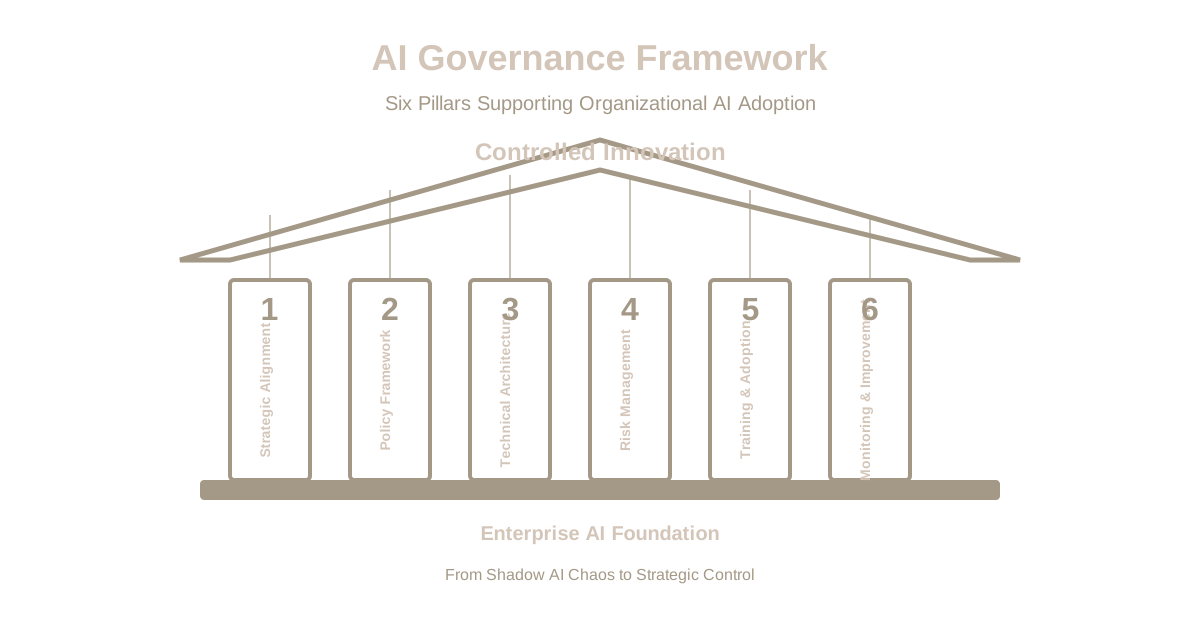
This article presents a proven 6-pillar AI governance framework that has helped organizations move from chaotic Shadow AI to strategic, controlled AI adoption. Whether you're a Fortune 500 enterprise or a 200-person mid-market firm, these principles scale to your organization's size, industry, and risk tolerance. The goal: 100% approved AI usage with zero Shadow AI—not through prohibition, but through providing better alternatives.
Why Traditional IT Governance Fails for AI
Before diving into the framework, understand why AI governance is fundamentally different from traditional SaaS governance.
The Velocity Problem
Traditional IT procurement:
- RFP process: 3-6 months
- Security review: 2-4 weeks
- Contract negotiation: 4-8 weeks
- Implementation: 2-3 months
- Total time to value: 6-12 months
AI tool adoption:
- Sign up with email: 2 minutes
- Credit card payment: 1 minute
- Start using with company data: Immediately
- Total time to value: 3 minutes
By the time traditional IT governance identifies an AI tool need, evaluates vendors, and approves a solution, employees have been using Shadow AI for 6-12 months. The governance process itself creates the Shadow AI it's meant to prevent.
The Accessibility Problem
Traditional enterprise software required IT involvement: servers to provision, VPNs to configure, clients to install. This natural friction gave IT time to assess and govern tools before widespread adoption.
AI tools eliminated that friction. No installation, no IT tickets, no procurement approvals—just a browser and a credit card. Business amnesia and organizational memory challenges drive employees to seek immediate AI solutions without considering governance implications.
The Value Problem
Here's the uncomfortable truth: Shadow AI tools are often better than IT-approved alternatives. Consumer AI has been optimized for user experience, instant gratification, and addictive engagement. When IT finally approves an "enterprise AI solution," it's often:
- Slower (security layers add latency)
- More complex (enterprise features create UI clutter)
- More expensive (enterprise pricing)
- Less capable (conservative model selection)
Employees resist migration because the approved tool feels like a downgrade. Effective AI governance must provide tools that are demonstrably better than Shadow AI alternatives, not just compliant.
The Knowledge Problem
Traditional IT governance assumes IT teams have deep expertise in the technology being governed. With AI, this assumption fails:
- AI capabilities evolve weekly (new models, new features)
- Business use cases emerge faster than IT can document them
- Non-technical employees often understand AI value better than IT
- Security implications require specialized AI/ML knowledge
IT teams are asked to govern technology they don't fully understand, for use cases they haven't imagined, against risks they can't fully quantify. This knowledge gap paralyzes decision-making, creating governance vacuums that Shadow AI fills.
The 6-Pillar Enterprise AI Governance Framework
Effective AI governance requires simultaneous work across six interdependent pillars. Neglect one, and the entire framework weakens. Master all six, and you create an environment where controlled AI adoption becomes the path of least resistance.
Pillar 1: Strategic Alignment & Executive Sponsorship
Why this matters: AI governance fails without C-suite commitment. When executives don't understand or support AI strategy, middle management receives mixed signals, IT lacks enforcement authority, and employees ignore policies.
Core Components:
AI Strategy Document:
- Business objectives: Which strategic goals does AI support?
- Competitive positioning: How does AI affect market competitiveness?
- Risk tolerance: What level of AI risk is acceptable for potential value?
- Investment framework: How much will we invest in AI capabilities?
- Success metrics: How will we measure AI governance effectiveness?
Executive Sponsor Assignment:
- Typically CFO or COO (someone with budget authority and operational scope)
- Responsible for AI governance committee leadership
- Breaks cross-functional deadlocks
- Communicates AI strategy to board
- Allocates resources for implementation
Board Education:
- Quarterly AI governance updates to board/audit committee
- Shadow AI risks and mitigation strategies
- Competitive AI adoption benchmarking
- Regulatory compliance status
- Major AI investment decisions
Example Strategic Alignment Statement:
"[Organization] will adopt AI strategically to improve operational efficiency, customer experience, and competitive positioning while maintaining rigorous data protection and regulatory compliance. We will provide employees with approved AI platforms that offer superior capabilities to consumer tools, eliminating Shadow AI through better alternatives rather than prohibition. AI governance is a board-level priority with C-suite accountability."
How Waymaker Supports This Pillar:
The Context Compass framework provides a strategic approach to organizational AI adoption. Rather than viewing AI as a tool, Context Compass positions AI as an organizational intelligence capability that compounds over time—making strategic alignment easier by connecting AI directly to business value.
Pillar 2: Policy Framework & Acceptable Use
Why this matters: Ambiguous policies create confusion and inconsistent enforcement. Clear policies provide employees with bright lines: what's permitted, what's prohibited, and why.
Core Components:
AI Usage Policy:
Scope: Applies to all employees, contractors, temporary workers, and third parties with data access
Approved Tools:
- [List approved AI platforms by name]
- Waymaker Commander (enterprise AI with DPAs; BAAs requested from its AI providers)
- [Other approved tools for specific use cases]
Prohibited Tools:
- Consumer AI services (ChatGPT, Claude.ai, Gemini, etc.) when used with company or customer data
- AI tools without organization-approved accounts
- Personal AI accounts for business purposes
Acceptable Use:
- AI may be used for [list approved use cases]: research, document drafting, data analysis, etc.
- All AI usage must comply with data classification policies
- [Sensitive data types] may not be input into AI tools without [specific approvals]
- AI-generated content must be reviewed by qualified humans before use in [critical applications]
Prohibited Use:
- Inputting confidential customer information into unapproved AI
- Using AI to make decisions without human oversight for [list contexts]
- Attempting to circumvent AI monitoring or security controls
- Sharing organization AI accounts or credentials
Data Classification Integration:
- Public data: May be used with approved AI tools
- Internal data: May be used with approved AI tools for authorized purposes
- Confidential data: Requires manager approval and data sanitization
- Restricted data (PHI, PII, PCI, financial): Requires compliance officer approval; HIPAA-compliant AI only
Consequences:
- First violation: Warning and mandatory retraining
- Second violation: Disciplinary action up to suspension
- Third violation: Termination and potential legal action
- Violations causing data breaches: Immediate termination, potential criminal/civil liability
Policy Communication:
- Published in employee handbook and intranet
- Distributed via email with acknowledgment requirement
- Covered in new employee onboarding
- Reviewed annually with all staff
- Updated as AI capabilities and risks evolve
Example Policy Excerpt:
"Employees may use Waymaker Commander for business-related AI assistance, including document drafting, data analysis, and strategic planning. Waymaker is approved because it provides contractual data protection (BAAs with AI providers), enterprise security controls (MFA, audit logs), and compliance certifications (SOC 2, GDPR). Employees may not use consumer AI tools like ChatGPT or Claude.ai with company or customer data, as these services lack the contractual protections and security controls our organization requires. Violations will result in disciplinary action."
How Waymaker Supports This Pillar:
Waymaker's architecture makes it easy to write compliant policies. The platform's approved enterprise status with BAAs, DPAs, and security certifications provides the foundation for "why this tool is approved" explanations that help employees understand the policy rationale.
Pillar 3: Technical Architecture & Platform Selection
Why this matters: Governance fails if approved platforms don't meet business needs. Employees will circumvent poor solutions regardless of policy.
Core Components:
Platform Selection Criteria:
Security Requirements:
- Encryption in transit (TLS 1.3 minimum)
- Encryption at rest (AES-256 minimum)
- Role-Based Access Control (RBAC)
- Multi-Factor Authentication (MFA) support
- Single Sign-On (SSO) integration
- Audit logging (minimum 1-year retention)
- Regular security audits and penetration testing
Compliance Requirements:
- Business Associate Agreement (BAA) for HIPAA if applicable
- Data Processing Agreement (DPA) for GDPR if applicable
- SOC 2 Type II certification (current or in progress)
- Standard Contractual Clauses (SCCs) for international data transfers
- Zero data retention for AI model training (contractual guarantee)
Functional Requirements:
- Supports business use cases (document generation, analysis, etc.)
- Integrates with existing systems (CRM, project management, etc.)
- Provides credit-based or usage-based consumption (predictable costs)
- Offers manual mode or fallback when AI unavailable
- Scales to organization size and growth projections
Vendor Requirements:
- Financial stability (3+ years operating history preferred)
- Customer references from similar organizations
- Responsive support with defined SLAs
- Transparent pricing without surprise fees
- Clearly documented data flows and subprocessors
Architecture Principles:
Single Platform Strategy: Rather than approving 10 different AI tools for different use cases, select one comprehensive platform that handles 80% of needs. Add specialized tools only when clearly justified.
Why: Reduces training burden, simplifies security monitoring, consolidates spending, creates consistent user experience.
API-First Integration: Ensure approved platform integrates with existing workflows rather than requiring separate logins and context-switching.
Why: Integration reduces friction, increasing adoption of approved tools over Shadow AI.
Zero Trust Architecture: Assume approved platform could be compromised; layer additional controls (DLP, monitoring, access controls) around it.
Why: Defense in depth protects against platform vulnerabilities and insider threats.
Waymaker Architecture Advantages:
Waymaker was designed specifically for enterprise AI governance:
- Centralized platform: Strategic execution platform with AI enhancement (not AI-only tool)
- Credit-based consumption: Transparent costs, no hidden fees, predictable budgeting
- AI routing: Intelligent routing to appropriate models (cost optimization)
- Manual mode fallback: Software works fully without AI (no vendor lock-in)
- Enterprise controls: RBAC, MFA, SSO, audit logs all standard
- Compliance ready: DPAs and GDPR compliance built in; BAAs requested; SOC 2 for Waymaker itself on the roadmap
Read more about context engineering vs prompt engineering to understand Waymaker's architectural approach to organizational AI.
Pillar 4: Risk Management & Compliance
Why this matters: AI introduces novel risks that traditional risk frameworks don't fully address. Explicit AI risk management prevents surprises.
Core Components:
AI Risk Assessment Matrix:
Create a risk matrix mapping AI usage scenarios to potential impacts:
| Use Case | Data Type | AI Tool | Risk Level | Mitigation |
|---|---|---|---|---|
| HR policy drafting | Public | Waymaker | Low | Human review before publication |
| Customer proposal generation | Confidential | Waymaker | Medium | Manager approval required |
| Financial analysis | Financial | Waymaker | High | Dual human review + audit trail |
| Patient diagnosis assistance | PHI | Waymaker (HIPAA) | Critical | Physician final decision + documentation |
Risk levels trigger different controls:
- Low: Standard usage, routine monitoring
- Medium: Manager approval, enhanced logging
- High: Compliance officer awareness, quarterly audit
- Critical: Board awareness, continuous monitoring, immediate incident escalation
Compliance Mapping:
Map AI governance to regulatory requirements:
GDPR Article 28 (Processor Requirements):
- Requirement: Data Processing Agreement with AI vendor
- Mitigation: Waymaker DPA executed and reviewed annually
- Evidence: Copy of DPA in compliance repository
HIPAA Privacy Rule (Business Associates):
- Requirement: BAA with all vendors processing PHI
- Mitigation: Process PHI only through a vendor with an executed BAA (for Waymaker, confirm current status with Waymaker before processing PHI)
- Evidence: Copy of the executed BAA; employee training records
SOX Section 404 (Internal Controls):
- Requirement: Document controls over financial reporting
- Mitigation: AI policy prohibits AI-generated financial statements; human review required
- Evidence: Policy document; financial close process documentation
Incident Response Plan:
AI-Specific Incident Types:
- Shadow AI data breach (employee uses unapproved tool with sensitive data)
- AI hallucination incident (AI generates false information used in business decision)
- Compliance violation (AI usage violates GDPR, HIPAA, etc.)
- Reputational incident (AI-generated content causes public relations crisis)
Response Protocol:
- Detection: Monitoring alerts, employee reports, customer complaints
- Assessment: Severity classification (P1 Critical to P4 Low)
- Containment: Immediate actions to stop harm
- Investigation: Root cause analysis
- Remediation: Fix underlying issues
- Notification: Regulators, customers, board as required
- Prevention: Policy/technical updates to prevent recurrence
Continuous Risk Monitoring:
- Monthly review of AI usage anomalies
- Quarterly risk assessment updates
- Annual comprehensive AI risk audit
- Board reporting on AI risk landscape changes
Pillar 5: Training, Change Management & Adoption
Why this matters: The best governance framework fails if employees don't understand it or resist adoption. Change management determines success.
Core Components:
Stakeholder Communication Strategy:
Different audiences need different messages:
Executive Leadership:
- Message: "AI governance protects the organization while enabling innovation. We're providing employees with better tools than Shadow AI."
- Communication: Board presentations, executive briefings, strategic planning sessions
- Frequency: Quarterly updates
Middle Management:
- Message: "You're responsible for ensuring your team uses approved AI tools. We'll provide training and support."
- Communication: Manager training sessions, policy implementation guides, escalation procedures
- Frequency: Initial training + annual refreshers
Employees:
- Message: "We're giving you powerful AI tools that are officially approved and better than consumer alternatives. Here's how to use them responsibly."
- Communication: Hands-on training, quick-start guides, ongoing tips and best practices
- Frequency: Onboarding + quarterly "AI tips" communications
IT & Security:
- Message: "Here's how to monitor, support, and enforce AI governance. You're enablers, not blockers."
- Communication: Technical training, monitoring dashboards, incident response procedures
- Frequency: Initial training + as-needed technical updates
Training Program Design:
Module 1: Why AI Governance Matters (30 minutes)
- Shadow AI risks (security, compliance, productivity)
- Real breach examples and costs
- Organization's AI strategy and vision
- How approved tools protect employees and organization
Module 2: Using Waymaker Effectively (60 minutes)
- Account setup and authentication (SSO)
- Basic AI features (document generation, analysis, etc.)
- Data classification guidance (what data is appropriate)
- Credit budgets and responsible consumption
- Context Compass methodology introduction
- Integration with existing workflows
Module 3: Responsible AI Usage (30 minutes)
- Recognizing AI hallucinations and errors
- When human review is required
- Appropriate vs inappropriate use cases
- Reporting concerns or incidents
- Career impact of AI proficiency
Module 4: Hands-On Practice (60 minutes)
- Guided exercises for common use cases
- Department-specific scenarios
- Q&A with governance team
- Certification quiz (80% pass required)
Training Delivery:
- Live virtual sessions (recorded for on-demand access)
- In-person workshops for key departments
- Self-paced e-learning modules
- Department-specific training (Sales, Finance, HR, etc.)
- Role-specific advanced training (power users, admins)
Adoption Incentives:
Positive Incentives:
- Gamification: "AI Champions" program recognizing top adopters
- Credit bonuses: Departments exceeding adoption goals get extra AI credits
- Success stories: Internal newsletter featuring employees solving problems with AI
- Career development: AI proficiency as promotion criteria
Friction Reduction:
- SSO integration: One-click login (no separate passwords)
- Slack/Teams integration: AI in existing workflows
- Templates library: Pre-built prompts for common tasks
- Power user support: Dedicated Slack channel for advanced users
Negative Reinforcement:
- Progressive discipline: Warnings → suspension → termination for Shadow AI
- Manager accountability: Manager performance includes team compliance rates
- Audit visibility: Regular compliance reports to leadership
Change Management Timeline:
Phase 1: Awareness (Weeks 1-2)
- C-suite announces AI governance initiative
- "Why this matters" communications to all employees
- FAQ document addressing concerns
- Initial training schedule published
Phase 2: Pilot (Weeks 3-6)
- 20-50 pilot users across departments
- Intensive training and support
- Gather feedback and refine approach
- Celebrate early wins publicly
Phase 3: Rollout (Weeks 7-12)
- Department-by-department deployment
- Ongoing training sessions
- Support office hours and helpdesk
- Shadow AI sunset (technical controls + policy enforcement begins)
Phase 4: Optimization (Week 13+)
- Usage analytics review
- Best practices documentation
- Advanced training for power users
- Continuous improvement based on feedback
Pillar 6: Monitoring, Enforcement & Continuous Improvement
Why this matters: Governance without monitoring is governance theater. Continuous improvement keeps governance relevant as AI evolves.
Core Components:
Technical Monitoring:
Network Monitoring:
- Monitor traffic to known AI domains (openai.com, claude.ai, etc.)
- Alert on attempts to access unapproved AI services
- Block consumer AI domains at firewall (optional but effective)
- Whitelist approved domains (waymaker.io, etc.)
Endpoint Monitoring:
- Browser extension detection (consumer AI extensions)
- Application monitoring (unapproved AI desktop apps)
- Data Loss Prevention (DLP) rules for AI-related data exfiltration
- Clipboard monitoring for copy-paste to unapproved services (controversial but effective)
Usage Analytics:
- Waymaker usage metrics (who's using AI, how often, for what)
- Credit consumption by department (spending patterns)
- Feature adoption rates (which AI capabilities are valuable)
- User satisfaction surveys (NPS for approved platform)
Anomaly Detection:
- Unusual usage patterns (sudden spikes, off-hours usage)
- Potential data exfiltration (large copy operations)
- Failed authentication attempts
- Shadow AI signals (VPN usage increase, cloud storage uploads)
Compliance Audits:
Quarterly AI Governance Reviews:
- Review AI usage reports with governance committee
- Assess policy violations and disciplinary actions taken
- Update risk assessments for new AI capabilities
- Evaluate approved platform performance and user satisfaction
- Identify areas for policy clarification or training
Annual Comprehensive Audits:
- Independent third-party audit of AI governance program
- Compliance verification (GDPR, HIPAA, SOX, etc.)
- Vendor security assessment (SOC 2 review, penetration test results)
- Employee compliance testing (random sample interviews)
- Board presentation with audit findings and recommendations
Continuous Improvement Process:
Feedback Loops:
- Employee feedback portal for AI governance suggestions
- Monthly governance committee meetings reviewing feedback
- Quarterly "State of AI" internal surveys
- User group sessions with power users
- Integration with IT service management (ticket analysis)
Adaptive Policy Updates:
- Monitor regulatory changes (GDPR guidance, HIPAA updates)
- Assess new AI technologies and risks
- Update policies quarterly (or as needed for major changes)
- Communicate changes with rationale to avoid policy fatigue
Innovation Pipeline:
- Evaluate requests for new AI use cases
- Pilot emerging AI capabilities in controlled environments
- Expand approved use cases based on successful pilots
- Sunset low-value AI capabilities to maintain focus
Governance Metrics Dashboard:
Track and report these KPIs monthly:
Adoption Metrics:
- % employees with active Waymaker accounts (target: 90%+)
- % employees using AI weekly (target: 60%+)
- Average AI credits consumed per user (benchmark over time)
- User satisfaction score (target: 8.5/10+)
Compliance Metrics:
- Shadow AI incidents detected (target: <1 per month)
- Policy violations (target: <5 per quarter)
- Compliance audit findings (target: 0 high/critical findings)
- Employee training completion rate (target: 100%)
Business Value Metrics:
- Time saved per department (self-reported + analytics)
- Cost savings from consolidated AI spending
- Quality improvements (reduced errors, better outputs)
- Innovation indicators (new use cases, productivity gains)
Risk Metrics:
- Data breach incidents related to AI (target: 0)
- Near-miss incidents (caught before harm)
- Regulatory inquiries or penalties (target: 0)
- Reputational incidents (target: 0)
Implementing the Framework: Your 90-Day Roadmap
Comprehensive AI governance takes time, but you can achieve substantial progress in 90 days with focused execution.
Days 1-30: Foundation & Planning
Week 1: Executive Alignment
- Secure C-suite sponsor (typically CFO or COO)
- Form AI governance committee (IT, Security, Legal, Compliance, Business Units)
- Conduct Shadow AI audit to assess current state
- Define business objectives for AI adoption
Week 2: Policy Development
- Draft AI usage policy (use template from Pillar 2)
- Review with legal counsel and compliance officer
- Integrate with existing data classification policies
- Define consequences and enforcement procedures
Week 3: Platform Selection
- Evaluate approved platform candidates (start with Waymaker)
- Conduct security and compliance reviews
- Negotiate contracts and pricing
- Plan integration architecture
Week 4: Communication Planning
- Develop stakeholder communication plan
- Create training program outline
- Design change management approach
- Set adoption targets and success metrics
Days 31-60: Pilot & Refinement
Week 5-6: Pilot Setup
- Deploy Waymaker to 20-50 pilot users across departments
- Configure SSO, RBAC, credit budgets
- Provide intensive pilot user training
- Establish feedback channels
Week 7-8: Pilot Execution
- Monitor pilot user adoption and satisfaction
- Troubleshoot technical issues
- Gather use cases and success stories
- Refine policies based on pilot learnings
Week 9: Pilot Evaluation
- Analyze pilot metrics (usage, satisfaction, business value)
- Document lessons learned
- Update training materials based on feedback
- Prepare for organization-wide rollout
Days 61-90: Organization-Wide Deployment
Week 10: Rollout Launch
- C-suite announcement of AI governance program
- Publish AI usage policy organization-wide
- Launch training registration and schedule
- Begin monitoring for Shadow AI
Week 11-12: Department Deployments
- Deploy Waymaker to all employees
- Conduct department-specific training
- Provide support office hours
- Celebrate early wins and success stories
Week 13: Shadow AI Sunset
- Activate technical controls (firewall blocks, DLP rules)
- Begin enforcement of AI usage policy
- Communicate compliance expectations clearly
- Provide amnesty for prior Shadow AI use (go-forward enforcement only)
Post-90-Day: Continuous Governance
Month 4+:
- Monthly governance committee meetings
- Quarterly compliance audits
- Ongoing training for new employees
- Continuous policy refinement
- Innovation pipeline for new use cases
Common Implementation Challenges & Solutions
Challenge 1: "Employees Resist Change"
Symptom: Low adoption rates, continued Shadow AI usage, complaints about approved platform.
Root Causes:
- Approved platform is genuinely worse than Shadow AI (functionality gap)
- Training inadequate (users don't know how to use it effectively)
- Messaging wrong ("AI ban" vs "better AI")
- Insufficient executive support (employees sense lack of commitment)
Solutions:
- Ensure approved platform is objectively better (Waymaker's enterprise features > consumer ChatGPT)
- Invest in comprehensive training (not just "how to click" but "how to be productive")
- Reframe messaging: "We're giving you powerful, officially-approved AI"
- Visible executive usage (CEO mentions using Waymaker in all-hands)
- Gamification and incentives (AI Champions program, credit bonuses)
Challenge 2: "IT Lacks AI Expertise"
Symptom: Slow decision-making, risk-averse blocking, inability to troubleshoot AI-specific issues.
Root Causes:
- IT teams haven't been trained on AI technology
- AI evolves faster than IT can build expertise
- IT culture emphasizes stability over innovation
Solutions:
- Partner with Waymaker support for technical expertise
- External AI governance consultant for policy framework
- AI training for IT team (both technical and strategic)
- Cross-functional governance committee (business reps have voice)
- "Safe to experiment" sandbox environments for learning
Challenge 3: "Policies Don't Keep Up with AI Evolution"
Symptom: Policies reference outdated AI capabilities, gaps for new tools, ambiguity about edge cases.
Root Causes:
- AI technology evolves weekly (new models, new features, new risks)
- Policy update process too slow
- No one assigned to monitor AI landscape
Solutions:
- Assign "AI Technology Monitor" role (could be governance committee member)
- Quarterly policy reviews minimum (monthly better)
- "Living document" approach with version control
- Clear escalation process for ambiguous cases
- Broader "principles" guidance rather than hyper-specific rules
Challenge 4: "Can't Measure ROI"
Symptom: Executives question AI governance investment; hard to justify continued resources.
Root Causes:
- Didn't define success metrics up front
- Focused on compliance (cost avoidance) rather than value creation
- No baseline data for comparison
Solutions:
- Define metrics during planning phase (see Pillar 6 dashboard)
- Track both risk metrics (breaches avoided) and value metrics (time saved, quality improved)
- Calculate Shadow AI cost baseline, compare to Waymaker investment
- Business case: Avoided breach cost ($4.45M) + productivity gains + competitive advantage
- Qualitative benefits: Employee satisfaction, customer confidence, board assurance
The Governance Maturity Model: Where Are You?
Assess your organization's AI governance maturity:
Level 1: Unaware
- No AI policy exists
- Leadership unaware of Shadow AI usage
- No approved AI platforms
- No monitoring or enforcement
- Risk: Extreme (uncontrolled AI usage)
Level 2: Reactive
- Became aware of Shadow AI after incident or audit
- Policy in draft or recently published
- Considering approved platform options
- Minimal monitoring
- Risk: High (still mostly uncontrolled)
Level 3: Developing
- Policy published and communicated
- Approved platform selected (e.g., Waymaker)
- Training program launched
- Basic monitoring in place
- Risk: Medium (transition period)
Level 4: Managed
- 90%+ employees using approved platform
- Comprehensive monitoring and enforcement
- Shadow AI incidents rare (<1/month)
- Quarterly governance reviews
- Risk: Low (controlled with known exceptions)
Level 5: Optimizing
- 100% approved AI usage (zero Shadow AI)
- Continuous improvement culture
- Innovation pipeline for new use cases
- Governance committee anticipates rather than reacts to AI evolution
- Employee AI proficiency competitive advantage
- Risk: Minimal (mature governance with proactive risk management)
Goal: Most organizations should target Level 4 within 12 months, with continuous progress toward Level 5.
Taking Action: Start Your AI Governance Journey
Shadow AI isn't going away. AI capabilities will only become more powerful, more accessible, and more tempting for employees to adopt without approval. The question isn't whether to implement AI governance—it's whether you implement it proactively or reactively after a breach forces action.
Immediate Actions (This Week):
- Assess your current state using the maturity model above
- Conduct Shadow AI audit to quantify exposure
- Secure executive sponsor (typically CFO or COO)
- Form governance committee (cross-functional representation)
- Request Waymaker demo focused on governance capabilities
30-Day Implementation (This Month):
- Draft AI usage policy using Pillar 2 framework
- Select approved platform (evaluate Waymaker)
- Design training program for organization
- Plan pilot deployment with 20-50 users
90-Day Transformation (This Quarter):
- Execute pilot and gather feedback
- Roll out organization-wide with training
- Sunset Shadow AI through policy + technical controls
- Establish monitoring and continuous improvement
The organizations that master AI governance in 2025 will have a significant competitive advantage: faster AI adoption, better risk management, higher employee productivity, and confident executive leadership. Start building your governance framework today.
Experience Waymaker: AI Governance Built In
Waymaker Commander was designed specifically to be the approved AI platform at the center of your governance framework. Unlike consumer AI tools retrofitted for enterprise use, Waymaker's architecture assumes governance requirements from day one.
See how Waymaker supports all six governance pillars:
- Strategic alignment through Context Compass methodology
- Policy compliance with BAAs, DPAs, and security certifications
- Technical architecture with RBAC, SSO, MFA, and audit logs
- Risk management with transparent data flows and zero training retention
- Training resources and partner support for adoption
- Monitoring capabilities with usage analytics and compliance reporting
Register for the beta and build your governance framework on a platform designed for control without compromise.
AI governance is the path from chaos to competitive advantage. Learn more about the Context Compass framework that provides strategic structure for AI adoption, and explore how business amnesia drives Shadow AI when organizational memory systems fail.
About the Author

Stuart Leo
Stuart Leo founded Waymaker to solve a problem he kept seeing: businesses losing critical knowledge as they grow. He wrote Resolute to help leaders navigate change, lead with purpose, and build indestructible organizations. When he's not building software, he's enjoying the sand, surf, and open spaces of Australia.