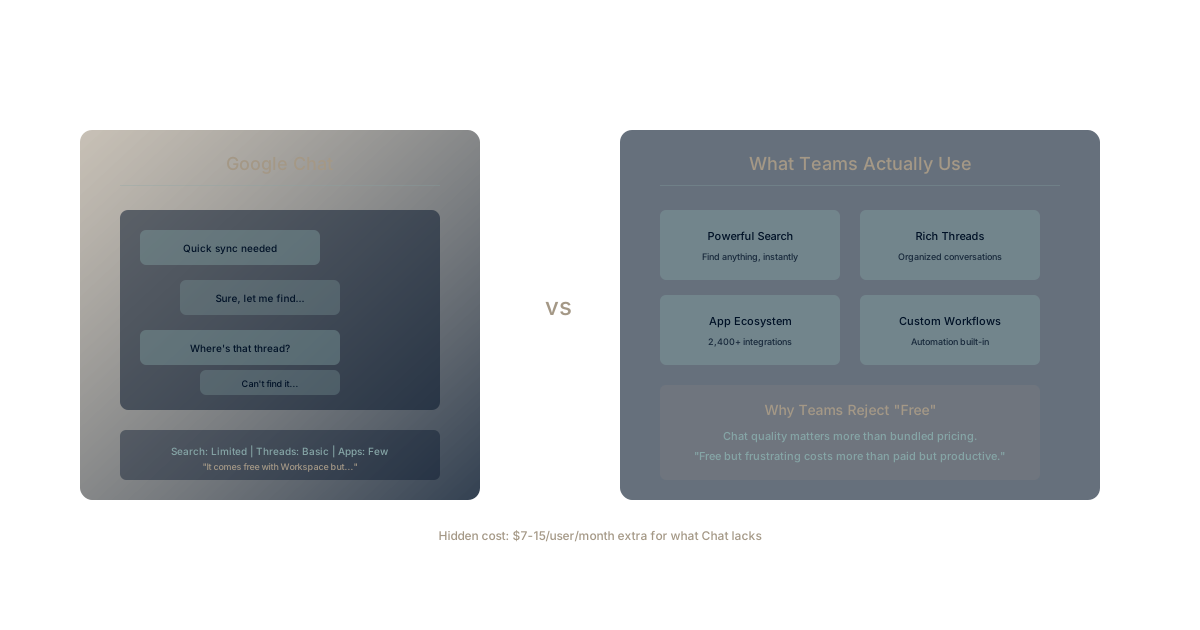
Google Workspace includes Google Chat. It's part of the bundle. No additional cost. Integrated with Gmail, Drive, and Meet.
So why do Workspace customers keep paying for Slack?
The answer reveals what actually matters in team communication tools—and why "free with the bundle" doesn't win when quality falls short.
The Google Chat Reality
What Chat Offers
Google Chat provides:
- Basic messaging: Direct messages and group conversations
- Spaces: Organized conversation threads
- Gmail integration: Chat visible in Gmail sidebar
- Google Meet: Video calls from chat
- File sharing: Drive integration for attachments
On paper, it covers the basics. In practice, teams find it insufficient.
Where Chat Falls Short
Teams consistently cite these gaps:
Search limitations: Finding past conversations is frustrating. Slack's search is legendary. Chat's search feels like an afterthought.
Thread handling: Conversations become confusing. Threading exists but feels awkward compared to competitors.
App ecosystem: Slack offers 2,400+ integrations. Chat's ecosystem is sparse by comparison.
Customization: Workflows, automation, and customization options lag far behind.
UX polish: The interface feels less refined, less focused, less purposeful.
According to enterprise user feedback, Google Chat adoption in companies with existing Slack usage remains low even when included in Workspace subscriptions.
The "Good Enough" Trap
Google's approach to Chat exemplifies a pattern:
- Include feature in bundle
- Make it work at basic level
- Assume bundle inclusion drives adoption
- Don't invest in making it excellent
This works for commoditized features. It fails for tools where quality directly impacts daily work.
Why Teams Pay Extra for Communication
Communication Is Core Infrastructure
Chat isn't a nice-to-have. For distributed teams, it's primary infrastructure:
- Decisions made in threads: Important context lives in chat
- Culture built in channels: Team connection through daily interaction
- Speed enabled by search: Finding information fast matters
- Workflows automated: Integrations reduce manual work
Sub-par chat infrastructure affects everything that flows through it.
The Search Quality Gap
Consider the daily impact of search quality:
With excellent search: "Where did we discuss the API approach?" → Found in 10 seconds With poor search: Multiple failed searches → Ask colleague → Wait for response → Maybe find it
Multiply by dozens of searches daily. Poor search compounds into hours of lost time weekly.
The Integration Gap
Modern work involves many tools. Chat integrations enable:
- Notifications: Alert channels automatically from other systems
- Actions: Take action on other systems from chat
- Context: Pull information from other systems into conversations
- Automation: Workflows triggered by chat activity
Slack's 2,400+ integrations create an ecosystem. Chat's limited integrations create walls.
The Threading Gap
Threading affects communication quality:
Good threading: Conversations stay organized, context preserved, easy to follow later Poor threading: Conversations fragment, context lost, confusion compounds
Teams using Chat often find themselves confused about which conversation relates to which topic. This isn't a minor annoyance—it's organizational friction applied to every discussion.
The Hidden Cost of "Free"
Opportunity Cost
When teams use a subpar tool:
- Discussions take longer than necessary
- Information gets lost more often
- Integration gaps require manual bridging
- Daily friction accumulates
The cost isn't visible on an invoice, but it's real.
Productivity Differential
Research from Slack's work analytics suggests teams using optimized communication tools:
- Make decisions 25% faster
- Spend less time searching for information
- Report higher satisfaction with collaboration
These differentials compound across teams and time.
The Switching Cost Calculation
Teams evaluating Slack vs. Chat inclusion do math:
Slack cost: $7-15 per user per month Chat cost: $0 (included in Workspace) Savings: $84-180 per user per year
Slack value:
- Better search (hours saved per user monthly)
- Better integrations (workflow automation value)
- Better threads (communication clarity value)
- Better ecosystem (reduced tool friction)
For most teams doing the calculation honestly, the value far exceeds the cost.
What Google Would Need to Change
Search Parity
To compete with Slack, Chat would need:
- Search that finds messages reliably
- Filters that narrow results effectively
- Search that includes file content
- Results that include thread context
This isn't impossible—Google invented modern search. They just haven't applied that capability to Chat.
Integration Ecosystem
Building a competitive ecosystem requires:
- Robust API for developers
- Marketplace for discovery
- Partnership development
- Enterprise integration focus
This is a multi-year investment Google hasn't prioritized.
UX Investment
Making Chat feel as polished as Slack requires:
- User research with heavy chat users
- Interface refinement for clarity
- Threading model improvement
- Mobile experience optimization
Again, achievable—but requiring focus Google hasn't applied.
Strategic Commitment
The real gap is strategic:
Slack exists as a communication company. Everything depends on chat quality. Google offers Chat as a bundle feature. Many things compete for attention.
This commitment differential shows in product quality.
Making the Communication Decision
When Chat Is Sufficient
Chat works for organizations with:
- Light communication needs
- Few integration requirements
- Simple collaboration patterns
- Strong commitment to all-Google ecosystem
If your team's chat usage is occasional and straightforward, Chat's limitations may not matter.
When Slack Justifies Cost
Slack justifies its cost when:
- Chat is core infrastructure
- Search quality matters daily
- Integrations enable workflows
- Team scales require organization
For most knowledge work teams, these conditions apply.
The Hybrid Option
Some organizations use both:
- Chat for casual Google Workspace integration
- Slack for core team communication
This adds context switching cost but may fit specific needs.
The Broader Pattern
Bundle Features vs. Best-of-Breed
Google Chat exemplifies a common pattern:
Bundled features: Good enough, included free, drive adoption through convenience Best-of-breed tools: Excellent at one thing, worth paying for quality
For commoditized features, bundles win. For core infrastructure, quality wins.
Communication Is Not Commoditized
Email might be commoditized—one email client is much like another.
Real-time team communication isn't commoditized:
- Quality differences directly affect daily work
- Search and threading matter enormously
- Ecosystem effects create compounding value
Chat is infrastructure, not utility. Infrastructure quality matters.
Experience Unified Communication with Waymaker
Want to see what happens when communication connects to work context? Waymaker Commander integrates communication with projects, goals, and organizational knowledge—giving conversation the context it needs.
Communication that understands your work. Context that travels with conversation.
Register for the beta and experience communication in context.
Free isn't valuable if it's frustrating. Quality is worth paying for when it's daily infrastructure. Teams that default to included-but-limited tools pay in friction what they save in license fees. The calculation favors quality for core communication. Learn more about communication tool costs and explore Microsoft 365 fatigue patterns.
This analysis draws from user research across organizations that have evaluated and often rejected Google Chat despite its zero incremental cost.
Part of our guide to leaving google workspace.
About the Author

Waymaker Editorial
Stuart Leo founded Waymaker to solve a problem he kept seeing: businesses losing critical knowledge as they grow. He wrote Resolute to help leaders navigate change, lead with purpose, and build indestructible organizations. When he's not building software, he's enjoying the sand, surf, and open spaces of Australia.