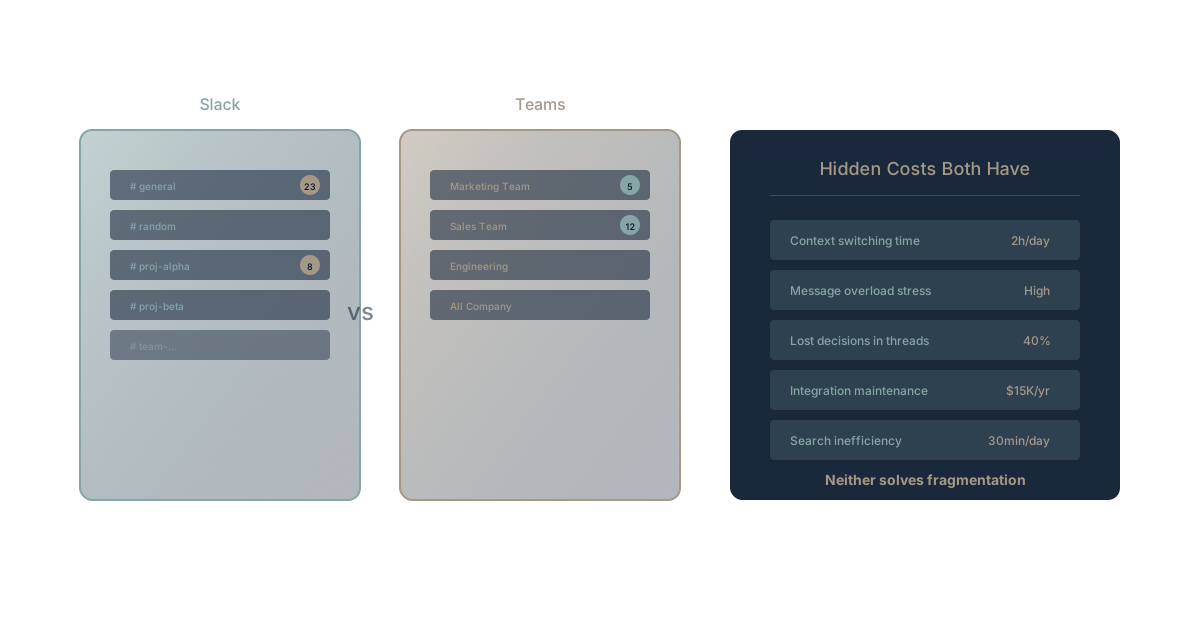
The Slack vs. Teams debate generates endless comparisons: features, pricing, integrations, user experience. What's missing from these comparisons is more important than what's included.
Both platforms carry hidden costs that dwarf their license fees.
This isn't a "which is better" analysis. It's an examination of costs that affect both platforms equally—costs that marketing glosses over and organizations rarely calculate.
The Visible Comparison
Pricing on Paper
Slack:
- Free: Limited history, integrations
- Pro: $8.75/user/month
- Business+: $15/user/month
- Enterprise Grid: Custom pricing
Microsoft Teams:
- Free: Limited features
- Included with Microsoft 365: $12-57/user/month
- Teams Premium: +$10/user/month
For a 100-person company:
- Slack Pro: $10,500/year
- Teams (with M365 Business Basic): $14,400/year
These numbers drive most comparison decisions. They shouldn't.
Feature Comparison
The typical feature comparison:
| Capability | Slack | Teams |
|---|---|---|
| Messaging | Excellent | Good |
| Threading | Better | Improving |
| Video calls | Via integration | Native |
| File sharing | Good | Deep M365 integration |
| Search | Strong | Improving |
| Integrations | More options | Fewer but deeper |
Feature comparisons miss the point. Both tools handle messaging. The question is what messaging costs your organization.
The Hidden Cost Categories
Hidden Cost 1: The Attention Tax
Both platforms interrupt continuously.
Slack's notification reality:
- Average user checks Slack 9+ times per hour (RescueTime data)
- Each check disrupts focus regardless of content relevance
- FOMO drives checking even when notifications are off
Teams' notification reality:
- Deeply integrated notifications across M365
- Chat notifications mix with calendar, email, activity
- Harder to separate "important" from "ambient"
The cost calculation:
Research from Gloria Mark shows each interruption costs 23 minutes of recovery time. Even if only 10% of checks trigger significant interruption:
- 9 checks/hour × 8 hours = 72 checks/day
- 10% significant = 7 interruptions/day
- 7 × 23 minutes = 161 minutes lost daily
- At $75/hour = $200/person/day
Annual attention tax per 100 employees: ~$5 million
Neither Slack nor Teams is immune. The platform enabling always-on communication imposes the tax.
Hidden Cost 2: The Context Destruction
Chat is ephemeral. Decisions made in chat disappear.
The pattern:
- Important discussion happens in channel
- Decision reached, briefly celebrated
- Week passes
- Someone asks: "What did we decide?"
- Search finds 47 messages containing keywords
- Nobody's sure which message is the decision
What this costs:
- Time re-finding decisions
- Time re-making decisions that were already made
- Inconsistent execution from unclear decisions
- Business amnesia accumulating over time
This isn't a feature problem—it's inherent to chat architecture. Important decisions mixed with casual conversation in a chronological stream.
Hidden Cost 3: The Knowledge Graveyard
Both platforms accumulate vast knowledge that becomes unfindable.
Slack:
- Free plan: 90-day history limit
- Paid plans: Unlimited history, limited findability
- Channels proliferate, knowledge fragments
- Departing employees' DMs vanish
Teams:
- Files scattered across channels and chats
- Conversation history mixed with SharePoint
- Cross-team discovery difficult
- SharePoint's organization problems apply
The math:
IDC research shows knowledge workers spend 30% of their time searching for information. If even 20% of that search time involves chat platforms:
- 30% searching × 20% in chat = 6% of work time
- 6% × 2,000 annual hours = 120 hours/person/year
- 120 hours × $75 = $9,000/person/year
Annual knowledge loss cost per 100 employees: $900,000
Hidden Cost 4: The Meeting Inflation
Chat doesn't replace meetings. It often creates more of them.
The pattern:
- Complex topic surfaces in chat
- Too complicated for typing
- "Let's jump on a call"
- Call scheduled (often with more people than needed)
- Outcome documented in... chat
Research from Atlassian shows professionals attend 62 meetings per month, with 25-50% considered unnecessary.
Both Slack and Teams make jumping on calls easy. Easy meetings multiply.
The cost:
If chat causes even 2 unnecessary meetings per person per week:
- 2 meetings × 30 minutes × 52 weeks = 52 hours/person/year
- 52 hours × $75 = $3,900/person/year
Annual meeting inflation per 100 employees: $390,000
Hidden Cost 5: The Platform Dependency
Choosing Slack or Teams creates ecosystem effects.
Slack dependency:
- Workflows built on Slack integration
- Bots and automations tied to Slack
- Team culture adapted to Slack norms
- Switching cost grows with each integration
Teams dependency:
- Deep Microsoft 365 integration (benefit and trap)
- Files, calendar, calls all intertwined
- Harder to exit Microsoft ecosystem
- M365 fatigue effects compound
The cost:
Lock-in reduces negotiating power, limits options, and creates technical debt that compounds over time. Quantifying this precisely is difficult, but it's not zero.
Hidden Cost 6: The Culture Cost
Chat platforms shape organizational culture, not always positively.
Always-on expectations:
- Presence indicators create pressure
- Fast response becomes norm, then obligation
- Work-life boundaries blur
- Burnout risk increases
Shallow communication:
- Complex ideas compressed into short messages
- Nuance lost in text
- Emoji reactions replace thoughtful responses
- Depth sacrificed for speed
Documentation avoidance:
- Chat feels like documentation (it isn't)
- "It's in Slack" becomes acceptable answer
- Real documentation discipline erodes
- Institutional knowledge degrades
Gallup research connects these cultural factors to engagement and retention. The costs are real if hard to quantify precisely.
The Structural Problem
Chat as Primary vs. Chat as Support
The hidden costs emerge when chat becomes the primary work platform rather than a support tool.
Chat as support (appropriate):
- Quick questions that need quick answers
- Social connection and team building
- Real-time coordination during active work
- Notification of events needing attention
Chat as primary (problematic):
- Decision-making conversations
- Knowledge repository expectations
- Project management substitute
- Document collaboration alternative
Both Slack and Teams work well as support tools. Problems emerge when organizations expect them to serve as primary work platforms.
The Missing Layer
What both platforms lack: organizational memory architecture.
Chat provides:
- Chronological conversation
- Keyword search
- Channel organization
Organizational memory requires:
- Decision capture and retrieval
- Context preservation across projects
- Knowledge connection across teams
- Strategic coherence over time
The gap between chat capabilities and organizational needs creates the hidden costs.
Reducing Hidden Costs
Strategy 1: Communication Hygiene
Reduce notification noise:
- Aggressive channel curation
- Default to async, real-time for urgent only
- Scheduled notification windows
- Individual discipline supported by policy
Cost reduction: Attention tax decreases with interruption reduction
Strategy 2: Decision Discipline
Capture decisions outside chat:
- Decision log updated after important discussions
- Clear "decision made" markers
- Regular decision review
Cost reduction: Context destruction decreases with intentional capture
Strategy 3: Knowledge Systems
Don't rely on chat for knowledge:
- Proper documentation systems for persistent knowledge
- Chat for ephemeral, docs for permanent
- Regular chat-to-documentation harvesting
Cost reduction: Knowledge graveyard impact decreases with systematic documentation
Strategy 4: Meeting Boundaries
Prevent meeting inflation:
- "Could this be async?" question before scheduling
- Time-boxed synchronous windows
- Async defaults with sync exceptions
Cost reduction: Meeting costs decrease with async-first culture
Strategy 5: Platform Limits
Recognize what chat is for:
- Clear use cases defined
- Alternative tools for non-chat needs
- Periodic evaluation of platform scope
Cost reduction: Dependency costs decrease with bounded expectations
The Real Decision Framework
Beyond Slack vs. Teams
The productive question isn't "Which chat platform?" It's "What communication architecture minimizes total costs?"
Questions to ask:
- What's our true communication cost (attention + context loss + knowledge decay)?
- What role should real-time chat play in our work?
- What systems capture decisions and knowledge properly?
- How do we reduce hidden costs regardless of platform?
The Platform Consideration
Some organizations are rethinking chat centrality entirely.
The alternative model:
- Unified work platforms where communication lives within project context
- AI-assisted capture of decisions from conversations
- Async-first with sync-when-needed
- Context engineering over chat engineering
This isn't anti-chat—it's pro-coherent communication architecture.
Experience Communication With Context
Want to see what happens when communication exists within work context rather than in a separate stream? Waymaker Commander integrates communication with projects and decisions—so context is preserved and decisions are captured automatically.
The result: Communication that supports work without the hidden costs of always-on chat platforms.
Register for the beta and experience the difference between chat platforms and contextual communication.
Slack vs. Teams is the wrong debate. Both platforms impose similar hidden costs: attention fragmentation, context destruction, knowledge decay, meeting inflation. These costs dwarf license fees. The productive question isn't which chat platform to choose—it's how to architect communication that supports work without these hidden costs. Learn more about our Context Compass framework and explore how context engineering creates communication that preserves organizational knowledge.
The Waymaker Editorial team researches enterprise communication tools. This analysis synthesizes productivity research, industry data, and implementation experience from organizations using both platforms.
Part of our guide to leaving microsoft 365.
Frequently asked questions
- What are the hidden costs of Slack and Microsoft Teams?
- Three that do not appear on an invoice: the attention cost of interruption, the loss of context when discussion is scattered across channels, and knowledge that becomes unfindable once it scrolls away. All are paid in time rather than money, which is why they go unmanaged.
- Is Slack or Teams cheaper?
- The comparison usually favours Teams because it arrives bundled with a Microsoft 365 subscription many organisations already hold. That makes it cheaper on the invoice and not necessarily cheaper in use — the hidden costs are a property of chat as a medium rather than of either product.
- Why does team chat destroy context?
- Because a decision made in a thread has no home afterwards. The conclusion is reachable only by whoever was in that channel at that time, and it degrades as the thread scrolls. What is lost is not the message but the reasoning around it.
- Does chat replace documentation?
- No, though teams frequently behave as if it does. Chat is good at coordination and poor at retention — searching a year-old channel to reconstruct why something was decided is a common and expensive experience. Decisions worth keeping need somewhere durable.
- How do you reduce the cost of team chat?
- Move the things worth keeping out of it. Decisions, specifications and anything a future colleague will need should live somewhere designed for retrieval, leaving chat for coordination. That is a habit rather than a tool change, but the tool can make it easier or harder.
About the Author

Waymaker Editorial
Stuart Leo founded Waymaker to solve a problem he kept seeing: businesses losing critical knowledge as they grow. He wrote Resolute to help leaders navigate change, lead with purpose, and build indestructible organizations. When he's not building software, he's enjoying the sand, surf, and open spaces of Australia.