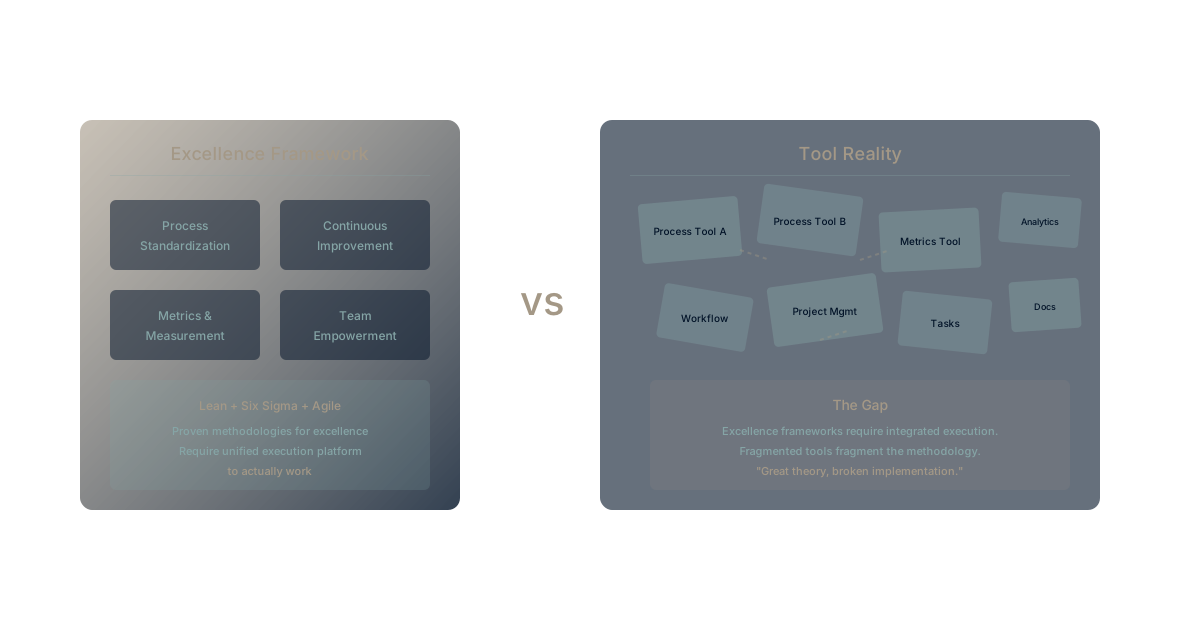
Your organization adopted Lean. You've trained teams on Six Sigma. You run Agile ceremonies religiously. The frameworks are solid. The methodology is sound.
But operational excellence remains elusive. Not because the frameworks don't work—but because the tools fragment their execution.
Operational excellence requires continuous, measurable, connected improvement. Fragmented tool environments deliver disconnected, unmeasurable, episodic efforts.
The Excellence Framework Reality Gap
What Methodologies Require
Lean, Six Sigma, TPS, and modern operational excellence frameworks share common requirements:
Visibility: Real-time view of operations across the organization Standardization: Consistent processes that can be measured Continuous improvement: Systematic identification and resolution of waste Measurement: Data-driven decision making with clear metrics Connection: Understanding how changes in one area affect others
These aren't optional nice-to-haves. They're foundational requirements for any excellence methodology to function.
What Tools Deliver
The average organization's tool environment delivers the opposite:
Fragmented visibility: Each tool shows a piece; no tool shows the whole Inconsistent processes: Different teams use different tools differently Episodic improvement: Initiatives without systematic follow-through Scattered measurement: Metrics in 10 systems that don't connect Isolated changes: Improvements in silos without understanding impact
According to McKinsey research, most operational excellence initiatives fail to achieve sustained results. Tool fragmentation is a primary cause.
The Toyota Production System Lesson
Toyota's excellence didn't come from frameworks alone—it came from integrated systems. The famous Toyota Production System works because:
- Information flows visually across the entire production system
- Problems surface immediately through connected monitoring
- Improvement cycles complete quickly with visible results
- Standards are enforced through system design, not heroic effort
Modern organizations try to replicate Toyota's methodology while using tools that prevent Toyota's visibility. It's like implementing just-in-time inventory across disconnected spreadsheets.
How Tool Fragmentation Breaks Excellence
The Measurement Problem
Excellence requires measurement. Measurement requires:
Consistent data: Same definitions, same collection methods Connected data: Understanding relationships between metrics Timely data: Current enough to act on Accessible data: Available to those who need it
Fragmented tools destroy all four:
- Inconsistent: Each tool defines metrics differently
- Disconnected: No relationship mapping across systems
- Delayed: Manual aggregation takes days or weeks
- Siloed: Different teams see different data
The reporting nightmare isn't just inconvenient—it's a fundamental barrier to operational excellence.
The Standardization Problem
Excellence frameworks require standard work:
- Standard processes that can be measured and improved
- Standard metrics that enable comparison
- Standard tools that enforce consistency
When every team uses different tools:
- Processes vary by tool capability and team preference
- Metrics don't translate across systems
- "Standards" exist in documentation but not in execution
You can't improve what you can't standardize. You can't standardize what lives in 47 different systems.
The Continuous Improvement Barrier
PDCA (Plan-Do-Check-Act) requires:
Plan: Identify improvement opportunity based on data Do: Implement change in controlled environment Check: Measure impact against baseline Act: Standardize successful changes, iterate on failures
Fragmented tools break this cycle:
- Plan: Data scattered across systems; opportunity identification slow
- Do: Implementation requires changes across multiple tools
- Check: Impact measurement requires manual cross-system analysis
- Act: Standardization impossible across disconnected systems
The cycle that should take days takes months. Improvement velocity drops to near zero.
The Knowledge Loss Problem
Excellence depends on organizational learning:
- What improvements have we tried?
- What worked? What didn't?
- What's the root cause of recurring problems?
- How do we prevent knowledge loss when people leave?
This is the business amnesia problem applied to operations. Without organizational memory, you can't learn systematically. Without learning, you can't achieve sustained excellence.
What Excellence-Enabling Platforms Look Like
Unified Operations Visibility
True operational platforms provide:
Single view: All work, all teams, all metrics in one place Real-time status: Current state visible immediately Drill-down capability: Summary to detail in the same system Cross-functional view: Operations, finance, customer impact connected
When visibility is structural rather than assembled, excellence becomes possible.
Built-In Standardization
Platforms enable standardization by design:
Process templates: Standard workflows enforced by the system Consistent metrics: Definitions built into the platform Automatic collection: Data captured through normal work Enforced practices: Standards maintained without heroic effort
Standardization shouldn't require constant vigilance. It should be the natural result of using the system.
Connected Measurement
Excellence platforms connect:
Operational metrics → Financial outcomes → Customer impact
When you improve cycle time, you can see the revenue effect. When you reduce defects, you can trace customer satisfaction changes. The connections exist in the system, not in someone's head.
Embedded Improvement Cycles
PDCA should be structural:
Plan: Data analysis tools identify opportunities automatically Do: Controlled changes tracked in the same system as work Check: Impact measurement against automatically maintained baselines Act: Successful changes become system defaults
When improvement is built into how work flows, continuous improvement becomes possible.
From Fragmentation to Excellence
Assess Your Excellence Infrastructure
Before implementing another methodology, assess your tools:
Visibility test: Can you see all operations in one view? Time to assemble that view? Standardization test: Are processes consistent across teams? Enforced by systems or documents? Measurement test: Can you get cross-functional metrics in real-time? How long does it take? Improvement test: How long from identifying an opportunity to measuring improvement impact?
If the answers reveal fragmentation, no methodology will deliver sustained excellence.
Prioritize Platform Consolidation
Excellence requires platform thinking:
- Identify excellence requirements: What visibility, standardization, and measurement do you need?
- Map current capabilities: Which tools provide what? Where are the gaps?
- Define platform criteria: What would a unified system need to enable?
- Evaluate consolidation options: Build, buy, or platform?
See our guide to SaaS stack consolidation for detailed methodology.
Design for Excellence
When implementing platforms:
Start with measurement: Define the metrics that matter for excellence Build in standards: Configure processes that enforce consistency Enable visibility: Ensure the right views exist for different stakeholders Embed improvement: Create workflows that include PDCA cycles
Excellence should be a system property, not a heroic achievement.
The Excellence Technology Stack
What Actually Works
Organizations achieving sustained operational excellence share technology patterns:
Single work platform: All execution in one connected system Integrated planning: Strategy to operations in same environment Automatic data capture: Metrics from work, not separate tracking AI-enhanced analysis: Pattern recognition across operations Real-time visibility: Current state always available
This is the Context Compass approach applied to operations—building organizational intelligence that enables rather than hinders excellence.
What Doesn't Work
Patterns that consistently fail:
Best-of-breed sprawl: 47 excellent tools that don't connect Manual dashboards: Excellence reports that are always stale Document-based standards: Process documents no one follows Spreadsheet metrics: Analysis that can't keep up with reality Separate improvement tracking: Initiatives disconnected from operations
Excellence requires integration. Integration requires platform thinking.
Experience Operational Excellence with Waymaker
Want to see what operational excellence looks like on a unified platform? Waymaker Commander connects strategy to execution with built-in visibility, standardization, and improvement workflows.
Stop trying to achieve excellence across fragmented systems. Start with a platform designed for continuous improvement.
Register for the beta and experience operations that actually enable excellence.
Operational excellence isn't a methodology problem—it's a platform problem. The best frameworks in the world can't overcome fragmented tool environments. Organizations that achieve sustained excellence do so because their tools enable rather than hinder it. Learn more about consolidating your SaaS stack and explore what matters in OKR software.
Stuart Leo has led operational transformations at organizations across industries. This guide reflects the consistent pattern: methodology fails without platform support.
About the Author

Stuart Leo
Stuart Leo founded Waymaker to solve a problem he kept seeing: businesses losing critical knowledge as they grow. He wrote Resolute to help leaders navigate change, lead with purpose, and build indestructible organizations. When he's not building software, he's enjoying the sand, surf, and open spaces of Australia.