Every Monday, finance needs a revenue forecast. It requires data from Salesforce, HubSpot, your billing system, and two spreadsheets that someone maintains manually.
Every quarter, the board needs a strategic progress report. It pulls from your OKR tool, project management platform, customer success data, and a deck that the strategy team updates whenever they remember.
Every week, operations needs a capacity report. It combines timesheet data, project allocations, HR headcount, and contractor invoices from three different systems.
Sound familiar?
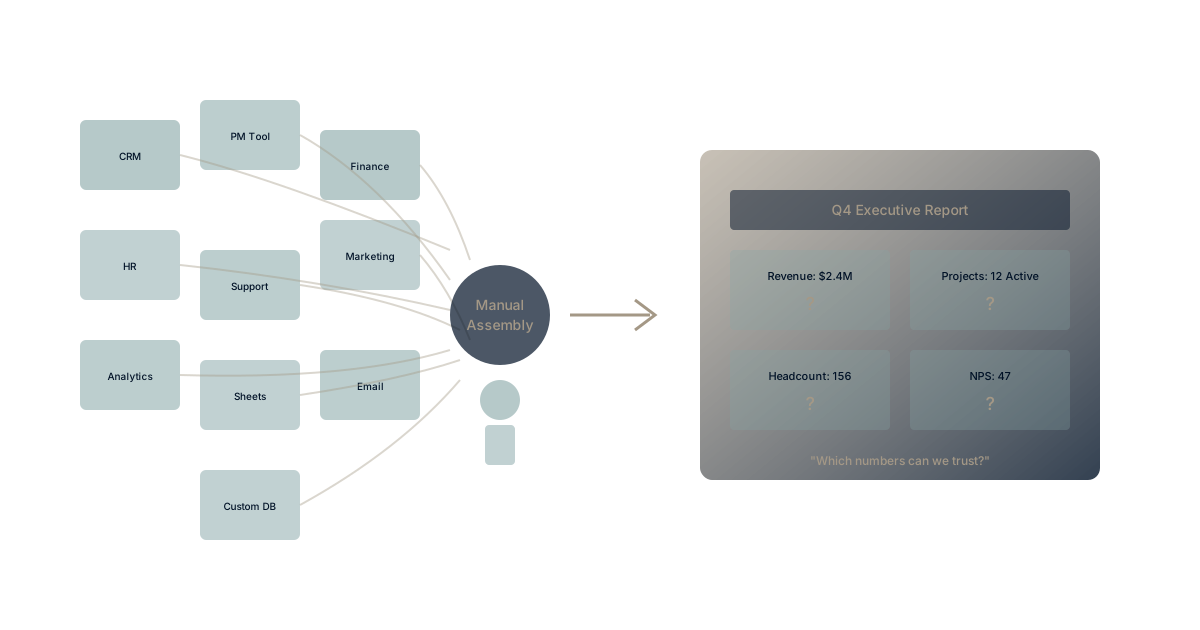
The average company's reporting process has become a data assembly nightmare. Not because people don't want accurate reports—but because the data to create them lives in 10+ disconnected systems.
The Anatomy of Reporting Pain
The Manual Assembly Tax
Watch any operations or finance team prepare a leadership report. You'll see this pattern:
- Export from System A (CRM data)
- Export from System B (Project data)
- Export from System C (Financial data)
- Open master spreadsheet (The "real" report)
- Copy-paste, reformat, reconcile (The manual tax)
- Discover discrepancy (Data doesn't match)
- Investigate source (Which system is right?)
- Make judgment call (Pick a number)
- Repeat for next section (Different data sources)
- Finalize before meeting (Usually last minute)
According to Deloitte research, knowledge workers spend 1.8 hours per day—9 hours per week—searching for and gathering information. A significant portion is this manual report assembly process.
The context switching between systems alone costs organizations billions in lost productivity. And that's before you count the errors introduced by manual data handling.
The Trust Deficit
When reports require manual assembly from multiple systems, a dangerous dynamic emerges: nobody fully trusts the numbers.
Leaders learn to ask:
- "Where did this number come from?"
- "Is this the same definition we used last month?"
- "Did we include the new project?"
- "Why is this different from what I saw in [other tool]?"
Each question triggers mini-investigations. Each investigation consumes time. And often, the answer is "the systems don't agree, so we picked one."
This isn't data-driven decision making. It's data-adjacent decision making—where the numbers exist but confidence is low.
The Version Control Nightmare
Multi-source reporting creates version control chaos:
Monday 9am: Draft report with Q3 numbers Monday 2pm: Sales updates CRM with late deals Monday 4pm: Report reviewed (with outdated data) Tuesday 9am: Someone notices discrepancy Tuesday 11am: Report revised with new numbers Tuesday 2pm: Board deck updated (but linked slide isn't) Wednesday: Different versions floating in email threads
By the time a report is "final," multiple versions exist across email, shared drives, and various tools. Which one is actually current? Often, nobody's certain.
Why This Problem Persists
The Tool Proliferation Trap
Every tool promised to solve a specific problem—and they did. But each tool also became a data island:
| Tool | What It Does Well | Data It Creates |
|---|---|---|
| CRM | Sales management | Pipeline, deals, customers |
| PM Tool | Project tracking | Tasks, timelines, resources |
| Finance System | Accounting | Revenue, expenses, forecasts |
| HR Platform | People management | Headcount, performance, comp |
| Support Tool | Customer service | Tickets, satisfaction, issues |
| Marketing Platform | Campaign management | Leads, engagement, attribution |
| Analytics Tool | Product metrics | Usage, retention, conversion |
Each tool optimizes for its domain. None optimizes for cross-domain reporting.
The Integration Illusion
"We have integrations" is a common response. But most integrations are:
One-way: Data flows in one direction only Delayed: Sync happens on schedule, not real-time Partial: Only specific fields transfer Brittle: Breaks when either system updates
True integration would mean any report could pull live data from any system with consistent definitions. That's not what most "integrations" provide.
The BI Tool Limitation
Business intelligence tools (Tableau, Looker, PowerBI) promise to solve this. They help—but they don't eliminate the problem.
BI tools require:
- Clean data sources (you still need integration)
- Consistent definitions (someone must maintain)
- Technical expertise (not everyone can build reports)
- Data warehousing (another system to maintain)
BI tools make reporting easier once data is unified. They don't unify the data.
The Hidden Costs
Direct Time Cost
For a typical mid-size company:
Finance team: 10 hours/week on report assembly Operations team: 8 hours/week on status reports Strategy team: 6 hours/week on progress reports Sales ops: 8 hours/week on pipeline reports Marketing ops: 5 hours/week on performance reports
Total: 37 hours/week = nearly 1 FTE just assembling reports
At fully-loaded cost of $75/hour, that's $144,000/year on manual report assembly.
Decision Delay Cost
Beyond assembly time, fragmented reporting delays decisions:
- Board questions can't be answered in the meeting
- Strategy pivots wait for data validation
- Problems get identified weeks late
- Opportunities pass while numbers are being reconciled
These delays are harder to quantify but often more costly than the assembly time itself.
Error Cost
Manual data handling introduces errors:
- Copy-paste mistakes
- Formula errors in spreadsheets
- Outdated source data
- Mismatched date ranges
- Definition inconsistencies
Harvard Business Review research suggests only 3% of companies' data meets basic quality standards. Manual multi-system reporting is a primary contributor.
What Better Looks Like
The Unified Reporting Vision
Imagine reports that:
Pull live data: Real-time from source, not exports Maintain definitions: Consistent across all reports Update automatically: No manual refresh needed Trace sources: Click any number to see where it came from Maintain history: Previous periods calculated the same way
This isn't fantasy. It requires unified work data—everything from strategy to execution in one place, or at least with true integration.
Characteristics of Effective Reporting
Single source of truth: One authoritative number per metric Consistent definitions: Revenue means the same thing everywhere Real-time access: Current data, not last week's export Audit trail: Understand how any number was calculated Self-service: Leaders can get answers without waiting
The organizational memory framework provides a model for how work data should connect. When it does, reporting transforms from nightmare to non-event.
Getting from Here to There
Short-Term Improvements
If you can't unify systems immediately:
- Document definitions: Write down what each metric means
- Standardize cadence: Pull data at consistent times
- Create master templates: One spreadsheet per report type
- Assign ownership: Someone owns each report's accuracy
- Add checksums: Build validation into manual processes
These don't solve the problem, but they reduce errors and improve trust.
Medium-Term Strategy
Evaluate your reporting pain against consolidation opportunity:
High-pain reports: Which reports consume the most assembly time? Primary sources: Which 3-4 systems contribute most report data? Consolidation candidates: Which tools could be replaced with unified platforms?
The tools that appear most frequently in your reporting nightmare are consolidation priorities.
Long-Term Transformation
True reporting transformation requires:
- Platform consolidation: Reduce the number of source systems
- Data architecture: Design how information connects
- Definition governance: Central authority on metric meanings
- Reporting infrastructure: Build once, use everywhere
This is the same journey as tool rationalization—reporting improvement is a downstream benefit.
Experience Unified Reporting with Waymaker
Want to see what reporting looks like when strategy, projects, and execution live in one place? Waymaker Commander eliminates the multi-system reporting nightmare by design.
When goals, projects, tasks, and outcomes share a single platform, reports build themselves. No exports. No reconciliation. No trust deficit.
Register for the beta and experience data that actually connects.
The reporting nightmare is a symptom, not the disease. The disease is fragmented work data across disconnected tools. Cure the fragmentation, and reporting takes care of itself. Learn more about knowledge silos and explore the true cost of tool sprawl.
If your Monday starts with export-copy-paste-reconcile, you're paying the fragmentation tax. Every week.
About the Author

Waymaker Editorial
Stuart Leo founded Waymaker to solve a problem he kept seeing: businesses losing critical knowledge as they grow. He wrote Resolute to help leaders navigate change, lead with purpose, and build indestructible organizations. When he's not building software, he's enjoying the sand, surf, and open spaces of Australia.