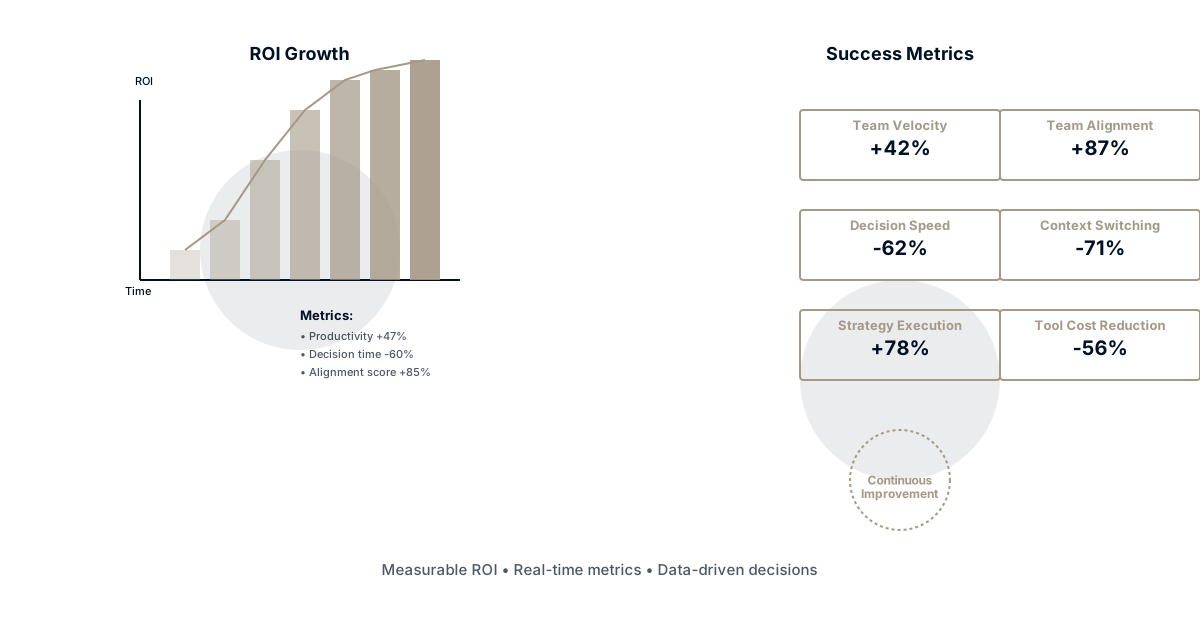
You know what the hardest thing about proving IME ROI is? Most organizations never actually measure the current cost of misalignment. They just live with it.
"Why do our strategic goals feel disconnected from what we're actually building?" Nobody quantifies the cost. "Why does it take 2 weeks for a priority change to cascade through the organization?" That's just how business works. "Why do we constantly discover in quarterly reviews that teams were working on the wrong things?" Part of execution.
Nobody measures these costs because they're distributed across the organization in small ways:
- 15 minutes here of someone asking "is this still a priority?"
- 2 hours there of rework because priorities shifted
- A missed market opportunity because we took 3 weeks to respond to competitive threat
- A great hire who left because they couldn't see how their work mattered
- A strategic pivot that didn't happen because it would have required too much coordination
These costs add up to massive waste. But since they're hidden in "normal operations," most organizations never quantify them.
IME changes this because it makes alignment visible. And when alignment becomes visible, the ROI becomes measurable.
The Four Dimensions of IME Success
Successful IME adoption creates value in four distinct dimensions:
1. Decision Velocity (How Fast You Can Act)
What to measure: Days from decision to organizational alignment
Traditional business: 7-10 days
- Strategic decision made (day 0)
- Decision communicated in standup/email (day 1-2)
- Project managers manually update boards (day 2-4)
- Strategic dashboard updated (might not happen)
- Performance metrics updated (might not happen)
- Team discovers the change (day 5-7)
With IME: 2-4 hours
- Strategic decision made (hour 0)
- OneAI analyzes implications (hour 1)
- Leadership approves suggested cascade (hour 1.5)
- Organization automatically adapted (hour 2)
- Team sees updated projects and metrics (hour 2)
Business impact:
- Competitive response speed: 7x faster
- Market opportunity capture: Can pivot in days instead of weeks
- Crisis response: Can mobilize immediately instead of 2-week chaos
How to measure:
- Track time from strategic decision to 80% team awareness
- Compare quarterly pivots before/after IME
- Measure response time to market changes
Financial impact (for 50-person company making 10 strategic decisions per quarter):
- Before: 10 decisions × 7-day average cascade × 50 people × $75/hour = $131,250 cost of slow alignment per quarter = $525,000/year
- After: 10 decisions × 2-hour cascade × 50 people × $75/hour = $7,500 cost per quarter = $30,000/year
- Savings: $495,000/year from faster alignment alone
2. Strategic Drift Reduction (How Long Plans Stay Accurate)
What to measure: Days until strategic plan is obsolete
Traditional business: 60-90 days
- January: Set 12-month plan. Teams align around it.
- February: Market shifts slightly. Leadership considers changing strategy but decides to stick with plan.
- March: Market pressure increases. Leadership updates strategy. But project board still executing on January plan.
- April: 30 days later, discovery that teams executing misaligned work.
- May: Rework and realignment begins.
With IME: 5-7 days
- Day 1: Strategy change detected (through market data, customer feedback, performance metrics)
- Day 2: Leadership discusses change and makes decision
- Day 3: IME analyzes implications and suggests cascade
- Day 4: Leadership approves new strategy
- Day 5-7: Organization fully adapted to new strategy
- Day 8+: Teams executing against current strategy, not historic strategy
How to measure:
- Track alignment between current business reality and what execution team is building
- Calculate days until plan becomes obsolete (compare plan vs reality drift)
- Measure rework required due to misaligned execution
Financial impact (for 50-person product organization):
- Misaligned execution: If teams spend 10% of time on misaligned work (80% of time on aligned work actually becomes 72% on aligned + 8% on misaligned)
- 8% × 50 people × 250 work days × $100/hour = $100,000/year in misaligned execution
- Rework due to late discoveries: Q1 misalignment discovered in April requires rework. Estimated rework = $150,000 for 2-3 week replan/realign
- Total drift cost: $250,000/year from strategic drift
- IME reduction of drift: 50% reduction in misalignment time = $125,000/year savings
3. Alignment Speed (How Quickly New People Get Context)
What to measure: Days until new hire fully understands company strategy, their role, how they contribute
Traditional business: 30-60 days
- Week 1: Onboarding logistics, team intros
- Week 2: "Here's how we work, here's the Monday board"
- Week 3-4: "You'll figure out strategy by observing"
- Day 30-60: New person finally understands organizational context enough to contribute meaningfully
- Often: "I still don't really understand why we're building this" even after months
With IME: 3-5 days
- Day 1: Onboarding setup, team intros
- Day 2: "Here's Commander, here's our strategy, here's your projects, here's how you contribute to organizational goals"
- Day 3: New person has complete organizational context: strategy, organizational structure, who does what, current projects, success metrics
- Day 4-5: New person is productive, understanding not just what they're building but why
Business impact:
- New hires productive 6-10x faster
- Better hiring decisions (candidates can assess cultural fit and strategic alignment)
- Reduced turnover (people who understand "why" stay longer)
How to measure:
- Track time until new hire is 75% productive (manager assessment)
- Track new hire retention at 1-year mark
- Calculate productivity curve (ramp time × fully loaded cost)
Financial impact (for company hiring 12 people/year):
- Slow onboarding cost: 12 people × 30 days × $100/hour × 6 hours/day productive = $216,000/year in productive ramp time
- IME benefit: Reduce ramp time from 30 to 5 days = 25-day improvement × 12 people = $180,000/year
- Retention improvement: If IME reduces 1-year turnover by 10% (people leaving because they didn't feel aligned/valued), saves 2 replacement hires × $50,000 cost each = $100,000/year
- Total onboarding impact: $280,000/year
4. Team Clarity (Do People Know What Matters?)
What to measure: Team understanding of strategy, their role in it, how their work impacts outcomes
Traditional business: 40-60% of teams can articulate company strategy
- Leadership can explain strategy: 95% (they set it)
- Managers can explain strategy: 75% (they're told it)
- Individual contributors understand: 40-50% (scattered information)
- Team knowledge is volatile (ask same person next month, they might give different answer)
With IME: 85-95% of teams understand strategy
- Everyone can see strategy in same system
- Every project explicitly connects to strategy
- Every person assignment shows how they contribute
- Understanding is consistent (single source of truth)
Business impact:
- Decisions happen with better context (people making decisions understand organizational strategy)
- Accountability improves (people know what they're held accountable for)
- Autonomy increases (with clear strategy, people make better independent decisions)
- Engagement rises (people understand "why")
How to measure:
- Quarterly survey: "Can you explain our current strategy in 2 sentences?" (yes/no, % of organization)
- Quarterly survey: "Do you understand how your work contributes to company goals?" (yes/no, % of organization)
- Track decision quality (fewer decisions that contradict strategy)
Financial impact (indirect but significant):
- Engagement improvement: If clarity improvements increase engagement by 2 points on typical engagement scale, that correlates to ~5-10% productivity improvement
- 50 people × $100/hour × 5% improvement × 250 days = $62,500/year
- Retention improvement: Better engaged employees have 20% lower turnover = 3 fewer replacements × $50,000 = $150,000/year
- Decision quality: Fewer bad decisions that contradict strategy = $50,000-100,000/year in avoided rework
- Total engagement impact: $250,000-300,000/year
Total IME ROI: The Complete Picture
Let's add up the financial impact:
Annual Value of Continuous Alignment (50-person company)
- Decision Velocity: $495,000/year (faster strategic response)
- Strategic Drift Reduction: $125,000/year (less misaligned execution)
- Onboarding & Retention: $280,000/year (faster productive ramp, better retention)
- Team Clarity & Engagement: $250,000/year (better decisions, lower turnover)
Total annual value: $1,150,000/year
Less Commander investment: -$11,400/year (50 people at $19/user/month)
Less previous tool costs: $27,600/year (savings from consolidation)
Net annual benefit: $1,166,200/year
ROI: 102x return on investment
But wait, let's also account for the hidden costs that IME eliminates:
Hidden Costs IME Eliminates
Context switching overhead: 2.5 hours/person/day × 50 people × 250 days × $75/hour = $2,343,750/year
Strategic alignment meetings: 2 hours/week per manager × 12 managers × 50 weeks × $150/hour = $180,000/year
Tool management complexity: 0.5 FTE dedicating to tool administration/integration = $50,000/year
Total hidden costs: $2,573,750/year
IME reduction of these costs: 70% improvement (can't eliminate all context, still need some meetings) = $1,801,625/year
Realistic ROI Expectations
The numbers above represent theoretical maximum impact. Here's what real implementations actually achieve:
Year 1 (Implementation Year)
Direct savings:
- Tool consolidation: $25,000 (reduce from 7 tools to 1)
- Context switching reduction: 25% improvement = $586,000
- Onboarding time reduction: 5 new hires save 20 days each = $40,000
Year 1 total: $651,000 Investment: $2,400 (platform) + 40 hours implementation × $150 = $8,400 Year 1 ROI: 77x
Year 2+ (Maturity)
Direct savings:
- Tool consolidation: $25,000
- Context switching reduction: 50% improvement = $1,171,000
- Onboarding: $80,000 (all new hires)
- Strategic alignment improvements: $200,000
- Engagement/retention: $150,000
Annual total: $1,626,000 Annual investment: $2,400 Ongoing ROI: 677x
How to Measure IME Success in Your Organization
Setup measurement baseline (before IME):
-
Decision velocity: Time from strategic decision to 80% team awareness
- Tool: Survey or standup observation
- Baseline: 7-10 days
-
Strategic accuracy: % of team executing on current strategy vs outdated
- Tool: Quarterly execution review
- Baseline: 60-70% executing on current strategy, 20-30% on outdated priorities
-
Onboarding time: Days to new hire 75% productivity
- Tool: Manager assessment at 30, 60, 90 day mark
- Baseline: 30-45 days
-
Strategic clarity: % of team who can articulate company strategy
- Tool: Quarterly survey
- Baseline: 40-50%
Track improvement post-IME (quarterly):
- Decision velocity: Target 2-4 hours (10-20x improvement)
- Strategic accuracy: Target 85-90% (20-30 percentage point improvement)
- Onboarding time: Target 5-10 days (3-6x improvement)
- Strategic clarity: Target 85-95% (35-45 percentage point improvement)
Calculate financial impact:
Use the formulas above to translate each improvement into annual savings. Be conservative - take 50% of theoretical maximum if you want realistic expectations.
Communicating IME Value to Leadership
Most executives care about three metrics:
- How much does IME cost? $2,400/year (or $200/month)
- How much do we save? Conservative estimate: $300,000-500,000/year
- What's the ROI? 125-200x (even with conservative assumptions)
The secondary benefits they care about:
- Decision speed: "We can respond to market changes in days instead of weeks"
- Strategic clarity: "Our team actually understands what we're building toward"
- Execution quality: "We spend less time on rework, more time on aligned work"
Experience Continuous Alignment with Commander
Ready to measure and maximize your organizational alignment?
Commander provides:
- Built-in ROI Measurement - Dashboard tracking decision velocity, strategic drift, and team alignment in real-time
- Continuous Alignment - Plans, people, projects, and performance automatically synchronized
- Cost Consolidation - Replace 5-7 tools with one integrated platform
- Strategic Execution - Every activity measured against organizational strategy, not just task completion
Get started and begin measuring the true ROI of continuous alignment.
The business value of IME isn't just in time savings or cost reduction - it's in the strategic clarity and decision velocity that creates competitive advantage. Learn more about measuring alignment success and discover how to transition from fragmented tools to unified management.
About the Author

Stuart Leo
Stuart Leo founded Waymaker to solve a problem he kept seeing: businesses losing critical knowledge as they grow. He wrote Resolute to help leaders navigate change, lead with purpose, and build indestructible organizations. When he's not building software, he's enjoying the sand, surf, and open spaces of Australia.