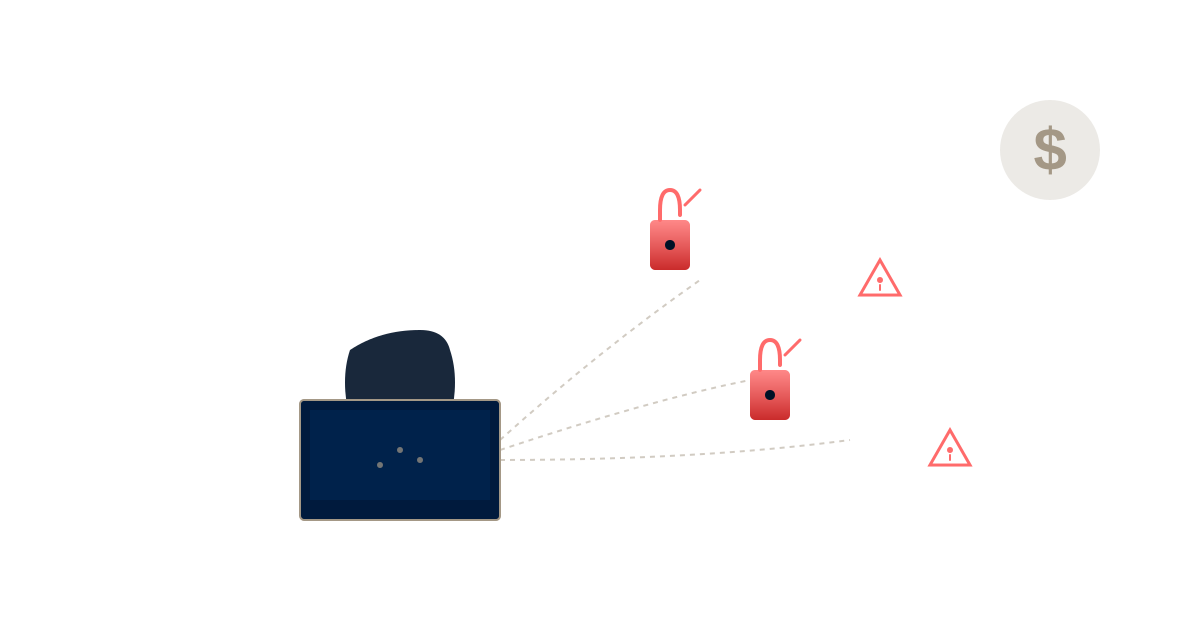
Right now, 59% of your employees are using unapproved AI tools. Three-quarters of them are sharing sensitive company data with these platforms. Every document uploaded, every customer record queried, every strategic plan analyzed—all flowing into systems you don't control, governed by terms of service you haven't reviewed, protected by security measures you can't verify.
The average cost of a data breach in 2024 reached $10.22 million, according to IBM's Cost of a Data Breach Report. Add AI-specific violations and the price jumps another $670,000. Yet most CFOs and security officers remain unaware that their greatest vulnerability isn't a sophisticated hack—it's the "helpful" AI assistant your marketing team discovered last Tuesday.
This is Shadow AI: the unauthorized, unmonitored, uncontrolled adoption of artificial intelligence tools across your organization. And it's not just a technical problem. It's an existential threat to your business, your compliance posture, and your competitive advantage. Here's why this crisis demands your immediate attention—and what you can do about it before it's too late.
The Shadow AI Crisis: Hidden in Plain Sight
Shadow AI isn't new. It's the AI-era evolution of Shadow IT, the practice of employees using unauthorized technology tools without IT approval. But AI makes this problem exponentially more dangerous.
When employees installed unapproved project management software in the 2010s, the risk was modest: some duplicated data, maybe integration headaches. Shadow AI creates fundamentally different risks. These tools don't just store your data—they analyze it, learn from it, and potentially share it with their model training pipelines.
The scale is staggering. A 2024 survey by The CFO found that 59% of employees regularly use unapproved AI tools. Of those users, 75% share sensitive business data including financial information, customer records, strategic plans, and proprietary research. The majority don't even realize they're creating a security exposure.
The $670,000 Shadow AI Tax
The financial impact goes beyond the headline data breach number. Organizations face a compounding cost structure:
Direct Breach Costs: $10.22M average breach + $670K AI-specific penalties Regulatory Fines: GDPR violations up to €20M or 4% of global revenue, HIPAA penalties up to $1.5M per violation Lost Business: Average 65% customer churn post-breach for companies with poor data protection Remediation: 18-24 months to fully recover brand reputation and customer trust Competitive Disadvantage: Intellectual property exposure to competitors through AI training data
But here's what makes Shadow AI particularly insidious: traditional security tools can't see it. Your firewalls, your data loss prevention systems, your endpoint protection—all designed for traditional IT threats. They're blind to employees copying customer lists into ChatGPT or uploading product roadmaps to Claude.ai.
The math is brutal: A mid-sized company with 500 employees and 59% Shadow AI adoption has approximately 295 unauthorized AI users. If just 2% experience a security incident in a year (a conservative estimate), that's 6 breaches. At $670K each, you're looking at $4 million in Shadow AI costs before counting the major breach that exposes your entire customer database.
Why Traditional Controls Fail Against Shadow AI
Organizations spent decades perfecting IT governance frameworks. Why aren't they working for AI?
The Accessibility Problem: AI tools require no installation, no VPN access, no IT permissions. An employee visits a website, creates a free account, and starts sharing company data. The entire process takes three minutes and leaves no trace in your security logs.
The Value Trap: Employees don't use Shadow AI to be malicious. They use it because it works—dramatically better than approved tools. When a sales rep can generate a proposal in 10 minutes using ChatGPT versus four hours using your approved template library, which will they choose? The productivity gain seems worth the unmeasured risk.
The Invisible Data Flow: Traditional data loss prevention (DLP) tools monitor file transfers, email attachments, and database queries. Shadow AI circumvents all of this. An employee reads a confidential document, then prompts an AI tool based on that information. No file was transferred. No data "left" your network. Yet your intellectual property just became part of someone else's training corpus.
Learn more about how business amnesia compounds the Shadow AI problem—when employees don't know what information is sensitive, they can't make informed decisions about what to share.
The 53% Problem: OpenAI and the Shadow AI Pipeline
Research shows that 53% of all Shadow AI usage flows through OpenAI's products, primarily ChatGPT. This concentration creates a single point of catastrophic failure for data security.
Here's what happens when an employee uses the free version of ChatGPT:
- No Business Agreement: The relationship is governed by consumer terms of service, not an enterprise Data Processing Agreement (DPA)
- No Data Control: OpenAI's consumer terms allow training on user inputs unless specifically opted out
- No Compliance Coverage: No HIPAA Business Associate Agreement, no GDPR Standard Contractual Clauses, no audit rights
- No Visibility: Your security team has zero insight into what's being shared
- No Recourse: When (not if) something goes wrong, you have no legal protections or service level agreements
The irony is painful: OpenAI offers enterprise-grade API services with Business Associate Agreements, zero data retention, and proper security controls. But Shadow AI users bypass all of these protections in favor of the free consumer product.
This isn't an anti-OpenAI message. The same pattern repeats with Anthropic's Claude, Google's Gemini, and dozens of smaller AI services. The technology isn't the problem—the unauthorized, uncontrolled access is the problem.
Real Breach Scenarios: How Shadow AI Fails
These scenarios come from actual breach disclosures and security incidents documented in 2024:
Healthcare: The HIPAA Nightmare
A medical billing company's coding specialist used ChatGPT to help categorize complex procedures. Over six months, she uploaded 2,400 patient records containing names, dates of birth, diagnosis codes, and treatment details. The company discovered the breach during a routine audit.
Cost: $1.2M in HIPAA penalties, $2.8M in patient notification and credit monitoring, $6.5M in legal settlements. Total: $10.5M. The coding specialist was trying to do her job better.
Financial Services: The Due Diligence Disaster
An M&A analyst at a private equity firm used Claude.ai to analyze acquisition targets. He uploaded confidential information memorandums, financial models, and management presentations for 14 potential deals worth $890M combined. A competitor acquired three of those targets at prices that suggested insider knowledge of their bidding strategy.
Cost: Impossible to quantify precisely. Lost deals, damaged reputation, SEC inquiry, three portfolio companies settling for less than projected value. Estimated total impact: $47M.
Legal: The Privileged Communication Leak
An associate attorney used ChatGPT to draft a motion in a major litigation case, including confidential client communications and case strategy. The opposing counsel's AI monitoring service detected similar language patterns in a separate case and filed a motion to compel discovery of AI tool usage.
Cost: $3.2M legal fees defending the breach, $8M malpractice settlement with client, attorney disciplinary proceedings, firm reputation damage. The associate was trying to work faster to meet billable hour requirements.
These weren't sophisticated attacks. No hackers, no malware, no social engineering. Just employees trying to do their jobs more efficiently, unaware that their helpful AI assistant was creating catastrophic liability.
The GDPR and CCPA Problem: Regulatory Time Bombs
European and California regulators have made their position clear: unapproved AI tool usage constitutes a data processing violation. Shadow AI creates multiple compliance failures:
No Data Processing Agreement: GDPR Article 28 requires written contracts with all data processors. Shadow AI users typically have no agreement whatsoever, or at best consumer terms that don't meet legal requirements.
No Lawful Basis: Organizations must establish a legal basis for data processing under GDPR Article 6. "Our employee thought it would be helpful" is not a recognized basis.
No Data Transfer Protections: Many AI tools process data in multiple jurisdictions. Without proper Standard Contractual Clauses or adequacy decisions, international data transfers violate GDPR Article 44.
No Data Subject Rights: GDPR gives individuals the right to access, correct, and delete their data. With Shadow AI, organizations often don't know where data went, making compliance impossible.
No Data Breach Notification: GDPR requires breach notification within 72 hours. If you don't know Shadow AI exists, you can't detect the breach, let alone report it.
The penalties are severe: up to €20 million or 4% of global annual revenue, whichever is higher. For a $500M company, that's a potential $20M fine—on top of the breach costs, legal fees, and business impact.
Why Shadow AI Spreads: The Productivity Paradox
Banning AI tools doesn't work. Employees will use them anyway, just more carefully hidden. Understanding why Shadow AI proliferates is the first step toward solving it.
The Approved Tools Gap: Most organizations' approved software stack was designed for the pre-AI era. Word processors, spreadsheets, project management tools—all built on the assumption that humans do the thinking and software handles the storage. Employees discover AI tools that actually help them think, and there's no going back.
The Innovation Pressure: Business leaders demand faster results, better analysis, more creative solutions. Then they're shocked when employees find tools that deliver exactly that. The disconnect between leadership expectations and approved resources creates the Shadow AI vacuum.
The Permission Paradox: By the time IT evaluates, pilots, negotiates contracts, and deploys an approved AI tool, the technology has evolved two generations. Employees watch competitors racing ahead with AI while their organization debates vendor selection criteria.
Discover how context engineering provides the framework for controlled AI adoption that delivers productivity gains without security compromises.
The Approved Alternative: What Controlled AI Looks Like
Shadow AI isn't inevitable. Organizations that take AI governance seriously can provide approved alternatives that employees actually want to use—eliminating the incentive for Shadow AI adoption.
Contractual Protections: Proper enterprise agreements with AI providers include Business Associate Agreements for HIPAA compliance, Data Processing Agreements for GDPR, and explicit "no training on customer data" clauses. These aren't suggestions—they're legally binding commitments.
Zero Data Retention: Enterprise API access from providers like OpenAI and Anthropic includes zero data retention guarantees. Your data processes transiently and is immediately deleted, never entering training pipelines or long-term storage.
Audit and Compliance: Approved platforms provide audit logs, compliance certifications (SOC 2, ISO 27001), and clear data residency options. Your security team can monitor usage, detect anomalies, and prove compliance during audits.
Usage Controls: Credit-based consumption models give organizations precise control over AI usage. Set department budgets, require manager approval for large requests, and receive detailed usage analytics—impossible with Shadow AI.
The Context Compass framework demonstrates how organizations can build AI memory systems that enhance capabilities while maintaining complete security and compliance control.
The Waymaker Approach: Approved AI by Design
Full disclosure: Waymaker is built to be the approved alternative to Shadow AI. Here's how we prevent the risks documented in this article:
Business Associate Agreements: We submitted BAA requests to both OpenAI and Anthropic on November 3, 2025. Until they are executed, confirm current status with Waymaker before processing PHI. Your data is covered by our enterprise API agreements, not consumer terms of service.
No Training on Customer Data: Our Privacy Policy explicitly states: "We DO NOT use your content, prompts, or inputs to train AI models. We DO NOT share your data with AI providers for training." This isn't a marketing claim—it's a legally binding commitment.
Enterprise Security: SOC 2 certification for Waymaker itself on the roadmap, GDPR compliant with Data Processing Agreements, TLS 1.3 encryption in transit, AES-256 at rest. Australia-based hosting with clear data residency.
Zero Data Retention: Our API usage with OpenAI and Anthropic includes zero data retention. Your data processes transiently and is immediately deleted. We can prove this during audits.
Audit Trails: Complete logging of all AI interactions, with role-based access controls and multi-factor authentication. Your security team has full visibility into AI usage across your organization.
Credit-Based Control: Organizations purchase AI processing credits and allocate them to teams or projects. When credits run low, employees know to be judicious. When they run out, the platform continues to work—just without AI enhancement, preventing any disruption.
This is what separates an approved platform from Shadow AI: transparency, contracts, compliance, and control.
From Shadow AI to Strategic Advantage
The organizations that solve Shadow AI first will gain a massive competitive advantage. While competitors struggle with breaches, regulatory fines, and lost customer trust, compliant organizations will be:
Moving Faster: Approved AI tools mean no delays waiting for security reviews of every new service. Employees can innovate within secure guardrails.
Retaining Customers: Data protection is now a primary purchasing criterion. Buyers audit their vendors' AI practices. Organizations with clean AI governance win deals that Shadow AI organizations lose.
Attracting Talent: Top performers want to work with cutting-edge tools. An approved AI platform is a recruitment advantage over companies that ban AI entirely or look the other way at Shadow AI.
Building Moats: The intellectual property protection from controlled AI creates strategic advantages that compounds over time. Competitors using Shadow AI are inadvertently sharing their innovations with model training pipelines.
The choice is clear: controlled AI adoption or uncontrolled Shadow AI risk. There's no third option. The question is whether you discover your Shadow AI problem through a planned audit or a regulatory notification.
Immediate Action Steps: Your Shadow AI Response Plan
If you suspect Shadow AI in your organization (and statistically, you should), here's your first 48-hour action plan:
Hour 1-4: Discovery
- Survey employees anonymously: "What AI tools do you use for work?"
- Check corporate credit card statements for OpenAI, Anthropic, or AI tool subscriptions
- Review browser history on a sample of company devices (with legal approval)
- Interview department heads about productivity improvements in the last six months
Hour 5-8: Risk Assessment
- Identify which AI tools are being used and for what purposes
- Determine what data categories have been shared (PII, PHI, trade secrets, etc.)
- Assess regulatory exposure based on your industry and jurisdiction
- Calculate potential breach costs using industry benchmarks
Hour 9-24: Immediate Containment
- Don't ban AI tools yet (drives usage underground)
- Create a Shadow AI amnesty program: employees disclose usage without penalty
- Document all Shadow AI tools and usage patterns
- Preserve evidence for potential breach notification requirements
Hour 25-48: Strategic Response
- Form AI governance committee with representation from IT, legal, compliance, and business units
- Draft AI usage policy that acknowledges legitimate business needs
- Begin evaluation of approved AI platforms with proper security controls
- Communicate timeline for transitioning from Shadow AI to approved tools
The worst response is to ignore the problem. The second worst is to ban AI entirely. The right response acknowledges that AI delivers real value—and provides a secure way to capture that value.
The Shadow AI Audit: Are You Exposed?
Take our seven-question Shadow AI assessment to evaluate your organization's risk. If you answer "no" or "unsure" to any question, you likely have Shadow AI exposure:
- Do you have a written AI usage policy that employees have acknowledged?
- Can your IT team see all AI tool usage across your organization?
- Do you have Data Processing Agreements with AI tool vendors?
- Can you prove during an audit that no sensitive data has been shared with unauthorized AI tools?
- Do your approved tools provide the AI capabilities employees need?
- Have you trained employees on data classification and AI sharing risks?
- Do you have an incident response plan specifically for AI-related breaches?
If you're concerned about your answers, our partner network includes business advisors and compliance specialists who help organizations transition from Shadow AI to approved platforms.
Shadow AI is the $10M breach you can prevent. Every day you delay is another day of uncontrolled data exposure, regulatory risk, and potential catastrophic loss. Learn about our approach to AI memory that doesn't compromise security, and discover how to build organizational memory systems that enhance intelligence while maintaining control.
About the Author

Stuart Leo
Stuart Leo founded Waymaker to solve a problem he kept seeing: businesses losing critical knowledge as they grow. He wrote Resolute to help leaders navigate change, lead with purpose, and build indestructible organizations. When he's not building software, he's enjoying the sand, surf, and open spaces of Australia.