Your client just read the Shadow AI article from The CFO. They're concerned. Maybe panicked. They're calling you—their trusted business advisor—asking: "Do we have a Shadow AI problem? What should we do?"
This is the conversation every business advisor, consultant, and strategic partner will have in 2025. Shadow AI represents one of the most significant hidden risks in modern business, but it's also one of the most misunderstood. Your clients need you to cut through the hype, assess their actual exposure, and provide a clear path forward that balances security with innovation.
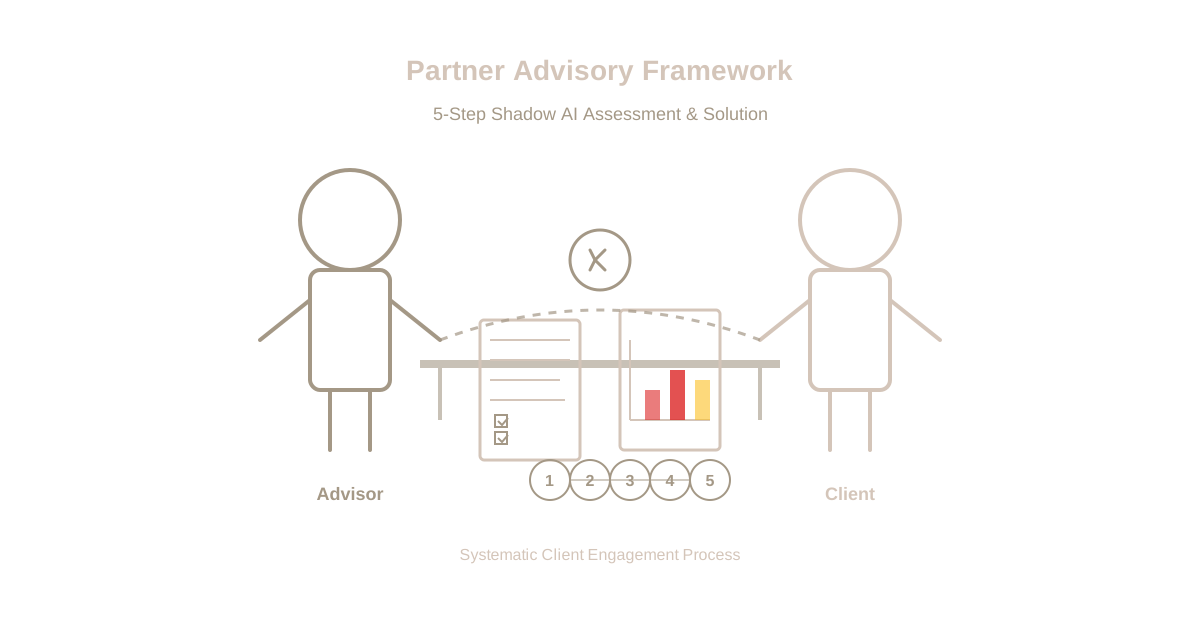
This guide provides a proven 5-step framework for addressing client Shadow AI concerns. Whether you're a Waymaker Certified Partner, independent consultant, or strategic advisor, these conversation starters, assessment tools, and positioning strategies will help you guide clients from awareness to action. Our partner network of 500+ advisors has used these approaches successfully across industries from healthcare to professional services.
The opportunity is significant: organizations need trusted advisors to navigate AI governance, and Shadow AI is the entry point for broader strategic conversations about technology adoption, risk management, and operational excellence.
Understanding Your Role in the Shadow AI Conversation
As a business advisor, you occupy a unique position of trust. Your clients confide in you about challenges they might not share with their board or even their executive team. When Shadow AI enters the conversation, they're not just asking about technology—they're asking about organizational risk, competitive positioning, and leadership blind spots.
Why Clients Come to You
The CFO's Dilemma: CFOs understand financial risk but may lack technical depth to assess AI security claims. They know a $4.45M data breach (IBM's global average) could devastate their organization, but they don't know how to evaluate whether their current AI usage creates that exposure. You bridge this gap by translating technical risks into business terms and financial impact.
The CEO's Innovation Pressure: CEOs face relentless pressure to adopt AI or risk competitive obsolescence. They're told "AI will transform your industry" daily. But when they discover that 59% of employees already use AI tools—without approval—they realize they've lost control. They need you to help them regain control without killing innovation. Understanding business amnesia and organizational memory is critical context for these conversations.
The CISO's Impossible Position: Chief Information Security Officers are tasked with preventing breaches while enabling business agility. Shadow AI represents both their worst nightmare (uncontrolled security risk) and their biggest challenge (users resist security controls that slow them down). They need frameworks, not blanket bans.
The Advisory Opportunity
Shadow AI creates multiple engagement opportunities:
Immediate Assessment (1-2 weeks, $10K-$25K):
- Shadow AI audit across organization
- Risk quantification and exposure analysis
- Quick-win recommendations
- Executive presentation with findings
AI Governance Implementation (2-3 months, $50K-$150K):
- Comprehensive AI policy development
- Approved platform selection and deployment
- Change management and training
- Ongoing governance structure
Strategic AI Roadmap (3-6 months, $100K-$500K):
- Enterprise AI strategy aligned with business objectives
- Departmental AI use case development
- Technology selection and integration architecture
- Performance measurement and optimization
Ongoing Advisory (Retainer, $5K-$20K/month):
- Quarterly AI governance reviews
- Emerging risk monitoring
- Policy updates for new AI capabilities
- Executive advisory and board presentations
The Shadow AI conversation is your entry point to these larger engagements. But first, you need a systematic approach to the initial assessment.
The 5-Step Shadow AI Advisory Framework
This framework guides clients from awareness through implementation. Each step includes conversation starters, diagnostic questions, and tools you can use immediately.
Step 1: Establish the Business Context (Week 1)
Before diving into technical assessments, understand the client's business reality. Shadow AI risks vary dramatically by industry, size, and regulatory environment.
Discovery Questions:
Industry and Regulatory Exposure:
- "What regulatory frameworks govern your industry?" (HIPAA, GDPR, SOX, etc.)
- "Have you experienced data breaches or security incidents in the past 3 years?"
- "What are your contractual obligations to customers regarding data protection?"
- "Do you have cyber insurance? What's your coverage for third-party data breaches?"
Current AI Usage and Awareness:
- "What's your official AI policy?" (Most will say "We don't have one")
- "Which AI tools has your organization officially approved?" (Expect blank stares)
- "When employees need AI assistance, what do they use?" (Uncover Shadow AI)
- "How do you track AI spending across departments?"
Business Priorities and Constraints:
- "What are your top 3 strategic priorities this year?"
- "How important is AI adoption to your competitive positioning?"
- "What's your appetite for risk versus speed of innovation?"
- "What's your typical technology approval and procurement process?"
Output from Step 1:
- Written summary of client's regulatory exposure
- List of suspected Shadow AI tools in use
- Business priority alignment document
- Proposed scope for Shadow AI audit
Positioning Waymaker: At this early stage, introduce Waymaker as "an example of an approved enterprise AI platform" without hard-selling. Plant the seed: "Organizations that successfully navigate this typically select one approved platform with proper security controls rather than trying to govern 20 different tools."
Step 2: Conduct the Shadow AI Audit (Week 1-2)
Now deploy systematic discovery to uncover the actual scope of Shadow AI in the organization. The 7-question Shadow AI audit provides a structured framework, but you'll need to adapt it to your client's environment.
Data Collection Methods:
Anonymous Employee Survey (High participation, lower accuracy):
1. Do you use AI tools to help with your work? (Yes/No/Unsure)
2. Which AI tools do you use? (List with "Other" option)
3. How frequently? (Daily/Weekly/Monthly/Rarely)
4. What types of information do you input? (General/Confidential/Customer Data/Financial)
5. Has your organization provided training on AI usage? (Yes/No)
6. Are you aware of an official AI policy? (Yes/No/Unsure)
7. Would you use an officially-approved AI tool if available? (Yes/No/Maybe)
Department Head Interviews (Lower coverage, higher accuracy):
- IT/Security: "What AI tools are you seeing in logs and network traffic?"
- Finance: "What SaaS subscriptions might include AI capabilities?"
- HR: "What training requests have you received for AI skills?"
- Sales: "Are sales teams using AI for proposals or research?"
- Marketing: "What AI tools are in your tech stack?"
Technical Discovery (Requires IT cooperation):
- Browser extension analysis
- SaaS spend analysis (look for AI tools in expense reports)
- Network traffic analysis (AI API calls)
- OAuth application audit (connected applications)
Common Shadow AI Tools to Look For:
- ChatGPT (53% of Shadow AI usage per The CFO)
- Claude.ai
- Google Bard/Gemini
- Microsoft Copilot (consumer version)
- Jasper AI, Copy.ai (marketing)
- GitHub Copilot (developers)
- Grammarly Premium (AI-powered)
- Numerous vertical-specific AI tools
The 7-Question Audit Applied:
For each AI tool discovered, assess:
-
Contractual Protection: Does a Business Associate Agreement or Data Processing Agreement exist?
- Most Shadow AI: ❌ No
- Waymaker: ✅ Yes
-
Training Prohibition: Is AI model training on client data explicitly prohibited contractually?
- Most Shadow AI: ❌ No (or unclear consumer TOS)
- Waymaker: ✅ Yes (Privacy Policy Section 4)
-
Data Residency: Can you audit where data is processed and stored?
- Most Shadow AI: ❌ No (processed globally, unclear jurisdictions)
- Waymaker: ✅ Yes (Primary: Australia; documented in DPA)
-
Encryption: Enterprise-grade encryption in transit (TLS 1.3) and at rest (AES-256)?
- Most Shadow AI: ⚠️ Partial (TLS but consumer-grade infrastructure)
- Waymaker: ✅ Yes (TLS 1.3 + AES-256 + RLS)
-
Access Controls: Organization-level access controls and permission management?
- Most Shadow AI: ❌ No (individual consumer accounts)
- Waymaker: ✅ Yes (RBAC, MFA, SSO)
-
Audit Trails: Comprehensive logging for compliance investigations?
- Most Shadow AI: ❌ No (consumer account visibility only)
- Waymaker: ✅ Yes (7-year retention, compliance reporting)
-
Spending Control: Can organization control AI spending and usage?
- Most Shadow AI: ❌ No (individual subscriptions, shadow spending)
- Waymaker: ✅ Yes (Credit-based, department budgets)
Output from Step 2:
- Comprehensive Shadow AI inventory (tools, users, data types)
- Risk scoring matrix (High/Medium/Low per tool)
- Gap analysis against 7-question audit
- Estimated shadow spending on AI tools
- Department-specific risk hotspots
Client Presentation: Create a visual dashboard showing: (1) Number of shadow AI tools discovered, (2) Estimated users per tool, (3) Risk score (red/yellow/green), (4) Estimated annual shadow spend, (5) Projected breach cost if current trajectory continues.
Step 3: Quantify the Business Impact (Week 2)
CFOs and executives need numbers. Translate your audit findings into financial terms they understand.
Breach Cost Calculation:
Use IBM's Cost of Data Breach methodology adapted to your client:
Base breach cost: $4.45M (global average)
Industry multipliers:
- Healthcare: 1.8x ($8.01M average)
- Financial: 1.3x ($5.79M average)
- Technology: 1.1x ($4.90M average)
- Retail: 0.8x ($3.56M average)
- Professional Services: 1.0x ($4.45M baseline)
Size adjustments:
- Small (<500 employees): 0.5x
- Medium (500-5,000): 1.0x
- Large (5,000+): 1.5x - 2.0x
Regulatory multipliers:
- GDPR jurisdiction: +€20M potential fine or 4% global revenue
- HIPAA violation: +$100K - $50M per violation
- State laws (CCPA): +$7,500 per violation
Example Calculation:
Client: 800-person healthcare services firm with HIPAA obligations
Base breach cost: $4.45M Healthcare multiplier: 1.8x = $8.01M Size adjustment: 1.1x (medium-large) = $8.81M HIPAA violation potential: +$5M (conservative) Total potential exposure: $13.81M
With 5 high-risk Shadow AI tools × 40% of employees = risk of exposure in 2-3 high-risk scenarios annually.
Expected value of risk: $13.81M × 30% probability = $4.14M annual risk
Shadow IT Productivity Costs:
Don't forget the hidden costs of uncoordinated AI adoption:
Time waste:
- Employees learning multiple AI tools: 5-10 hours per employee annually
- IT troubleshooting Shadow AI issues: 2-3 hours per incident
- Redundant AI subscriptions: Average 3.2 overlapping tools per organization
- Data re-entry between systems: 2-4 hours per employee per month
Example:
- 800 employees × 8 hours learning time × $50/hour loaded cost = $320K
- 200 support incidents × 2.5 hours × $75/hour IT cost = $37.5K
- Redundant subscriptions: $20-$50 per user/month × 800 users × 3.2 tools = $512K - $1.28M annually
- Total waste: $869K - $1.64M annually
Opportunity Cost:
What could the organization accomplish with a coordinated AI strategy?
- Sales cycle reduction: 10-20% with AI-assisted proposal generation
- Customer service efficiency: 30% improvement with AI triage
- Strategic planning quality: Better decisions with organizational memory
- Employee satisfaction: Approved tools without security friction
Output from Step 3:
- One-page financial impact summary
- Risk exposure calculation (breach potential)
- Productivity cost analysis (shadow IT waste)
- Opportunity cost framework (unrealized benefits)
- ROI projection for approved platform adoption
Executive Presentation: Lead with the number: "Your current Shadow AI exposure represents $4.14M in annual breach risk and $1.2M in productivity waste. Here's how we solve this while enabling innovation..."
Step 4: Present the Approved Platform Solution (Week 3)
Now position Waymaker as the solution that addresses every concern uncovered in your audit.
The Solution Framework:
Problem Identified → Waymaker Solution → Client Benefit
Shadow AI Risk: Employees using unapproved tools with customer data Waymaker Solution: Enterprise-approved platform with BAAs and DPAs Client Benefit: Contractual data protection guarantees, regulatory compliance
Productivity Waste: Multiple overlapping AI tools, redundant spending Waymaker Solution: Single platform with intelligent routing to multiple AI models Client Benefit: Consolidated spending, consistent user experience
Compliance Gaps: No audit trails, unclear data residency Waymaker Solution: Comprehensive logging, transparent data processing locations Client Benefit: Pass compliance audits, satisfy regulatory requirements
Loss of Control: Can't govern what you can't see Waymaker Solution: Credit-based consumption with department budgets Client Benefit: Executives control AI spending and usage organization-wide
Positioning Language for Client Conversations:
Opening: "Based on our audit, I've identified a platform that directly addresses each of the concerns we uncovered. Unlike consumer AI tools, Waymaker was built from the ground up as an enterprise-approved platform."
Security Positioning: "Waymaker uses OpenAI and Anthropic through enterprise API agreements, not consumer terms—without the $1M+ enterprise sales commitment you'd face negotiating directly." (For HIPAA work: Waymaker has requested BAAs from both providers; confirm current status with Waymaker before processing PHI.)
Compliance Positioning: "For your HIPAA obligations, Waymaker provides audit trails and data residency controls, and has requested BAAs from its AI providers—confirm their status before any PHI goes in. SOC 2 certification for Waymaker itself is on the roadmap."
Financial Positioning: "Instead of multiple shadow subscriptions costing $50-$200 per employee annually, AI credits come included in every Waymaker licence, so there is no separate AI subscription to approve. When credits run out, the software continues working in manual mode—no vendor lock-in."
Innovation Positioning: "Here's what sets Waymaker apart: their 'AI enhances but never requires' philosophy. This isn't an AI-first tool that forces AI into everything. It's a strategic execution platform that intelligently enhances workflows with AI when it adds value."
The Waymaker Differentiation Table:
Create a comparison for your client:
| Capability | Shadow AI (ChatGPT, etc.) | Waymaker |
|---|---|---|
| Business Associate Agreement | ❌ Consumer terms only | ⚠️ Requested from OpenAI + Anthropic — confirm status |
| Data Processing Agreement | ❌ Not available | ✅ Every customer |
| AI Training Prohibition | ⚠️ Unclear/opt-out | ✅ Contractual guarantee |
| Enterprise Access Controls | ❌ Individual accounts | ✅ RBAC, MFA, SSO |
| Audit Trails | ❌ Consumer visibility | ✅ 7-year retention |
| Data Residency Control | ❌ Unknown/global | ✅ Australia primary, documented |
| Spending Control | ❌ Shadow subscriptions | ✅ Credit budgets by department |
| Compliance Certifications | ❌ Consumer service | ✅ GDPR; SOC 2 for Waymaker itself on the roadmap |
| Works without AI | ❌ AI is the product | ✅ Manual mode when credits exhausted |
Introducing the Context Compass:
One of Waymaker's key differentiators is the Context Compass framework—a methodology for organizational intelligence that goes beyond simple prompt engineering.
Why this matters for your clients:
Most AI tools require users to provide all context in every interaction. Waymaker captures organizational context across four layers (Universal Knowledge, Organizational Memory, Project Context, Interaction Context), so AI responses improve as the organization uses the platform.
Advisor positioning: "Think of this as the difference between an AI tool and an AI-powered organizational intelligence system. Your team builds knowledge assets that compound over time rather than starting fresh with every prompt."
This positions you as bringing sophisticated AI strategy thinking, not just tool selection. Learn more about context engineering vs prompt engineering to deepen your advisory expertise.
Output from Step 4:
- Waymaker solution brief tailored to client
- Comparison table: Shadow AI vs Waymaker
- Pricing proposal based on organization size
- Implementation timeline and milestones
- Partner support commitment
Step 5: Guide Implementation and Change Management (Weeks 4-12)
Selecting an approved platform is only half the battle. Your clients need you to guide the organizational change that ensures adoption and eliminates Shadow AI usage.
Implementation Phases:
Phase 1: Executive Alignment (Week 4)
- Present business case to C-suite
- Secure budget approval
- Assign executive sponsor (typically CFO or COO)
- Establish AI governance committee
Phase 2: Pilot Deployment (Weeks 5-7)
- Select 20-50 pilot users (high Shadow AI usage departments)
- Configure Waymaker organization structure
- Set up SSO and access controls
- Establish credit budgets by department
- Provide pilot user training
- Gather feedback and refine
Phase 3: Organization Rollout (Weeks 8-10)
- Deploy to all departments with training
- Migrate existing projects and documents
- Communicate approved AI policy
- Sunset Shadow AI tools (policy + technical controls)
- Provide change management support
Phase 4: Governance and Optimization (Weeks 11-12 and ongoing)
- Quarterly governance committee reviews
- AI usage analytics and optimization
- Policy refinement based on emerging needs
- Success metrics and ROI reporting
Change Management Messaging:
The way you position this transition determines adoption success. Never: "We're banning AI tools you've been using."
Instead: "We're providing you with an officially-approved AI platform that's more powerful than the consumer tools you've been using—and it protects the organization from data breach risks."
Key messages:
- Choice, not restriction: "You can now use AI without worrying about security"
- Upgrade, not downgrade: "Waymaker provides capabilities consumer tools don't"
- Empowerment: "We're giving you credit budgets to experiment and innovate"
- Safety: "This protects you, the organization, and our customers"
Partner Role During Implementation:
Your ongoing advisory support is critical:
Technical:
- Coordinate with Waymaker support team for configuration assistance
- Troubleshoot integration issues
- Optimize credit allocation based on usage patterns
Strategic:
- Facilitate governance committee meetings
- Develop department-specific AI use cases
- Create internal communication materials
- Present results to board/executives
Training:
- Conduct department-specific training sessions
- Create internal AI usage guidelines
- Develop best practices library
- Celebrate early wins and success stories
Output from Step 5:
- Implementation project plan with milestones
- Change management communication templates
- Training materials and schedules
- Governance framework and meeting cadence
- Success metrics dashboard
Common Client Objections and How to Address Them
As you guide clients through this framework, anticipate these objections:
Objection 1: "Our employees will resist. They like their current AI tools."
Response: "That's exactly why we start with a pilot in high-usage departments. When employees see that Waymaker provides better AI capabilities plus official approval, resistance evaporates. In our partner network, we see 80%+ adoption within 60 days when the pilot is structured well. The key is messaging it as an upgrade, not a restriction."
Objection 2: "This seems expensive compared to a $20/month ChatGPT subscription."
Response: "Let's look at total cost of ownership. Right now, you have shadow spending across multiple tools—we found $500K+ in our audit. Plus, you're carrying $4M+ in breach risk. Waymaker consolidates that spending, eliminates the risk, and provides enterprise capabilities consumer tools can't match. The ROI is clear when you include avoided breach costs."
Objection 3: "Can't we just use OpenAI's enterprise plan directly?"
Response: "You could, but you'd be building everything else from scratch. Waymaker provides the strategic execution platform with AI enhancement, not just access to AI models. Plus, you'd need $1M+ annual commitment for enterprise OpenAI. Waymaker gives you the same BAA protections with flexible consumption pricing and a platform that works without AI when credits are exhausted."
Objection 4: "What if Waymaker shuts down or raises prices dramatically?"
Response: "This is where Waymaker's architecture is brilliant. Unlike AI-first tools, Waymaker's platform works fully in manual mode when AI credits are exhausted. You're not held hostage. Plus, as a Certified Partner, I maintain relationships with multiple enterprise AI platforms. If Waymaker ever becomes a poor fit, we'll transition you. But their 'AI enhances but never requires' philosophy specifically prevents vendor lock-in."
Objection 5: "Our industry has unique requirements. Will this really work for us?"
Response: "That's why we start with the audit tailored to your industry. Healthcare has different requirements than financial services. But the fundamentals are the same: you need contractual data protection, compliance capabilities, and controlled AI access. Waymaker's architecture supports industry-specific configurations. Let's look at how other [industry] firms are using it." (Share relevant case studies or connect with Waymaker partner manager for reference customers.)
Building Your Shadow AI Advisory Practice
Shadow AI represents a significant practice-building opportunity for business advisors. Here's how to position yourself as the go-to expert:
Content Marketing:
- Write articles about Shadow AI risks specific to your target industries
- Share client success stories (anonymized) on LinkedIn
- Host webinars: "Shadow AI Audit: What Every [Industry] Needs to Know"
- Create assessment tools clients can use for self-diagnosis
Partner Program Leverage:
- Become a Waymaker Certified Partner for referral commissions
- Access partner-exclusive training and resources
- Co-market with Waymaker for industry-specific campaigns
- Participate in partner community for best practice sharing
Service Packaging:
- Shadow AI Audit: 1-2 week engagement, $10K-$25K
- AI Governance Implementation: 2-3 month project, $50K-$150K
- Strategic AI Roadmap: 3-6 month engagement, $100K-$500K
- Retainer Advisory: Ongoing governance, $5K-$20K/month
Industry Specialization:
- Develop deep expertise in 1-2 regulated industries (healthcare, finance, legal)
- Build industry-specific Shadow AI case studies
- Create compliance mapping (HIPAA, GDPR, SOX → Waymaker capabilities)
- Partner with industry associations for thought leadership
Waymaker Partner Benefits:
- Commission on referred customers (discuss with partner manager)
- Co-marketing support and lead generation
- Technical training and certification
- Priority support for your clients
- Access to product roadmap and beta features
Resources for Waymaker Partners
As you build your Shadow AI advisory practice, leverage these resources:
Assessment Tools:
- 7-Question Shadow AI Audit
- Business Amnesia organizational memory assessment
- Financial impact calculator (available in partner portal)
Client Education Materials:
- Waymaker vs Shadow AI comparison
- GDPR, HIPAA, and Shadow AI compliance
- True cost of Shadow AI ROI analysis
Technical References:
- Waymaker Privacy Policy Section 4 (AI Services)
- Data Processing Agreement template
- Security architecture documentation
- Compliance certifications (SOC 2, GDPR)
Partner Community:
- Monthly partner calls with product updates
- Private Slack/Teams channel for partner questions
- Quarterly partner summit for training and networking
- Partner success manager for your clients
Next Steps for Advisors:
- Schedule Shadow AI audit with your top 3 clients most at risk
- Join Waymaker Partner Program for referral commissions and resources
- Complete Certification Training to deepen your technical expertise
- Share this guide with fellow advisors building AI governance practices
The Shadow AI crisis is your clients' biggest hidden risk and your biggest opportunity to provide strategic value. With this framework, you're equipped to guide them from awareness to action while building a thriving advisory practice.
Experience Waymaker: The Approved AI Platform
Ready to see Waymaker in action for your clients? Waymaker Commander demonstrates the enterprise AI capabilities that make Shadow AI unnecessary.
Partner Demo Access:
- Full feature access for client demonstrations
- Sandbox environment for testing
- Partner-branded demo assets
- Technical pre-sales support
Register for partner beta access and experience the platform you'll recommend to clients.
Shadow AI is the entry point to broader AI governance advisory services. Learn more about the Context Compass framework that differentiates Waymaker, and explore how context engineering creates sustainable competitive advantages for your clients.
About the Author

Stuart Leo
Stuart Leo founded Waymaker to solve a problem he kept seeing: businesses losing critical knowledge as they grow. He wrote Resolute to help leaders navigate change, lead with purpose, and build indestructible organizations. When he's not building software, he's enjoying the sand, surf, and open spaces of Australia.