Your startup just raised $50M Series B. The board wants 10x growth in 18 months. You hire aggressively, expand to new markets, and scale operations rapidly. Twelve months later, you're burning cash, culture is toxic, and systems are collapsing. What happened? You tried to buy scale instead of earning it. You skipped growth stages that can't be skipped.
This pattern destroys thousands of businesses annually. Leaders confuse fundraising with capability development. They assume capital accelerates maturity. They scale operations faster than organizational capacity. According to research from CB Insights on startup failures, 44% of startups fail due to running out of cash, but the underlying cause is often premature scaling—attempting to reach advanced growth stages without building foundational capabilities.
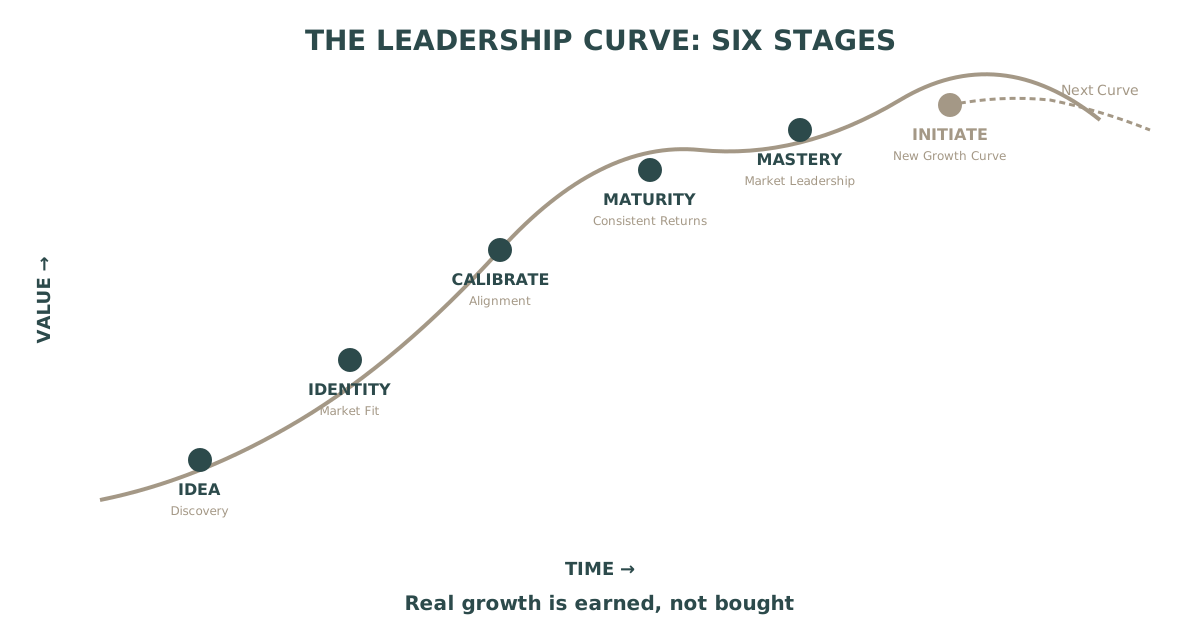
The first principle of the Resolute Leadership Curve framework addresses this directly: "Real growth is earned, not bought." Sustainable organizational growth requires progressing through six distinct stages—Idea, Identity, Calibrate, Maturity, Mastery, and Initiate—each demanding specific skills, systems, and character development. Shortcuts lead to collapse. Patient progression builds lasting value.
The Problem: Different Stages Require Different Leadership
The leadership capabilities that launch a startup will destroy a scaling company. The systems that create efficiency at scale will kill innovation in early stages. The character traits that build market leadership differ fundamentally from those required for breakthrough innovation.
Why "Just Scale Faster" Fails
Common growth mistake:
- Company achieves product-market fit with 20 employees
- Raises capital to "accelerate growth"
- Hires to 200 employees in 12 months
- Result: Chaos, inefficiency, cultural breakdown, talent exodus
The root cause: Attempting to reach Maturity stage without building Calibrate stage capabilities—aligned teams, mature systems, scalable processes.
The WeWork Cautionary Tale
WeWork's fake growth pattern:
- Rapid expansion: 800+ locations in 124 cities without proven unit economics
- Hype-driven valuation: $47 billion peak valuation based on growth narrative, not fundamentals
- Unsustainable metrics: Losing $219,000 per hour at IPO attempt
- Leadership failure: Charismatic founder without operational discipline
- Collapse: Valuation crashed to $2.9 billion (94% decline)
What was missing: WeWork attempted to reach Mastery (market leadership) without developing Calibrate capabilities (system alignment) or Maturity capabilities (consistent returns on investment). Fake growth inevitably collapses.
The Amazon Counter-Example
Amazon's real growth pattern:
- Patient capital: Operated at low/no profit for years while building infrastructure
- Systematic development: Matured logistics systems before scaling product categories
- Customer obsession: Perfected customer experience at each growth stage
- Strategic reinvestment: Allocated profits to future capabilities (AWS, Prime, etc.)
- Earned leadership: Became market leader through systematic capability development
The difference: Amazon earned scale by progressing through growth stages methodically, building foundations before advancing. This created sustainable competitive advantage that compounds over decades.
Learn more about why resolute leadership builds systems while charismatic leadership creates dependency.
The Six Stages of the Leadership Curve
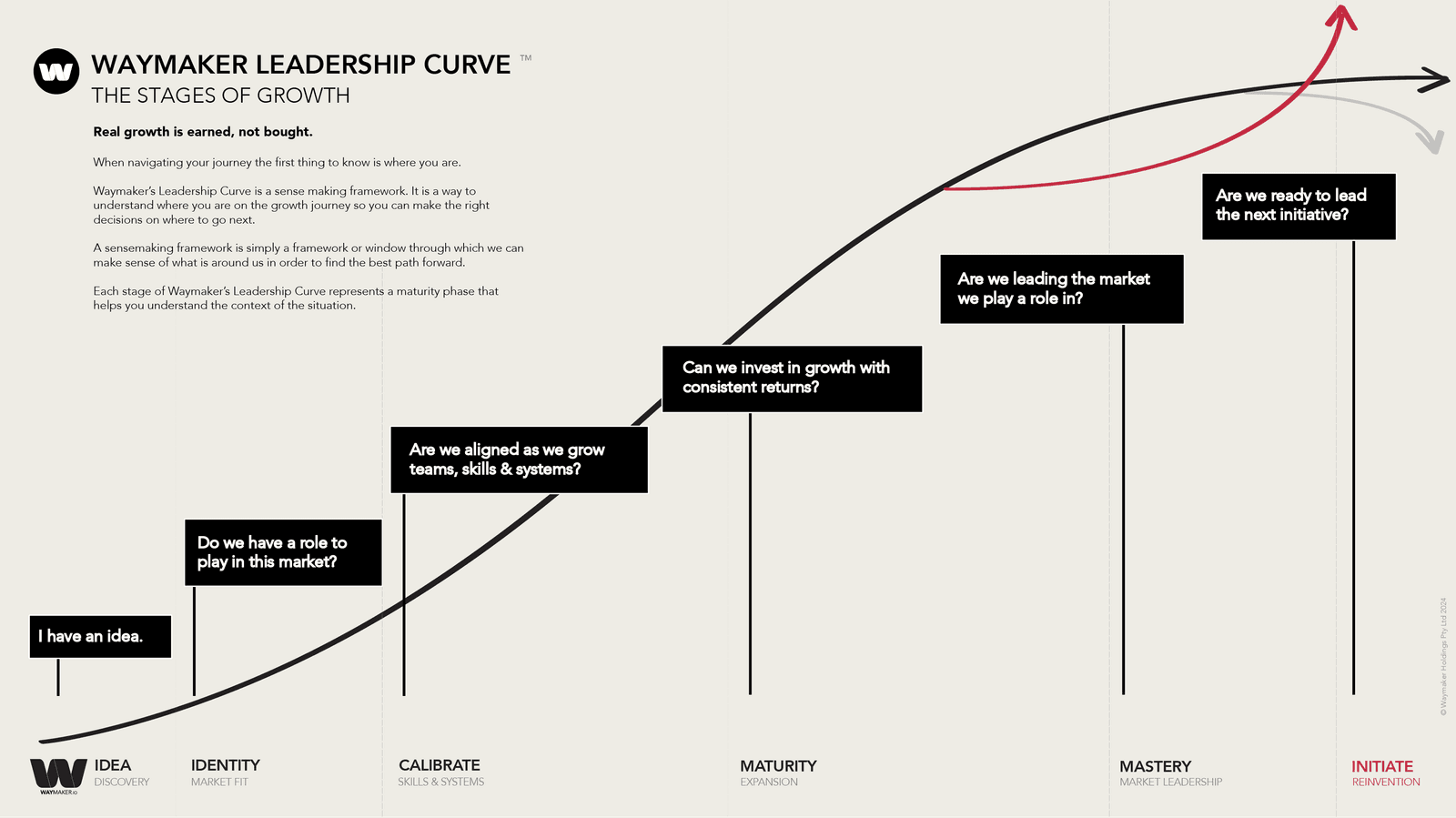
Every organization, product, or leader starts at the bottom of the leadership curve as an immature, unclear idea. The journey from concept to market mastery follows six predictable stages. Understanding where you are determines what you need to do next.
Stage Overview
The six stages are: Idea, Identity, Calibrate, Maturity, Mastery, and Initiate.
Each stage represents a key milestone requiring specific focus and goals to advance effectively:
- Idea (Discovery) - From problem to potential solution
- Identity (Market Fit) - From solution to market validation
- Calibrate (Alignment) - From validation to systematic growth
- Maturity (Consistent Returns) - From growth to market leadership pursuit
- Mastery (Market Leadership) - From competitive to dominant position
- Initiate (New Growth Curve) - From current success to future innovation
Critical principle: What gets you to one stage is unlikely to be sufficient for the next stage. Each advancement demands new competencies, different systems, and evolved character.
Real Growth vs. Fake Growth Indicators
Before examining each stage, understand the fundamental distinction:
Real Growth Characteristics:
- ✅ Sustainable unit economics with clear path to profitability
- ✅ Deliberate capability building at each stage
- ✅ Patient capital with long-term investment perspective
- ✅ Genuine market demand and customer satisfaction
- ✅ Continuous reinvestment in future capabilities
Fake Growth Warning Signs:
- ❌ Growth dependent on unsustainable customer acquisition costs
- ❌ Hype-driven valuations disconnected from fundamentals
- ❌ Expansion faster than capability development allows
- ❌ Short-term metrics prioritized over long-term viability
- ❌ Profit extraction without reinvestment in growth
According to Harvard Business Review research on sustainable growth, companies that prioritize capability building over rapid scaling achieve 3.6x higher long-term returns than those pursuing growth-at-any-cost strategies.
This article provides an overview of the six growth stages. For complete stage-by-stage playbooks, assessment tools, and capability development frameworks, get Resolute by Stuart Leo on Amazon.
Stages 1-2: Idea and Identity (Foundation Phases)
Stage 1: IDEA - "I have an idea"
Focus: Discovery of problems and potential solutions in the market.
Primary goal: Sharpen understanding of the problem and validate a viable solution exists.
Key activities:
- Problem space exploration and customer pain point identification
- Solution ideation and prototype development
- Early testing with potential customers
- Refinement based on feedback and learning
Success metrics:
- Clear problem definition with specific customer segment
- Validated solution hypothesis through early tests
- Identified path from concept to market offering
Leadership requirement: Creative exploration combined with disciplined validation. Avoid falling in love with solution before proving problem.
Common mistakes:
- ❌ Building solution before validating problem
- ❌ Targeting everyone instead of specific segment
- ❌ Confusing friends' encouragement with market validation
What capability must be built: Problem-solution clarity sufficient to test in market.
Stage 2: IDENTITY - "Do we have a role to play in this market?"
Focus: Establishing whether organization, product, or service has meaningful role in market.
Primary goal: Validate product-market fit through early success metrics and positive market response.
Key activities:
- Market testing with early adopter customers
- Observing how market responds to solution
- Identifying success patterns and repeatability signals
- Adjusting offering based on customer behavior
Success metrics:
- Early customer acquisition without heavy marketing spend
- Repeat purchases or engagement from initial customers
- Word-of-mouth referrals beginning organically
- Clear value delivery validated by customer retention
Leadership requirement: Market sensitivity with adaptive learning. Read signals accurately and adjust quickly without abandoning core insight.
Common mistakes:
- ❌ Declaring product-market fit based on vanity metrics
- ❌ Pivoting too frequently without testing thoroughly
- ❌ Scaling before establishing repeatable success pattern
What capability must be built: Market validation proving customers will pay for sustainable value delivery.
Progression indicator: Ready to advance when you have repeatable success pattern with specific customer segment and clear understanding of value drivers.
Stages 3-4: Calibrate and Maturity (Growth Phases)
Stage 3: CALIBRATE - "Are we aligned as we grow teams, skills, and systems?"
Focus: Aligning teams, skills, and systems as organization scales beyond founders.
Primary goal: Build foundational systems ensuring new team members can align with established practices and scale cohesively.
Key activities:
- Documenting processes and operational standards
- Building leadership team with complementary skills
- Creating onboarding and training systems
- Establishing communication cadences and decision-making frameworks
- Implementing tools and technologies for coordination
Success metrics:
- New employees productive within defined timeframe (30-60-90 days)
- Quality consistency maintained as team grows
- Clear accountability across functions and roles
- Reduced founder bottlenecks through delegation
Leadership requirement: Systems thinking with people development. Build infrastructure for scale while maintaining culture and quality.
Common mistakes:
- ❌ Hiring for skills without cultural alignment
- ❌ Building systems that constrain instead of enable
- ❌ Scaling team faster than management capability
- ❌ Neglecting leadership development of early employees
What capability must be built: Organizational alignment enabling growth without chaos. Learn more about how the 5 Management Questions create systematic alignment.
Stage 4: MATURITY - "Can we invest in growth with consistent returns?"
Focus: Achieving consistent growth with predictable, repeatable returns on investment.
Primary goal: Refine operations to ensure sustainable unit economics that support market leadership pursuit.
Key activities:
- Optimizing customer acquisition cost (CAC) and lifetime value (LTV)
- Building financial management disciplines and forecasting capabilities
- Identifying and uplifting immature areas within business
- Developing strategic planning capabilities
- Exploring expansion opportunities (new products, markets, channels)
Success metrics:
- Positive unit economics: LTV:CAC ratio >3:1
- Predictable revenue growth with defined CAC payback period
- Gross margins supporting sustainable operations
- Cash flow positive or clear path to profitability
- Strategic reinvestment generating returns
Leadership requirement: Operational excellence with strategic vision. Master current business while identifying next growth opportunities.
Common mistakes:
- ❌ Pursuing market leadership without mature fundamentals
- ❌ Optimizing for efficiency while killing innovation
- ❌ Taking profits without reinvesting in future capabilities
- ❌ Ignoring new competitors while focused internally
What capability must be built: Financial sustainability with strategic opportunity identification for next growth curve.
Critical decision at this stage: What new opportunities should we initiate to ensure continued growth after current model matures? (This becomes Stage 6: Initiate)
Stages 5-6: Mastery and Initiate (Leadership Phases)
Stage 5: MASTERY - "Are we leading the market we play a role in?"
Focus: Achieving and defending leading, influential position within target market.
Primary goal: Establish market leadership through first-mover advantage or outcompeting alternatives.
Key activities:
- Building brand authority and thought leadership
- Defending market position against competitive threats
- Expanding market influence through partnerships and ecosystem development
- Maintaining innovation edge to prevent disruption
- Critical: Launching opportunities identified during Maturity stage
Success metrics:
- Top 3 market position by relevant metric (revenue, customers, brand awareness)
- Pricing power - ability to command premium or set market rates
- Talent attraction - top performers seek to work for you
- Industry influence - competitors respond to your moves
Leadership requirement: Competitive defense with innovation offense. Protect current position while building future.
Common mistakes:
- ❌ Resting on market leadership without continuous innovation
- ❌ Prioritizing profits over reinvestment in R&D
- ❌ Ignoring emerging competitors with different business models
- ❌ Extracting value instead of creating new value
The hardest truth: Market leadership is when the hardest work begins. Competitors will exploit any opportunity to challenge your position. Maintaining leadership requires greater investment than achieving it.
Stage 6: INITIATE - "Are we developing the next wave of innovation?"
Focus: Launching new growth curve during Maturity stage to avoid decline.
Primary goal: Start work on next major innovation that will propel organization forward when current model peaks.
CRITICAL TIMING: Initiate phase must begin during Maturity stage, not after decline starts. Failing to initiate proactively leads to slow decline followed by accelerated fall.
Key activities:
- R&D investment in emerging technologies and markets
- Exploration of adjacent opportunities and business models
- Building capabilities for next-generation solutions
- Acquiring or partnering for future positioning
- Developing transformation leadership capabilities
Success metrics:
- Percentage of resources allocated to future capabilities (target: 10-20%)
- New product/market experiments launched and tested
- Leadership team capability for managing multiple business horizons
- Innovation pipeline with defined milestones
Leadership requirement: Transformation courage with change management skill. Potentially cannibalize current success to build future success.
Famous examples:
- Apple: Sacrificed iPod to launch iPhone, creating new growth curve
- Netflix: Killed DVD business to build streaming dominance
- Amazon: Invested retail profits into AWS, creating trillion-dollar opportunity
- Tesla: While mastering EVs, initiating energy storage, autonomous driving, AI/robotics
What happens without Initiate: Gradual decline often unnoticed until accelerated fall makes recovery nearly impossible. Organizations that fail to reinvest in future capabilities inevitably lose relevance.
Learn more about how real growth is earned through systematic progression.
Self-Assessment: Where Are You on the Curve?
Use this framework to identify your current stage and required next capabilities.
Stage Identification Questions
Answer YES/NO for each stage:
Idea Stage:
- Do we have a clearly defined problem worth solving?
- Have we developed a potential solution hypothesis?
- Are we actively testing our solution with potential customers?
Identity Stage:
- Are we seeing positive market response to our solution?
- Do we have early success metrics indicating product-market fit?
- Can we identify a repeatable pattern in customer acquisition?
Calibrate Stage:
- Are our teams, skills, and systems aligned for growth?
- Can new employees become productive within defined timeframes?
- Do we have documented processes for core operations?
Maturity Stage:
- Can we invest in growth with predictable, repeatable returns?
- Are our unit economics sustainable (LTV:CAC >3:1)?
- Have we identified opportunities for next growth curve?
Mastery Stage:
- Are we leading our market with influential positioning?
- Do we have pricing power and brand authority?
- Are we defending our position while innovating for future?
Initiate Stage:
- Are we actively developing the next wave of innovation?
- Are we allocating 10-20% of resources to future capabilities?
- Do we have R&D initiatives that could create new growth curve?
Your current stage: The last stage where you answered YES to all questions.
Capability Gap Analysis
For your current stage, assess these capability requirements:
Current Stage Capabilities (Must Have):
- What skills, systems, and character are required for success at this stage?
- Rate yourself 1-10 on each required capability
- Identify top 3 gaps requiring immediate attention
Next Stage Capabilities (Need to Build):
- What new skills, systems, and character are needed for next stage?
- Which capabilities can we start developing now?
- What investments (time, capital, talent) are required?
Growth Acceleration vs. Capability Building
Critical reflection:
- Are we trying to reach advanced stages without building foundational capabilities?
- Where are we confusing fundraising/revenue growth with organizational maturity?
- What shortcuts are we tempted to take that will create future problems?
The honest answer often reveals the difference between real and fake growth trajectory.
Experience the Complete Leadership Curve Framework
For complete stage-by-stage playbooks, capability development frameworks, self-assessment tools, and transformation guides for navigating each phase, get Resolute by Stuart Leo on Amazon.
The book provides:
- Detailed stage breakdowns with specific capability requirements
- Real vs. fake growth diagnostics to assess your trajectory
- Transition playbooks for advancing from one stage to next
- Initiate phase strategies for launching new growth curves
- Tesla, Amazon, and 30+ case studies showing the framework in action
Real growth is earned, not bought. Different stages require different leadership. Progress deliberately. Learn more about the complete Resolute Leadership Curve framework and the 12 Questions that create clarity at every stage.
About the Author

Stuart Leo
Stuart Leo founded Waymaker to solve a problem he kept seeing: businesses losing critical knowledge as they grow. He wrote Resolute to help leaders navigate change, lead with purpose, and build indestructible organizations. When he's not building software, he's enjoying the sand, surf, and open spaces of Australia.