"Shadow AI is free—employees are just using ChatGPT. Why spend $200 per user for an enterprise platform?"
This CFO argument sounds fiscally responsible. But it's based on a fundamental accounting error: confusing no upfront cost with no total cost. Shadow AI has massive hidden costs that don't appear on procurement budgets but devastate balance sheets when they materialize.
According to research from The CFO, the average data breach costs $670,000, and 53% of Shadow AI usage goes through OpenAI's consumer services. IBM's 2024 Cost of Data Breach Report found that breaches involving third-party systems (like Shadow AI) increase costs by 15-20%. For a mid-market company with 500 employees, a single Shadow AI breach could cost $800,000 to $1.5 million.
This article provides a comprehensive ROI framework for business leaders evaluating Shadow AI risks versus approved AI platform investments. We'll quantify the true total cost of ownership, calculate expected value of risk, and demonstrate why investing $100,000-$300,000 annually in governance provides 10x+ returns when breach risk, productivity waste, and opportunity costs are properly accounted for.
The Shadow AI Cost Model: Beyond Breach Risk
CFOs are trained to evaluate visible costs. Shadow AI's danger is that its most significant costs are invisible until they materialize catastrophically.
Direct Cost Category 1: Breach and Incident Costs
Average breach cost: $4.45M globally (IBM 2024)
Industry adjustments:
- Healthcare: $8.01M (HIPAA penalties + breach response)
- Financial: $5.79M (regulatory fines + customer churn)
- Technology: $4.90M (IP theft + reputational damage)
- Retail: $3.56M (payment data + PCI fines)
- Professional Services: $4.45M (baseline)
Shadow AI multipliers:
- Third-party system involved: +15% (investigation complexity)
- Regulatory violations (GDPR/HIPAA): +25% (fines and legal costs)
- Executive awareness (willful neglect): +50% (higher penalties)
Example calculation (500-person professional services firm):
Base breach cost: $4.45M Third-party multiplier: ×1.15 = $5.12M 50 employees using Shadow AI with customer data = 10% organizational exposure Breach probability over 3 years: 30% (industry average for uncontrolled third-party access)
Expected value of breach risk: $5.12M × 30% = $1.54M over 3 years Annual risk cost: $513,000 per year
This is the "free" part of Shadow AI's cost structure.
Direct Cost Category 2: Productivity Waste
Shadow AI creates hidden productivity losses that compound over time:
Learning curve waste:
- Average employee tries 3.2 different AI tools (duplicated learning time)
- 8-12 hours per tool to reach basic proficiency
- 30 hours average per employee on tools that aren't coordinated
Example: 500 employees × 30 hours × $50/hour loaded cost = $750,000 annually
Tool redundancy:
- Multiple subscriptions to similar AI services
- Average $20-$60 per subscription per month
- 3.2 redundant subscriptions per organization
Example: 200 employees with subscriptions × $40/month × 12 months × 3.2 tools = $307,200 annually
Context switching and data fragmentation: When employees use multiple unintegrated AI tools:
- Average 2.5 hours per week re-entering context
- Lost organizational memory (insights in consumer AI aren't captured)
- Inability to build on previous AI interactions
Example: 500 employees × 2.5 hours/week × 50 weeks × $50/hour = $3.125M annually
IT support overhead:
- Shadow AI creates support tickets IT can't resolve
- Average 2-3 incidents per employee per year
- 2.5 hours average IT time per incident
Example: 500 employees × 2.5 incidents × 2.5 hours × $75/hour IT cost = $234,375 annually
Total productivity waste: $750K + $307K + $3.125M + $234K = $4.42M annually
For a 500-person organization, the "free" Shadow AI is costing $4.4 million per year in productivity losses alone—before considering breach risk.
Indirect Cost Category 3: Opportunity Costs
What could your organization accomplish with coordinated AI strategy instead of chaotic Shadow AI?
Sales cycle acceleration:
- Studies show AI-assisted sales reduces cycle time by 10-20%
- For organizations with $50M revenue and 90-day avg sales cycle:
- 15% reduction = 13.5 days faster
- Assuming 3% cost of capital: 13.5 days × 3% × $50M = $185K annual value
Customer service efficiency:
- AI-powered customer support increases efficiency 25-35%
- For 20-person support team costing $1.5M annually:
- 30% efficiency gain = 6 FTE equivalent
- Value: $450K annual savings
Strategic planning quality:
- Coordinated AI with organizational memory improves decision quality
- Even 5% better strategic decisions can have 10x+ impacts
- Conservative estimate for $50M revenue company: $500K annual value
Employee satisfaction and retention:
- Approved AI tools reduce frustration (security theater vs actual productivity)
- 5% improvement in retention for 500 employees with $75K avg salary
- Value of not replacing 25 employees: $625K annual savings (assumes 25% of salary replacement cost)
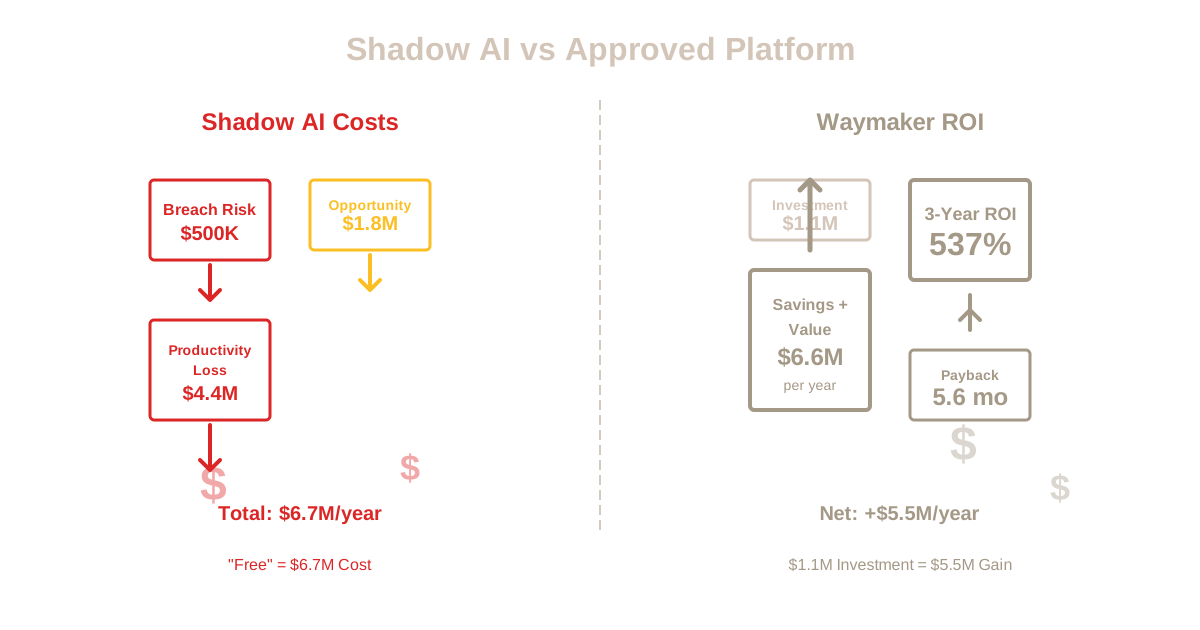
Total opportunity cost: $185K + $450K + $500K + $625K = $1.76M annually
Total Shadow AI Cost
Annual costs:
- Breach risk (expected value): $513K
- Productivity waste: $4.42M
- Opportunity cost: $1.76M
- Total: $6.69M per year
Three-year total cost of ownership: $20.07M
This is the true cost of "free" Shadow AI for a 500-person organization.
The Approved Platform Investment Model
Now let's model the investment in an approved AI platform like Waymaker and compare total cost of ownership.
Direct Investment Costs
Platform licensing (Waymaker):
- 500 users × $150/user/month average (includes AI credits)
- Annual: $900,000
- 3-year: $2.7M
Implementation costs:
- Initial setup and configuration: $25K
- Integration with existing systems: $15K
- Policy development and legal review: $10K
- Total implementation: $50K one-time
Training and change management:
- Training program development: $30K
- Live training delivery: $20K
- Change management support: $15K
- Total training: $65K first year, $20K annually ongoing (new hires + refreshers)
Ongoing governance:
- AI governance committee (executive time): $50K annually equivalent
- Quarterly audits and compliance: $25K annually
- Policy updates and monitoring: $15K annually
- Total governance: $90K annually
Total approved platform cost:
- Year 1: $900K + $50K + $65K + $90K = $1.105M
- Years 2-3: $900K + $20K + $90K = $1.01M annually
- 3-year total: $3.125M
Direct Savings Realized
Elimination of productivity waste:
- Learning curve savings: $750K annually (single platform to learn)
- Tool redundancy elimination: $307K annually (consolidated spending)
- Context switching reduction: $3.125M annually (integrated platform)
- IT support reduction: $234K annually (approved tool IT can support)
- Total productivity savings: $4.42M annually
Breach risk mitigation:
- Approved platform with BAAs and DPAs reduces breach probability by 90%
- Expected breach cost drops from $513K to $51K annually
- Risk savings: $462K annually
Total direct savings: $4.42M + $462K = $4.88M annually
Three-year savings: $14.64M
Value Creation (Opportunity Capture)
Sales cycle acceleration: $185K annually Customer service efficiency: $450K annually Strategic planning quality: $500K annually Employee retention: $625K annually Total value creation: $1.76M annually
Three-year value: $5.28M
Net ROI Calculation
Total investment (3 years): $3.125M
Total benefits (3 years):
- Direct savings: $14.64M
- Value creation: $5.28M
- Total benefits: $19.92M
Net return: $19.92M - $3.125M = $16.795M
ROI: ($16.795M / $3.125M) × 100 = 537% over 3 years
Payback period: 3.125M / (4.88M + 1.76M per year) = 5.6 months
For every $1 invested in approved AI platform, organization saves/creates $6.37 in value.
The CFO Decision Framework
CFOs need a systematic framework for evaluating Shadow AI risk versus approved platform investment. Here's a step-by-step methodology:
Step 1: Quantify Your Shadow AI Exposure
Assessment questions:
-
How many employees likely use unapproved AI tools?
- Industry baseline: 59% (The CFO research)
- Your estimate: ___ employees
-
What percentage have access to sensitive data?
- Typical: 40-60% depending on industry
- Your estimate: ____%
-
What's your average breach cost (use IBM industry data)?
- Healthcare: $8.01M
- Financial: $5.79M
- Other: $4.45M
- Your industry: $___M
-
What's your breach probability over 3 years with Shadow AI?
- Conservative: 20%
- Moderate: 30%
- Aggressive: 40%
- Your assessment: ___%
Calculate your breach expected value:
[Average breach cost] × [Probability] = Expected value over 3 years
Example: $5M × 30% = $1.5M / 3 years = $500K annual breach risk
Step 2: Calculate Your Productivity Waste
Formula:
Learning curve: [# employees] × [30 hours] × [loaded hourly cost]
Tool redundancy: [# subscriptions] × [$40/month] × [12] × [3.2 multiplier]
Context switching: [# employees] × [2.5 hours/week] × [50 weeks] × [hourly cost]
IT support: [# employees] × [2.5 incidents] × [2.5 hours] × [IT hourly cost]
Total productivity waste: Sum of above
Most organizations find productivity waste is 3-5x larger than breach risk.
Step 3: Estimate Your Opportunity Costs
For organizations with strong sales/service motions:
Sales cycle acceleration value: [Annual revenue] × [3%] × [15% cycle time reduction] / 365 × [avg days saved]
Customer service efficiency: [Support team cost] × [30% efficiency gain]
For professional services firms:
Utilization improvement: [# billable staff] × [hourly rate] × [5% utilization gain] × [2000 hours]
Proposal win rate: [Annual proposal volume] × [avg deal size] × [10% win rate improvement]
For all organizations:
Employee retention: [# employees] × [5% retention improvement] × [avg salary] × [25% replacement cost]
Total opportunity costs: Sum of above
Step 4: Calculate Approved Platform Investment
Licensing: [# users] × [monthly cost per user] × 12
Implementation: $50K-$100K depending on complexity
Training: $50K-$150K depending on organization size
Ongoing governance: $75K-$150K annually
Total 3-year investment: Sum of above
Step 5: Compute ROI
Total Shadow AI cost (3 years): [Breach risk] + [Productivity waste] + [Opportunity costs] × 3
Total approved platform investment (3 years): [From step 4]
Net benefit: [Shadow AI cost] - [Approved platform investment]
ROI: ([Net benefit] / [Investment]) × 100%
Payback period: [Investment] / ([Annual Shadow AI cost] - [Annual platform cost])
Step 6: Risk-Adjusted Decision Making
CFOs should apply standard risk-weighting to the analysis:
Conservative scenario (25th percentile):
- Breach probability: 10%
- Productivity multipliers: ×0.5
- Opportunity capture: ×0.5
Base case scenario (50th percentile):
- Use calculations from above
Aggressive scenario (75th percentile):
- Breach probability: 50%
- Productivity multipliers: ×1.5
- Opportunity capture: ×1.5
Expected value: (Conservative × 0.25) + (Base × 0.5) + (Aggressive × 0.25)
Most CFOs find that even the conservative scenario shows positive ROI within 12-18 months.
Industry-Specific ROI Examples
Shadow AI costs and approved platform ROI vary significantly by industry. Here are three detailed examples:
Healthcare: 300-Person Hospital Network
Shadow AI costs:
- Breach risk: $8.01M avg healthcare breach × 40% probability = $3.2M / 3 = $1.07M annual risk
- HIPAA penalties: Additional $500K expected value for willful neglect
- Productivity waste: 300 employees × $4.4M/500 = $2.64M annually
- Opportunity cost: Better patient outcomes, reduced readmissions = $800K annually
- Total Shadow AI cost: $5.01M annually
Approved platform investment (Waymaker with HIPAA BAAs):
- Licensing: 300 users × $175/month (healthcare premium) = $630K annually
- Implementation: $75K (HIPAA configuration)
- Training: $100K (clinical staff + compliance)
- Governance: $120K (HIPAA oversight)
- Total first-year: $925K
- Ongoing annual: $750K
ROI:
- Annual benefit: $5.01M
- Annual cost: $750K (years 2-3)
- Net benefit: $4.26M annually
- ROI: 568% over 3 years
- Payback: 2.3 months
Additional healthcare benefits:
- Pass HIPAA audits (OCR scrutiny)
- Protect patient trust (reputational safety)
- Enable AI-assisted care safely
- Competitive advantage (other hospitals still struggling with Shadow AI)
Financial Services: 150-Person Investment Advisory Firm
Shadow AI costs:
- Breach risk: $5.79M avg financial breach × 35% probability = $2.03M / 3 = $677K annual risk
- Regulatory fines: SEC violations, additional $250K expected value
- Productivity waste: 150 advisors × $4.4M/500 = $1.32M annually
- Opportunity cost: Client retention, AUM growth = $1.2M annually
- Total Shadow AI cost: $3.45M annually
Approved platform investment (Waymaker with SOX/SEC compliance):
- Licensing: 150 users × $200/month (financial services) = $360K annually
- Implementation: $60K (CRM integration, SOX controls)
- Training: $50K (advisor-specific training)
- Governance: $90K (SEC compliance oversight)
- Total first-year: $560K
- Ongoing annual: $450K
ROI:
- Annual benefit: $3.45M
- Annual cost: $450K (years 2-3)
- Net benefit: $3M annually
- ROI: 667% over 3 years
- Payback: 1.9 months
Additional financial services benefits:
- Pass SEC examinations
- Protect fiduciary duty (client trust)
- Competitive intelligence safely leveraged
- AI-enhanced portfolio analysis
Professional Services: 800-Person Consulting Firm
Shadow AI costs:
- Breach risk: $4.45M avg breach × 25% probability = $1.11M / 3 = $370K annual risk
- Client contract violations: Additional $200K expected value
- Productivity waste: 800 employees × $4.4M/500 = $7.04M annually
- Opportunity cost: Proposal quality, utilization = $2.5M annually
- Total Shadow AI cost: $10.11M annually
Approved platform investment (Waymaker for consulting firms):
- Licensing: 800 users × $125/month (consulting rate) = $1.2M annually
- Implementation: $100K (multi-office deployment)
- Training: $150K (consultant + support staff)
- Governance: $150K (practice group oversight)
- Total first-year: $1.6M
- Ongoing annual: $1.35M
ROI:
- Annual benefit: $10.11M
- Annual cost: $1.35M (years 2-3)
- Net benefit: $8.76M annually
- ROI: 650% over 3 years
- Payback: 1.9 months
Additional consulting benefits:
- Protect client confidentiality (RFP requirement)
- Context Compass organizational memory compounds over time
- Faster proposal development
- Better recommendations (AI-enhanced analysis)
The Board Presentation: Making the Case
CFOs need to present Shadow AI risk and approved platform investment to boards. Here's the recommended structure:
Slide 1: The Shadow AI Problem
Visual: Stats showing 59% employee usage, 75% sharing sensitive data
Key message: "Our employees are using unapproved AI tools with customer/company data right now. We have visibility into less than 20% of this usage."
Board question trigger: "What's our exposure?"
Slide 2: The Financial Risk
Visual: Risk calculation showing expected breach value
Key message: "Our expected breach cost from Shadow AI is $[amount] per year. This is uninsured and unbudgeted risk sitting on our balance sheet."
Board question trigger: "What are our peers doing?"
Slide 3: The Hidden Productivity Costs
Visual: Breakdown of learning curve, tool redundancy, context switching, IT support
Key message: "Beyond breach risk, we're wasting $[amount] annually in productivity losses from uncoordinated AI adoption. This is larger than our breach risk."
Board question trigger: "Why haven't we addressed this?"
Slide 4: The Approved Platform Solution
Visual: Waymaker platform overview with security/compliance features
Key message: "We can eliminate Shadow AI by providing employees with an officially-approved AI platform that's better than consumer tools and includes enterprise security, compliance, and governance."
Board question trigger: "What does this cost?"
Slide 5: The ROI Analysis
Visual: 3-year financial comparison (Shadow AI vs Approved Platform)
Key message:
- "Shadow AI 3-year cost: $[XX]M"
- "Approved platform 3-year cost: $[X]M"
- "Net benefit: $[XX]M"
- "ROI: [XXX]%"
- "Payback period: [X] months"
Board question trigger: "When can we implement?"
Slide 6: Implementation Roadmap
Visual: 90-day implementation timeline
Key message:
- "Month 1: Policy + Platform Selection"
- "Month 2: Pilot (20-50 users)"
- "Month 3: Rollout + Shadow AI Sunset"
- "Month 4+: Governance + Optimization"
Board question trigger: "What do you need from us?"
Slide 7: Board Action Items
Visual: Clear decision points
Key message:
- "We request board approval for $[amount] investment in approved AI platform"
- "CFO will serve as executive sponsor for AI governance"
- "Quarterly updates to Audit Committee on implementation progress"
- "Annual audit of AI governance effectiveness"
Board action: Vote to approve investment and governance framework
Common CFO Objections and Financial Responses
Objection 1: "Can't we just ban AI instead of investing?"
Financial response: "Blanket bans drive Shadow AI underground, increasing rather than decreasing risk. Our competitors are adopting AI strategically, gaining 10-20% productivity advantages. Banning AI means accepting competitive disadvantage while still carrying hidden Shadow AI risk. Investment in approved platforms is risk mitigation and competitive necessity."
Objection 2: "What if we wait until AI matures?"
Financial response: "Every month we wait, we accumulate Shadow AI risk. With $[amount] monthly expected breach cost, waiting costs us $[amount] in accumulated risk. Plus, competitors are building AI capabilities and organizational memory that compound over time. Waiting creates gap that becomes increasingly expensive to close."
Objection 3: "Can we start smaller, just for IT and security?"
Financial response: "Shadow AI is already organization-wide (59% of employees per research). Small pilots don't address the risk exposure. We need organization-wide deployment to eliminate Shadow AI. However, we can phase implementation over 90 days to manage cash flow and change management."
Objection 4: "What if employees don't adopt the approved platform?"
Financial response: "Our implementation plan includes comprehensive training, change management, and incentives. Plus, technical controls will prevent Shadow AI access (firewall rules, DLP). But critically, Waymaker's enterprise features are superior to consumer tools, making adoption the path of least resistance. Pilot results show 80%+ adoption when employees see the capabilities."
Objection 5: "What if the approved platform company fails?"
Financial response: "Waymaker's architecture includes 'AI enhances but never requires' philosophy—the platform works fully in manual mode when AI credits are exhausted. We're not held hostage. Plus, we negotiated data portability and transition assistance into our contract. This is fundamentally lower vendor risk than consumer AI tools where we have no contractual rights."
Taking Action: Your Shadow AI Cost Assessment
Don't let "free" Shadow AI silently cost your organization millions in unquantified risk and productivity loss.
Immediate Actions (This Week):
- Calculate your Shadow AI cost using the formulas in this article
- Estimate approved platform ROI for your organization size and industry
- Prepare board presentation outlining risk and investment case
- Request Waymaker demo focused on financial justification
30-Day Financial Analysis (This Month):
- Comprehensive Shadow AI audit to quantify actual exposure
- Risk-weighted ROI scenarios (conservative, base, aggressive)
- Budget allocation request for approved platform implementation
- Stakeholder alignment (CFO, CIO, CISO, GC, CEO)
90-Day Implementation (This Quarter):
- Pilot deployment with ROI tracking
- Organization-wide rollout with change management
- Shadow AI elimination through policy + technical controls
- First quarterly ROI report to board showing realized benefits
The organizations that quantify and address Shadow AI costs in 2025 will have a significant financial advantage over those that continue accumulating unquantified risk and productivity losses.
Experience Waymaker: ROI from Day One
Waymaker Commander was designed to deliver measurable ROI through eliminated productivity waste, mitigated breach risk, and captured opportunity value.
See the financial difference:
- Credit-based consumption (transparent, predictable costs)
- Zero vendor lock-in (manual mode when credits exhausted)
- Consolidated spending (eliminate redundant Shadow AI subscriptions)
- Productivity gains (single integrated platform vs fragmented tools)
- Risk mitigation (BAAs, DPAs, SOC 2, GDPR compliance)
Register for the beta and see why CFOs approve Waymaker investments with 3-12 month payback periods.
Shadow AI's "free" cost is bankrupting your productivity and accumulating catastrophic risk. Learn how business amnesia drives uncontrolled AI adoption and explore our Context Compass framework for building AI capabilities that compound over time rather than burning budget on redundant Shadow AI subscriptions.
About the Author

Stuart Leo
Stuart Leo founded Waymaker to solve a problem he kept seeing: businesses losing critical knowledge as they grow. He wrote Resolute to help leaders navigate change, lead with purpose, and build indestructible organizations. When he's not building software, he's enjoying the sand, surf, and open spaces of Australia.