Competitor prices below were correct when this was written and change regularly — they also vary by country and by annual versus monthly commitment. Check each vendor's own pricing page for current figures; the argument here does not depend on the exact number.
Google Workspace listed Business Starter at $7.20/user/month, Business Standard at $14.40 and Business Plus at $21.60 on annual commitment as of January 2026. Those figures have since changed and vary by country and commitment term — check Google's pricing page for the current number. The argument below does not depend on the exact figure.
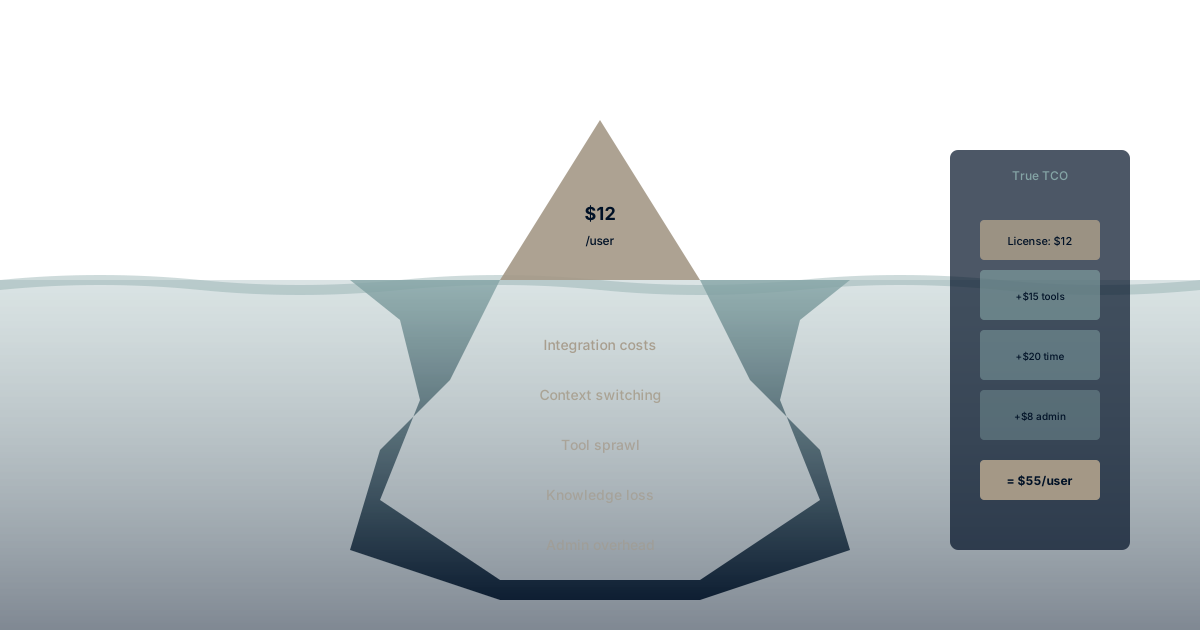
These numbers are the tip of the iceberg.
The true cost of running on Google Workspace extends far beyond license fees. This guide provides a framework for calculating Total Cost of Ownership (TCO)—because understanding real costs is essential for making informed platform decisions.
The Visible Costs
License Pricing Structure
Google Workspace pricing as of 2026 (annual commitment):
Listed prices as of January 2026, US dollars, annual commitment. They have since changed and vary by country — check Google's page for current figures.
| Plan | Per User/Month (Jan 2026) | Key Features |
|---|---|---|
| Business Starter | $7.20 | 30GB storage, basic Meet |
| Business Standard | $14.40 | 2TB storage, recording |
| Business Plus | $21.60 | 5TB storage, enhanced security |
| Enterprise Standard | ~$25 | Unlimited storage, vault |
| Enterprise Plus | ~$35 | Full security, compliance |
For a 100-person company:
- Starter: $8,640/year
- Standard: $17,280/year
- Plus: $25,920/year
These numbers are knowable, budgeted, and seemingly straightforward.
Add-On Costs
Beyond base licensing, common add-ons include:
Google Workspace Add-ons:
- Additional storage: Variable pricing
- Archived User licenses: ~$5/user/month
- Google Voice: $10-30/user/month
- Additional admin features: Enterprise only
Third-party integrations (typically required):
- Backup solutions: $3-10/user/month
- Advanced security: $5-15/user/month
- Email signatures: $1-3/user/month
- Migration tools: One-time costs
Typical add-on burden: 30-50% on top of base licensing for mature implementations. These are the hidden costs of Google Workspace most finance teams never line-item.
The Hidden Costs
Cost Category 1: Integration and Tool Sprawl
Google Workspace provides core productivity tools. Organizations typically add:
Project management: Asana, Monday, ClickUp, Basecamp ($10-30/user/month) Communication: Slack ($8-15/user/month) Documentation: Notion, Confluence ($10-15/user/month) CRM: Salesforce, HubSpot ($25-150/user/month) Finance: Various ($20-100/user/month)
Research from Okta shows organizations use an average of 89 apps. Google Workspace covers perhaps 5-7 of those. The rest represent additional cost.
The math: If your average tool costs $15/user/month and you have 20 tools beyond Workspace, that's $300/user/month—20x your Workspace license.
This is the tool sprawl problem. Workspace's limited scope requires tool supplementation that dwarfs the base cost.
Cost Category 2: Integration Maintenance
Tools don't naturally communicate. Making them work together costs:
Integration platforms: Zapier, Workato, Make ($50-500/month per workspace) Custom development: Developer time for API integrations — what we call the integration tax of connecting your apps Maintenance: Ongoing fixes when integrations break Monitoring: Ensuring data flows correctly
Gartner estimates integration costs at 30-50% of total SaaS spending for complex organizations.
For a 100-person company with 30 tools: Integration costs of $20,000-50,000/year are common.
Cost Category 3: Context Switching
Every time someone switches between applications, they lose focus and time.
The research: Gloria Mark at UC Irvine found that interruptions cost an average of 23 minutes of recovery time. Workers switch apps hundreds of times daily.
Conservative calculation:
- 720 app switches per day (industry average)
- 10% trigger significant cognitive cost
- 3 minutes average recovery
- $75/hour loaded cost
Daily cost per employee: $270 Annual cost for 100 employees: $6.75 million
Even if you discount these numbers by 75%, you're looking at $1.7 million annually—100x the Workspace license cost.
Cost Category 4: Knowledge Loss
Information scattered across Google Drive, email, chat, and supplementary tools creates knowledge silos.
The compounding cost:
- Search time: 1.8 hours daily per knowledge worker searching for information (McKinsey research)
- Duplicated work: Projects repeated because prior work wasn't findable
- Decision delays: Waiting for information that exists but can't be located
- Turnover knowledge loss: Departing employees take undocumented knowledge
IDC research estimates: $100,000 per 100 employees annually in direct knowledge-related productivity loss.
Cost Category 5: Security and Compliance
Google Workspace includes security features, but enterprise requirements often exceed them.
Common additional investments:
- Third-party backup: Google doesn't guarantee data recovery
- Advanced DLP: Beyond native capabilities for regulated industries
- CASB solutions: Cloud access security beyond Google's offering
- Compliance tools: SOC 2, HIPAA, GDPR compliance overhead
- Audit preparation: Documentation and evidence collection
For regulated industries: Additional security tooling often costs $5-15/user/month on top of Workspace.
Cost Category 6: Administration and Support
Running Google Workspace requires people.
Administrative overhead:
- Workspace admin: Managing users, policies, settings
- Support tickets: Helping users with issues
- Training: Onboarding and ongoing education
- Vendor management: Managing Google relationship and add-ons
For 100 users: Expect 0.25-0.5 FTE dedicated to Workspace administration. At $80,000 loaded cost, that's $20,000-40,000/year.
Cost Category 7: Limitations and Workarounds
Workspace limitations create workaround costs.
Common workaround scenarios:
Drive search limitations: Google Drive's knowledge graveyard problem means time spent manually organizing or searching
Collaboration limitations: Native tools lacking features forces adoption of additional platforms
Reporting limitations: Building reports across Google tools requires export and manual assembly
If you recognize these patterns, you may already be seeing the signs you've outgrown Google Workspace.
These workarounds are invisible costs—they don't appear on invoices but consume employee time.
Calculating Your Real TCO
The TCO Formula
Total Workspace TCO = License Costs + Add-Ons + Tool Sprawl + Integration Costs + Context Switching + Knowledge Loss + Security/Compliance + Administration + Workaround Costs
Sample Calculation: 100-Person Company
| Cost Category | Annual Cost | Notes |
|---|---|---|
| Workspace Business Standard | $17,280 | Base license |
| Common add-ons | $6,000 | Backup, security, signatures |
| Supplementary tools (20 tools) | $180,000 | $15/user avg × 20 tools |
| Integration platforms | $12,000 | Zapier, custom work |
| Context switching (25% of research) | $1,687,500 | Conservative estimate |
| Knowledge loss | $100,000 | IDC estimate |
| Additional security | $12,000 | Regulated industry |
| Administration | $30,000 | 0.4 FTE |
| Total TCO | $2,044,780 | |
| Per user/month | $1,704 |
The license fee ($14.40) is 0.8% of true per-user cost.
Reality Check on These Numbers
Some will argue these numbers are inflated. Fair points:
Context switching: Maybe your environment is less fragmented Knowledge loss: Maybe your documentation is better Tool sprawl: Maybe you use fewer supplementary tools
Counter-arguments:
These are conservative estimates compared to research averages. Most organizations don't measure hidden costs at all—which doesn't mean they don't exist.
The point isn't precision. The point is that license fees represent a tiny fraction of true costs. Whether the multiplier is 10x or 100x, focusing on license optimization misses the real opportunity.
What TCO Analysis Reveals
The Platform Decision
TCO analysis reframes the platform question.
Wrong question: "Should we pay $14/user or $20/user for productivity tools?"
Right question: "What platform architecture minimizes our total costs—including hidden costs?"
A platform costing $50/user/month that eliminates tool sprawl, reduces context switching, and preserves organizational knowledge might have lower TCO than a $14/user platform that requires $1,700/user in supplementary costs. The same logic exposes the true bill behind every other suite — see the Microsoft 365 pricing breakdown for the parallel math.
The Consolidation Opportunity
SaaS stack consolidation becomes obviously valuable through TCO lens.
If you could eliminate 10 tools:
- Direct savings: $15/user × 10 tools × 100 users = $180,000/year
- Integration savings: $4,000/year per eliminated integration
- Context switching reduction: Potentially millions
The ROI on consolidation dwarfs the ROI on license negotiation. This is the heart of the CIO guide to tool rationalization: cut the stack before AI makes the sprawl worse.
The AI Readiness Factor
TCO analysis reveals an often-overlooked cost: AI capability foregone.
Organizations with unified platforms can deploy AI with organizational memory. Organizations with fragmented stacks can only deploy AI within silos.
The opportunity cost: Every year with a fragmented stack is a year of AI capabilities not developed. Competitors who consolidate earlier will have AI advantages that compound.
Strategic Implications
For Finance Teams
Stop optimizing license costs. Start measuring total platform costs.
Questions to ask:
- What's our actual tool inventory and spending?
- What are we spending on integrations?
- How much time do employees lose to tool friction?
- What knowledge are we losing to fragmentation?
For IT Teams
Reframe procurement from "cheapest license" to "lowest TCO architecture."
Evaluation criteria to add:
- Integration capabilities and costs
- Administrative overhead requirements
- Knowledge preservation mechanisms
- Platform completeness vs. point solution nature
For Leadership
Understand that cheap licenses can be expensive platforms.
Strategic questions:
- Is our tool architecture supporting or hindering productivity?
- Are we building or losing organizational knowledge?
- What's our path to AI readiness?
Experience Lower TCO
Want to see what happens when tools consolidate instead of fragment? Waymaker Commander brings projects, documents, and strategy together in one platform—reducing tool count, integration overhead, and context switching costs.
The result: Platform TCO that reflects actual productivity value, not just license minimization.
Register for the beta and experience the difference between cheap tools and valuable platforms.
Frequently asked questions
Q: How much does Google Workspace cost per user in 2026? Seat prices vary by country and by whether you are on an annual or flexible commitment, and Google has changed them since this was written — read the current figure from Google's own pricing page. Whatever it says, the licence is the visible fee rather than the true cost: the tools bought to fill the gaps it leaves are usually the larger number.
Q: What is the real total cost of ownership for Google Workspace? TCO adds license fees plus add-ons, tool sprawl, integration costs, context switching, knowledge loss, security, administration, and workaround costs. In a sample 100-person calculation the license fee works out to roughly 0.8% of true per-user cost.
Q: Why is the license fee such a small part of total cost? Google Workspace covers only 5-7 of the average 89 apps organizations use, so the supplementary tools, integrations, and lost productivity dwarf the base price. This is the tool sprawl problem.
Q: How do I lower my Google Workspace TCO? Stop optimizing license costs and start measuring total platform costs, then consolidate. SaaS stack consolidation — eliminating tools, integrations, and context switching — delivers ROI that dwarfs license negotiation.
Google Workspace license fees are 1% of true platform costs. Understanding Total Cost of Ownership reveals the real economics of platform decisions. Cheap licenses that require 89 supplementary tools, constant context switching, and fragmented knowledge aren't actually cheap. True cost optimization comes from architecture decisions, not procurement negotiation. Learn more about our Context Compass framework and explore how platform consolidation creates genuine cost efficiency.
The Waymaker Editorial team researches enterprise technology economics. This TCO methodology synthesizes industry research, vendor data, and published pricing.
Part of our guide to leaving google workspace.
Frequently asked questions
- How much does Google Workspace cost per user in 2026?
- Seat prices vary by country and by whether you are on an annual or flexible commitment, and Google has changed them since this was written — read the current figure from Google's own pricing page. Whatever it says, the licence is the visible fee rather than the true cost: the tools bought to fill the gaps it leaves are usually the larger number.
- What is the real total cost of ownership for Google Workspace?
- TCO adds license fees plus add-ons, tool sprawl, integration costs, context switching, knowledge loss, security, administration, and workaround costs. In a sample 100-person calculation the license fee works out to roughly 0.8% of true per-user cost.
- Why is the license fee such a small part of total cost?
- Google Workspace covers only 5-7 of the average 89 apps organizations use, so the supplementary tools, integrations, and lost productivity dwarf the base price. This is the tool sprawl problem.
- How do I lower my Google Workspace TCO?
- Stop optimizing license costs and start measuring total platform costs, then consolidate. SaaS stack consolidation — eliminating tools, integrations, and context switching — delivers ROI that dwarfs license negotiation.
About the Author

Waymaker Editorial
Stuart Leo founded Waymaker to solve a problem he kept seeing: businesses losing critical knowledge as they grow. He wrote Resolute to help leaders navigate change, lead with purpose, and build indestructible organizations. When he's not building software, he's enjoying the sand, surf, and open spaces of Australia.