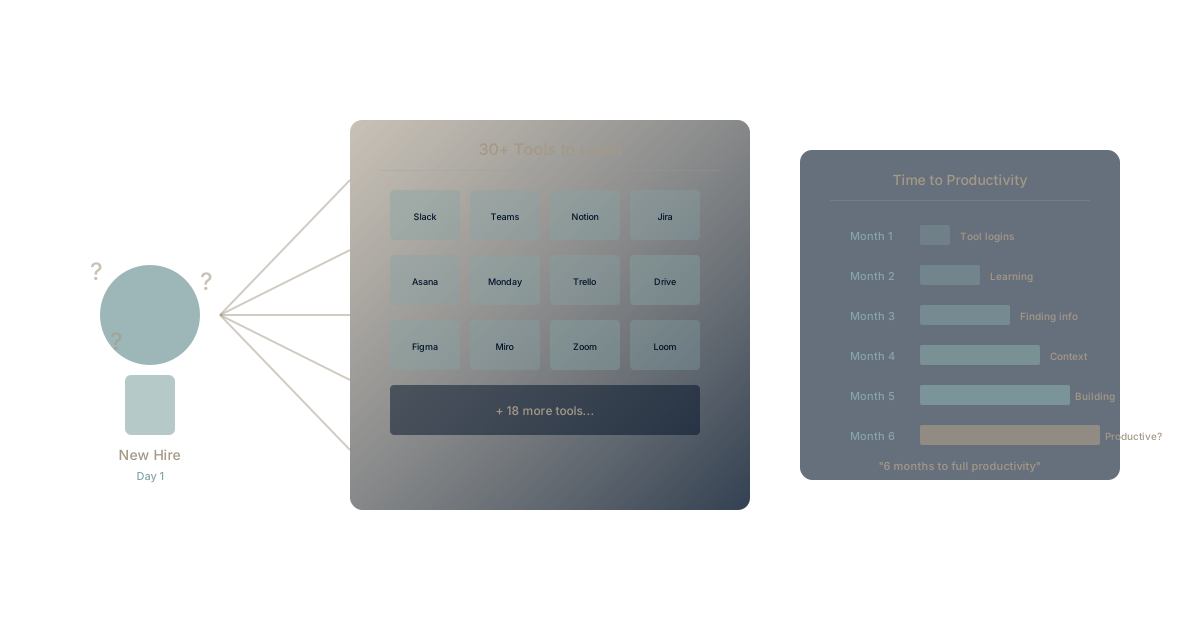
Your new hire starts Monday. They're talented, experienced, and ready to contribute. Six months later, they're still asking basic questions about how things work.
It's not a training problem. It's not a competence problem. It's a tool problem.
The average organization uses 47+ applications. Each one requires logins, learning curves, and context that lives nowhere accessible. Onboarding has become an archaeological expedition through fragmented systems.
The Modern Onboarding Nightmare
The Tool List Problem
Day one looks something like this:
- Communication: Slack, Teams, email, Zoom
- Project management: Asana, Jira, Monday, Trello
- Documents: Google Drive, SharePoint, Notion, Confluence
- Specialized tools: CRM, analytics, design tools, code repos
That's 12+ tools before lunch. And nobody remembers them all, so they discover new ones for weeks.
According to research from Okta, companies with 2,000+ employees deploy an average of 175 applications. New hires must navigate this landscape while also learning their actual job.
The Context Scattering Problem
Each tool holds a piece of the puzzle:
The roadmap lives in Product's planning tool. The why behind the roadmap lives in someone's head (or a Slack thread from 8 months ago). The technical decisions live in engineering's wiki. The customer context lives in the CRM. The goals live in a spreadsheet somewhere.
New employees spend their first months not doing work—but finding where work lives, where decisions were made, and what actually matters.
This is the knowledge silo problem magnified. Every piece of context requires knowing which tool holds it and where within that tool to look.
The Tribal Knowledge Gap
The most critical information isn't in any tool—it's in people's heads:
- "Oh, we don't actually use that process anymore."
- "Yeah, that document is outdated—just ask Sarah."
- "The real deadline is actually two weeks earlier."
- "That decision was reversed in a meeting last month."
New hires can't access organizational memory because it doesn't exist in a retrievable form. They depend on whoever happens to be available and willing to explain context.
The Real Costs
Time to Productivity
Traditional metrics say 90 days to productivity. Reality for knowledge workers at tool-fragmented companies:
Month 1: Tool orientation—just learning what exists Month 2: Process discovery—understanding workflows Month 3: Relationship mapping—learning who knows what Month 4: Context accumulation—building mental models Month 5: Pattern recognition—seeing how things connect Month 6: Contribution—finally adding value independently
Six months of ramp time. For every new hire. Every time.
At a salary of $100,000, that's roughly $50,000 of reduced productivity per new employee—just from the tool and context discovery burden.
Ongoing Dependency
Even after "onboarding," fragmented tools create permanent dependency:
- Questions that could be self-answered require asking colleagues
- Information that should be findable requires knowing who to ask
- Context that should be obvious requires explanation
The context switching burden doesn't end—it just shifts from "learning tools" to "navigating tools daily."
The Knowledge Trap
When employees leave, their accumulated context leaves with them. The next hire faces the same six-month climb. Knowledge doesn't compound—it resets.
This is business amnesia operating at the individual level. Each person becomes a single point of failure for the context they've accumulated.
Why Fragmented Tools Make Onboarding Harder
No Single Source of Truth
In fragmented environments, the answer to "where do I find X?" is always "it depends."
- Depends on the project
- Depends on the team
- Depends on when it was created
- Depends on who created it
New hires can't build reliable mental models because the patterns are inconsistent. What works for one project won't work for another. This slows learning and creates permanent uncertainty.
Context Doesn't Travel
When work moves between tools, context gets lost:
A customer request starts in the CRM. It becomes a Slack conversation. Someone creates a Jira ticket. Engineering discusses in their standup. Marketing gets a vague summary. Support never hears about it.
New employees trying to understand this customer need would need to trace across five systems—if they even knew to look. The integration tax falls hardest on those who don't know where to look.
Permissions Create Blind Spots
Tool fragmentation often means permission fragmentation:
- Engineering tools only accessible to engineering
- Finance systems locked to finance
- Executive dashboards invisible to new hires
New employees operate with partial visibility, missing context they don't know exists. They can't ask questions about information they don't know is available.
What Good Onboarding Looks Like
Unified Work Environment
Imagine onboarding to one system:
One place to see:
- What the organization is trying to achieve
- What projects are underway
- What decisions have been made
- What tasks need doing
- What everyone is working on
New hires can explore rather than excavate. The full picture is available from day one—not rationed across a dozen locked rooms.
Context That Travels With Work
In unified systems:
- A task includes why it matters (connected to goals)
- A document includes how it's used (connected to projects)
- A decision includes what it affected (connected to outcomes)
New employees understand not just what to do but why—because context is structural rather than tribal.
AI-Enhanced Discovery
With organizational memory systems, new hires can ask:
- "What's the history of this project?"
- "Why did we decide to use this approach?"
- "Who knows most about this customer?"
- "What similar problems have we solved before?"
AI with organizational context can answer questions that would otherwise require finding the right person at the right time.
Building Better Onboarding
Short-Term: Document the Maze
If you can't unify systems immediately:
Create tool maps: Which tool holds what type of information Document patterns: Standard workflows across teams Assign buddies: Experienced guides for tool navigation Build FAQ collections: Common questions and where to find answers
These are compensating controls—they don't solve the problem, but they reduce the discovery burden.
Medium-Term: Reduce Tool Count
Every tool eliminated removes:
- A login to learn
- A search to understand
- A permission to request
- A context boundary to cross
Prioritize consolidation that affects new hire visibility. Tools that fragment core knowledge hurt onboarding most.
Long-Term: Build Organizational Memory
True onboarding improvement requires context engineering:
- Strategic context accessible to all
- Decisions documented and findable
- History preserved and queryable
- AI that helps navigate complexity
When organizational memory exists structurally, onboarding becomes exploration rather than excavation.
The Compounding Effect
Better onboarding compounds:
Week 1 contribution instead of Month 6 contribution Questions answered by systems instead of colleagues Context preserved when people leave Knowledge accumulated across the organization
Each new hire either starts the six-month climb again—or joins a system that remembers and can teach.
Experience Unified Onboarding with Waymaker
Want to see what onboarding looks like in a unified system? Waymaker Commander connects strategy to execution in one workspace where new hires can see the full picture from day one.
No more tool archaeology. No more tribal knowledge dependency. Just work that makes sense from the start.
Register for the beta and experience onboarding that doesn't take six months.
Every new hire climbing the same six-month learning curve is a sign of systemic failure—not individual limitation. Organizations that build accessible context don't just onboard faster; they retain knowledge when people leave. Learn more about knowledge silos and explore the cost of tool sprawl.
This analysis draws from HR productivity research across organizations where tool fragmentation is the primary barrier to new hire effectiveness.
About the Author

Waymaker Editorial
Stuart Leo founded Waymaker to solve a problem he kept seeing: businesses losing critical knowledge as they grow. He wrote Resolute to help leaders navigate change, lead with purpose, and build indestructible organizations. When he's not building software, he's enjoying the sand, surf, and open spaces of Australia.