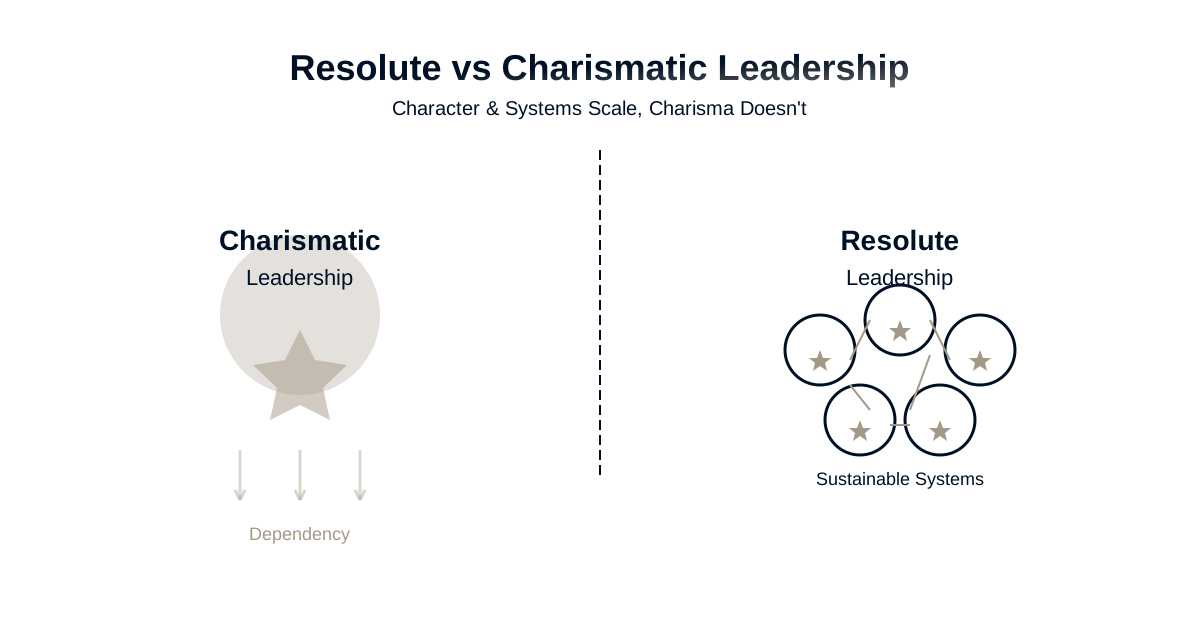
Every growing business eventually hits the same wall: the founder who built everything becomes the bottleneck. Every decision flows through them. Every problem waits for their solution. Every team member depends on their direction. The business doesn't scale because the leadership doesn't scale.
This isn't a capacity problem—it's a leadership model problem. When organizations rely on charismatic leadership, they build dependency. When that charismatic leader leaves, the leadership leaves with them, creating a vacuum that can collapse the entire organization.
There's a better way: resolute leadership. Leadership that deliberately develops others through character and values while equipping them with the skills and systems to reach their goals. Leadership that scales beyond any single individual.
The Charismatic Leadership Trap
Charismatic leadership depends on the innate appeal of an individual's chance character. It's often accidental and unpredictable—a powerful presence that naturally draws people in. And it works, until it doesn't.
The word "leadership" traces back to Old English "laedan" (to guide) and Proto-Indo-European roots from 4,500 years ago. The "-ship" suffix comes from "scyppan," meaning "to shape" or "to form." From the beginning of human history, leadership has been about more than just being in charge—it's about shaping a path and making a way for others safely through unknown territory.
But charismatic leadership confuses innate appeal with intentional development. Some children naturally "take the lead" on the playground—they suggest, demand, and direct, and others follow. This natural charisma can carry someone far. But natural doesn't mean sustainable.
The Hidden Cost of Charismatic Dependence
Consider what happens in a charismatic leadership model:
Decision Bottlenecks: Every strategic choice waits for the charismatic leader's input. Teams hesitate to act independently because "that's not how [the leader] would do it." A SaaS company I advised had a visionary CEO who personally approved every product feature. When he took a two-week vacation, development stopped. The team had capability but lacked permission to use it.
Knowledge Hoarding: Critical business knowledge lives in one person's head. The charismatic leader knows the key clients, understands the market nuances, and holds the strategic vision—but hasn't systematically transferred any of it. When they're unavailable, the organization flies blind.
Culture Vulnerability: The organization's culture reflects the charismatic leader's mood and values—but those values haven't been codified, systematized, or embedded in the team. Research on charismatic leadership shows that when charismatic founders leave, organizational culture often changes significantly as the leader's personal influence was the primary driver.
Succession Crisis: There's no clear path to replace the charismatic leader because the leadership itself is bound to their personality, not to transferable systems and values. WeWork's collapse after Adam Neumann's departure exemplifies this perfectly—charisma masked fundamental business weaknesses.
Charismatic leaders may be wise or foolish, altruistic or narcissistic, good-hearted or malevolent. The history of political leadership is filled with charismatic figures who led nations to both greatness and destruction. Charisma alone provides no moral direction.
What Resolute Leadership Actually Is
Resolute leadership is the deliberate practice of developing others through character and values while equipping and empowering them with the necessary skills and systems to reach their goals.
The fundamental difference is profound:
- Charismatic Leadership: "Follow me because of who I am"
- Resolute Leadership: "Grow through what I've built into the organization"
Think of the British military's implementation of Mission Command—a deliberate effort to embed a leadership framework into the very skills and systems of the organization. This approach ensured that leadership principles were ingrained at every level, creating a culture of autonomous, empowered decision-making on how to execute using skills and systems.
Mission Command became a means of aligning leaders with a unified purpose while equipping them with the tools and systems needed to execute effectively in dynamic and complex environments. Soldiers at every level could lead because the system developed them to lead, not because they personally knew the commanding officer.
The Two Core Elements of Resolute Leadership
Resolute leadership requires two foundational elements working in harmony:
1. Character and Values: The Unchanging Foundation
Character and values define whether a leader uses their influence for good or ill. These qualities are cultivated, not inherited, and they shape how a leader interacts with the world. In a VUCA (volatile, uncertain, complex, ambiguous) world, character and values don't change—they stay the same, providing stability and direction.
Essential elements of leadership character include:
- Integrity: Who are you when no one is watching?
- Humility: Do you give credit where it's due?
- Empathy: Do you see others as humans, not resources?
- Courage: Do you persist when times get tough?
- Authenticity: Can you meet people where they are?
Values reveal character, and character scales culture. The values demonstrated by a leader's actions—not words—become the foundation for organizational culture. Learn more about how values reveal character and character scales culture.
2. Skills and Systems: The Adaptive Tools
While character provides the foundation, leaders must continuously evolve their capabilities. In a VUCA world, skills and systems must change—leaders adapt old approaches and adopt new ones.
Critical skills and systems include:
- Strategic thinking: Planning, analysis, long-term vision
- Communication: Clear delegation and feedback
- Management systems: Frameworks for tracking performance
- Technology systems: Tools that enable scaled operations
Together, these elements form a holistic approach that balances inspiration with deliberate action. This is what we call the Resolute Leadership Curve—a sensemaking framework for navigating from chaos to order, finding a path to growth for both the organization and individual leadership.
MID-ARTICLE CTA: This article introduces the resolute leadership philosophy. For the complete Resolute Leadership Curve framework with assessment tools, the 12 Questions methodology, and implementation playbooks, get Resolute on Amazon.
The Leadership Curve: A Sensemaking Framework
The Resolute Leadership Curve is built upon five foundational principles:
1. Real growth is earned, not bought
The highest value growth is achieved through intentional maturity stages, each requiring development of character, skills, and systems that act as foundations for the next stage. Shortcuts lead to collapse. Learn more about why real growth is earned, not bought.
2. Lead people and manage things
Leadership is not management. The difference creates a positive tension in an organization when applied correctly through resolute leadership. Discover the distinction between leading people and managing things.
3. Values reveal character, character scales culture
The best organizations purposefully design their culture to create aligned character so who they say they are matches who their customers and employees experience.
4. Skills scale systems, and systems scale efficiency
Developing the right competencies at each stage creates layers of institutional capability that generate economies of scale.
5. Questions are more valuable than answers
Balancing leadership (driving into the future) and management (executing in the present) through critical questioning is essential for sustainable success.
The Leadership Curve maps organizational growth through distinct phases: Identity Formation, Market Fit, Team Calibration, and Market Scaling. At each phase, the leader who got you here isn't necessarily the leader who takes you there—but with resolute leadership, the organization can develop the capabilities needed at every stage.
Real-World Impact: Resolute vs. Charismatic
Let's examine the stark contrast between these leadership models through historical examples:
The Churchill Example: Resolute Leadership in Crisis
Winston Churchill's leadership during World War II exemplifies resolute leadership. His values of courage, determination, and love of freedom inspired resilience and unity among the British people. Churchill used his leadership skills—strategic thinking, negotiation, and public speaking—to guide people toward a common good.
But more importantly, Churchill built systems. He established the War Cabinet, implemented coordinated command structures, and developed communication systems that ensured decisions could be made and executed at every level. When he eventually left office, Britain didn't collapse—the systems and values he embedded continued to function.
His character scaled a culture of strength and resilience, one that valued freedom and dignity and could sustain itself beyond his individual presence.
The Counter-Example: Charismatic Leadership's Danger
History also provides stark warnings. Adolf Hitler's charismatic personality, combined with personal values of envy, ambition, and hatred, influenced followers to abandon their own values to align with his. He was effective in applying leadership skills—team building, goal setting, public speaking, management systems—but his values revealed his true character, which scaled a culture of evil.
When charismatic leadership lacks character and values aligned with human flourishing, it can lead to catastrophic outcomes. The charismatic leader may be wise or foolish, altruistic or narcissistic. Charisma provides no moral compass.
Modern Business Examples
Amazon's Resolute Approach: Jeff Bezos built Amazon through systematic development over decades. While Bezos has charisma, Amazon's success stems from embedded systems like the "Two Pizza Rule" for team sizes, the "Working Backwards" product development process, and the Leadership Principles that guide every hiring decision and strategy. When Bezos stepped down as CEO, Amazon continued to thrive because the leadership was in the systems, not just the individual.
WeWork's Charismatic Collapse: Adam Neumann's charismatic leadership drove WeWork to a $47 billion valuation in 2019. But when his charisma could no longer mask the lack of sustainable business fundamentals, the company collapsed to a fraction of that value. Without resolute systems and character-driven culture, charismatic appeal proved insufficient for long-term success.
From Charismatic Dependency to Resolute Sustainability
The companies that figure this out first will have a massive advantage. Their leadership won't just be slightly better at inspiring people—it will actually develop capability throughout the organization, creating genuine resilience and scalability.
Here's the fundamental shift:
Charismatic leadership assumes that exceptional individuals are rare, so it optimizes for dependency on those rare individuals. The organization orbits around the charismatic leader.
Resolute leadership develops leadership at every level through character, values, skills, and systems. It assumes that leadership can be cultivated, not just discovered. The organization functions as an interconnected system where many leaders can emerge and thrive.
The business that relies solely on charismatic leaders is vulnerable. The business that develops leaders intentionally can sustain influence even when individual leaders depart.
As General Norman Schwarzkopf said: "Leadership is a potent combination of strategy and character. But if you must be without one, be without strategy."
Experience Resolute Leadership with the Waymaker Framework
END-ARTICLE CTA: Want to build resolute leadership into your organization? The complete Resolute Leadership Curve framework provides:
- The 12 Questions methodology (5 Management + 7 Leadership Questions)
- Self-assessment tools for identifying your growth phase
- Character development frameworks for embedding values
- System-building playbooks for scaling leadership
Get Resolute on Amazon by Stuart Leo.
True leadership isn't about being irreplaceable—it's about building an organization that doesn't depend on you. Learn more about the Resolute Leadership Curve framework and discover how questions drive better leadership.
About the Author

Stuart Leo
Stuart Leo founded Waymaker to solve a problem he kept seeing: businesses losing critical knowledge as they grow. He wrote Resolute to help leaders navigate change, lead with purpose, and build indestructible organizations. When he's not building software, he's enjoying the sand, surf, and open spaces of Australia.