Your company has incredible culture. Everyone says so. The founding team shares values, works well together, and genuinely cares about the mission. Then you scale to 50 people. The culture starts fragmenting. New hires don't "get it" the way early employees did. Different departments develop different norms. What felt cohesive at 10 people feels chaotic at 50.
You hire for "culture fit," but it doesn't help. Some new hires seem perfect in interviews but create toxic dynamics on teams. Others don't match the founding team's personality but become cultural anchors. You can't figure out what's working and what isn't because you're confusing culture with personality, and values with vibes.
Here's what's actually happening: Your early culture emerged organically from the character of your founding team. As you scale, that character must be deliberately cultivated through explicit values, or culture will fragment into departmental silos with incompatible norms. According to research on scaling organizational culture, 85% of fast-growing companies experience culture fragmentation during the transition from 25 to 100 employees.
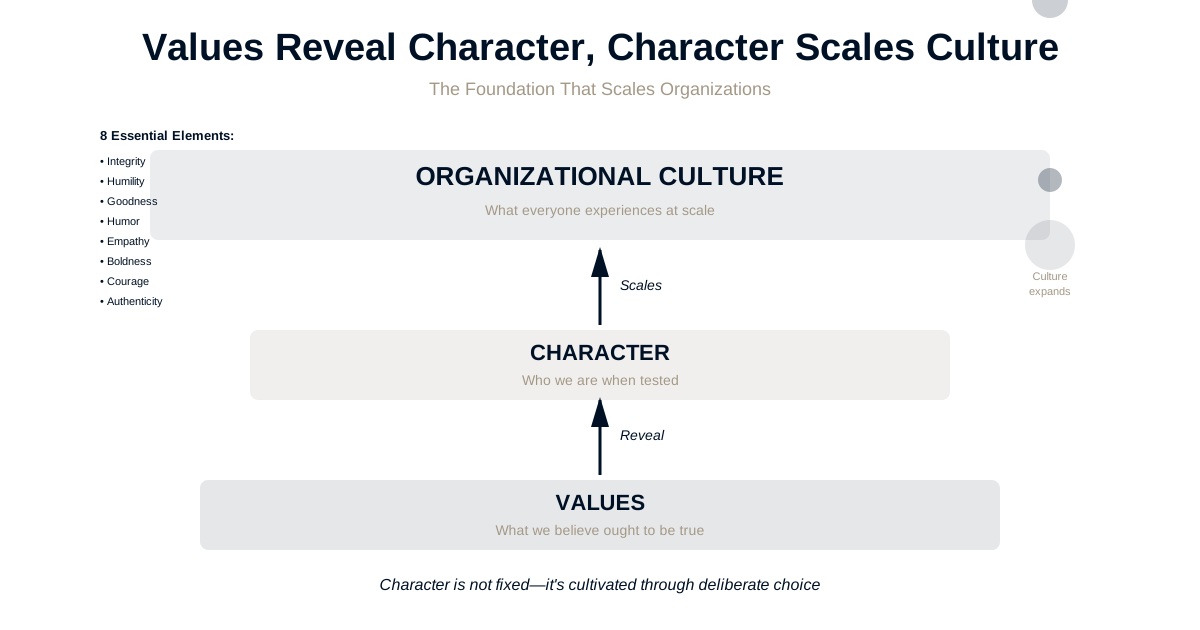
The third principle of the Resolute Leadership Curve addresses this directly: Values reveal character, character scales culture. Understanding this principle—and the distinction between character, values, and personality—is what allows organizations to maintain cultural cohesion while scaling from 10 to 1,000+ people.
The Problem: Culture Doesn't Scale Automatically
Early-stage culture is deceptively easy. With 5-10 people, culture emerges naturally from daily interaction. Founders model behaviors, early employees absorb them, and implicit norms develop organically. No documentation needed—everyone just "knows how we do things."
Then you scale.
What Breaks at Scale
At 25 people: Departments form. Engineering develops different norms than sales. What was implicit becomes unclear. New hires don't absorb culture through proximity to founders.
At 50 people: Multiple layers emerge. Managers interpret culture differently. Some preserve founding values, others drift. "Culture fit" becomes code for "people like us," leading to homogeneity that lacks the diversity needed for innovation.
At 100 people: Regional offices or remote teams create micro-cultures. Without explicit values and character expectations, culture fragments into disconnected subcultures that may contradict each other.
At 500+ people: Most employees never interact with founders. Culture is what they experience from their manager, not what founders intended. Without systematic cultivation, culture becomes whatever emerges locally.
The Cost of Culture Fragmentation
Let's quantify the impact for a 100-person company experiencing culture fragmentation:
Direct Costs:
- Turnover: 30% annual turnover (vs. 15% with strong culture) = 15 extra departures
- Replacement cost: $75K average per employee = $1.125M annually
- Lost productivity: 6 months to full productivity × 15 people × $100K annual value = $750K
Indirect Costs:
- Misalignment: Teams working at cross-purposes, duplicating effort = $500K in waste
- Decision paralysis: Unclear values mean leaders can't make confident calls = $300K in missed opportunities
- Innovation drag: Fragmented culture kills psychological safety needed for innovation = Unquantifiable but massive
Total annual cost: $2.675M+ for a 100-person company, or $26,750 per employee annually.
Companies with strong, scaled culture experience 50-70% lower turnover, 30% faster decision-making, and significantly higher innovation rates. The difference compounds over time.
But here's the mistake most leaders make: They try to scale personality instead of character, and preserve vibes instead of codifying values.
Character vs. Personality: The Critical Distinction
Most leaders confuse these concepts. Understanding the difference is essential to scaling culture.
What Personality Is
Personality = The combination of attitudes, inclinations, and behaviors that make someone recognizable and unique.
Traits include: introversion/extroversion, sense of humor, optimism/pessimism, serious/playful, detail-oriented/big-picture, etc.
Personality is:
- Partly genetic, partly environmental
- Shaped by upbringing and family culture
- Relatively stable but changeable throughout life
- Not inherently good or bad
- Observable in daily interactions
Example: A CEO who is introverted, serious, detail-oriented, and pessimistic (anticipates problems) can be an exceptional leader.
What Character Is
Character = The inner moral qualities and beliefs that determine what actions a person chooses and which they reject.
Elements include: integrity, humility, courage, empathy, authenticity, etc.
Character is:
- Cultivated deliberately through acts of will
- Formed through daily choices and experiences
- Centered on moral values (what "ought" to be)
- Tested and revealed in crisis
- The foundation that guides behavior under pressure
Example: A CEO with strong character demonstrates integrity (does what's right even when costly), humility (gives credit to others), and courage (makes hard calls under uncertainty)—regardless of their personality type.
Why This Matters for Culture
The mistake: Hiring for personality match ("culture fit") rather than character alignment.
What happens:
- You build a homogeneous team that thinks alike (limits innovation)
- You miss diverse candidates with different personalities but shared values
- Personality conflicts become culture problems
- No framework exists for addressing character issues
The solution: Define character requirements (values, integrity, courage) separately from personality preferences (working style, communication).
Churchill and his Chief of Staff, Alan Brooke, had completely different personalities—Churchill was impulsive and dramatic, Brooke was methodical and reserved. They clashed constantly. But they shared character: courage, integrity, commitment to defeating tyranny. Their character alignment made them effective despite personality differences.
Research on team diversity and performance shows that teams with diverse personalities but aligned values outperform homogeneous teams by 35% on complex problem-solving.
Learn more about how resolute leadership builds on character rather than charisma in Resolute Leadership vs Charismatic Leadership.
Values: What They Are (and Aren't)
Many companies have "values" plastered on walls that nobody believes or follows. Here's why: They confused values with aspirations, slogans, or beliefs.
Values vs. Beliefs
Beliefs = Assumptions about how the world actually is. Descriptive statements about reality.
Examples:
- "Customers want fast delivery"
- "Data-driven decisions produce better outcomes"
- "Remote work is as productive as office work"
Beliefs can be true or false. They're testable through evidence.
Values = Principles about how people ought to behave. Prescriptive standards for action.
Examples:
- "We treat customers with respect, even when they're wrong"
- "We make decisions based on evidence, not politics"
- "We trust team members to work effectively regardless of location"
Values turn beliefs into moral standards. They transform "is" into "ought."
Real Values vs. Aspirational Platitudes
Aspirational Platitudes (not actual values):
- "Innovation"
- "Excellence"
- "Customer focus"
- "Integrity"
These are generic, uncontroversial, and unactionable. Every company claims them. They don't guide decisions because they don't create trade-offs.
Real Values (create decision filters):
- "We ship fast and iterate, even if it means initial imperfection" (innovation > perfection)
- "We hire for potential and coach to excellence, not just hire experienced people" (growth > credentials)
- "We solve customer problems even when it's not profitable short-term" (relationships > transactions)
- "We speak truth to power, even when it's uncomfortable" (integrity > harmony)
Real values create tension. They force trade-offs. They make some people uncomfortable. They guide hard decisions when easier alternatives exist.
Testing If Values Are Real
Ask these questions about your stated values:
-
Would the opposite be obviously stupid? If no one would advocate the opposite, it's not a real value—it's a platitude.
- "Integrity" fails this test (no one advocates dishonesty)
- "Speed over perfection" passes (some companies value perfection over speed)
-
Do your hardest decisions reveal these values? If leaders make decisions that contradict stated values, they're aspirational, not real.
- Company values "work-life balance" but leaders email at midnight and expect responses
- Reality: The actual value is "availability and responsiveness"
-
Would living these values cause us to lose some opportunities? Real values constrain behavior, which means some opportunities don't align.
- "We only work with ethical clients" means rejecting profitable-but-questionable business
- If you'd never turn down revenue, it's not actually a value
Example: Patagonia
Stated value: "We're in business to save our home planet"
Evidence it's real:
- Donates 1% of sales to environmental causes (costs millions)
- Sued the Trump administration over public lands policy (risked customer backlash)
- "Don't Buy This Jacket" campaign encouraged less consumption (reduced short-term sales)
- Built supply chain around sustainability even when more expensive
Result: Values guide every decision, attract employees and customers who share them, create differentiation that commands premium pricing.
This article introduces how values reveal character and character scales culture. For complete frameworks on defining organizational values, building character-based culture, and scaling culture through the growth phases, get Resolute by Stuart Leo on Amazon.
The Eight Essential Elements of Character
Strong leadership requires strong character. These eight elements form the foundation:
1. Integrity
What it is: Consistency between words and actions. Doing what's right when no one is watching.
Why it matters: Without integrity, values are just marketing. Teams watch what leaders do, not what they say.
In practice: A CEO discovers their top salesperson falsified customer references to close deals. Despite the revenue impact, they're terminated immediately. The message: We don't compromise integrity for results.
Scaling impact: Integrity at the top creates accountability throughout the organization. One compromised integrity incident by leadership destroys years of cultural trust.
2. Humility
What it is: Giving credit where deserved. Letting achievements speak for themselves. Recognizing you don't have all the answers.
Why it matters: Humble leaders create psychologically safe environments where the best ideas win, regardless of source.
In practice: During a board presentation on a successful product launch, the CEO spends 80% of the time highlighting team contributions and 20% on strategy. The team, not the CEO, is positioned as the heroes.
Scaling impact: Humility creates cultures where people share credit, admit mistakes, and learn from failures—essential for innovation.
3. Goodness
What it is: Patience and generosity. Taking pleasure in sharing abundance rather than hoarding it.
Why it matters: Goodness creates reciprocity and loyalty. People work harder for leaders who genuinely care about their well-being.
In practice: A company facing cash flow challenges chooses to delay executive bonuses while ensuring employee salaries are paid on time. Executives eat last.
Scaling impact: Goodness cascades. Leaders who model generosity create cultures of mutual support rather than internal competition.
4. Humor
What it is: The ability to bring lightness and perspective during difficult times without diminishing serious challenges.
Why it matters: Humor reduces tension, builds connection, and helps teams persist through adversity.
In practice: After a failed product launch, the CEO opens the post-mortem meeting: "Well, that was a spectacular learning opportunity. Let's make sure we don't get this good at learning again." Tension breaks. Team engages constructively.
Scaling impact: Organizations that can laugh at themselves are more resilient and adaptable. Humor signals psychological safety.
5. Empathy
What it is: Seeing others as human beings with full lives, not just resources or tools.
Why it matters: Empathy creates loyalty and unlocks discretionary effort. People perform best when they feel valued as humans.
In practice: An employee's parent is diagnosed with terminal cancer. Instead of policy-driven "use your PTO," the CEO says: "Take whatever time you need. Your job will be here. Family comes first."
Scaling impact: Empathetic cultures have radically lower turnover and higher engagement because people aren't just employees—they're valued members of a community.
6. Boldness
What it is: The willingness to speak truth to power and listen when others speak truth to yours.
Why it matters: Boldness prevents groupthink and catches problems early. Organizations fail when bad news doesn't travel upward.
In practice: A junior engineer tells the CTO their architecture decision will create technical debt. Instead of defensiveness, the CTO says: "You might be right. Walk me through your thinking." Architecture changes.
Scaling impact: Bold cultures surface problems quickly and debate ideas vigorously, leading to better decisions.
7. Courage
What it is: Persistence when things get tough. Taking calculated risks despite fear. Making hard calls when easier alternatives exist.
Why it matters: Courage is required for every meaningful change. Without it, organizations stagnate or drift.
In practice: A company's largest customer (40% of revenue) demands exclusivity that would prevent future growth. Despite the risk, leadership declines and diversifies. Short-term pain, long-term survival.
Scaling impact: Courageous cultures tackle hard problems instead of avoiding them. This compounds into competitive advantage.
8. Authenticity
What it is: Meeting people where they are, regardless of your position. Being genuine rather than performing a role.
Why it matters: Authenticity builds trust and connection. People follow authentic leaders through uncertainty.
In practice: During an all-hands meeting, the CEO admits: "I don't know if this strategy will work. We're making our best decision with incomplete information. We'll adapt as we learn." Transparency builds trust.
Scaling impact: Authentic cultures don't waste energy on politics or performance. People can focus on actual work.
How Character Scales Culture
Here's the progression:
Stage 1: Founders Embody Character (10 people)
Early employees experience founder character directly through daily interaction. Culture emerges organically from observing and modeling founder behavior.
What works: Proximity allows character transfer through observation and storytelling.
What breaks: Can't scale beyond direct founder contact.
Stage 2: Values Codify Character (25-50 people)
As the team grows beyond founder proximity, character must be explicitly codified into values that guide behavior when founders aren't present.
What works: Clear values give managers frameworks for decisions. Hiring criteria shift from "people we like" to "people who share our values."
What breaks: Values that aren't lived by leadership become cynical slogans. Inconsistency destroys credibility.
Stage 3: Systems Reinforce Values (100-250 people)
Values are embedded into systems: hiring processes, performance reviews, promotion criteria, recognition programs, decision frameworks.
What works: Systems scale culture beyond individual relationships. New employees experience values through structure, not just stories.
What breaks: Systems that contradict values. Example: Valuing "work-life balance" while promoting those who work 70-hour weeks.
Stage 4: Culture Becomes Self-Reinforcing (500+ people)
When values are consistently lived and systematically reinforced, culture becomes self-reinforcing. Employees hold each other accountable to values without leadership enforcement.
What works: Culture scales independently of founders. Regional offices maintain cultural consistency. New leaders rise who embody the character and values.
What breaks: Complacency. Cultures must be actively maintained or they drift. Leaders must continuously model and reinforce values.
Example: Netflix
Netflix codified culture through their famous Culture Deck which explicitly describes values and expected behaviors:
- Value stated: "We're a team, not a family. Families keep underperformers. Teams cut them."
- System reinforcement: "Keeper Test" - Would you fight to keep this person? If not, help them transition out.
- Result: Clear expectations, high performance, cultural consistency across 12,000+ employees globally.
Controversial? Yes. But authentic to their values and systematically reinforced. That's why it scales.
Learn how skills and systems scale efficiency while values scale culture in Lead People, Manage Things.
The Culture-Character-Values Flywheel
Here's how it works in practice:
1. Leaders cultivate character (deliberately develop integrity, courage, empathy, etc.)
2. Character reveals itself through decisions under pressure, especially when doing right conflicts with doing easy
3. Observed character shapes explicit values ("This is who we are and how we operate")
4. Values guide behavior when leaders aren't present ("What would [Leader] do in this situation?")
5. Consistent behavior becomes culture ("This is how we do things here")
6. Culture attracts aligned people who reinforce values, creating self-reinforcing loop
7. Scaled culture develops next generation of leaders with the same character, continuing the cycle
The compounding effect: Year 1, culture is fragile and founder-dependent. Year 5, culture is resilient and self-reinforcing. Year 10, culture is a competitive advantage that's nearly impossible to replicate.
Practical Application: Building Character-Based Culture
Step 1: Define Character Requirements
What character elements are non-negotiable for leaders in your organization?
Start with the eight essentials:
- Integrity
- Humility
- Goodness
- Humor
- Empathy
- Boldness
- Courage
- Authenticity
Prioritize 3-5 that are most critical for your context.
Step 2: Translate Character Into Values
For each character element, define what it looks like in practice.
Example: Integrity
- Value: "We do what we say we'll do, even when it's hard"
- Behaviors: Honoring commitments, admitting mistakes, transparency about challenges
- Trade-off: We sacrifice short-term gains that compromise long-term trust
Step 3: Build Values Into Systems
Hiring: Include values-based questions in interviews. Assess character, not just competence.
Onboarding: Teach values explicitly. Share stories of values in action.
Performance: Evaluate character alongside results. Promote those who embody values.
Recognition: Celebrate examples of values-driven decisions, especially when costly.
Accountability: Address values violations swiftly, regardless of seniority or performance.
Step 4: Model Character as Leaders
The brutal truth: Your actual values are what you do, not what you say.
If you claim "customer focus" but prioritize internal politics, your actual value is politics.
If you claim "integrity" but overlook rule-breaking by top performers, your actual value is results-at-any-cost.
Leadership character test: What do you do when living your values costs you something significant?
Step 5: Maintain Culture Through Growth
At each growth phase:
- Identity (10-25 people): Codify the implicit values that emerged organically
- Calibrate (25-100 people): Build values into hiring, onboarding, and performance systems
- Maturity (100-500 people): Develop leaders who model and reinforce values consistently
- Mastery (500+ people): Create self-reinforcing culture where employees hold each other accountable to values
Explore how to navigate these growth phases in The Six Stages of the Leadership Curve.
From Personality to Character: The Transformation
Here's the fundamental shift organizations must make:
Early stage (0-25 people):
- Culture = Founder personality + emergent team dynamics
- Works because: Small team, daily interaction, organic alignment
- Breaks when: Growth exceeds founder proximity
Transition (25-100 people):
- Culture = Explicit values + systematic reinforcement
- Works because: Values guide decisions without founder presence
- Breaks when: Leaders don't model values or systems contradict values
Scaled (100+ people):
- Culture = Self-reinforcing values embodied by leaders at all levels
- Works because: Culture reproduces itself through shared character
- Sustains when: Continuous cultivation and zero tolerance for values violations
Companies that successfully make this transition create cultures that scale. Those that don't fragment into departmental silos with incompatible norms.
The Resolute Leadership Curve provides the framework for navigating this transition at each growth phase. Learn more about the complete framework in The Resolute Leadership Curve: A Sensemaking Framework for Growth.
Experience Character-Based Culture Building
This article introduces the third foundational principle: Values Reveal Character, Character Scales Culture. For the complete framework on building and scaling culture through organizational growth phases, including values definition workshops, character development exercises, and culture measurement tools, get Resolute by Stuart Leo on Amazon.
The book provides:
- Complete values definition and codification process
- Character development frameworks for leaders
- Systems for embedding values at each growth stage
- Culture assessment and reinforcement tools
- Case studies of character-based cultures at scale
The result: A culture that scales from 10 to 1,000+ people while maintaining coherence, attracting aligned talent, and creating sustainable competitive advantage.
Values reveal character through decisions under pressure, and character scales culture through systematic reinforcement. Learn more about how real growth is earned through character development and explore the complete Resolute Leadership Curve framework.
About the Author

Stuart Leo
Stuart Leo founded Waymaker to solve a problem he kept seeing: businesses losing critical knowledge as they grow. He wrote Resolute to help leaders navigate change, lead with purpose, and build indestructible organizations. When he's not building software, he's enjoying the sand, surf, and open spaces of Australia.