Here's the part that changes everything for your clients.
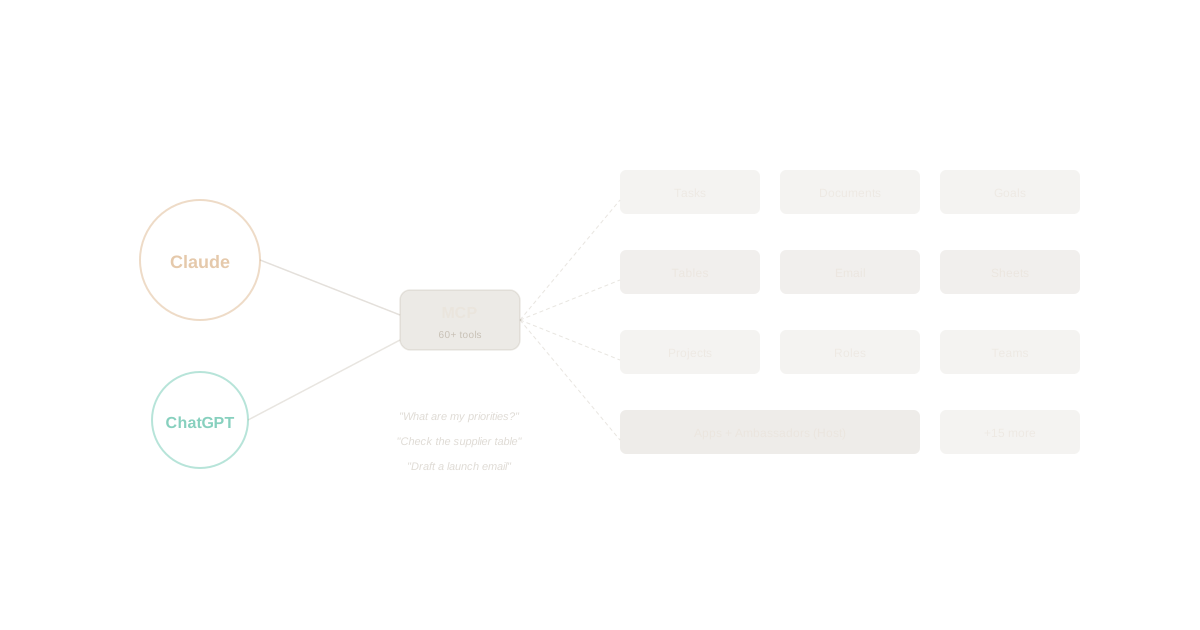
Waymaker connects to Claude and ChatGPT through MCP (Model Context Protocol). That means your client's AI assistant isn't just generating text — it's reading, writing, and managing their actual business data inside Waymaker.
No copy-pasting. No switching tabs. No "let me put that into our project management tool later." The AI works directly inside the system.
What This Looks Like in Practice
Your client is driving to work. They open Claude on their phone and say:
"What are my priorities today?"
Claude checks their Waymaker tasks, reads the due dates, looks at what's blocked, and gives them a briefing — pulled from real data, not a generic productivity tip.
They arrive at the office after a phone call with a supplier. They tell Claude:
"Write up the key points from my call with Davies Supply — pricing confirmed at $42/unit for 500+, lead time is 6 weeks, they need a PO by Friday. Save it as a document in the Davies Supply project."
Claude creates the document inside Waymaker, filed in the right project, visible to the right team members. No transcription app. No notes app. No email to self.
Later that afternoon, their operations manager asks about the status of the warehouse fit-out. The client asks Claude:
"What's the status of the Warehouse Fit-Out project? Any overdue tasks?"
Claude pulls the project, lists what's done, what's in progress, and what's overdue — with assignees and due dates. The client forwards the summary to their ops manager without opening a browser.
Before they leave for the day:
"Create a task for Sarah to send the PO to Davies Supply by Friday. High priority. Add it to the Procurement taskboard."
Done. Task created, assigned, due-dated, and visible on the board.
Email That Flows From Context
The next morning, the client's marketing manager needs to send a campaign to 200 leads. She asks Claude:
"Draft a product launch email for the EV Charger Pro — highlight the new fast-charge feature, include the $2,499 pricing, and send it from our marketing inbox to the EV Installers list."
Claude drafts the email, pulls the pricing from the product table, and queues it through Waymaker's built-in email. Business email, marketing campaigns, and shared inboxes — all inside the same platform where the team's work already lives. No Mailchimp. No separate email tool. No copy-pasting between systems.
Most businesses run email separately from everything else. Customer emails live in Gmail, follow-ups get lost, marketing campaigns go through a different tool, and nobody knows who replied to what. Waymaker's built-in email means customer communication, team inboxes, and marketing campaigns live alongside projects, tasks, and data. One system instead of three.
Tables as a Queryable Data Layer
Meanwhile, the operations lead wants to know which suppliers are overdue on deliveries. She asks Claude:
"Check the supplier table — which suppliers have an expected delivery date before today and a status that isn't 'delivered'?"
Claude queries the Waymaker table, filters the rows, and gives her a list with supplier names, order numbers, and how many days overdue. She creates follow-up tasks directly from the results. The data, the analysis, and the action all happen in one system.
This is where tables become a superpower. Tables in Waymaker are typed, structured, and queryable — not just a grid of cells. They're the data layer that everything else connects to.
"Which products have less than 50 units in stock?" Claude queries the inventory table and gives a filtered answer.
"What's our average order value this quarter?" Claude reads the orders table and calculates it.
"Add a new supplier — Davies Supply, contact Sarah Chen, payment terms net 30." Claude inserts the row.
The data is always live, always accurate, and always accessible through conversation. When Claude answers a question about suppliers, pricing, or inventory, it's pulling from real, structured data — not guessing from a chat transcript.
Build and Deploy Through AI
But it goes further than managing work. Waymaker Host lets you build and deploy through AI too.
The client needs a landing page for a new product launch. You open Claude Desktop, describe what they need, and Claude builds the page. You deploy it to Waymaker Host — live on their domain in minutes. No developer. No agency. No three-week turnaround.
Need a serverless agent that sends a weekly client summary email every Monday? Describe it to Claude, deploy it as an Ambassador on Host, and it runs automatically. The client's business just got smarter while they were in a meeting.
60+ Tools, One Connection
This is not a demo scenario. This is what the MCP integration does today, across 60+ tools covering:
- Tasks — create, assign, update, track across taskboards
- Documents — write, save, organise in project folders
- Goals — set key results, track progress, connect to projects
- Projects — plan, build, monitor across teams
- Roles — define responsibilities, assign ownership
- Tables — query, filter, insert, update structured data
- Sheets — financial models, calculations, resource plans
- Email — business email, shared inboxes, marketing campaigns
- Teams — manage members, permissions, structure
- Apps — build and deploy custom web applications
- Ambassadors — deploy serverless agents and automations
- Comments, folders, layers, connections — and more
Every one of these tools is accessible through Claude or ChatGPT. Your client manages their business through conversation — and every action lands in a system their whole team can see.
This article is part of The AI Transformation Playbook — a guide for advisors, consultants, and MSPs who deploy AI transformation for their clients.
Part of our guide to building and hosting what no one will build for you.
About the Author

Stuart Leo
Stuart Leo founded Waymaker to solve a problem he kept seeing: businesses losing critical knowledge as they grow. He wrote Resolute to help leaders navigate change, lead with purpose, and build indestructible organizations. When he's not building software, he's enjoying the sand, surf, and open spaces of Australia.