Competitor prices below were correct when this was written and change regularly — they also vary by country and by annual versus monthly commitment. Check each vendor's own pricing page for current figures; the argument here does not depend on the exact number.
For fifteen years, running a Mac business meant making the same uncomfortable trade. You loved your hardware. You loved the OS. And then you handed the rest of your business to Google or Microsoft — the two companies whose software felt least at home on your Mac.
On 14 April 2026, Apple changed half of that trade. Apple Business launched in more than 200 countries as a free service. For the first time, Apple has an official business platform that owns the Mac hardware, the MDM layer, professional email on your own domain, and the local reach layer — all without charging a cent. If you want the honest breakdown of what Apple Business actually includes and what it leaves out, the full Apple Business explainer is the place to start.
But Apple only built half the stack. Email and devices and Maps — solved. The productivity layer — documents, tasks, goals, sheets, shared inbox, CRM, custom apps — Apple did not build, and is not going to.
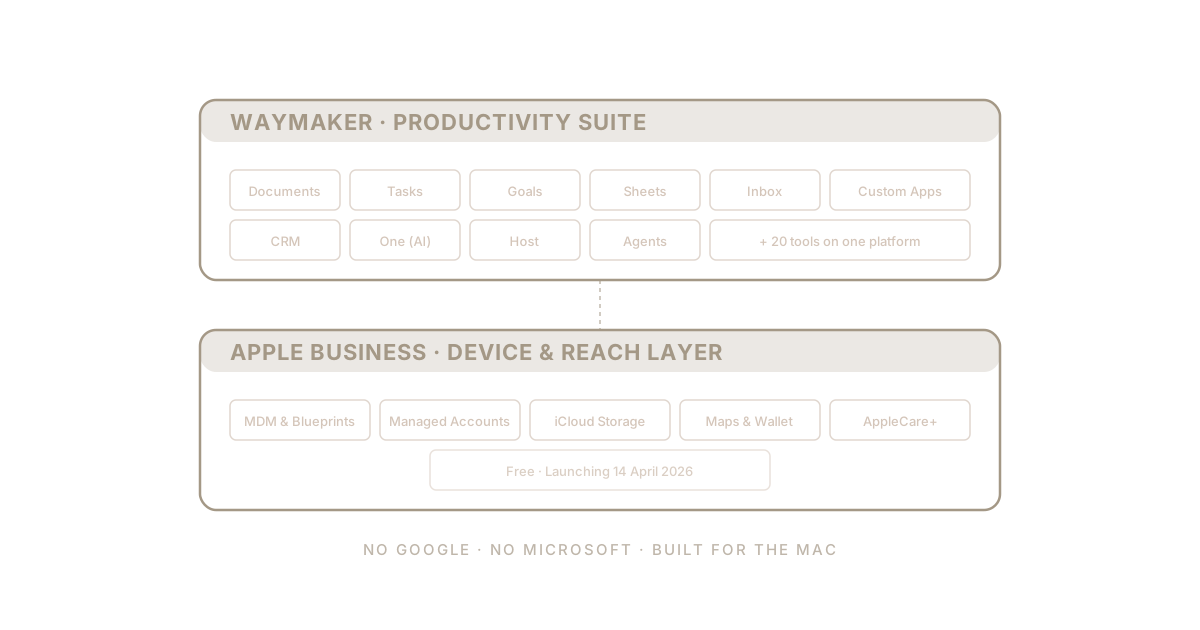
This is the new Mac business stack for 2026. Apple Business on the bottom. Waymaker on top. No Google. No Microsoft.
The Old Mac Business Stack
Here is what running a Mac business looked like before 14 April 2026. Pick your poison.
Option A: Apple + Google Workspace. The most common path. You run on Macs. You pay Google $7.20 per user per month for Gmail, Calendar, Drive, and Docs. You layer on Asana or ClickUp for tasks ($10.99–19/user). You add Notion for documents ($10/user). You add a CRM ($25+/user). You end up paying $50–100 per user per month for a stack where nothing talks to anything else, and all of it runs in a browser that fights your Mac's native tools. When you add up the real total cost of Google Workspace plus the tools it doesn't cover, it gets expensive fast.
Option B: Apple + Microsoft 365. Same shape, different provider. You pay Microsoft $6–22 per user per month for Outlook, Word, Excel, and Teams. You still need the tasks, goals, and operations tools Microsoft does not cover. The Office apps never quite feel right on a Mac — they have been second-class citizens for the entire twenty years they have existed there.
Option C: Apple-only. You try to run your business on iCloud, Pages, Numbers, Keynote, and Reminders. You get about eight employees deep before it falls over. iCloud was never designed for structured collaboration. Pages is not a document collaboration platform. Reminders is not a project management system. You love the aesthetic, but you lose visibility as soon as the team grows.
None of these are great. All of them involve compromise. All of them put Apple in second place on the software that runs your business.
The New Mac Business Stack
On 14 April 2026, the options changed. Apple Business is now a real, free, first-party product — and it solves the parts of the stack Apple is uniquely positioned to own. Devices, email, storage, and Maps presence all come from Apple. Free. Built for macOS from day one.
What Apple Business does not include is the productivity layer — documents, sheets, tasks, goals, shared inbox, CRM, AI, and the platform for building custom business apps. That is the layer Waymaker was built for.
The Mac business stack for 2026 looks like this.
| Layer | Product | Price |
|---|---|---|
| Hardware | Your Macs, iPads, iPhones | — |
| Device management (MDM) | Apple Business | Free |
| Custom domain email + mailbox* | Apple Business | Free |
| iCloud storage and file sync | Apple Business | Free |
| Local reach (Maps, Wallet, Tap to Pay) | Apple Business | Free |
| AppleCare+ for Business | Apple Business | Free |
| Document collaboration (shared, real-time) | Waymaker | $19/seat/mo |
| Task, project, and goal management | Waymaker | included |
| Sheets, forms, and structured business data | Waymaker | included |
| Shared inbox, CRM, and customer ops | Waymaker | included |
| Custom apps, agents, and automations | Waymaker Host | included |
| AI layer across everything | Waymaker One | included |
One stack. Two vendors. Neither of them is Google or Microsoft.
Apple Business email, calendar, and directory features require macOS 26 (shipping autumn 2026). Until then, Mac businesses can still use Apple Business for MDM, Maps, Wallet, and iCloud — and should keep their existing email provider or use Waymaker email for the interim. See Apple Business Explained for the full picture.
Why This Stack Works
Three reasons this specific combination beats every other option.
Reason 1: Apple and Waymaker do not overlap
Most Mac business stacks fall apart because of overlap. You end up paying for the same functionality twice — one version inside Google Workspace, another inside a separate tool, a third bundled with your CRM. Every overlap is money wasted, a vendor relationship to manage, and a place where data gets stranded.
Apple Business and Waymaker have zero overlap. Apple does devices, email, Maps, Wallet, Tap to Pay, managed accounts, and AppleCare. Waymaker does documents, tasks, goals, sheets, inbox, CRM, and custom apps. One thing you get from Apple (free). One thing you pay for (Waymaker). No duplicate tools, no overlapping SKUs, no features you are paying for twice.
This is what a clean stack looks like. Every tool has exactly one home.
Reason 2: Both products treat Mac as a first-class citizen
Google Workspace runs in a browser because Google built a browser. Microsoft 365 runs in Electron because Microsoft is a Windows company. Neither of them cares whether your Mac experience feels right.
Apple Business runs on macOS because the company that built it also built the operating system. Of course it does.
Waymaker was built for Mac-first businesses from the beginning. Documents, sheets, tasks, and goals are fast in Safari — not just Chrome. The Waymaker Companion for macOS syncs tasks to Apple Reminders natively. Calendar integrates through CalDAV so Apple Calendar works without compromise. You do not feel like you are fighting your operating system because Waymaker was built to respect it — the same reason Mac users have been ditching Google Workspace in growing numbers over the last two years.
This is the first time in the history of Mac business software that you can buy a complete stack where every layer was designed for the Mac from the ground up. Not Windows software bolted onto macOS. Not a browser app pretending to be native. A real stack that belongs on a Mac.
Reason 3: Waymaker fills exactly the gap Apple left
Apple Business is free. Apple Business is generous. Apple Business is also deliberately narrow. Apple is not trying to be your productivity suite — they are trying to be your device, email, and brand layer. They stopped exactly where stopping made sense.
Waymaker starts exactly where Apple Business stops. Email flows through Apple Business. The business operates on Waymaker. When you want to track tasks, you're in Waymaker. When you want to collaborate on a document, you're in Waymaker. When you want to see your goals, your sales pipeline, your customer support queue, your financial models, or the custom apps your team has built — all of that is in Waymaker. When you want AI that actually knows your business, it is running on Waymaker One.
Apple gives you the bottom. Waymaker gives you the top. They meet in the middle with no seams because neither of them is trying to be the other.
What You Get
Here is what you actually run when you adopt this stack.
From Apple Business (free, launches 14 April 2026):
- Zero-touch Mac setup for new hires with preconfigured apps, settings, and security via Blueprints
- Centralised MDM across every Mac, iPhone, and iPad in the company
- Managed Apple Accounts with cryptographic separation between work and personal data
- Professional email on your custom domain
- iCloud file backup and sync, work-scoped
- Role-based app distribution through the App Store
- Brand presence on Apple Maps with photos, hours, promotions, and customised actions
- Logo display in Apple Wallet, Mail, and Tap to Pay on iPhone
- AppleCare+ for Business for hardware support
- Admin API for automated device and user management
From Waymaker (from $19 per seat per month):
- Document collaboration with real-time editing, comments, and version history
- Tasks and kanban boards with priorities, assignees, and due dates
- Goals and OKRs tied directly to the work that delivers them
- Sheets with typed columns for structured business data
- Shared inbox for support@, sales@, and customer operations
- Built-in CRM with contacts, deals, and pipeline
- Waymaker Host — the platform for building custom apps, agents, and automations on your own business data
- Waymaker One — the AI layer that runs across everything, not a chatbot bolted on
- 20 productivity tools included in the base tier, at one price
What you do not pay for:
- Google Workspace
- Microsoft 365
- Asana, ClickUp, Monday, Jira
- Notion, Confluence
- Airtable, Smartsheet
- Slack, Teams
- HubSpot, Pipedrive, or any standalone CRM
- A separate MDM vendor like Jamf or Intune
- A separate local presence tool
The stack collapses from ten vendors to two. The monthly bill collapses from $80–120 per user to $19. And you stop handing your data to the two companies whose entire business model is selling it.
Who This Is For
Not every business. This stack is built for one specific profile, and it is worth being honest about who that is.
This is for you if:
- Your team runs on Macs (or wants to)
- You have five to fifty employees
- You want one productivity platform instead of ten
- You have specifically rejected Google and Microsoft — on privacy, cost, aesthetics, or all three
- You want your software to feel like it belongs on a Mac
- You want the option to build custom tools for your business without hiring a developer
This is not for you if:
- You have deep dependencies on Microsoft Office file formats and macros that cannot be broken
- You need Active Directory integration at an enterprise scale
- You are happy with your Google Workspace or Microsoft 365 setup and have no reason to change
If you are in the first group, the Mac business stack for 2026 is Apple Business on the bottom and Waymaker on top. Nothing else. No Google. No Microsoft. The shape of it is the same as the complete Mac business setup guide we published earlier this year, now with Apple Business filling the device layer that used to require a third-party MDM.
What if your team has PCs too?
Most real-world businesses do. The designer on a MacBook Pro sits next to the bookkeeper on a Windows laptop. A new hire shows up with a Dell. The contractor you work with every week runs Linux. Apple Business cannot help any of those people — it only manages Apple devices, and the companion app only runs on iOS, iPadOS, and macOS.
Waymaker does not have that problem. Waymaker is web-first and works identically on every operating system. The designer on macOS, the bookkeeper on Windows, and the contractor on Linux all get the same email, the same documents, the same tasks, the same goals, the same shared inbox, and the same custom apps. Everyone is on one productivity platform, regardless of what is on their desk.
For a mixed-OS business, the stack is simpler — Waymaker on every machine, with Apple Business added for the Mac fleet only. The Mac team gets the free device management and Maps presence Apple Business provides. The PC and Linux teams get managed separately (Intune, Kandji, or whatever your IT already uses). But everyone, on every device, is on Waymaker. That is the advantage of a productivity suite that was not tied to one operating system.
How to Move
If you are a new business, the choice is free. Start on Apple Business the day it launches, sign up for Waymaker, and you are done. You have skipped the lock-in problem entirely.
If you are already on Google Workspace or Microsoft 365, the move takes a weekend for most teams under 20 people. Waymaker has a migration guide: Replace Google Workspace, keep your email. Your domain stays. Your email addresses stay. Your team keeps working through the transition. If you are starting from Microsoft, the Microsoft 365 alternative for Mac users covers the shape of that move.
Apple Business migrates automatically from Apple Business Manager and Apple Business Connect on 14 April. If you already use either of those, you do nothing. Apple handles it.
The Bottom Line
The Mac business stack changed on 14 April 2026. For the first time, there is a complete answer for Mac-first businesses that does not include Google or Microsoft anywhere in the middle of it. Apple Business owns the device and email and location layer. Waymaker owns the productivity layer. Everything above and below is free or already yours.
Two vendors. One stack. No duopoly. Built for the Mac.
Read why Mac businesses are switching to Waymaker
Sources
- Apple: Introducing Apple Business (25 March 2026)
- Apple: Apple Business preview page
- Google Workspace pricing
- Microsoft 365 business plans
About the Author

Stuart Leo
Stuart Leo founded Waymaker to solve a problem he kept seeing: businesses losing critical knowledge as they grow. He wrote Resolute to help leaders navigate change, lead with purpose, and build indestructible organizations. When he's not building software, he's enjoying the sand, surf, and open spaces of Australia.