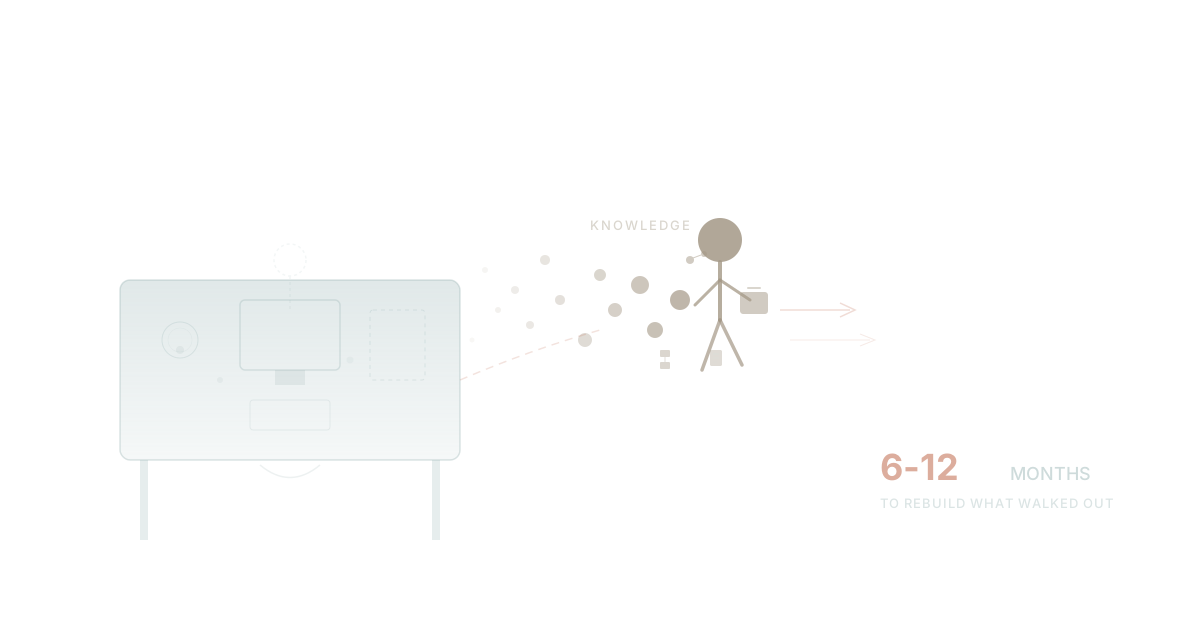
She gave two weeks notice on a Tuesday. By Friday, the panic had started.
Not the HR kind of panic — the forms were filed, the exit interview was scheduled, the job listing was drafted. The real panic was quieter. It lived in the questions nobody could answer. Where did she keep the vendor contracts? What was the logic behind the pricing tiers she built? Which clients had verbal agreements that never made it into the CRM? Why did she route certain support tickets directly to engineering instead of following the standard workflow?
Your best employee did not just do a job. She was the living, breathing operating system of your business. And now she is walking out the door with years of knowledge that was never written down, never captured in a system, and never accessible to anyone but her.
This is not a hypothetical scenario. According to research from SHRM, the average cost to replace a mid-level employee is six to nine months of their salary. But that figure only captures recruitment and training. It does not capture the knowledge hemorrhage — the invisible loss that compounds for months after they leave.
The Five Categories of Knowledge That Walk Out the Door
When a high-performing employee departs, the damage is not a single event. It is a slow unraveling across five categories that most organizations never think to inventory.
1. Client Relationship Knowledge
Your best account manager does not just manage accounts. She knows that the CEO of your largest client hates email and prefers a quick phone call. She knows that the procurement team at another client requires three weeks of internal approvals, not the two weeks stated in their policy. She knows which contacts are champions and which are blockers, and she has spent years learning the difference.
Research from HBR confirms that relationship capital is among the most valuable and least transferable assets in any business. When it leaves, clients feel the absence before your replacement even starts. Renewal conversations stall. Upsell opportunities vanish. And the competitor who has been waiting in the wings suddenly gets a meeting.
2. Process Knowledge — The Unwritten Rules
Every business has two sets of processes: the documented ones and the real ones. Your operations lead knows that the inventory system throws false errors on the third Tuesday of each month and you need to run a manual reconciliation. She knows that the "standard" approval workflow actually requires looping in finance when the deal exceeds a threshold that is different from the one in the policy document.
These unwritten rules are the connective tissue of your operations. They are the reason things actually work. And they exist almost entirely in people's heads, scattered across knowledge silos that no one has mapped.
3. Tool Configurations and Workarounds
The average business uses over 100 SaaS applications. Your power users have spent months — sometimes years — configuring dashboards, building custom reports, setting up automation rules, and creating workarounds for tool limitations. When they leave, all of that institutional configuration knowledge goes with them.
The new hire inherits a stack of tools that appear to work but are full of invisible logic. The Zapier automation that routes leads to the right salesperson based on criteria nobody documented. The spreadsheet formula that calculates commissions using a custom logic that accounting depends on but does not understand. The CRM tags that mean something specific to the departed employee and nothing to anyone else.
This is the app sprawl problem at its most dangerous: when knowledge is not just fragmented across tools but embedded in configurations that only one person understands.
4. Vendor and Partner Contacts
Who is the account rep at your logistics partner who can expedite shipments? Which freelancer delivers the best design work and what is their rate? Who at the software vendor can override a billing issue without going through the standard support queue?
These relationships are currency. They represent years of trust-building and negotiation. When the employee who holds them leaves, you do not just lose contact information — you lose the context that makes those relationships productive. The new person calling that vendor rep is a stranger. The informal agreements, the favors owed, the mutual understanding of how to get things done quickly — all of it resets to zero.
5. Strategic Context — The "Why" Behind the "What"
Perhaps the most expensive category of knowledge loss is strategic context. Your departing employee knows why certain decisions were made. She was in the room when leadership decided to exit a market segment, pivot a product line, or restructure the sales team. She knows what was tried before and failed. She knows which ideas were evaluated and rejected, and the reasons behind those rejections.
Without this context, organizations fall into what I call business amnesia — the tendency to repeat past mistakes because the institutional memory of those mistakes has vanished. In Resolute, I describe this pattern as one of the most destructive forces in organizational performance. Companies that cannot remember what they have learned are condemned to relearn it, often at enormous cost.
This is the same pattern explored in detail in building organizational culture without amnesia: when the "why" behind decisions disappears, culture erodes and strategic drift begins.
The Real Cost: 6 to 12 Months of Compounding Damage
The recruitment cost is straightforward to calculate. The knowledge cost is not, because it compounds over time.
Month 1-2: The discovery phase. The team discovers gaps they did not know existed. Projects stall as people realize the departed employee was the only one who understood key dependencies. Client requests go unanswered because relationship context is missing.
Month 3-4: The workaround phase. The team builds temporary fixes. Other employees absorb extra work. Productivity drops 20-30% as experienced staff spend time answering questions they assumed were documented.
Month 5-6: The relearning phase. The new hire is onboarded but still operating at 40-60% capacity. Mistakes are made — the same mistakes the departed employee learned to avoid years ago. A client escalation occurs because the new account manager did not know about an unwritten agreement.
Month 7-12: The slow rebuild. Performance gradually returns to baseline. But "baseline" is lower than before because some knowledge was never recovered. The vendor relationship that took three years to build starts over from scratch. The process optimization that saved 15 hours a week was never documented and is now lost.
Gartner research estimates that the total cost of turnover — including lost productivity, knowledge loss, and reduced team performance — reaches 1.5 to 2 times the departing employee's annual salary. For a senior employee earning $120,000, that is $180,000 to $240,000 in total impact. For a small business, that figure can represent the difference between a profitable year and a loss.
This is the same hidden cost destroying your valuation that private equity firms and acquirers factor into their assessments.
The Root Problem: Knowledge Trapped in Heads Instead of Systems
The reason employee departures cause so much damage is not that people leave. People will always leave. The problem is where the knowledge lives.
In most small and mid-size businesses, critical knowledge exists in exactly three places:
- Individual memory — what people remember from experience
- Scattered tools — fragments across email, chat, documents, and spreadsheets
- Informal conversations — decisions made in hallways, on calls, and in DMs that were never recorded
None of these are resilient. Memory fades. Tool fragments become unsearchable. Conversations disappear into archives nobody revisits. The result is a business that depends entirely on specific people to function, which means every departure is a crisis.
This is the pattern that knowledge silos create: even when information technically exists somewhere in your tech stack, it is functionally invisible to anyone who was not present when it was created.
The contrast is a business where knowledge is embedded in a connected platform — where client relationship history, process documentation, tool configurations, vendor contacts, and strategic context all live in a system that persists regardless of who is on the team.
Building a Business That Remembers
The solution is not more documentation mandates. Every organization has tried the "let's document everything" approach. It fails because documentation is a tax on the people who are busiest doing the actual work.
The solution is designing your operational environment so that knowledge is captured as a byproduct of work, not as an additional task.
This means three shifts:
1. Unify Where Work Happens
When your team operates across 50 disconnected tools, knowledge fragments are an inevitability. Each tool becomes a silo. When you consolidate into a unified productivity platform, context stays connected. The project update, the client note, the process change, and the strategic decision all exist in the same system, linked and searchable.
This is the foundation of building a strategic command centre without amnesia — a single environment where organizational memory accumulates naturally.
2. Make Context Persistent, Not Personal
The goal is to shift knowledge from individual heads to shared systems. Not through documentation mandates, but through tools that make it easier to capture context than to skip it. When updating a client record takes 10 seconds inside the same platform where you track your tasks, people do it. When it requires switching to a separate CRM, logging in, finding the right record, and typing a note, they do not.
McKinsey research shows that knowledge workers spend 19% of their week searching for information. The organizations that reduce this number are not the ones with better documentation habits — they are the ones with better information architecture.
3. Build on a Platform, Not a Patchwork
The most resilient businesses are not the ones with the best employees. They are the ones where the platform itself carries the knowledge. Client history, process logic, vendor relationships, and strategic context are not trapped in any individual's experience — they are embedded in the connected system where work happens.
This is the principle behind building custom apps on a unified foundation: when your business operations run on a platform that connects data, tools, and context, the departure of any individual — no matter how talented — does not create an organizational crisis.
The Test: What Would Happen Tomorrow?
Here is a simple thought experiment. Pick the employee your business depends on most. Now imagine they give notice tomorrow.
Ask yourself:
- Could someone else pick up their client relationships within a week?
- Are the processes they manage documented in a system, or only in their head?
- Would the tools they configured continue to function correctly without them?
- Do you know every vendor and partner contact they manage?
- Could a new hire understand why past decisions were made?
If the answer to any of these is no, your business has a knowledge resilience problem. You are one resignation away from months of disruption — not because you made a hiring mistake, but because your systems were not designed to retain knowledge independently of the people who created it.
The companies that survive and thrive through turnover are not the ones that never lose good people. They are the ones that built environments where knowledge persists, context compounds, and the platform remembers what individuals cannot.
Context engineering is the discipline of designing these environments. And in an era where AI can amplify organizational memory through frameworks like the Context Compass, the gap between knowledge-resilient businesses and knowledge-fragile ones is widening fast.
Your best employee will leave someday. The question is whether your business will remember what she knew.
Knowledge loss from employee turnover is a preventable crisis. Learn how unified productivity platforms keep institutional knowledge embedded in your business, not trapped in the heads of individuals who might leave tomorrow.
About the Author

Stuart Leo
Stuart Leo founded Waymaker to solve a problem he kept seeing: businesses losing critical knowledge as they grow. He wrote Resolute to help leaders navigate change, lead with purpose, and build indestructible organizations. When he's not building software, he's enjoying the sand, surf, and open spaces of Australia.