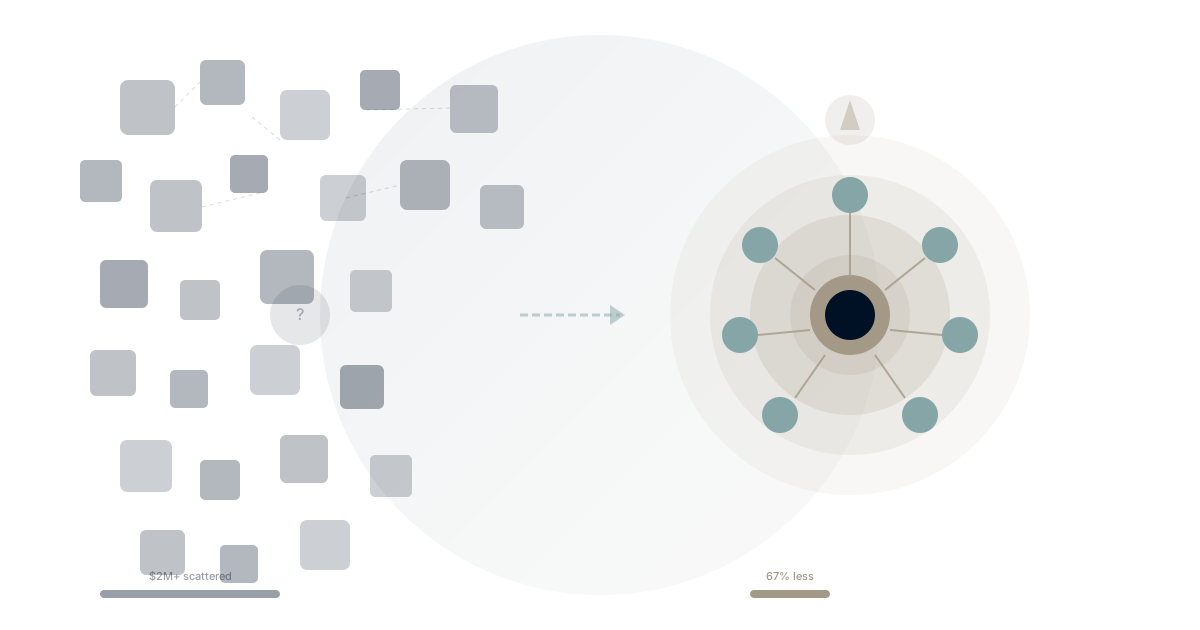
Your business probably runs on somewhere between 15 and 40 different software applications. You're paying for each one separately. Your data lives in silos. Nothing quite works together.
And here's the uncomfortable truth: this is by design.
For 15 years, the tech industry told you "there's an app for that" was a feature, not a bug. Every problem got its own specialized solution. The result? A $2M+ annual software stack that creates more problems than it solves.
According to Gartner research, the average enterprise now uses 110+ SaaS applications. Mid-market companies use 40-70. Small businesses use 15-30. And every single one of these tools claims to be "essential."
This is the app sprawl crisis. And it's costing you far more than you realize.
The Five Waves That Created This Mess
In my book Resolute, I analyze how five waves of transformational change created today's fragmented business software landscape. Understanding this history is crucial for understanding why your tech stack looks the way it does.
Wave 1: Sales (Early 2000s)
Salesforce pioneered cloud CRM and proved software could live in the browser. Every sales team got their own tool. The promise: "Know your customer better."
The result: Customer data trapped in sales software that only sales could access.
Wave 2: Service (Late 2000s)
Case management systems, CTI integration, knowledge bases. Customer service departments got their tools too.
The result: Service teams couldn't see what sales promised. Sales couldn't see what service was handling.
Wave 3: Marketing (2007-2012)
This is where things exploded. Marketing automation went from 150 vendors in 2011 to over 14,000 products from 5,000+ vendors today, according to Scott Brinker's MarTech research.
The result: Marketing campaigns disconnected from sales pipelines and service delivery.
Wave 4: Finance (Mid-2010s)
Xero, QuickBooks Online, MYOB, expense management, billing platforms. Finance got modernized too.
The result: Financial data completely disconnected from customer data, project data, and operational data.
Wave 5: AI (Now)
Here's where the model breaks down completely.
"The fifth wave is fundamentally different... whilst an organization can do some parts of one or all of the previous transformations, the fifth wave requires mature transformation across sales, marketing, service, operations, and finance." — Resolute
AI requires unified data to work. But four waves of fragmentation created the opposite. Your AI initiatives fail because your data is scattered across 40 disconnected tools.
The industry spent 15 years creating specialized silos. Now they're trying to sell you AI that can't work without unified data.
The True Cost of App Sprawl
Most organizations dramatically underestimate what fragmentation is actually costing them. Here's the real math.
Direct Costs: The Subscription Bill
The obvious cost is the software subscriptions themselves:
| Category | Typical Tools | Annual Cost (25 users) |
|---|---|---|
| Productivity | Google Workspace or M365 | $4,500-7,500 |
| Project Management | Asana, Monday, ClickUp | $3,000-6,000 |
| Communication | Slack, Zoom | $3,000-6,000 |
| CRM | Salesforce, HubSpot | $6,000-30,000 |
| Documentation | Notion, Confluence | $2,400-6,000 |
| OKRs/Goals | Lattice, 15Five | $3,000-7,500 |
| Marketing | Mailchimp, HubSpot | $6,000-24,000 |
| Finance | Xero, Expensify | $3,000-6,000 |
| Subtotal | $30,900-93,000 |
For a mid-market company, direct subscription costs alone can exceed $500,000 annually.
Indirect Costs: The Integration Tax
But subscriptions are just the beginning. The real costs are hidden.
Integration development and maintenance:
- Custom integrations: $25,000-100,000 per integration
- Annual maintenance: 20% of build cost
- Average company needs 10-20 integrations
- Total: $250,000-500,000 annually
According to MuleSoft's Connectivity Benchmark, organizations spend an average of $3.5M annually on integration initiatives.
Data quality and reconciliation:
- Manual data entry across systems: 15-20 hours/week per team
- Data discrepancy resolution: 5-10 hours/week
- Report reconciliation: 10-15 hours/week
- Total: 30-45 hours/week of lost productivity
Context switching costs:
- Average worker switches apps 1,100+ times per day (RescueTime research)
- Each switch costs 23 minutes of focus (UC Irvine study)
- Total: 40% of productive time lost to switching
The $2M+ Reality
For a 100-person company, the true cost of app sprawl:
| Cost Category | Annual Cost |
|---|---|
| Direct subscriptions | $200,000-500,000 |
| Integration development | $250,000-500,000 |
| Integration maintenance | $50,000-100,000 |
| Lost productivity (context switching) | $500,000-1,000,000 |
| Data quality issues | $200,000-400,000 |
| Security and compliance overhead | $100,000-200,000 |
| Total | $1,300,000-2,700,000 |
This doesn't include opportunity costs: the deals lost because sales couldn't access service history, the campaigns that failed because marketing couldn't see purchase data, the strategic decisions made on incomplete information.
Seven Signs Your Organization Has an App Sprawl Problem
Not sure if this applies to you? Here are the warning signs:
1. No One Knows How Many Apps You Have
When was the last time you audited your software stack? If IT, Finance, and department heads give different answers to "how many apps do we use?"—you have a problem.
The test: Can anyone in your organization produce a complete list of all software subscriptions in under an hour?
2. The Same Data Lives in Multiple Places
Customer contact information in CRM, email tool, support system, and marketing platform. Project status in task manager, status reports, and Slack messages. Financial data in accounting software, spreadsheets, and project tools.
The test: Pick any entity (customer, project, employee). How many places does their data live?
3. "Integration" Is a Full-Time Job
If you have people whose primary job is making your tools talk to each other, you've institutionalized the problem.
The test: How many hours per week does your team spend on integration maintenance, data sync, and API troubleshooting?
4. Meetings Are for Information Sharing
When meetings exist primarily to share information that should flow automatically between systems, your tools have failed you.
The test: What percentage of your meetings would be unnecessary if everyone could see the same data?
5. New Hires Take Weeks to Get Productive
Onboarding someone means provisioning 15+ accounts, teaching 15+ interfaces, and explaining 15+ workflows.
The test: How long until a new hire can independently navigate your complete tool stack?
6. Reports Require Manual Reconciliation
If generating a cross-functional report requires exporting from multiple systems, manual cleanup, and spreadsheet gymnastics—your data architecture is broken.
The test: How long does it take to answer "what's our customer satisfaction by revenue segment by region?"
7. You've "Consolidated" Multiple Times
If you've done a "tool consolidation" initiative before and still have 30+ apps, you've been consolidating within silos rather than across them.
The test: After your last consolidation, did total tool count actually decrease? By how much?
The Security Time Bomb
App sprawl isn't just inefficient—it's dangerous.
Credential Sprawl
Each employee has credentials in 15-40 systems. That's 15-40 attack vectors. 15-40 password reset policies. 15-40 MFA configurations (or lack thereof).
According to Verizon's Data Breach Report, 61% of breaches involve credentials. More credentials = more attack surface.
Shadow IT Explosion
When official tools don't work together, people find workarounds. Free trials. Personal accounts. Unapproved apps. Each one is an unmonitored data leak.
Our research shows the average organization has 2.5x more apps than IT knows about. See our deep dive on shadow AI risks.
Compliance Nightmares
GDPR, HIPAA, SOC2—all require you to know where data lives. When customer data is scattered across 40 systems, compliance is nearly impossible.
The question auditors ask: "Show me everywhere this customer's data exists."
The honest answer for most companies: "We don't know."
Why Consolidation Keeps Failing
You've probably tried to fix this before. Here's why it didn't work.
The "Best of Breed" Trap
The conventional wisdom: choose the best tool for each category. The result: 15 "best" tools that don't work together.
Best-of-breed thinking optimizes locally while destroying global efficiency. The best CRM + the best project manager + the best email tool = three silos of excellence.
The Integration Fantasy
"We'll integrate everything!" But integrations:
- Break when vendors update APIs
- Only sync the data you configure
- Create lag and sync conflicts
- Cost money to build and maintain
Integration is a band-aid, not a cure.
The Platform-That-Isn't
Some vendors claim to be "platforms" but are really point solutions with integrations. Monday's "Work OS," Notion's "All-in-one workspace," ClickUp's "One app to replace them all"—they're all missing major categories.
The test: Does the platform include email, calendar, video calls, documents, spreadsheets, presentations, task management, goals, forms, databases, and automations? If not, you still need other tools.
The Path Forward: From Fragmentation to Foundation
The solution isn't better integration. It's architectural change.
Recognize the Real Problem
The problem isn't that you have bad tools. The problem is that you have many tools. The fragmentation itself is the issue.
Evaluate Total Cost of Ownership
Stop comparing tool vs. tool. Start comparing total stack cost—including integration, maintenance, productivity loss, and security overhead.
Prioritize Unified Context
Your AI investments will fail without unified data. Every strategic initiative requires cross-functional visibility. Context is the competitive advantage of the next decade.
Consider True Platforms
A real platform isn't a point solution with integrations. It's a unified foundation where:
- All data lives in one place
- All tools share context automatically
- All users have one login, one interface, one source of truth
- AI has access to complete organizational context
What WaymakerOS Offers
WaymakerOS is built on the premise that fragmentation is the problem. Instead of being another tool in your stack, it aims to be the stack.
20 integrated tools replacing:
- Google Workspace / Microsoft 365 (Email, Calendar, Docs, Sheets, Presentations)
- Slack / Teams (Messages, Video Calls)
- Asana / Monday / ClickUp (Taskboards)
- Notion (Documents, Tables)
- Lattice / 15Five (Goals & OKRs)
- Mailchimp (Journeys)
- And more (Forms, Automations, Address Book)
One platform. One login. One price. One source of truth.
The 67% cost savings come not from cheaper individual tools, but from eliminating the integration tax, the context switching costs, and the security overhead of managing 15+ vendors.
Explore unified productivity →
Further Reading
Understand the Problem
- Tool Sprawl: How 47 Apps Killed Our Productivity
- The $100K Knowledge Silo Problem
- Context Switching Costs: The $450B Problem
- Shadow AI: The $10M Data Breach Waiting to Happen
Industry-Specific App Sprawl
- Why Your Tourism Business Runs on 12 Apps
- The Property Manager's App Stack Problem
- Professional Services Firms Lose 5 Hours a Week to Tool Switching
The Hidden Costs
- What Happens When Your Best Employee Leaves and Takes the Knowledge
- The $2,400 Per Employee Cost of App Sprawl
- Your Team Uses 7 Apps Before Lunch — Here's the Real Cost
- Why Small Businesses Pay Enterprise Prices for Broken Software
- Shadow AI Is Already in Your Business — How to Channel It
Explore Solutions
- Unified Productivity: Replace Your Stack
- Complete Google Workspace Migration Guide
- Best Microsoft 365 Alternative for Small Business
Compare Platforms
The fragmentation era is ending. The question isn't whether your organization will consolidate—it's whether you'll do it proactively or be forced to do it reactively when your AI investments fail without unified data.
Part of our guide to all-in-one business platforms.
About the Author

Stuart Leo
Stuart Leo founded Waymaker to solve a problem he kept seeing: businesses losing critical knowledge as they grow. He wrote Resolute to help leaders navigate change, lead with purpose, and build indestructible organizations. When he's not building software, he's enjoying the sand, surf, and open spaces of Australia.