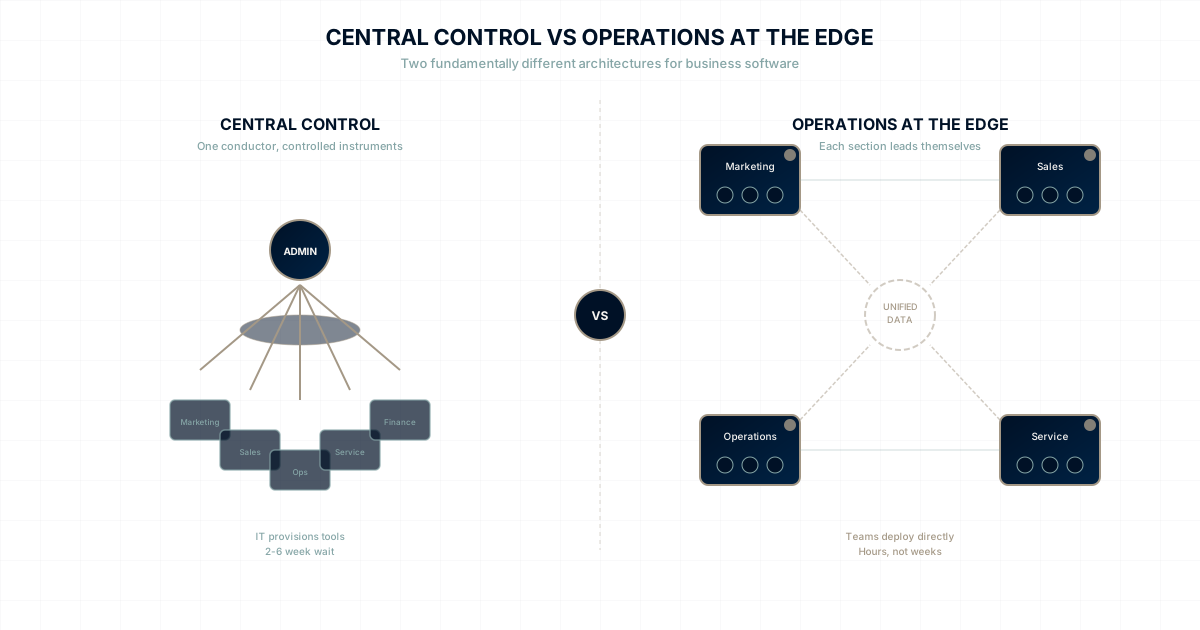
There are two fundamentally different philosophies for building business software.
The first—central control—concentrates capability at headquarters. IT provisions tools. Administrators control access. Every team gets what central decides they need.
The second—operations at the edge—distributes capability to where work happens. Workspaces deploy their own tools. Teams move at the speed of need. Operations happen where they matter.
Microsoft and Google built trillion-dollar empires on the first philosophy. WaymakerOS is built entirely on the second.
This isn't just a product difference. It's an architectural divergence with profound implications for how organizations operate, adapt, and scale.
The Central Control Model
The Architecture of Control
Microsoft 365 and Google Workspace share the same fundamental architecture:
Central Administration:
- Global admins control all settings and policies
- Tool access granted through central provisioning
- Custom configurations require admin approval
- Integrations managed through central IT
Standardized Features:
- Same tool set for every team
- Limited customization per workspace
- Features determined by organization-wide licensing
- Changes require organization-wide updates
Unified But Rigid:
- Data technically in one place (per product)
- But siloed across product boundaries
- Integration between products requires work
- Custom workflows need development
How Central Control Works in Practice
Marketing needs an email automation:
- Marketing identifies the need
- Request submitted to IT
- IT evaluates within existing tool constraints
- If current tools can't do it: lengthy procurement process
- If they can: IT configures the solution
- Marketing receives a standardized workflow
- Modifications require returning to step 2
Timeline: 2-8 weeks
Sales needs a custom pipeline view:
- Sales identifies the need
- Request submitted to CRM administrator
- Admin evaluates within platform constraints
- Configuration work scheduled (competing priorities)
- Solution delivered (often compromised)
- Changes require new requests
Timeline: 1-4 weeks
Operations wants to track a new metric:
- Operations identifies what needs tracking
- Request submitted to BI/data team
- Data team evaluates data availability
- Dashboard development scheduled
- Development, testing, deployment
- Modifications require new development
Timeline: 3-6 weeks
The pattern is consistent: teams identify needs, but capability lives elsewhere.
The Conductor Model
Think of central control like Montgomery's "tidy battlefield" orchestra: one conductor directing every instrument.
The conductor (central IT/admin) determines:
- Which instruments are available (tool selection)
- When each instrument plays (provisioning)
- How each section performs (configuration)
- What the overall piece sounds like (standardization)
Individual musicians (teams) execute their parts precisely as directed. Improvisation isn't just discouraged—it's structurally impossible. The first violin can't decide to try a different bowing technique. Marketing can't decide to deploy a new workflow.
Everything flows through the conductor.
This creates predictability. It creates standardization. It also creates bottlenecks.
The Operations at the Edge Model
The Architecture of Sovereignty
WaymakerOS inverts the architecture:
Workspace Sovereignty:
- Each workspace controls its own tools
- Teams deploy capabilities without central approval
- Custom configurations at the workspace level
- Integrations and automations team-controlled
Distributed Capability:
- Tools available to all workspaces by default
- Deep customization per workspace
- Features available immediately, not gated by licensing tiers
- Changes happen at the speed of need
Unified Data, Distributed Operations:
- Single organizational database
- Shared context across all workspaces
- No product boundaries fragmenting data
- Custom apps access the same unified data
How Operations at the Edge Works in Practice
Marketing needs an email automation:
- Marketing identifies the need
- Marketing opens their workspace
- Marketing builds the journey in Journeys
- Testing and refinement (same session)
- Journey live
Timeline: Hours
Sales needs a custom pipeline view:
- Sales identifies the need
- Sales opens their workspace
- Sales creates a Tables view with custom fields
- Pipeline view configured with automations
- View live
Timeline: Hours
Operations wants to track a new metric:
- Operations identifies what needs tracking
- Operations creates tracking in Tables
- Builds dashboard view
- Sets up automations for data collection
- Metric live
Timeline: Hours
The pattern is different: teams identify needs and fulfill them.
The Section Leader Model
Operations at the edge is like Mission Command's transformation: each section of the orchestra leads themselves while playing the same symphony.
The platform provides:
- The score (unified data and organizational context)
- The instruments (comprehensive tool suite)
- The concert hall (infrastructure and governance)
Each section (workspace) determines:
- How they interpret their part (workflow design)
- What dynamics to employ (automation and customization)
- When to play forte or piano (capability deployment)
The result isn't chaos—it's distributed capability with unified purpose. Marketing plays marketing. Sales plays sales. Operations plays operations. All drawing from the same unified data, all moving toward organizational objectives.
Capability lives where work happens.
Direct Comparison
Tool Access
| Aspect | Central Control (Microsoft/Google) | Operations at the Edge (WaymakerOS) |
|---|---|---|
| Who provisions tools? | Central IT/Admin | Workspace teams |
| How long to access? | Days to weeks | Immediate |
| Who controls configuration? | Global administrators | Workspace users |
| Can teams build custom workflows? | Limited (requires admin) | Yes (native capability) |
| Can teams deploy automations? | Depends on licensing/approval | Yes (standard) |
Data Architecture
| Aspect | Central Control (Microsoft/Google) | Operations at the Edge (WaymakerOS) |
|---|---|---|
| Where does data live? | Siloed by product | Single unified database |
| Contact in email same as CRM contact? | No (separate systems) | Yes (same record) |
| Cross-product visibility? | Requires integration | Native |
| Custom apps access data? | Via APIs (complex) | Via Context API (native) |
| Data reconciliation needed? | Yes (constant) | No (unified by design) |
Customization
| Aspect | Central Control (Microsoft/Google) | Operations at the Edge (WaymakerOS) |
|---|---|---|
| Who can customize? | Admins (org-wide) | Users (workspace-level) |
| Custom fields? | Admin-controlled | Workspace-controlled |
| Custom workflows? | Requires development | Built-in (Automations) |
| Custom apps? | External development | Built-in (Host) |
| Time to customize? | Weeks | Hours |
Governance
| Aspect | Central Control (Microsoft/Google) | Operations at the Edge (WaymakerOS) |
|---|---|---|
| Security policies | Global admin | Platform-level |
| Audit trails | Per product | Unified |
| Compliance | Per product configuration | Platform-level |
| Data governance | Fragmented across products | Unified |
| Access control | Central admin | Platform + workspace |
Real-World Scenarios
Scenario 1: Competitive Response
A competitor announces a major change. You need to respond within 48 hours.
With Central Control:
- Marketing requests emergency campaign capability
- IT escalates as high priority
- Email platform configuration begins
- Sales requests CRM modifications for competitive tracking
- Operations requests reporting updates
- Result: Partial response in 2 weeks, full response in 4+ weeks
With Operations at the Edge:
- Marketing opens workspace, builds response journey
- Sales creates competitive tracking in Tables
- Operations sets up response tracking dashboard
- Leadership sees unified view of response
- Result: Full response live in 8 hours
Difference: 8 hours vs 4 weeks. In competitive response, timing is everything.
Scenario 2: New Product Launch
Launching a new product requires coordinated changes across marketing, sales, operations, and service.
With Central Control:
- Marketing submits landing page and campaign requests
- Sales submits pipeline and reporting requests
- Operations submits fulfillment workflow requests
- Service submits documentation and support queue requests
- Each request enters separate queues
- Result: Launch delayed 6-8 weeks while requests process
With Operations at the Edge:
- Marketing creates landing page and campaigns in their workspace
- Sales adds pipeline stages and tracking in their workspace
- Operations builds fulfillment workflows in their workspace
- Service creates support documentation and routing in their workspace
- All workspaces share unified product data
- Result: Launch on original timeline, coordinated through shared data
Difference: On-time launch vs 2-month delay.
Scenario 3: Process Improvement
Operations identifies a manual handoff causing 3-hour delays daily.
With Central Control:
- Operations documents the problem
- IT scopes the automation project
- Development scheduled (3-6 months out)
- Solution built and tested
- Deployed to production
- Result: 6 months of delays (540+ hours lost) before fix
With Operations at the Edge:
- Operations identifies the problem
- Operations builds automation in Automations tool
- Tests in sandbox
- Deploys to workspace
- Result: Fixed in 3 days, immediate efficiency capture
Difference: 6 months of waste vs 3 days.
The Structural Difference
The differences above aren't about features. They're about architecture.
Central Control Creates Bottlenecks
In the central control model, capability flows through choke points:
Team Need → Central IT → Approval → Configuration → Team Receives
Every step adds latency. Every approval adds delay. The more teams you have, the more requests compete for central attention. Bottlenecks compound.
Operations at the Edge Eliminates Bottlenecks
In the operations at the edge model, capability flows directly:
Team Need → Team Acts → Capability Live
There's no queue because there's no gatekeeper. Governance happens at the platform level, not the feature level. Teams act at the speed of need.
The Mathematical Reality
Consider a 500-person company with 10 functional teams:
Central Control:
- Each team generates ~50 capability requests/year
- 500 requests through central IT annually
- Average resolution: 3 weeks
- Total organizational wait time: 1,500 weeks annually
- That's 28+ person-years of waiting
Operations at the Edge:
- Same capability needs
- Each team resolves their own needs
- Average resolution: 1 day
- Total organizational wait time: ~100 days
- That's 0.4 person-years of waiting
The efficiency difference is measured in orders of magnitude, not percentages.
Why Central Control Persists
If operations at the edge is so much better, why does central control dominate?
Historical Momentum
Microsoft and Google built their empires when central control made sense. Early IT systems were genuinely dangerous without expert oversight. Network security required specialized knowledge. Software configuration was complex.
Organizations learned to trust central IT. That trust became habit. Habit became policy. Policy became culture.
Legitimate Concerns (That Edge Solves Differently)
"We need standardization" Central control: Enforce one way of doing things Operations at the edge: Share data and context; let teams choose methods
"We need security" Central control: Control access to tools Operations at the edge: Secure the platform; tools inherit security
"We need compliance" Central control: Audit each system separately Operations at the edge: Audit the unified platform
"We need cost control" Central control: Gate tool access through procurement Operations at the edge: Eliminate tool sprawl through unified platform
Operations at the edge doesn't ignore these concerns—it addresses them at a different level. Platform governance instead of feature gatekeeping.
Vendor Lock-in
Perhaps most significantly: Microsoft and Google benefit from central control.
- Central admins become product experts
- Organizations build around platform-specific workflows
- Switching costs compound with every integration
- Central control concentrates power with the vendor
Operations at the edge distributes power to users. That's better for organizations but different for vendor economics.
Making the Choice
Central Control May Fit If:
- You operate in a highly regulated industry where standardization isn't optional
- Your teams genuinely benefit from identical workflows
- You have unlimited IT resources to process requests quickly
- Speed of response doesn't affect competitive position
- Your data fragmentation cost is acceptable
Operations at the Edge Fits If:
- Your teams know their operational needs better than central IT
- Speed matters in your competitive environment
- You've experienced the cost of waiting for provisioning
- Your data is siloed and you're tired of reconciliation
- You believe the people doing the work should have the tools to do the work
The Invitation
Central control was appropriate for an earlier era of technology. When systems were fragile. When security required gatekeeping. When configuration was genuinely complex.
That era has passed.
Modern platforms can provide governance without bottlenecks. Security without gatekeeping. Compliance without fragmentation. The tradeoff between control and capability is false.
You don't have to choose between oversight and agility.
WaymakerOS proves this daily. Platform-level governance provides the security, compliance, and audit requirements organizations need. Workspace sovereignty provides the capability, speed, and autonomy teams need.
The conductor can set the tempo without controlling every note. The orchestra can play together without losing the ability to improvise.
Operations at the edge. It's not just different. It's better.
Continue the Journey
- Operations at the Edge: Why WaymakerOS Exists: The full philosophy
- Workspace Sovereignty: What autonomous workspaces look like
- Why Your Teams Are Waiting for IT: The IT bottleneck in detail
- The HQ Bottleneck: How centralized software kills innovation
WaymakerOS. The way to make your business OS. Make the way.
Central control or operations at the edge. The choice is clear.
Experience workspace sovereignty with Commander.
Part of our guide to building and hosting what no one will build for you.
About the Author

Stuart Leo
Stuart Leo founded Waymaker to solve a problem he kept seeing: businesses losing critical knowledge as they grow. He wrote Resolute to help leaders navigate change, lead with purpose, and build indestructible organizations. When he's not building software, he's enjoying the sand, surf, and open spaces of Australia.