There's a moment in every growing organization when something breaks.
Not visibly. Not dramatically. The systems keep running. The reports still generate. The dashboards remain green.
But underneath, innovation dies. Good ideas never ship. Competitive responses arrive too late. Teams stop trying to improve because "it's not worth the hassle."
This is the HQ bottleneck. And it's killing more businesses than any competitor ever could.
The Bottleneck Forms
The HQ bottleneck doesn't emerge overnight. It accumulates.
Stage 1: Reasonable Centralization
When an organization is small, everyone does everything. Marketing manages their own tools. Sales picks their own CRM. Operations builds their own tracking systems.
Then something happens—a security incident, a compliance audit, a data breach at a competitor—and leadership makes a reasonable decision: centralize control. IT will manage tools. Approved vendors only. Consistent configurations. Proper governance.
This makes sense. Central control provides security, reduces chaos, ensures consistency.
Stage 2: The Queue Forms
As the organization grows, requests multiply. Marketing needs a new email automation. Sales needs CRM modifications. Operations needs a new workflow. Customer service needs a knowledge base update.
Each request enters the IT queue. IT is staffed for operational maintenance, not continuous capability delivery. The queue grows.
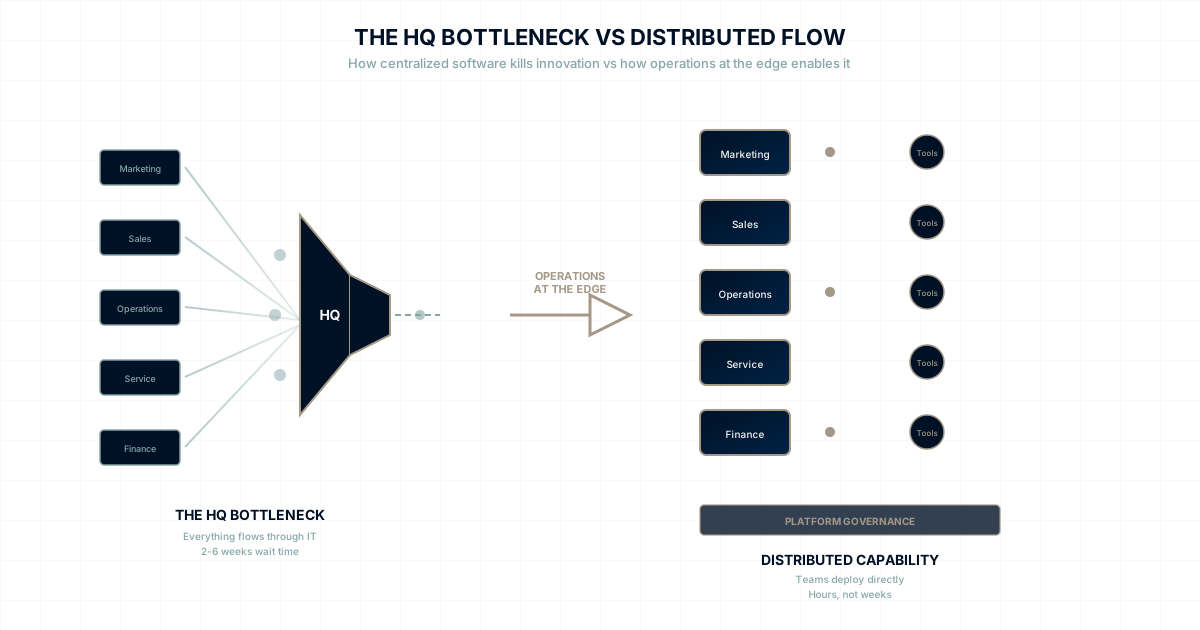
Average request resolution: 2-6 weeks.
Stage 3: Learned Helplessness
Teams learn that asking for capability changes is painful. The process is slow. The outcomes are often compromised. Sometimes requests simply die in the queue.
"We should try X" becomes "That would require IT approval, so let's not bother."
Innovation dies in the queue.
Stage 4: Shadow IT
Frustrated teams work around central control:
- Marketing signs up for their own email platform (paid on a personal card)
- Sales uses spreadsheets instead of waiting for CRM changes
- Operations builds rogue databases to track what matters
- Everyone uses Dropbox or Google Drive for file sharing
Data fragments. Security erodes. The cure creates worse disease than the symptom.
Stage 5: The Permanent Bottleneck
Organizations now have:
- Central IT overwhelmed with requests
- Shadow IT creating security and data problems
- Teams unable to innovate or respond quickly
- Leadership wondering why things take so long
The HQ bottleneck is complete. Self-reinforcing. Self-perpetuating.
The Innovation Tax
The bottleneck imposes a tax on everything the organization does.
Tax on Speed
Every capability change requires:
- Identifying the need
- Documenting requirements
- Submitting the request
- IT triage and prioritization
- Assignment to a resource
- Scoping and planning
- Development or configuration
- Testing
- Deployment
- Training
Conservative estimate: 20-40 hours of effort for a capability that would take 2-4 hours to implement directly.
The innovation tax rate: 500-2,000%
Tax on Ideas
The more expensive an idea is to implement, the fewer ideas get implemented.
When testing a concept requires a 6-week IT project, only "sure things" get attempted. Experimentation becomes uneconomical. The organization loses the ability to learn through iteration.
Ideas that never get tried:
- Quick A/B tests on marketing campaigns
- Custom pipeline views for specific opportunities
- Process automations discovered through daily work
- Dashboard experiments for new metrics
- Integration ideas from frontline workers
Each untried idea represents potential competitive advantage abandoned.
Tax on Talent
The best employees want to make an impact. They have ideas. They see opportunities. They know how to improve things.
When those employees encounter the HQ bottleneck repeatedly—when their ideas die in queues, when their suggestions require months of approval, when their expertise meets institutional friction—they leave.
They go to organizations that trust them. That give them tools. That let them act.
The HQ bottleneck is a talent filter. It retains those willing to wait. It expels those capable of more.
Tax on Competition
Markets move fast. Competitors announce changes. Customer needs evolve. Opportunities appear and disappear.
With a 4-6 week capability deployment cycle, organizations respond to last month's competitive landscape. By the time the response deploys, the situation has changed.
The HQ bottleneck makes organizations structurally slow. Not because people work slowly, but because capability changes queue through a bottleneck.
Why It Persists
The HQ bottleneck persists because it solves real problems for someone.
For IT Leadership
Central control provides:
- Clear accountability for systems
- Standardized configurations
- Security oversight
- Vendor consolidation
- Predictable budgets
These are legitimate concerns. IT leaders aren't wrong to want them. They're wrong to believe the bottleneck is the only way to achieve them.
For Finance
Central control enables:
- Software spending visibility
- Contract negotiation leverage
- Budget allocation clarity
- Cost attribution
Finance wants to know where software money goes. Central procurement provides that visibility. The question is: what visibility costs $2M annually in lost productivity?
For Risk Management
Central control promises:
- Consistent security policies
- Audit trail completeness
- Compliance adherence
- Risk mitigation
When central controls every tool, central can ensure every tool meets standards. The question is: does the bottleneck itself create larger risks through shadow IT and competitive disadvantage?
For the Status Quo
Perhaps most powerfully: the HQ bottleneck persists because changing it requires acknowledging that it exists.
Admitting the bottleneck means admitting years of accumulated organizational debt. It means rethinking structures that feel permanent. It means trusting teams in ways that feel risky.
Inertia is powerful. The bottleneck persists because removing it is harder than enduring it.
The Competitive Reality
Here's the uncomfortable truth: while you queue, competitors act.
What Happens in 6 Weeks
Consider what fast-moving competitors accomplish while your capability request processes:
Week 1-2: While you document requirements, they've already launched v1, measured results, and iterated to v2.
Week 3-4: While you wait for prioritization, they've tested three approaches and found what works.
Week 5-6: While you're in development, they've captured market share and established positioning.
By the time you deploy: The opportunity has shifted. The window has closed. The competitive advantage is gone.
The Compounding Disadvantage
Each capability delay compounds:
- Delayed campaign = missed leads
- Missed leads = lost pipeline
- Lost pipeline = missed revenue
- Missed revenue = reduced investment capacity
- Reduced investment = slower next iteration
Organizations with HQ bottlenecks don't fall behind linearly. They fall behind exponentially.
When Fast Organizations Compete Against Slow
Markets increasingly favor speed. Digital channels reward rapid iteration. Customer expectations demand quick responses.
When a fast organization competes against a slow one:
- They test more approaches
- They find winning strategies faster
- They respond to market signals quickly
- They capture opportunities before they're obvious
Speed isn't an advantage. It's table stakes. The HQ bottleneck makes speed structurally impossible.
The Operations at the Edge Alternative
What if capability didn't flow through HQ?
Distributed Capability
In the Operations at the Edge model:
Marketing deploys email journeys, forms, and campaigns in their workspace—without IT involvement.
Sales creates custom pipeline views, tracking tables, and automations—without waiting for CRM modifications.
Operations builds workflow automations, tracking systems, and dashboards—without submitting tickets.
Customer Service implements routing rules, knowledge bases, and response templates—without development queues.
Each workspace has sovereignty over its operational tools.
Platform Governance
"But what about security? Compliance? Cost control?"
Operations at the edge doesn't eliminate governance—it restructures it:
Security: The platform is secure. All workspaces inherit platform security. No tool-by-tool security reviews needed.
Compliance: Audit trails at the platform level. Governance policies enforced structurally. Compliance happens automatically.
Cost Control: Single platform subscription replaces 15+ tools. No shadow IT because legitimate tools are available. Spending visible at the organization level.
Governance happens at the platform level. Capability happens at the workspace level. Both. Simultaneously.
IT as Enabler
In this model, IT's role transforms:
From: Gatekeeper processing capability requests
To: Platform enabler ensuring organizational success
IT focuses on:
- Platform security and performance
- Best practices and training
- Strategic technology decisions
- Enabling teams to self-serve
This is a better role. IT professionals report higher satisfaction enabling success than processing queues.
The Transformation Path
Breaking the HQ bottleneck isn't instant. But it's achievable.
Step 1: Quantify the Bottleneck
Make the invisible visible:
- How many capability requests per month?
- Average time from request to deployment?
- How many projects cite IT dependencies as blockers?
- What shadow IT exists in the organization?
- What's the cost in hours, opportunity, and talent?
Most organizations are shocked when they see the numbers.
Step 2: Identify High-Impact Teams
Some teams suffer from the bottleneck more than others:
- Marketing (campaign timing is critical)
- Sales (pipeline customization affects deals)
- Operations (efficiency improvements compound)
- Customer Service (response time impacts satisfaction)
Start where pain is highest and impact is clearest.
Step 3: Pilot Workspace Sovereignty
Implement workspace sovereignty for one team:
- Give them a platform with real operational tools
- Provide autonomy over their workspace configuration
- Maintain platform-level governance
- Measure: time-to-capability, productivity, satisfaction
Step 4: Expand Based on Results
When the pilot succeeds (and it will):
- Expand to additional teams
- Migrate data from legacy tools
- Sunset shadow IT as legitimate autonomy increases
- Shift IT resources from gatekeeping to enabling
The Permission Culture Antidote
The deepest problem with the HQ bottleneck isn't the delays. It's the culture it creates.
Permission culture is what happens when organizations consistently require approval for capability:
- Teams stop asking for what they need
- Ideas die before they're voiced
- Innovation becomes someone else's job
- "That's not possible" becomes the default response
Breaking the bottleneck breaks permission culture. When teams can act, they start acting. When ideas can be tested, they get tested. When innovation is possible, innovation happens.
Workspace sovereignty isn't just an efficiency improvement. It's a cultural intervention.
The Invitation
Your organization has an HQ bottleneck. Every organization with centralized software control does.
The question isn't whether it exists. The question is: what's it costing you?
In delayed responses. In lost opportunities. In departed talent. In competitive disadvantage.
The organizations winning in 2026 aren't the ones with the most software. They're the ones where the people doing the work have the tools to do the work.
They've eliminated the HQ bottleneck. Not by ignoring governance. By restructuring it.
Platform governance. Workspace sovereignty. Operations at the edge.
The bottleneck is optional. And it's time to eliminate it.
Continue the Journey
- Operations at the Edge: Why WaymakerOS Exists: The full philosophy
- Why Your Teams Are Waiting for IT: The IT bottleneck detailed
- Workspace Sovereignty: What autonomous workspaces look like
- Central Control vs. Operations at the Edge: Direct comparison
WaymakerOS. The way to make your business OS. Make the way.
Break the HQ bottleneck.
Experience workspace sovereignty with Commander.
About the Author

Stuart Leo
Stuart Leo founded Waymaker to solve a problem he kept seeing: businesses losing critical knowledge as they grow. He wrote Resolute to help leaders navigate change, lead with purpose, and build indestructible organizations. When he's not building software, he's enjoying the sand, surf, and open spaces of Australia.