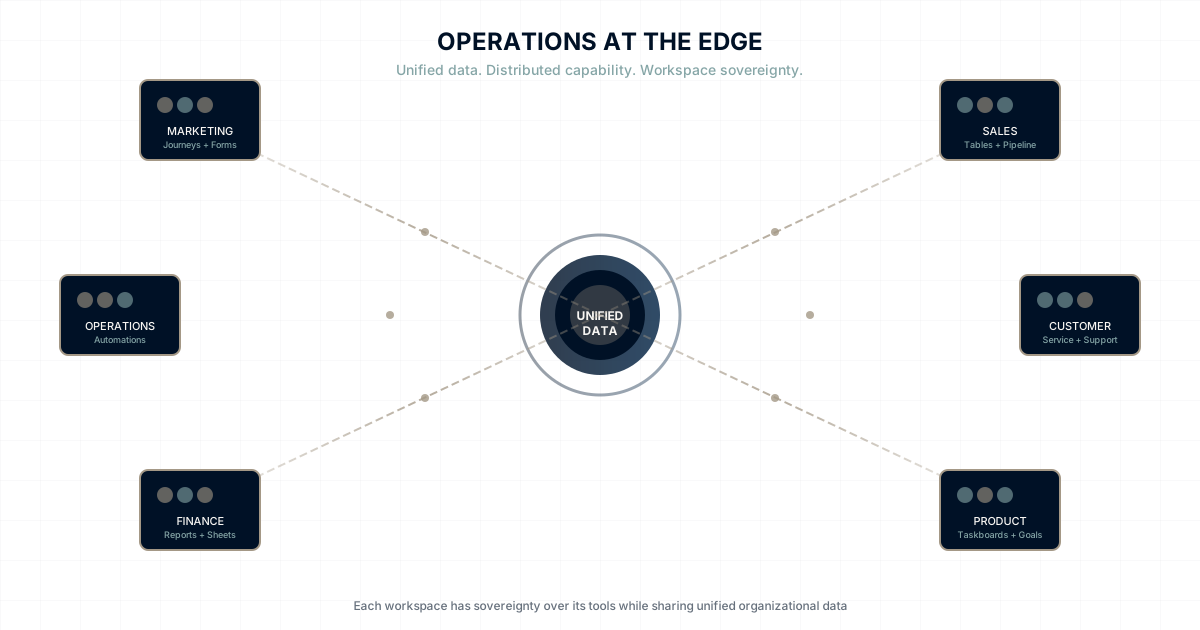
Operations at the Edge is a principle: push operational capability to where work happens, not to where decisions are made.
It sounds simple. It changes everything.
The Core Idea
Most business software centralizes control. IT provisions tools. HQ approves workflows. Teams wait for someone else to give them permission to do their jobs effectively.
Operations at the Edge inverts this. The people doing the work have the tools to do the work.
| Centralized Operations | Operations at the Edge |
|---|---|
| IT provisions tools | Teams deploy their own tools |
| HQ approves workflows | Workspaces control their workflows |
| Permission-based access | Capability-based access |
| Data siloed by function | Data unified across functions |
| Control at the center | Capability at the edge |
This isn't about removing structure. It's about distributing capability while maintaining coherence.
Where the Idea Comes From
The principle has roots in military doctrine—specifically Mission Command, developed by the British Military after the Falklands War revealed the fatal flaw of centralized command.
In 1982, soldiers in combat frequently hesitated, waiting for explicit orders, even in situations where acting independently could have avoided casualties. The problem wasn't the soldiers. It was the system.
Mission Command was the response: push planning to the edge. Give commanders on the ground the authority and tools to make decisions. Trust the people closest to the action.
The results transformed military operations:
- Leaders connected around aligned outcomes
- Purpose and direction clarified
- Trust and authenticity increased
- Speed of collaboration accelerated
- Decision-making decentralized
The British Military developed the 7 Questions for Combat Estimates to implement this—a systematic approach ensuring everyone at every level asked the same strategic questions.
I later adapted this framework for business leadership as the 7 Questions of Leadership. But I realized something else: business software has the same HQ bottleneck problem that military command had.
The Software Parallel
Consider what happens in most organizations:
- Marketing wants email automation? Go through central IT.
- Sales needs a custom dashboard? Wait for HQ approval.
- Operations wants to track a new metric? Submit a ticket.
- Customer service needs a new workflow? Get in line.
Like soldiers waiting for orders, capable teams hesitate. They wait for IT to provision tools. They wait for HQ to approve workflows. They wait for someone else to give them permission to do their jobs.
This is the Microsoft and Google model—one conductor directing every instrument. Centralized software. Central control. Central bottlenecks.
The solution is the same as Mission Command: push operational capability to the edge.
The Four Components
Operations at the Edge has four essential components that work together:
1. Workspace Sovereignty
Each workspace is a self-contained operational unit with autonomy over its tools.
A marketing workspace can deploy email journeys, forms, and automations—without waiting for HQ. A sales workspace can build pipeline tables, dashboards, and workflows. An operations workspace can create tracking systems, reports, and integrations.
No tickets. No waiting. No permission.
2. Unified Data
Every workspace draws from the same organizational database.
The customer record in marketing is the same customer record in sales. The project in operations is the same project visible in goals. Context doesn't fragment. It follows the work.
This is critical: distributed operations without unified data creates chaos. Operations at the Edge requires both.
3. Content Syndication
Sovereign workspaces don't operate in isolation. They publish and subscribe to each other.
Think about what the World Wide Web did: any page could link to any other page. Information flowed. Knowledge compounded. Networks emerged.
The Business Web applies the same principle to your organization:
- Executive publishes business strategy → Departments subscribe with live updates
- IT publishes an expense tracker app → Finance, Sales embed it with their own context
- Data Team publishes an analytics agent → Any workspace invokes it for insights
This is the network effect that transforms Operations at the Edge from "autonomous teams" into "a connected business web."
4. Platform Governance
Everything lives within the organization's security perimeter.
Teams get the speed they need. Leadership gets the oversight they require. Compliance gets the audit trail it demands. This is what makes Operations at the Edge different from shadow IT.
Distributed capability with unified intelligence AND proper governance.
From Sovereignty to Syndication: The Business Web
Workspace sovereignty is the foundation. But the real breakthrough is what happens when sovereign workspaces connect to each other.
We call this The Business Web: a federated network of workspaces, apps, and agents that teams own, publish, and subscribe to.
| World Wide Web | The Business Web |
|---|---|
| Websites connect to websites | Workspaces connect to workspaces |
| Hyperlinks share information | Subscriptions share content |
| Web apps run anywhere | Apps embed across workspaces |
| APIs serve requests | Agents serve the organization |
This is the insight that changes everything: Your business has been stuck in silos across OTHER PEOPLE'S networks—Google's, Microsoft's, Notion's. Operations at the Edge means you build YOUR OWN network.
- Notion gives you pages. We give you a network.
- Google gives you tools in their cloud. We give you the infrastructure to build your own.
- Microsoft gives you apps on their platform. We give you sovereignty.
Stop living in their network. Build your own.
What It Enables
When you push operations to the edge:
Speed increases. Marketing launches campaigns when the market demands, not when IT has bandwidth. Sales builds the tools they need when opportunities arise. Operations tracks what matters when it matters.
Trust compounds. Workspace sovereignty sends a clear message: we trust you to do your job. Teams that feel empowered take ownership. Ownership drives accountability. Accountability delivers results.
Context follows work. Because data is unified, AI and applications understand the full picture. A customer inquiry connects to open projects, pending tasks, and historical context automatically.
Innovation decentralizes. The people closest to problems create solutions. Custom apps, workflows, and automations emerge from the people who need them—not from central teams guessing at requirements.
What It Requires
Operations at the Edge isn't free. It requires:
Unified data architecture. You can't distribute operations if data is fragmented across 15 systems. Operations at the Edge requires a foundation where data is unified by design.
Platform governance. Distributed capability without oversight is shadow IT. Operations at the Edge requires organizational identity management, unified permissions, and audit trails.
Cultural shift. Leaders must trust teams with operational autonomy. Teams must accept accountability that comes with sovereignty. This is a fundamental change in how organizations think about control.
Who It's For
Operations at the Edge works for organizations where:
-
Speed matters more than uniformity. If every team must follow identical workflows, centralized control makes sense. If teams need to adapt to local conditions, distribute the capability.
-
Context varies by function. Marketing, sales, operations, and finance each have unique needs. Forcing them into one-size-fits-all tools creates friction.
-
Innovation comes from practitioners. The best solutions often come from people doing the work, not central teams planning from headquarters.
-
Trust is high. Operations at the Edge assumes teams will use their sovereignty responsibly. Without organizational trust, it becomes chaos.
The Alternative
Not every organization should adopt Operations at the Edge.
Some contexts genuinely need central control:
- Highly regulated industries with strict compliance requirements
- Environments where consistency matters more than speed
- Organizations without the trust culture to support distributed autonomy
- Situations where the cost of inconsistency outweighs the benefits of speed
For these organizations, the traditional model—central IT controlling all tools—remains appropriate. The cost is slower adaptation, but the benefit is uniform control.
The Principle in Practice
Operations at the Edge is the philosophy behind WaymakerOS. Every architectural decision we make flows from this principle:
- Commander gives teams workspace sovereignty with 20+ integrated tools
- Unified data ensures context follows work across the platform
- Platform governance provides organizational identity management and audit trails
- Host lets teams deploy custom apps without central IT involvement
- API enables programmatic extension at the edge
But the principle isn't exclusive to WaymakerOS. Any organization can start applying it:
- Audit your bottlenecks. Where do teams wait for permission to do their jobs?
- Identify distributed capability. What tools could teams deploy themselves with proper governance?
- Unify your data. Where does context fragment between functions?
- Build trust. What cultural changes enable distributed autonomy?
The Transformation
When organizations adopt Operations at the Edge—and The Business Web—they experience the same transformation the British Military discovered:
- Leaders connect around aligned outcomes instead of micromanaging tool access
- Purpose and direction clarify because every workspace has access to organizational goals
- Trust and authenticity increase because sovereignty communicates respect
- Speed and volume of collaboration accelerate because bottlenecks disappear
- Decision-making decentralizes to the people closest to the action
- Knowledge flows through the network via publish/subscribe between workspaces
The British Military learned that centralized command creates hesitation.
We learned that centralized software creates the same problem.
The solution is the same: trust the people closest to the action. Then connect them.
Continue the Journey
Explore the philosophy and its implications:
- Why WaymakerOS Exists: The full story of The Business Web in practice
- Workspace Sovereignty: What autonomous workspaces look like
- The Falklands Lesson for Business Software: The military doctrine behind the philosophy
- Mission Command for Software: How military doctrine translates to software architecture
- The HQ Bottleneck: Why central IT control creates hesitation
- The Computing History Parallel: Why 70 years of computing history predicts this shift
Operations at the Edge.
Your business's private web.
Stop living in their network. Build your own.
Part of our guide to building and hosting what no one will build for you.
About the Author

Stuart Leo
Stuart Leo founded Waymaker to solve a problem he kept seeing: businesses losing critical knowledge as they grow. He wrote Resolute to help leaders navigate change, lead with purpose, and build indestructible organizations. When he's not building software, he's enjoying the sand, surf, and open spaces of Australia.