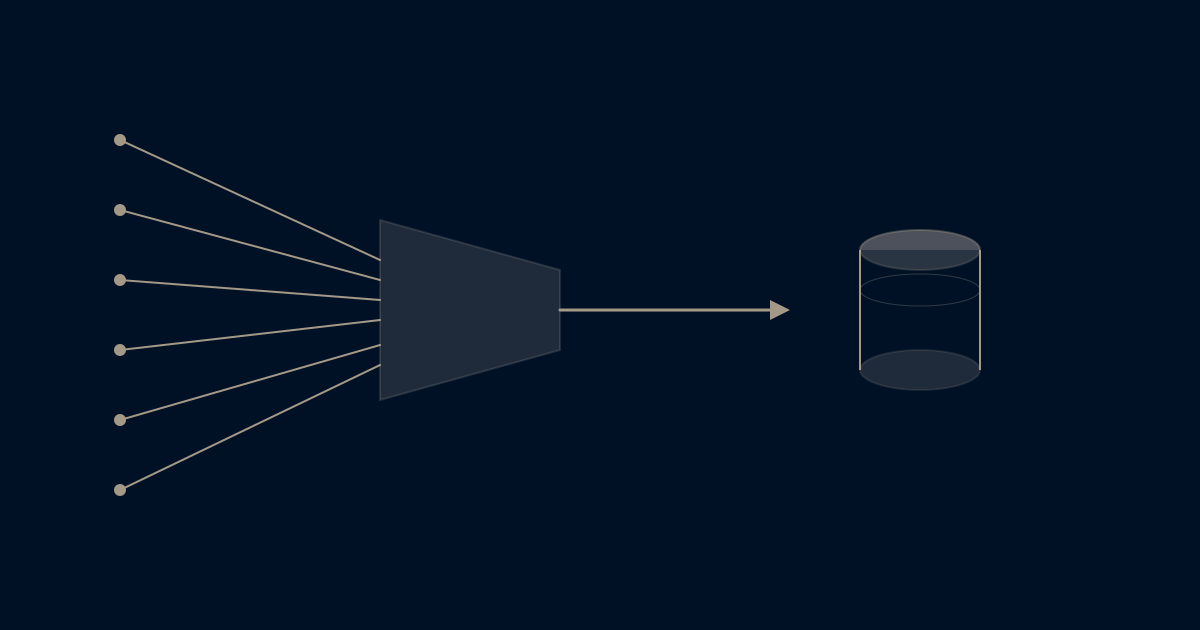
Every serverless function that touches a database opens a connection. One function, one connection. Ten concurrent invocations, ten connections. A traffic spike at 2pm on a Tuesday, and suddenly your database is fielding 500 simultaneous connections from functions that each need the database for 50 milliseconds.
This is the connection storm problem. It is the single most common infrastructure failure mode in serverless architectures. And for over a decade, the standard answer has been the same: deploy PgBouncer.
PgBouncer works. It is battle-tested, open-source, and handles connection pooling for PostgreSQL with minimal overhead. But "works" and "worth the operational cost" are different conversations.
What PgBouncer Actually Requires
PgBouncer is a lightweight connection pooler that sits between your application and your PostgreSQL database. It maintains a pool of persistent connections and multiplexes incoming requests across them. Instead of 500 functions each opening their own connection, all 500 route through PgBouncer, which maps them to a much smaller pool of 20-50 actual database connections.
The theory is clean. The practice is not.
To run PgBouncer in production, you need:
-
A server to run it on. PgBouncer does not run inside your database. It is a separate process that needs its own compute. That means provisioning a VM, a container, or adding it to an existing server -- each with its own trade-offs.
-
Configuration tuning. Pool mode (session, transaction, or statement),
max_client_conn,default_pool_size,reserve_pool_size,server_idle_timeout-- these all interact with each other and with your specific workload patterns. The defaults are rarely right for production. The PgBouncer documentation covers the options, but tuning requires understanding your traffic profile. -
Authentication management. PgBouncer has its own
userlist.txtor can delegate toauth_query. Either way, you are managing database credentials in a second location. Rotate a password in PostgreSQL and forget PgBouncer, and your application goes dark. -
TLS configuration. If your database requires encrypted connections (it should), PgBouncer needs its own TLS certificates configured for both the client-facing and server-facing sides.
-
Monitoring. PgBouncer has an internal
SHOWcommand interface for stats. But that data does not appear in your existing monitoring stack automatically. You need to integrate it -- typically via a Prometheus exporter or custom scripts. -
High availability. A single PgBouncer instance is a single point of failure. In production, you need at least two instances behind a load balancer or DNS failover. Now you are maintaining a small cluster.
-
Ongoing maintenance. PgBouncer needs patching, its host OS needs updates, and its configuration needs revisiting as your traffic patterns change. Someone owns this. In a small team, that someone is usually the same developer trying to ship features.
None of this is insurmountable. Thousands of production systems run PgBouncer successfully. But each item on that list is an hour of engineering time that does not ship a feature, fix a bug, or improve the product. For a team of four developers building a customer-facing application, PgBouncer is a tax on velocity.
Why Serverless Makes It Worse
Traditional application servers maintain persistent database connections across requests. A Node.js Express server opens a connection pool at startup and reuses those connections for every incoming request. PgBouncer is helpful here but not critical -- the application itself is already pooling.
Serverless flips this model. Each function invocation is a fresh execution context. There is no persistent process to hold a connection pool. Every cold start means a new TCP handshake, a new TLS negotiation, and a new PostgreSQL authentication sequence. Even warm invocations may not reuse connections depending on the runtime.
The result is that serverless architectures need connection pooling more urgently than traditional ones, while simultaneously making it harder to implement. It is part of a wider business context gap in modern serverless architecture -- the runtime is elastic, but everything it depends on is not. You cannot run PgBouncer inside a serverless function. It must be an external service. Which brings you back to provisioning, configuring, and maintaining dedicated infrastructure -- the very thing serverless was supposed to eliminate.
This is not an edge case. Any team running serverless functions against a relational database will hit connection limits. PostgreSQL's default is 100 connections. A moderately popular API with 50 concurrent users can exhaust that in seconds during a traffic spike. The database does not crash -- it starts refusing connections. Your functions start throwing errors. Your users see failures.
The ops burden compounds for teams with external databases. If your primary data lives in a managed enterprise database -- Oracle, SQL Server, or an on-premises PostgreSQL cluster controlled by a different team -- you may not have the access or the authority to deploy PgBouncer next to the database. You are asking a DBA team to install and maintain software for your serverless architecture. That conversation rarely goes quickly.
Managed Connection Pooling: The Alternative
Managed connection pooling eliminates the deployment and maintenance burden by moving the pooler into the platform layer. You point it at your database. It handles everything else.
Three services lead this category in 2026:
Cloudflare Hyperdrive
Hyperdrive is Cloudflare's managed connection pooler. It sits between serverless functions running on Cloudflare Workers and any PostgreSQL-compatible database, anywhere.
What it does:
- Maintains persistent connection pools to your database across Cloudflare's global edge network. Your functions connect to the nearest Hyperdrive instance; Hyperdrive maintains a small pool of real connections to your database.
- Caches query results at the edge for read-heavy workloads. A query that returns the same data repeatedly is served from cache, eliminating the database round-trip entirely.
- Requires zero deployment. You create a Hyperdrive configuration with your database connection string. That is it. No servers, no containers, no TLS certificates to manage.
- Works with any PostgreSQL database. Managed services like Supabase, Neon, and Amazon RDS. Self-hosted PostgreSQL. Enterprise databases that speak the PostgreSQL wire protocol. The database does not need to know Hyperdrive exists.
The configuration is a connection string and a few optional parameters. No pool size tuning, no auth file management, no HA setup. Cloudflare runs thousands of Hyperdrive instances globally -- your functions connect to the nearest one, and Hyperdrive manages the upstream pool to your database.
For teams whose data lives in an external database managed by a separate team, this is transformative. You do not need the DBA team to install anything. You do not need firewall rules for a PgBouncer server. You need the database connection string and network access from Cloudflare's IP ranges.
Supabase Connection Pooler
Supabase includes a built-in connection pooler (powered by Supavisor) for every Supabase project. If your database is on Supabase, connection pooling is already available -- you just use the pooler connection string instead of the direct connection string.
Supavisor supports both transaction mode and session mode, handles TLS automatically, and scales with your Supabase plan. No configuration beyond choosing which mode to use. For teams already on Supabase, the pooling problem is solved before it starts.
Neon
Neon is a serverless PostgreSQL provider that includes built-in connection pooling via PgBouncer as a managed service. Every Neon database endpoint has a pooled connection string available. Like Supabase, if you are already using Neon, connection pooling requires zero additional infrastructure.
What Changes When Pooling Is Managed
The shift from self-managed to platform-managed pooling is not just about saving time on initial setup. It changes the operational profile of your architecture.
Connection limits stop being emergencies. With PgBouncer, hitting the pool ceiling means diagnosing configuration, potentially resizing infrastructure, and redeploying. With managed pooling, the platform handles scaling within the service's limits. You monitor usage; you do not manage capacity.
Database migrations get simpler. Moving from one PostgreSQL host to another -- say, from a self-hosted instance to a managed service -- means updating a connection string in one place. You do not need to redeploy PgBouncer, update its auth configuration, or re-establish TLS trust.
Cold start latency drops. Managed poolers maintain warm connections to your database. When a serverless function invokes, it connects to the pooler (fast, nearby) rather than establishing a new connection to the database (slow, distant). For functions that run at the edge -- close to users but far from the database -- the difference is 100-300ms per cold start. That gap is one of the hidden costs of serverless cold starts for global apps, and a warm pool removes most of it.
External database integration becomes viable. Teams with data in Oracle, SQL Server, or legacy PostgreSQL clusters can use managed pooling as a bridge. The pooler maintains the small number of persistent connections the database team is comfortable with, while your serverless functions scale freely on the other side. No one needs to install software on the database server.
Security surface shrinks. Self-managed PgBouncer means another process with credentials, another service to patch, another component to audit. Managed pooling moves that responsibility to the platform provider. Your credentials are stored in one place (the pooler configuration), and the platform handles encryption in transit.
When You Still Need PgBouncer
Managed pooling is not universally superior. There are cases where PgBouncer remains the right choice:
-
Non-PostgreSQL databases. Hyperdrive and Supavisor target PostgreSQL. If your primary database is MySQL, SQL Server, or another system, PgBouncer is not relevant and managed alternatives are limited. ProxySQL exists for MySQL; other databases have their own poolers.
-
Ultra-specific tuning requirements. If you need precise control over pool sizing, eviction policies, or custom authentication flows, PgBouncer gives you full access to every parameter. Managed services abstract these decisions away -- which is usually desirable, but not always.
-
Air-gapped environments. If your database is in a network that cannot reach external services, managed cloud poolers are not an option. PgBouncer deployed within the same network remains the only choice.
-
Cost sensitivity at extreme scale. At very high connection volumes, managed pooling services may cost more than a well-tuned PgBouncer cluster. The crossover point varies by provider, but if you are managing tens of thousands of connections per second, the economics are worth calculating.
For the majority of teams -- particularly those with fewer than 50 developers, running serverless workloads against PostgreSQL databases -- managed pooling eliminates a category of infrastructure work with no meaningful trade-off.
The Broader Pattern: Ops Work That Disappears
Connection pooling is one example of a larger shift in how platforms handle infrastructure. The pattern repeats across several categories:
-
SSL certificates. Five years ago, every deployment needed certificate provisioning and renewal. Today, platforms handle it automatically. Nobody misses managing Let's Encrypt cron jobs.
-
CDN configuration. Static asset serving used to require configuring a CDN, setting cache headers, and managing invalidation. Modern deployment platforms include CDN by default.
-
DDoS protection. Previously a separate service to procure and configure. Now a baseline feature of edge platforms.
-
Connection pooling. Following the same trajectory. The technical requirement has not changed -- databases still have connection limits, serverless functions still create connection storms. But the operational burden is moving from the application team to the platform.
This is the difference between a deployment platform and a business platform. A deployment platform runs your code. A business platform runs your code and handles the infrastructure concerns that used to require dedicated engineering time. Connection pooling, edge caching, real-time capabilities, authentication -- each one is a line item that either consumes your team's time or is handled by the platform.
The question for any team evaluating their infrastructure stack is not "can we manage PgBouncer?" You can. The question is "should we?" When managed alternatives exist that require zero deployment, zero maintenance, and zero on-call burden, the engineering time saved is better spent on the custom software that differentiates your business.
Making the Switch
If you are currently running PgBouncer and considering a move to managed pooling, the migration path is straightforward:
-
Identify your database type and host. Managed pooling works with PostgreSQL and PostgreSQL-compatible databases. If you are on Supabase or Neon, enable the built-in pooler. If your database is elsewhere, evaluate Cloudflare Hyperdrive. Teams weighing where to run the functions on top of it can compare the options in the Vercel vs Waymaker Host platform comparison.
-
Create the managed pooler configuration. For Hyperdrive, this is a single CLI command or dashboard action. For Supabase/Neon, it is already available -- use the pooler connection string.
-
Update your application's connection string. Replace the PgBouncer endpoint with the managed pooler endpoint. If your application uses environment variables for the connection string (it should), this is a single config change.
-
Test under load. Run your existing load tests against the new pooler. Verify that connection behaviour, transaction handling, and query performance match your expectations.
-
Decommission PgBouncer. Once the managed pooler is handling production traffic, remove the PgBouncer instance, its host infrastructure, its monitoring configuration, and its entry in your runbooks. That is not just cleanup -- it is reducing your operational surface area.
The migration is typically completed in a single sprint. The ongoing savings are measured in hours per month that your team reclaims from infrastructure maintenance and redirects toward building software.
The Bottom Line
PgBouncer solved connection pooling. It did not solve the operational burden of running connection pooling infrastructure. For teams running serverless workloads against PostgreSQL -- especially teams with external databases, small ops teams, or a preference for building at the edge -- managed connection pooling eliminates an entire category of infrastructure work.
No servers to provision. No configuration to tune. No credentials to synchronize. No high-availability clusters to maintain. No on-call rotations for a component that exists solely to keep your database from being overwhelmed by the architecture you chose.
The database connection problem has not gone away. The ops burden has. For most teams in 2026, that is the right trade-off.
Frequently asked questions
Q: What is connection pooling without PgBouncer?
It is managed connection pooling -- a pooler that lives in the platform layer instead of on a server you run. You point it at your database and it maintains the persistent connections, so you never deploy, tune, or patch PgBouncer yourself.
Q: Why is connection pooling more important for serverless?
Each serverless function invocation is a fresh execution context with no persistent process to hold a connection pool, so every cold start opens a new database connection. That is part of the broader business context gap in serverless architecture, and it means serverless needs pooling more urgently than traditional servers do.
Q: What are the managed alternatives to PgBouncer?
Cloudflare Hyperdrive, the Supabase connection pooler (Supavisor), and Neon's built-in pooling. All three target PostgreSQL or PostgreSQL-compatible databases and require zero deployment on your side.
Q: When should I still run PgBouncer myself?
For non-PostgreSQL databases, ultra-specific tuning requirements, air-gapped environments, or cost sensitivity at extreme scale. For most teams under 50 developers running serverless against PostgreSQL, managed pooling wins with no meaningful trade-off.
Q: Does managed pooling work with my existing database?
Yes, as long as it speaks the PostgreSQL wire protocol -- managed services like Supabase, Neon, and Amazon RDS, self-hosted PostgreSQL, or enterprise databases. The database does not need to know the pooler exists, which makes it viable even when a separate team controls the database.
Building serverless applications that need reliable database connections? WaymakerOS Host includes managed Postgres, edge compute, and the platform infrastructure that lets your team focus on building -- not on managing poolers. Learn how Host works or explore why serverless functions need business context.
Related reading: Understand the difference between a deployment platform and a business platform, see why serverless functions without context fall short, or read the full Vercel vs Waymaker Host comparison. For broader platform strategy, see why 2026 is the year of custom apps and how app sprawl costs $2,400 per employee.
Part of our guide to building and hosting what no one will build for you.
Frequently asked questions
- What is connection pooling without PgBouncer?
- It is managed connection pooling -- a pooler that lives in the platform layer instead of on a server you run. You point it at your database and it maintains the persistent connections, so you never deploy, tune, or patch PgBouncer yourself.
- Why is connection pooling more important for serverless?
- Each serverless function invocation is a fresh execution context with no persistent process to hold a connection pool, so every cold start opens a new database connection. That is part of the broader business context gap in serverless architecture, and it means serverless needs pooling more urgently than traditional servers do.
- What are the managed alternatives to PgBouncer?
- Cloudflare Hyperdrive, the Supabase connection pooler (Supavisor), and Neon's built-in pooling. All three target PostgreSQL or PostgreSQL-compatible databases and require zero deployment on your side.
- When should I still run PgBouncer myself?
- For non-PostgreSQL databases, ultra-specific tuning requirements, air-gapped environments, or cost sensitivity at extreme scale. For most teams under 50 developers running serverless against PostgreSQL, managed pooling wins with no meaningful trade-off.
- Does managed pooling work with my existing database?
- Yes, as long as it speaks the PostgreSQL wire protocol -- managed services like Supabase, Neon, and Amazon RDS, self-hosted PostgreSQL, or enterprise databases. The database does not need to know the pooler exists, which makes it viable even when a separate team controls the database.
About the Author

Waymaker Editorial
Stuart Leo founded Waymaker to solve a problem he kept seeing: businesses losing critical knowledge as they grow. He wrote Resolute to help leaders navigate change, lead with purpose, and build indestructible organizations. When he's not building software, he's enjoying the sand, surf, and open spaces of Australia.