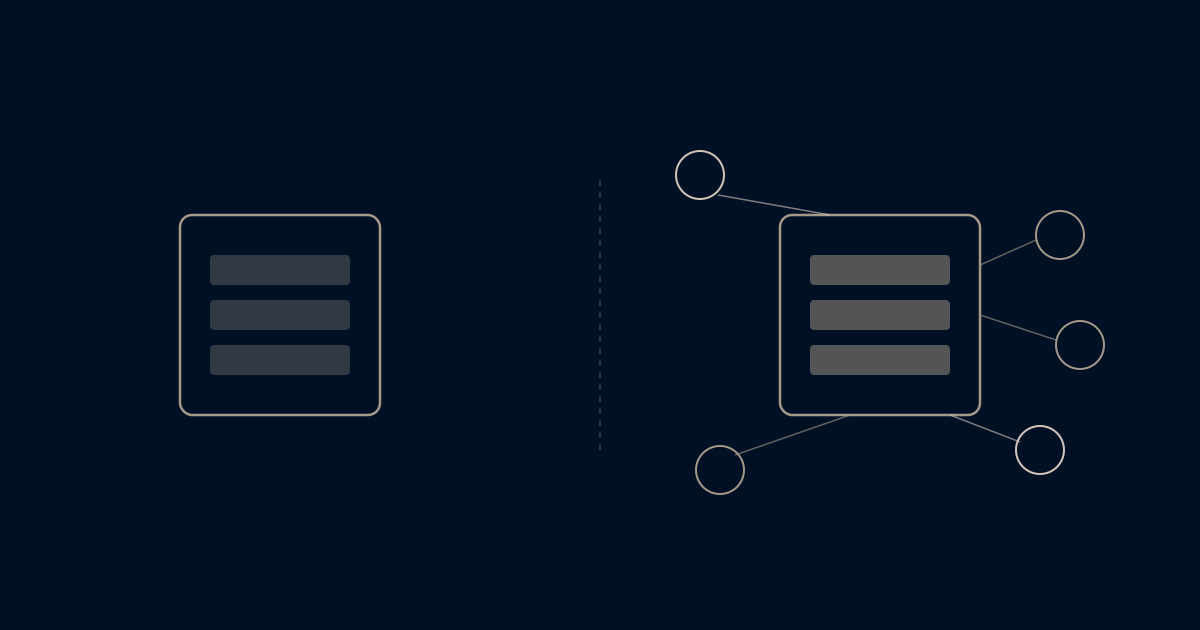
Every platform answers a question. The question it answers determines what you can build on it.
Vercel, Netlify, Railway, Render — these answer: "Where do I deploy my code?"
A business platform answers something fundamentally different: "Where do I build software that understands my organisation?"
That distinction sounds academic until you are three months into a project, your serverless function needs to know who is calling it, what team they belong to, what they have permission to see, and what goals their work connects to. On a deployment platform, you build all of that yourself. On a business platform, it is already there.
This article unpacks the difference, when each is the right choice, and why the gap between them is widening in 2026.
Two Questions, Two Architectures
A deployment platform solves an infrastructure problem. Your code needs to run somewhere reliable, fast, and scalable. The platform handles servers, CDN, SSL certificates, build pipelines, and auto-scaling. You push code, it goes live. That is genuinely valuable.
A business platform solves an organisational problem. Your code needs to run somewhere reliable, fast, and scalable — and it needs to understand the business it serves. Who is the user? What role do they hold? What data are they authorised to access? What projects are active? What goals matter this quarter?
The deployment platform gives your code a home. The business platform gives your code a context.
This is not a quality distinction. Vercel is an excellent deployment platform. It does what it does better than almost anyone. The question is whether what it does is sufficient for what your organisation actually needs to build.
What Deployment Platforms Do Well
Credit where it is due. Modern deployment platforms have made infrastructure nearly invisible for frontend teams. The experience is remarkable:
Push code, get a URL. Git push triggers a build pipeline. Preview URLs generate for every pull request. Production deploys happen in seconds. The feedback loop between writing code and seeing it live has never been shorter.
Scaling is automatic. Traffic spikes do not require capacity planning. Serverless functions scale to zero when idle and spin up on demand. You pay for what you use.
Developer experience is polished. Build logs, deployment history, environment variables, rollbacks — the tooling is mature and well-designed. For a team shipping a Next.js application, the workflow is nearly frictionless.
CDN and edge caching are built in. Static assets serve from edge locations worldwide. Dynamic content can run at the edge or in specific regions. Performance optimisation is handled by the platform, not by your team.
For a standalone web application with its own authentication, its own database, and its own business logic, a deployment platform is often the right choice. It solves the infrastructure problem cleanly and lets your team focus on code.
The trouble starts when "standalone" stops describing what you are building.
What a Business Platform Adds
A business platform includes everything a deployment platform provides — hosting, compute, CDN, scaling — and then adds the organisational layer that deployment platforms deliberately leave out.
Identity and Permissions
On a deployment platform, every serverless function starts from zero. It receives an HTTP request with no inherent knowledge of who sent it. You install an auth library, configure it, write middleware to validate tokens, query a database to check permissions, and handle every edge case yourself. This is table stakes for any real application, and on a deployment platform, it is entirely your problem.
On a business platform, identity is structural. Every request arrives with context: who the user is, what organisation they belong to, what role they hold, what they are permitted to access. Your serverless function — your agent running at the edge — inherits this context automatically. You write business logic, not auth plumbing.
Organisational Data
On a deployment platform, your function can access whatever database you connect it to. But that database contains only what you have built and populated. If your function needs to know the team structure, current projects, active goals, or document library, you build and maintain those systems yourself — or integrate with three more SaaS products.
On a business platform, organisational data exists as a native layer. The same platform where you deploy code is the same platform where teams manage their work. A serverless function can query active goals, open tasks, team membership, or document content through a single API call. Not because you built an integration, but because the data and the compute share the same foundation.
This is what a Context API looks like in practice:
ctx.user        → who is calling
ctx.org         → which organisation
ctx.permissions → what they can access
ctx.commander   → goals, projects, tasks, documents
ctx.tables      → structured business data
ctx.ai          → organisational intelligence
Your function receives context instead of constructing it.
AI That Knows the Business
The AI conversation in 2026 has moved past "can it summarise text?" to "does it understand the organisation?" The difference matters.
An AI assistant on a deployment platform can access whatever you feed it — typically the contents of a single conversation or document. It has no awareness of your strategic goals, your project pipeline, your team structure, or your operational data. Every interaction starts from scratch unless you build and maintain the connective tissue yourself.
An AI layer on a business platform has context across the entire workspace. It sees goals, projects, tasks, documents, tables, roles, and permissions — not because someone built an integration, but because the AI and the data share the same platform. The intelligence is unified by architecture, not bolted on by middleware.
This is the difference between an AI that can write a paragraph and an AI that can tell you which projects are at risk based on task velocity, team capacity, and strategic priority. The second kind requires context. Context requires a platform.
The Integration Tax
Here is the part that does not show up on pricing pages.
When you deploy on a platform that handles only infrastructure, everything else becomes your integration burden. Authentication. Permissions. User management. Organisational context. Business data access. AI coordination. Monitoring. Logging. Each one is a separate system to select, configure, integrate, and maintain.
The industry has a name for this: the integration tax. It is the cumulative cost of connecting systems that were never designed to work together.
For a single application, the tax is manageable. Install Clerk for auth, connect to Supabase for data, add OpenAI for AI, wire up Sentry for monitoring. A few environment variables and some middleware. Maybe a weekend of work.
For five applications, three automations, and an AI agent that needs to understand the business? The tax compounds. Every new function needs the same auth setup. Every automation needs the same data access patterns. Every AI interaction needs the same context injection. You are not building products anymore. You are maintaining plumbing.
A business platform eliminates the integration tax by making identity, data, and intelligence native to the platform itself. The first application takes the same time to build. The fifth takes a fraction, because the foundation was already there.
This is the same principle behind unified productivity: the value is not in any single tool, but in the connections between them.
When Deployment Platforms Are the Right Choice
Deployment platforms are not inferior. They solve a different problem, and sometimes that problem is exactly the one you have.
You are building a single public-facing application. A marketing site, a SaaS product with its own auth, a developer tool. The application is self-contained. It has its own users, its own data, its own logic. It does not need to know about your organisation's goals or team structure.
Your team already has its infrastructure stack. You have chosen your auth provider, your database, your monitoring tool, your AI provider. You are experienced with those choices. The deployment platform is the last piece — it hosts the result.
You are optimising for framework-specific performance. If you are building exclusively with Next.js and need features like Incremental Static Regeneration, Vercel's first-party support is unmatched. The framework and the platform were built by the same team. That matters.
Your organisation is not the user. If the software you are building serves external customers with no connection to your internal operations, a deployment platform gives you exactly what you need without the overhead of an organisational layer you will never use.
In these scenarios, a business platform adds complexity without proportional value. Use the simpler tool.
When You Need a Business Platform
The calculus changes when your software needs to understand the organisation it serves.
You are building internal tools. A dashboard that shows project status by team. An approval workflow that routes based on role. A reporting tool that aggregates data across departments. Internal tools are inherently organisational — they need identity, permissions, and business context. Building all of that from scratch on a deployment platform is weeks of work that a business platform provides on day one.
You are building multiple applications. The second application you deploy needs the same auth, the same data access, the same permission model as the first. On a deployment platform, you duplicate that work or build a shared services layer. On a business platform, it already exists. The marginal cost of each additional application drops dramatically.
You need automations that understand context. A serverless function that fires when a task status changes. A webhook handler that routes based on team assignment. An agent that summarises progress against quarterly goals. These are not generic compute tasks — they require organisational awareness. On a business platform, they inherit it.
Your AI needs to be useful, not just present. If your organisation wants AI that can answer "What projects are at risk this quarter?" or "Which team has the highest task completion rate?" or "Summarise the strategic implications of our Q2 pipeline" — the AI needs data it cannot get from a deployment platform. It needs the context that comes from being embedded in the business.
You want to distribute capability to teams. This is the Operations at the Edge principle. When marketing needs a campaign tracking tool, when sales needs a custom pipeline view, when operations needs an automation — do they file a ticket with central IT, or do they build it themselves on a platform that already handles the hard parts? A business platform makes the second option possible.
The Context API Concept
The technical heart of the difference is what we call the Context API — the idea that serverless functions should arrive at execution already knowing who called them and what they have access to.
On a deployment platform, a serverless function receives a raw HTTP request:
Request → Function → Response
Everything between the arrows is your responsibility. Parse the token. Validate the session. Look up the user. Check permissions. Query the database. Handle errors. Return the response.
On a business platform with a Context API, the function receives a rich context object:
Request → [Platform injects identity, permissions, org data] → Function → Response
The function starts from context, not from zero. It knows who is calling, what they can see, and has access to the organisational data layer without a single line of integration code.
This is not a convenience. It is an architectural decision that determines how fast your team can ship, how many applications they can maintain, and how much of their time goes toward building things that matter versus rebuilding plumbing that every function needs.
In the year of custom apps, the organisations that ship fastest will be the ones that eliminated the integration tax before they started building.
The Future: Every Platform Becomes a Business Platform
The trajectory is clear. Ten years ago, "hosting" meant provisioning a server. Five years ago, it meant pushing code to a CI/CD pipeline. Today, the leading deployment platforms are inching toward organisational awareness — Vercel is adding storage, databases, and AI integrations. Netlify is building identity and access management. Every platform is moving up the stack.
They are moving in this direction because the market demands it. Teams do not just need somewhere to deploy code. They need somewhere to build software that works within the context of their business.
The question for any organisation evaluating platforms in 2026 is not "which has the best deployment pipeline?" — that problem is solved. The question is: does this platform understand my organisation, or do I have to teach it everything from scratch, every time, for every function I build?
Deployment platforms give you fast infrastructure. Business platforms give you fast infrastructure plus the organisational layer that turns code into capability.
The difference is the distance between hosting software and building a business.
Choosing Your Platform
Here is a framework for the decision:
| If you are building... | Consider... |
|---|---|
| A single public-facing SaaS product | Deployment platform (Vercel, Netlify, Railway) |
| Multiple internal tools for your organisation | Business platform |
| Automations that need to know who, what, and why | Business platform |
| A standalone marketing site or blog | Deployment platform |
| Custom software that connects to goals, projects, and teams | Business platform |
| AI-powered tools that need organisational context | Business platform |
| A prototype or MVP with no org dependency | Deployment platform |
The honest answer for many organisations is both. A deployment platform for public-facing products. A business platform for everything that needs to understand the organisation.
But increasingly, the organisations that build fastest are the ones that chose a single platform capable of both — where public apps and internal tools share the same identity, the same data, and the same intelligence layer.
That is what a business platform provides. Not a replacement for deployment platforms, but a superset of them — one where code does not just run, it belongs.
Ready to see the difference? WaymakerOS is the way to make your business OS. Commander gives you 20 tools for daily operations (the foundation). Host gives you the platform to design, build, and own custom apps, agents, and automations (the build layer). One connects everything with organisational intelligence. Explore what you can build or see how unified productivity works.
Related reading: Best all-in-one business platforms 2026, Operations at the Edge, 2026: The year of custom apps, App sprawl costs $2,400 per employee, Central control vs edge.
Part of our guide to building and hosting what no one will build for you.
About the Author

Stuart Leo
Stuart Leo founded Waymaker to solve a problem he kept seeing: businesses losing critical knowledge as they grow. He wrote Resolute to help leaders navigate change, lead with purpose, and build indestructible organizations. When he's not building software, he's enjoying the sand, surf, and open spaces of Australia.